The Kentucky Twins
Reprinted from Bluegrass Unlimited Magazine
June 1986, Volume 20, Number 12
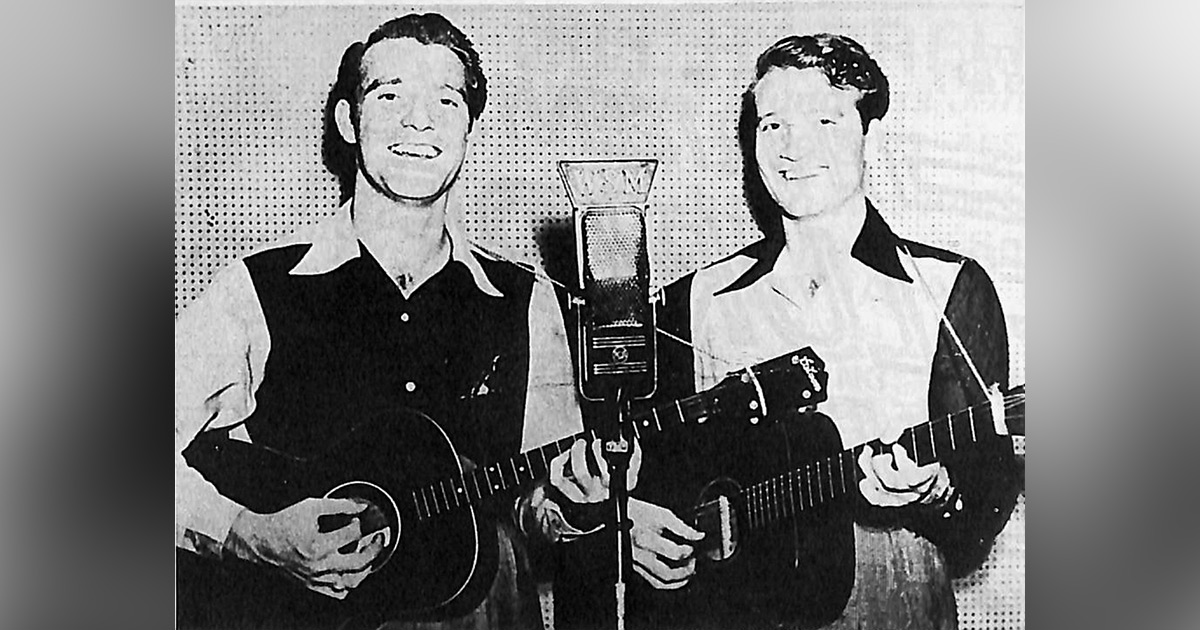
To the younger generation of bluegrass fans, the number of brother duets whose stylings influenced the music’s development must seem like an endless list —from Anglin, Bailes, Cope, Delmore and ever onward. One can then shift to Andrews, Bolick, Callahan, Dixon, and perhaps move right through the entire alphabet. During the period running from about 1935 to 1955, “Brother” groups were indeed numerous and while some have been more significant than others (the vocal harmonies of all went into the roots of bluegrass to varying degrees.) One of these once significant pairs, the Hankinson Brothers, gained a considerable reputation as Mel and Stan, the Kentucky Twins. They worked extensively on major radio stations during the later 1940s, recorded on major labels, and toured widely as a featured act with Bill Monroe and his Blue Grass Boys.
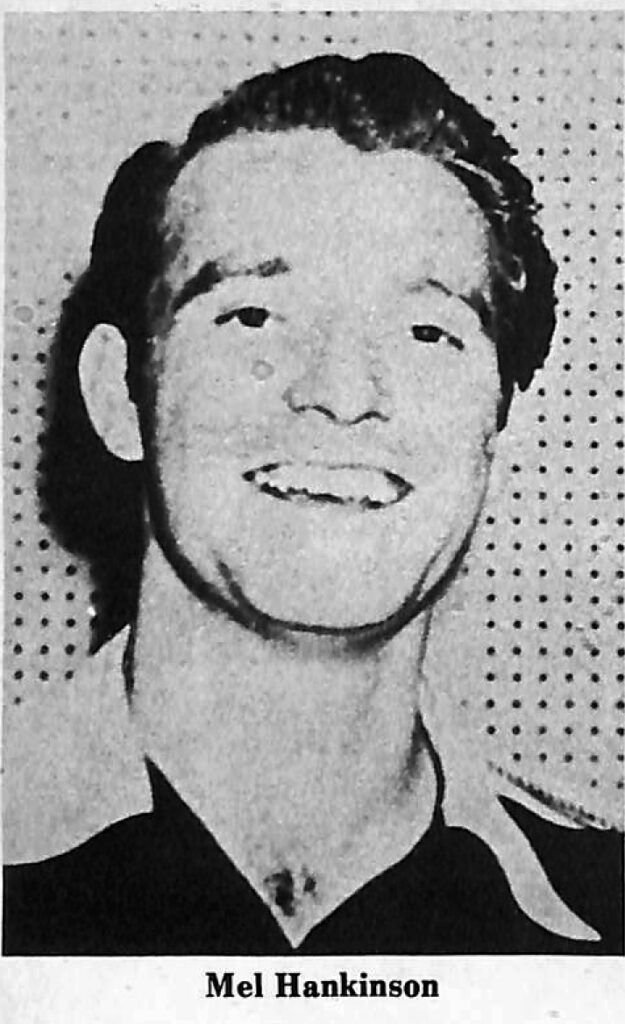
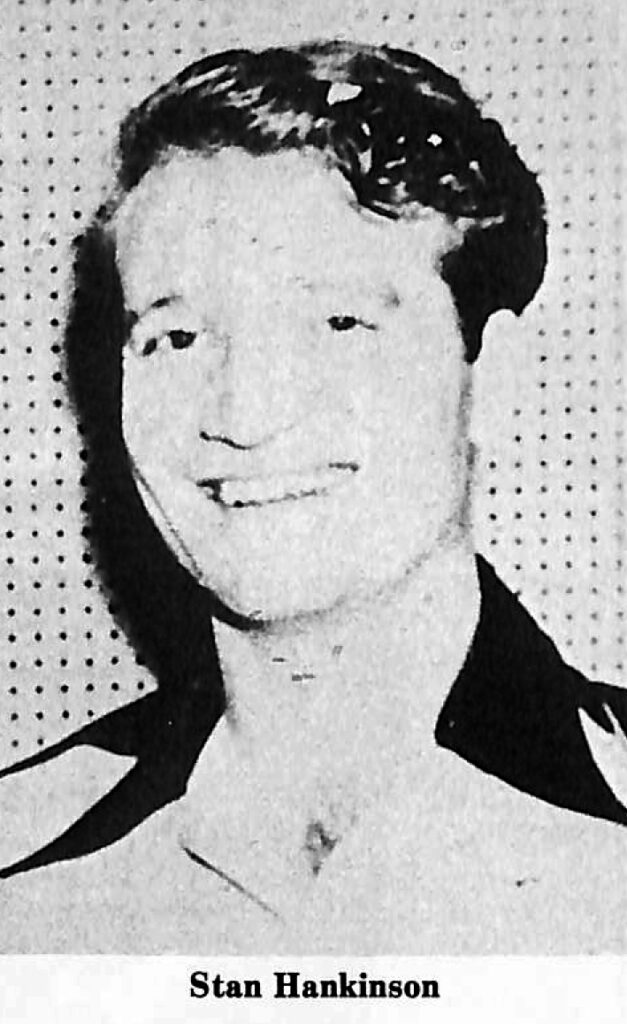
Harlan County, Kentucky, served as birthplace for the Kentucky Twins. Stanford Darwin Hankinson was born there on December 25, 1919 and Melvin William Hankinson on March 23, 1923. Like Jack and Jim Anglin, the Kentucky Twins did not achieve “twin” status until they had become adults and professional musicians. Neither did they remain long in Kentucky, their coal miner father moved to Chambersville, Pennsylvania about 1925 taking the family of ten children in tow.
The Great Depression proved to be tough years for the Hankinsons, but like most other working-class folks they managed to survive through a combination of farm and mine work. After 1933, the Civilian Conservation Corps provided some work, briefly for Mel, and two more extended stints for Stan in Virginia and New Mexico respectively. At the latter location, Stan assisted a crew of archeologists uncovering primitive Indian relics and other remains at Chaco Canyon National Monument some ninety miles from Gallup. Eventually Stan returned to Pennsylvania and took a job in the mines with his father. Three years later he also worked in another mine at Ernest, Pennsylvania.
Stan recalls that he began listening to the Grand Ole Opry regularly when he was about ten and began to pick and sing at the age of twelve. Mel began to play at about the age of ten. This coincided with a period when the Delmore Brothers started to attain popularity via WSM radio and Bluebird Records and Mel and Stan tended to be much influenced by them. Stan always played rhythm guitar and Mel usually played tenor guitar. However, the latter also displayed skills on mandolin, fiddle, and banjo.
For several years Mel and Stan worked as part-time musicians in the Pennsylvania coalfields. Stan recalls that they often played square dances for two dollars a night. In the meantime, both brothers married and had children.
When World War II came to an end several new radio stations went into operation, among them WDAD in Indiana, Pennsylvania. Mel and Stan obtained a regular program. They also had a program at WJTN Jamestown, New York. Soon they acquired sufficient popularity that they began to consider a full-time career in country music. First, they decided to try getting on at WWVA, but as they drove toward that Ohio River industrial center their thoughts turned more in the direction of Nashville. Accordingly, they kept their 1937 Chevrolet heading southward until they reached the Tennessee capital.
Like many unknowns in Nashville, the Hankinson boys found themselves in a big, strange town filled with accomplished and aspiring hill country pickers. A fortunate encounter with Art Satherly of Columbia Records helped provide the boys with an opening of sorts. Uncle Art assisted the brothers in securing a regular radio spot at KMOX in St. Louis, Missouri which at that time featured some daily country shows and a Saturday morning, program, Barnyard Follies, on the CBS network. The job in St. Louis provided Mel and Stan with additional experience and exposure, but not a whole lot of financial remuneration since KMOX’s more established artists tended to retain the most lucrative spots for themselves. By 1947, they decided to try Nashville one more time, and if unsuccessful, to go back to Pennsylvania. The boys had begun doing an original song entitled “Tennessee Gambler” which they hoped would become the key that would unlock the door of success.
Forced to sell their car to obtain cash, Mel and Stan purchased bus tickets to Nashville, via Louisville. Stan recalls that FBI agents apparently mistook them for a pair of criminals while they were at the bus depot. However, they soon moved on and made it to Nashville.
Mel and Stan went to the WSM studio where their song “Tennessee Gambler” made a highly favorable impression on Bill Monroe. Noted then as now for his reserved nature, Stan says he was “not a man to make a big fuss over anything.” Nonetheless, it was apparent that “he really got a big kick out of ‘Tennessee Gambler’” and had them sing it over several times. Bill had sufficient influence at WSM that he secured a spot for the young duo on a morning program. Stan recalls that he even threatened to take his about-to-go-to-press new songbook and go to WLAC if they were not hired. In gratitude, Mel and Stan gave Bill a share in “Tennessee Gambler” which he included in his second song folio Bill Monroe’s Blue Grass Country Songs (Hill and Range, 1950).
Mel and Stan enjoyed the three years (roughly 1947,1948, and 1949) they spent at WSM and the Grand Ole Opry immensely. In the earlier period they worked most of the time with Bill Monroe’s unit. They remember Lester Flatt, Earl Scruggs, Benny Martin, and Jackie Phelps as among their close associates at that time. The duo also played outfield positions with the now legendary Blue Grass Boys baseball team.
It was also in that first year in Nashville of 1947 that they did their initial recording session with Majestic Records. They cut the four songs with only their own guitars and a bass fiddle in the WSM studios. The first release consisted of “Tennessee Gambler” backed with Roy Hall’s old hit of 1940, “Don’t Let Your Sweet Love Die.” This coupling, Stan believes, was their most popular record and he thinks that their rendition of “Don’t Let Your Sweet Love Die” kept that song alive at a period when virtually no one else had been doing it. After Mac Wiseman and Reno and Smiley waxed it some years later the song went on to achieve the standard status it has today. Mel and Stan’s second Majestic release was a cover of the Monroe hit, “Mother’s Only Sleeping” and a less memorable original entitled “Love Me Or Leave Me.”
Mel and Stan hoped that these initial recordings would rejuvenate Art Satherley and Columbia’s initial interest in them. However, as Stan remembers it, Columbia moved rather slowly and in the meantime Tex Ritter who had a liking to their traditionally-oriented duet induced Lee Gillette to sign them to a Capitol contract. They subsequently went on to wax a dozen sides with that firm.
As with the Majestic sides, the Capitol masters were all cut in the WSM studios with only acoustical accompaniment. In addition to Mel and Stan’s own guitars and a bass fiddle, they had Mac McGar, a highly significant Grand Ole Opry mandolin picker, helping out on several of the numbers. (The seldom recorded McGar is perhaps best heard on record on Ernest Tubb’s Decca waxing of “Warm Red Wine.”) Songs waxed at the initial session in March 1949 included an early Louvin composition entitled “Whispering Now” and an answer to the Bailes Brothers’ hit of 1945 called “I Have Dusted Off The Bible,” with lyrics that Kyle Bailes had written. Another release featured a pair of their own songs, “I’ve Lost All” and “I’ll Gladly Take You Back Again.”
A second Capitol session made in September 1949 resulted in eight additional songs. The numbers included a pair of mother tributes, “Always Remember Your Mother” coupled with “I Dreamed I Saw Mother In Heaven,” the latter being among their compositions. “I’d Like To Find A New Friend Everyday” received a great deal of air play and an inspirational number entitled “Tear Stains On The Old Family Bible” attracted considerable attention. Other Capitol releases included Wally Fowler’s “Silver Tears,” “Carolina,” “There’s Just One Life To Live,” and “Remember Me Love In Your Prayers.” Although several of the songs they cut for Gillette were good ones such as “I’d Live To Find A New Friend,” “Tear Stains On The Old Family Bible,” their own “I Dreamed I Saw Mother In Heaven,” and the Louvin original “Whispering Now” none achieved the hit status needed to either propel them to stardom or sustain a lengthy career.
As time passed, the Kentucky Twins found themselves working less with Monroe and more with Ernest Tubb and especially the blackface team of Jamup and Honey. While the Kentucky Twins had plenty of regular work on personal appearance tours, it hardly ranked as an easy living. These were the days of tent shows in the warm months and schools in the cooler ones. Stan remembered frequently being on the road for virtually two weeks, having about four hours at home with his family on Saturday afternoon, playing the Opry, and then taking off quickly to play a Sunday afternoon show in Michigan. Since they did not seem to be getting but about two songs on the Opry anyway, and not the best time spots, they began to look for possible breaks elsewhere.
About this time, the winter of 1949-1950, Zeb Turner induced the Kentucky Twins along with Grady Martin and a couple of other Nashville musicians to move to KWKH Shreveport, Louisiana. Things did not go well for them at the Louisiana Hayride and after a few weeks the Hankinsons returned to Nashville and secured a 5:15 p.m. daily program at WLAC. The so-called “studio stars” at this Nashville station (such as Mac Odell and Big Jeff Bess) relied more on salaries and songbook sales to sustain them than extensive touring, which at least gave them more time with their families. Since Mel and Stan still had Capitol recordings being released and a new songbook for sale to listeners, their six-month stint at WLAC proved to be both lucrative and relatively relaxing. Their songbook illustrates that in addition to songs recently recorded by the brothers that their repertory included such older numbers from the duet tradition as “Two Little Rosebuds” and the Carter Family’s “Jimmy Brown, The Newsboy” (soon to be revived on record by Flatt and Scruggs).
Meanwhile relatives in Pennsylvania kept urging the Hankinsons to relocate closer to home. As a result, they secured a job at the WWVA World’s Original Jamboree with Red Belcher and the Kentucky Ridge Runners. Belcher played a respectable old-time banjo and sang a bit, but relied more on his talents as a pitchman (good radio advertising salesman) to sustain him on radio and the skills of better musicians—usually a brother duet—to attract crowds to show dates. Budge and Fudge Mayse, Galen and Melvin Ritchey, and most recently Everett and Bea Lilly had earlier fulfilled this role with Belcher’s group when the Kentucky Twins joined forces with the jovial radio veteran.
Mel and Stan stayed with the World’s Original Jamboree for a year working extensively not only with the Kentucky Ridge Runners but also with vocalist Hawkshaw Hawkins whose honky-tonk vocals mixed with some older styled songs was making him into a major figure in country music. They also worked a great deal with the Sunshine Boys.
However, work at Wheeling also meant more travel and road work again and as the Kentucky Twins grew older their once youthful enthusiasm for show business had begun to wane. Spending more time at home with their families appealed to them as time passed. Moving to Michigan, they secured factory jobs and relegated themselves to weekend club work for the next couple of years. Various musicians including Hawkins and Merle Travis came through from time to time and the brothers maintained their contacts with show business.
In 1953, through a friend of the Twins’ brother Carl Hankinson, Mel and Stan learned that WABI Bangor, Maine wanted a country duet. The brothers contacted the station and went back to music full-time. For the next three years, the Kentucky Twins based themselves at WABI radio and also at WABI-TV which was a brand new television channel. Stan has been told that he and his brother constituted the first live country television act in the Pine Tree State.
During this era Mel and Stan issued a second songbook which they sold over the air and on their show dates. Unlike the earlier book which contained many of the songs the boys had recorded as well as old standard duet tunes, this newer book contained numerous songs popular in the mid-1950s such as “I Don’t Hurt Anymore,” “Your Cheatin’ Heart,” and “You Better Not Do That,” numbers not generally associated with duet acts. This suggests that even without the rise of rock and roll that many of the traditionally oriented acts were finding that much of the newer material did not adapt particularly well to recent trends in the business.
Still, business remained good for the Hankinsons during their Bangor years. Numerous Wheeling Jamboree acts like Doc and Chickie Williams and Wilma Lee and Stoney Cooper guested on their shows often and they drew good crowds. Opry stars also worked the area at times. Maine itself has produced several major hard-core country vocalists over the years as Lone Pine (Harold Breau), Dick Curless, and Gene Hooper, not to mention major bluegrass pickers like Clarence and Roland White. Despite its northerly and “way down east” locale, numerous commentators have talked about the popularity of country music in Maine, so perhaps it is small wonder that the Kentucky Twins prospered there.
From 1956, however, both Mel and Stan decided to abandon the business. Mel returned to Pennsylvania and worked in the steel mills, recently retiring after about a 22-year stint. Stan moved to Chillicothe, Ohio, where he spent eighteen years working primarily in wholesaling and rearing his family that had increased to five. In 1975, with coal enjoying an economic renaissance and skilled miners much in demand he went to work for the Southern Ohio Coal Company whose three large captive mines fuel the huge Gavin Plant at Cheshire, Ohio. He retired in 1982 and presently lives near Wellston, Ohio.
From time to time Mel and Stan get together and do a little picking and singing. Mostly just for the entertainment of themselves, family and close friends. They had no regrets about their years in country music and Stan speaks glowingly about his experiences with Roy Acuff, Ernest Tubb, and most especially Bill Monroe. At the same time they also have no regrets that they left country music when they did. Still, the broad tradition of harmony duets of which they were once a part survive, chiefly in the sounds of bluegrass, vocal harmony, and to a lesser extent in the sounds of the new wave of traditionalists typified by the Whites and Ricky Skaggs.