
The California Bluegrass Association
Promoting Bluegrass Music in The Golden State for Nearly Fifty Years
California is a long way from the heartland of bluegrass music, however, the California Bluegrass Association (CBA) represents the largest organized community of bluegrass enthusiasts in the United States. Regarding the popularity of bluegrass in California, Keith Little, one of the forty charter members of the association, said, “Bluegrass developed in California due to the geographic isolation of displaced southerners who had migrated to California. During the dustbowl days and the second world war, many people from the south moved to California and they brought their music with them. When we started the annual Father’s Day Festival, in 1976, people were hungry for it.”
The California Bluegrass Association was the brainchild of California attorney, and banjo picker, Carl Pagter. Keith Little remembers, “There was a lot of interest in bluegrass during the early 1970s in California, but it wasn’t organized. When I was about eighteen years old I attended a bluegrass festival that was held at the Marin Civic Center. I was camped in the parking lot and jamming with Roscoe Keithley, a Missouri native who was living in California. Carl stuck his head in the tent and said, ‘Do you want to be charter members of a non-profit organization that will help organize and promote bluegrass in California?’ I said, ‘Yes! Sign me up.’ Carl was an attorney and needed to sign up forty members before he could file the non-profit paperwork.” The California Bluegrass Association was incorporated in December of 1974.
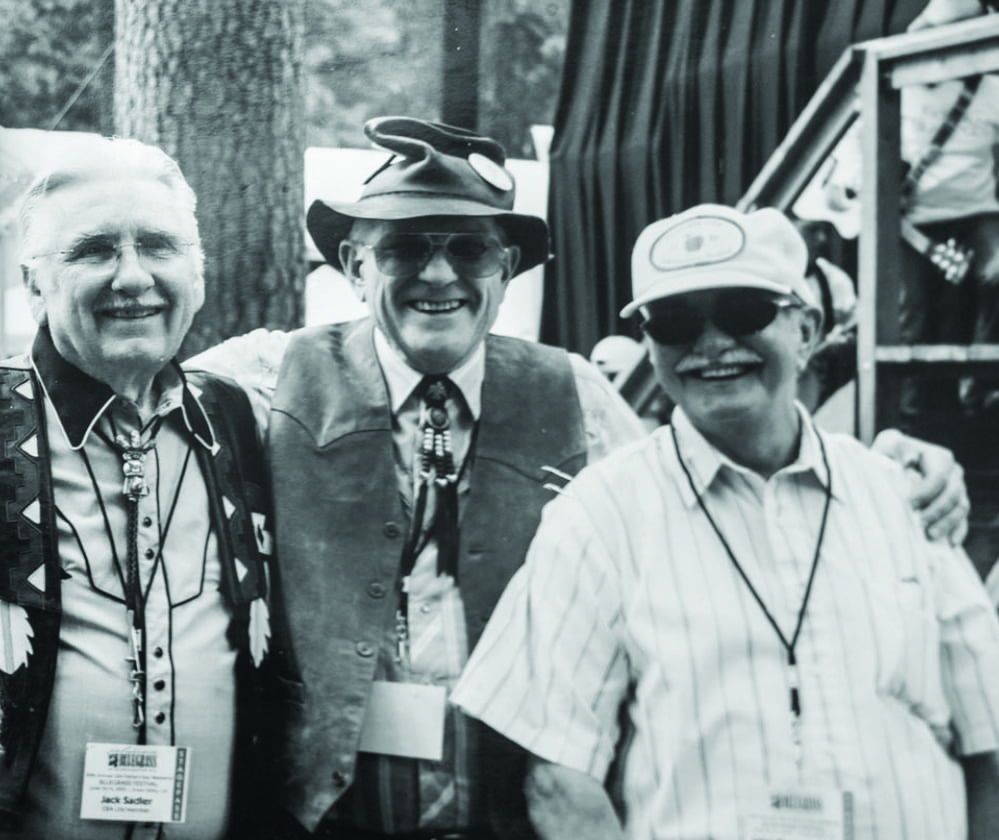
Keith remembers that in addition to himself and Pagter, some of the other early members were Jack Sadler, Jake Quensenberry, Steve deHaff, Burney Garelick, Ray Edlund, Laurie Lewis, and John Murphy. Pagter held membership card number one, Quensenberry number two, and Sadler number three. Shortly after the organization was formed Burney Garelick began working to produce the association’s newsletter, Bluegrass Breakdown, and Steve deHaff tasked Keith Little, Roscoe Keithley, and John Murphy to find a suitable place in the Sierra foothills to hold an annual bluegrass festival.
Bluegrass Breakdown
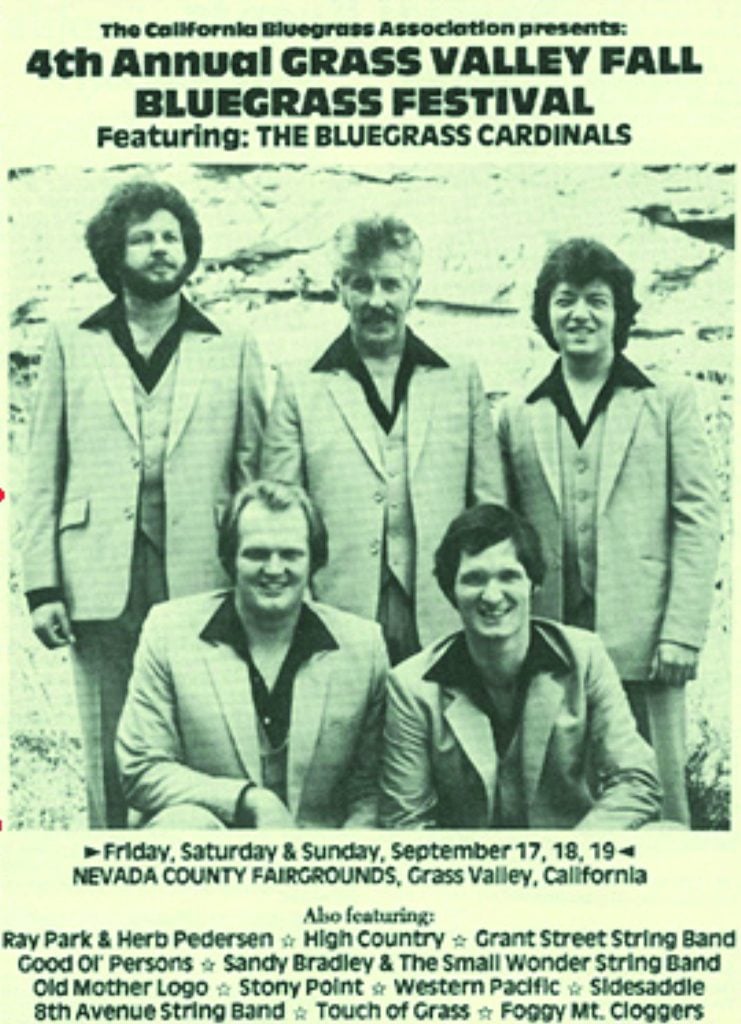
One way that the CBA has always connected with their members is its monthly newsletter Bluegrass Breakdown. This publication has changed formats over the years, but it has always faithfully arrived in member’s mailboxes each month. At its peak size, the Bluegrass Breakdown was a significantly large newsprint formatted publication. Today the Bluegrass Breakdown is a four-page print publication that can also be downloaded from the website in a PDF format. The reduction in page count primarily occurred when the CBA began posting news, articles, and other items of interest, on its website. CBA board chairman Pete Ludé said, “In keeping up with the digital age we present new articles on the website every few days.”
The publication has always provided CBA readers with interesting and informative articles, bluegrass news, performance schedules, album reviews, and more. Years ago, I joined CBA primarily to be able to receive the Bluegrass Breakdown each month.
The Bluegrass Breakdown also highlights what the CBA calls its “Honorary Lifetime Members.” This honor is an award given to California bluegrass fans and artists who have contributed to furthering the mission of the CBA. Pete Ludé said, “The Honorary Lifetime member is someone who has contributed to the vision of CBA, which is to help promote and preserve bluegrass and old-time music. Some people do it through volunteering, some people do it through promoting the music—but, it is a little bit more ‘behind the scenes.’ It is not the Grammys, or the IBMA awards about performance. It is for those who are working behind the scenes to keep the music alive.”
The CBA Father’s Day Festival
Regarding the first CBA annual festival, Keith Little remembers, “They wanted to hold the festival in the Sierra foothills because most of the members were in the Bay area and they thought it would be a good location. I was raised in that area and so they conscripted me to find a location. I had been to most of the fairgrounds in the region, except for the one in Grass Valley—the Nevada County Fairgrounds. John Murphy, Roscoe Keithley and I piled into a VW station wagon and drove up there to look at it. It was a Sunday, so the fairgrounds were closed, but we could look through the fence and tell that it was an ideal location.” The new association held their first festival at the Nevada County Fairground in 1976 and now, forty-seven years later, that event is still held every June in that same location. Keith remembers, “The Good Old Persons and the Vern Williams Band played a few benefit shows to raise money for that first festival and Herb Pedersen was able to get Josh Graves to perform at the festival that year.”
In an article written about the CBA festival in Bluegrass Unlimited (in the January 1992 issue) CBA member Vic Clearley remembers that first festival. He said, “It was so wonderful for me and for an awful lot of other people who though we were poor lost souls. You see, before the CBA and the festival, I’d sit at home and play my hillbilly music and figured that there wasn’t nobody else like me in California. I discovered this festival—joined up as CBA member #26o—and thought to myself, ‘Oh, my God, this is fantastic.’” Many other California bluegrass fans felt the same way and, as a result, the CBA is still going strong and continuing to fulfill its mission to “encourage, foster, and cultivate the preservation, appreciation, understanding, enjoyment, support and performance of bluegrass, old-time, gospel, and traditional instrumental and vocal music of the United States.”
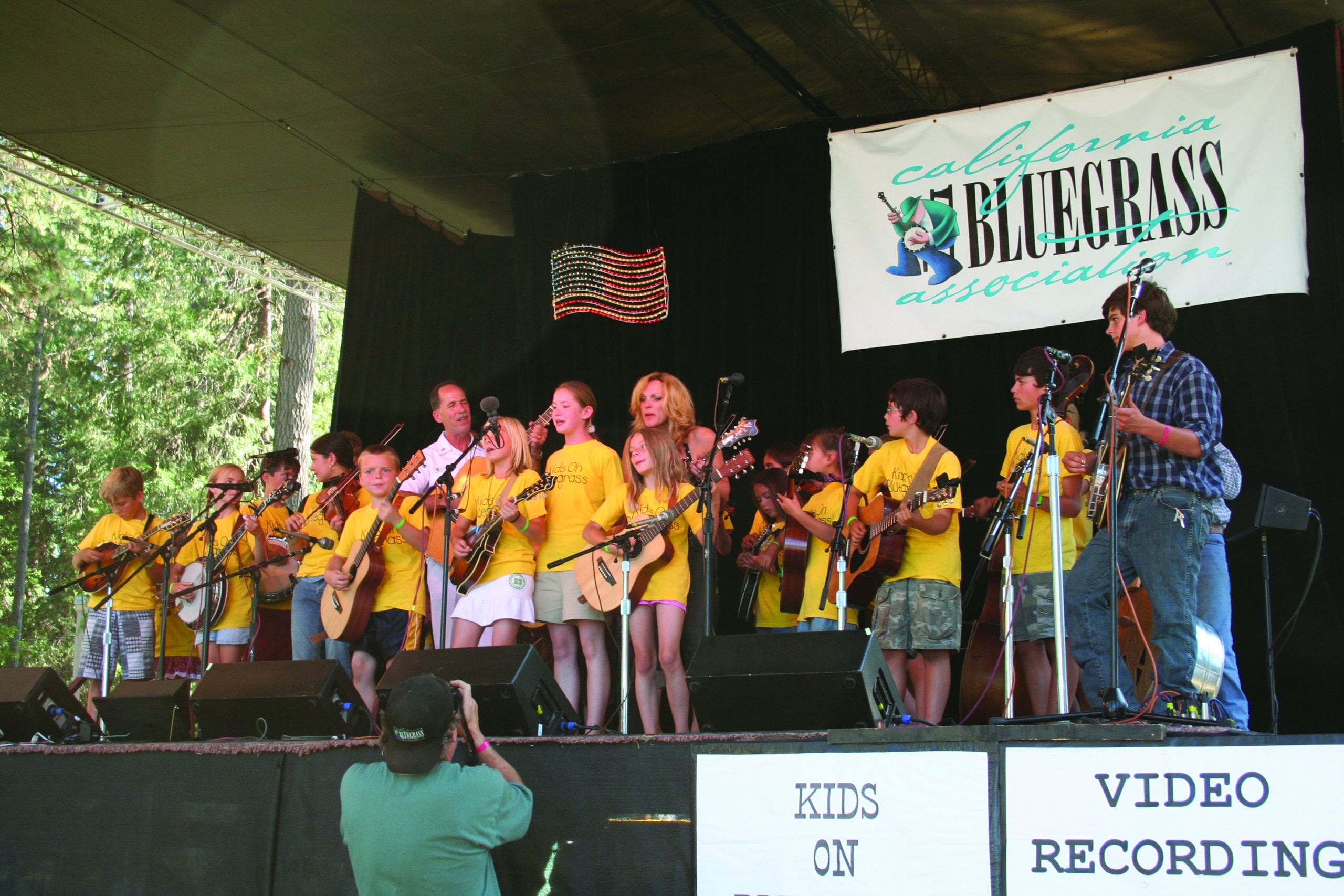
Over the years the CBA Father’s Day Festival has hosted many of the major bluegrass acts and along the way they added a four-day music camp (to be held June 12-15 this year). The music camp is held just prior to the festival and typically brings in twenty instructors and 200 students. During the festival weekend other activities include a Youth Academy and the Kids on Bluegrass Program, which was founded many years ago by Frank Solivan, Sr. and allows young kids who are already somewhat proficient on their instruments to meet each other, work up a set list, and perform on the main stage. There are also “Drop-in” workshops held during the festival weekend. And, of course, in addition to the stage shows, there is lots of jamming in the campground.
Other CBA Events & Programs
Although the CBA Father’s Day Festival is their biggest event, there are many other events that the CBA sponsors each year. State-wide events include the Spring Campout (held in Lodi), the Fall Campout (also held in Lodi), the Great 48 (held in Bakersfield in January), the South State 48 (held in Carlsbad in November) and the Golden Old-Time Campout (held in Northern or Central California). The Great 48 and the South State 48 are indoor jamming parties held in the winter. Regarding these events, Pete Ludé said, “The tradition was that it was 48 hours of non-stop jamming. It has since grown to be three and a half days of solid jamming from a Thursday to a Sunday.” Workshops and concerts are also included with the jamming at these events.
In addition to the state-wide programs, CBA also is involved with hosting and promoting regional events. The CBA has twenty-five regional directors who are very active in promoting concerts and jam sessions throughout their regions of the state. The concert programs not only feature local bands, but also support nationally touring bands as they travel through the state.
During the pandemic, CBA organized a live streaming Jam-A-Thon to raise money to support their Youth Academy Online. The event was held in January of 2021 and during its 50+ hours of continuous live music, workshops, and jams, over 200 artists from twelve countries came together to play music. The Jam-A-Thon was viewed by over 70,000 people worldwide. The event raised over $25,000.
The Jam-A-Thon donations were used to develop a new interactive educational bluegrass website for young bluegrass musicians. This website is hosted by TrueFire.com. The director of the program is Kimber Ludiker of Della Mae. So far, instructors include Pheobe Hunt (fiddle), Tristan Scroggins (mandolin), Courtney Hartman (guitar), Tray Wellington (banj0), Sav Sankaran (bass), Marcy Marxer (ukulele), and Cathy Fink (clawhammer banjo). Check it out at californiabluegrass.org/bluegrass-academy.
Another kid’s program that the CBA is developing is bluegrass iPad app. Pete Ludé said, “This app will allow the real young ones to get use to the instruments and see how they work. It will have some sing-a-long songs to keep them busy while their older siblings are off woodshedding. This app is based on one that was sort of out in the field already, but it had gone obsolete and so we purchased the rights to that and created a whole set of characters—cute bluegrass animals that are playing the instruments. That app will be officially launched at the Father’s Day festival this year. We are beta testing on the Apple site right now.” The app will be titled “Bluegrass Campout.”
Future Programs
Looking into the future, the CBA will be continuing to host and promote all of the events and programs mentioned above, plus they are always looking for new ways to bring bluegrass music to Californians. One new program that they are currently working to initiate is the “Bluegrass Bridge” program to help provide instruments and instruction to incarcerated individuals in the California state prison system. Ludé said, “We will provide instruments and instruction books and bring some bands in for performances. We are hoping to bring inmates together through music and also provide a bridge from inside the prison system to when they get released and want to do something with their lives afterwards.”
Another program that the association is pursuing is “Global Connections.” Ludé explains, “We are in formal discussions with similar organizations around the world—Korea, France, Italy, Ireland—to share stories from bluegrassers from around the globe. In the next month or so we will be kicking off this program (via a website) that will be a way to exchange inspiration and ideas among bluegrass fans and organizations around the globe.”
Bluegrass organizations, associations, societies, and clubs around the world provide a very important source of information and networking for bluegrass artists and fans. Without these groups promoting and supporting festivals, concerts, and jam sessions, bluegrass would not be nearly as strong as it is today. Historically, the California Bluegrass Association has served as a strong example to other groups in their ability to represent and promote bluegrass music. Although bluegrass music originated in the south, it is thriving on the west coast due to the efforts of the CBA and their hardworking volunteers.