
The Bluegrass Journeymen Academy
Building Bridges Through Bluegrass
Photos by Elliot Siff
My journey began with a text from mandolin legend Christopher Henry: “Do you want to teach mandolin in Nepal?” I said yes. Less than a week later, I was on a plane headed for Kathmandu with my mandolin case in hand. It happened very fast for me because I was replacing Colorado mandolinist Brett Kretzer as the mandolin instructor for the Bluegrass Journeymen Academy. I was quickly added to WhatsApp group chats with the rest of the crew, who had already been in Nepal for weeks. I was the new guy and a bit overwhelmed, but I was immediately welcomed into the family.
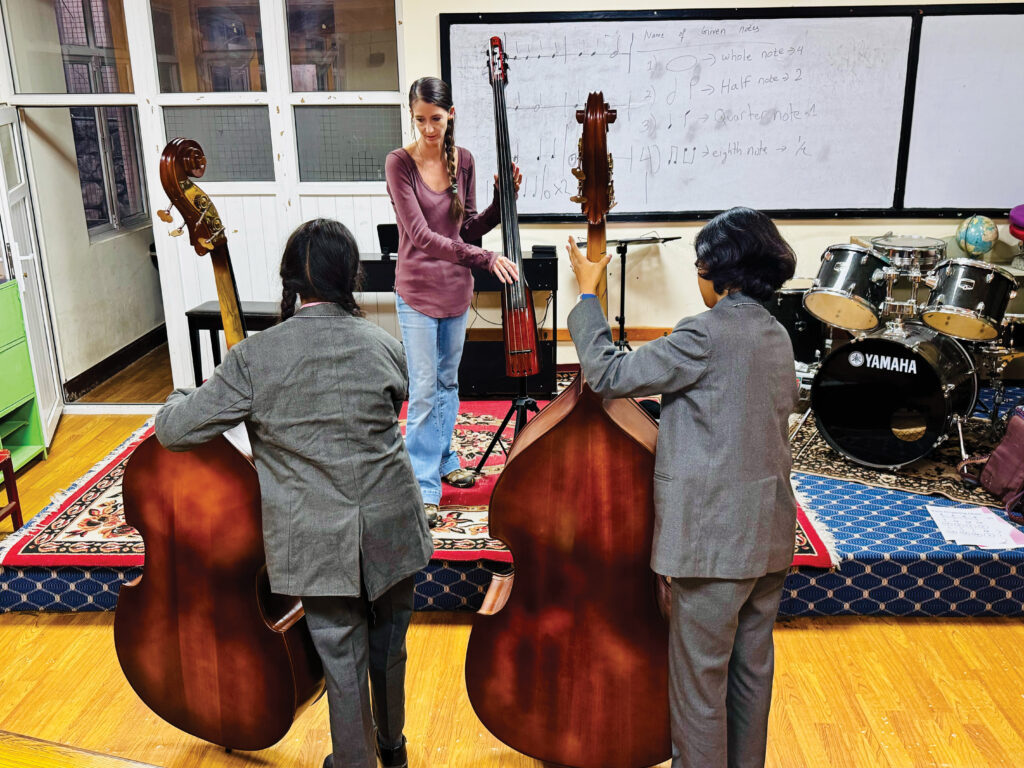
When I arrived in Nepal, the first member of the Journeymen family I met in person was the Scottish fiddler extraordinaire Ben Errington, who picked me up at the airport. Errington was our fiddle instructor. When we arrived at Hotel Omana, I met the rest of the crew. Max Winkles was the banjo teacher from Wisconsin; Kretzer was the mandolin teacher (whom I’d be replacing in the coming days); and our guitar instructor was Chad Andrew Harris from Charlotte, North Carolina. Towards the end of the semester, Angel Chantel arrived from Knoxville, Tennessee, to be our bass teacher. It was a great crew. The first night I was in Nepal, I stayed up late picking and hanging with Harris. It was my first day, and I was already making lifelong friends and memories.
I had arrived a few days early to adjust to the drastic time change and familiarize myself with a typical day teaching bluegrass in Nepal. Mornings were free time. We explored the neighborhood, ate a leisurely breakfast at the hotel (there was a restaurant right there), and picked. Morning jam sessions were standard. There was also a great coffee place just a five-minute walk up the street called Himalayan Java. Around 2:30, the instructors met in the hotel courtyard and called a taxi to take us to work at Triyog High School.
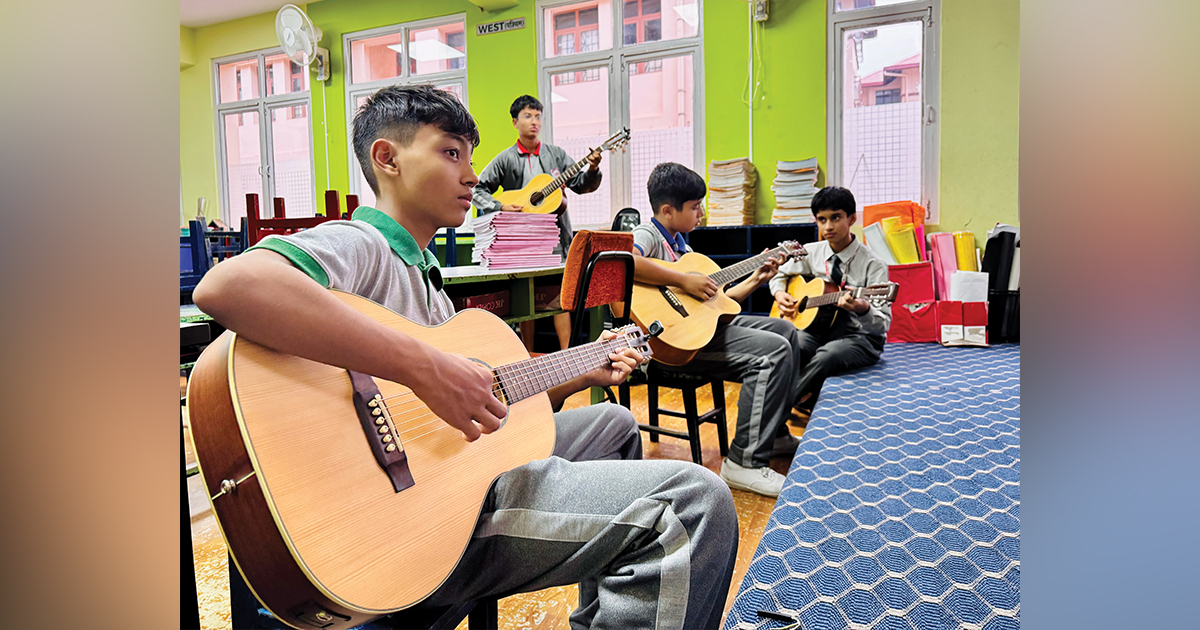
The Bluegrass Journeymen Academy had recently partnered with Triyog High School (K-12) in Kathmandu, Nepal, to launch an ongoing after-school music program. 27 students ages 10-14 signed up to learn guitar, mandolin, fiddle, banjo, and bass. A typical after-school session began with sectionals on each instrument for about 45 minutes. Each teacher had 5-8 students of the same instrument. The banjos worked on forward rolls, the mandolins worked on chops, the fiddles worked on bowing, and the guitars worked on solid backup. In the second half of the session, the kids would split into bands. This way, they could better understand the role of each bluegrass instrument within the ensemble.
When I first arrived in the classroom, the students had already learned a handful of tunes. I was amazed by the chemistry between the instructors and students, and by how quickly they were learning. Many of the students had no prior musical experience and were picking up melodies like “Angeline the Baker,” “Old Joe Clark,” and “You Are My Sunshine.” The crew, students, and school all worked together seamlessly.
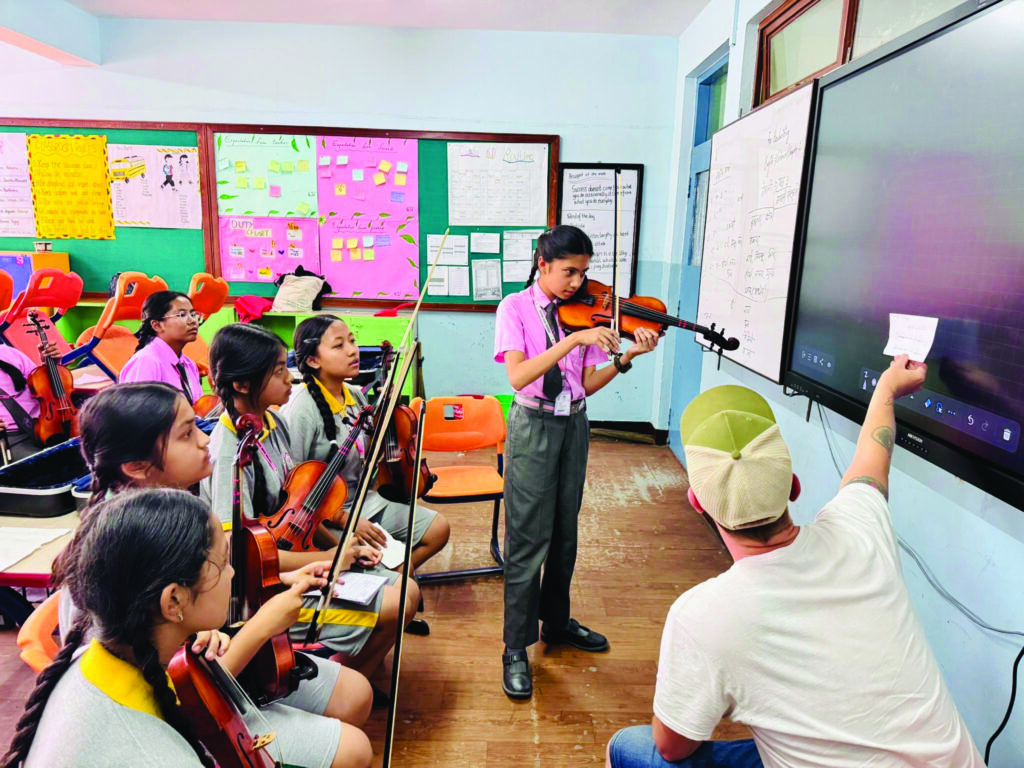
One significant reason Triyog was such a perfect match was John Karnajit, the school’s music teacher. Karanjit would often join us for dinner, drive us back to the hotel after work, and make sure we felt comfortable at Triyog each day. He shared in our excitement of learning and sharing music. Karanjit added, “I am really proud to have such talented and skilled bluegrass musicians and teachers who always helped our students explore, learn, and perform. After work, having tea, dinner, and going to their gigs were remarkable moments that we spent as colleagues.” John Karnajit is one of the warmest people I’ve ever met.
The Origins of the Bluegrass Journeymen Academy
The Bluegrass Journeymen Academy is the brainchild of Colorado mandolinist Patrick Fitzsimons. I had the opportunity to ask Fitzsimons about the program’s origins. He explained, “It started when I met Tara Lindhart just a few years ago. I had seen her film, The Mountain Music Project, talking about all her adventures in Nepal. That film really inspired me to get this done. I contacted Tara. She was already doing her trekking programs. She was recruiting musicians for treks, and that really appealed to me. I went on one of those treks, and in addition to that, I came here with my band, The Bluegrass Journeymen, a few years ago. We did a short tour of Kathmandu. I thought it would be a great idea to do a more substantial education program — not just where we do a workshop for one or two days, play some tunes, and explain what bluegrass is but actually do a real long-term instructional project where we bring over mandolins, banjos, fiddles, and guitars — and then bring great instructors to show them how to play these songs. I figured that was the way to create a bluegrass scene in this country and make the music stick. I have to give Tara a lot of credit for laying the groundwork for all this. She was the pioneer.”
I asked Fitzsimons how he found the first batch of teachers. He said, “Whatever I could think of. We put an ad in Bluegrass Unlimited — we went to message boards like Bluegrass Banjo Hangout, as well as a lot of word of mouth. I have to give a lot of credit to Christopher Henry — He hooked me up with Chad and with you.”
Fitzsimons sees the Bluegrass Journeymen Academy as a long-term endeavor. He explained, “We plan to continue— for the rest of my life — keep doing these teaching programs at a minimum of two months. We’re going to start new programs at new schools — bringing new teachers and more instruments — teaching new songs and basically continue with this mission of spreading bluegrass around the world as long as I can.”
To help guide the program into the future, Fitzsimons enlisted his friend Elliot Siff as the program’s manager. Siff has been tasked with booking flights, organizing fundraising efforts, and managing social media outreach. I felt in good hands with Siff, who managed my travel and prepared me for the journey.
Performing in Kathmandu
When the crew was not in the classroom, we were also working musicians. One highlight for me was playing a bluegrass gig at a Nepali bar called Ramsterdam. A poster of Jerry Garcia hung on the wall, and flags from various countries hung from the ceiling. We all loved to hang out at Ramsterdam. Winkles played several other gigs with local blues musicians he met at Ramsterdam. Errington had regular gigs with some of the best regional gypsy jazz players, while Harris joined a Nepali reggae band.
While the Nepali music scene was rich and diverse, bluegrass was definitely new to it. Chantel added, “It was clear that many audience members were hearing bluegrass for the first time. I also had the chance to perform with a Nepali folk band called The Flying Spirits, which turned out to be one of the most memorable shows I’ve ever played. Learning and performing original Nepali folk music was an absolute joy. The experience reinforced how universal music truly is — folk traditions, especially in mountainous regions, share a deep emotional and cultural connection no matter where you are in the world.”
Errington added, “Playing music on the Kathmandu scene is always loads of fun. I’ve played with a lot of different groups here over the years, always in styles that are seldom heard here or not in the mainstream, such as bluegrass and jazz manouche, and one thing I can say is that the Nepali community is very receptive and loves to experience something new that they haven’t heard before. Bluegrass is still in its infancy here, but the reception and feedback we’ve received while playing have been superb. I think that the Nepali community finds it easy to enjoy bluegrass because this is a country that is still very much in touch with its own roots and traditional culture, music included, meaning that these sorts of traditionally linked styles of music have a commonality that can be felt if not articulated.”
The Second Semester
The second semester of the Bluegrass Journeymen Academy (held October through mid December 2025) built upon what we accomplished in the first. Harris, Chantel, and Errington returned to their roles while some new teachers, such as banjoist Taylor Schuck and mandolinist Sammy Blackmore, were flown out to Nepal to become Bluegrass Journeymen.
As someone who was there for the first semester, I wanted to know how the students were progressing and what new songs and concepts they learned. Chantel explained,” [This past semester] we added ‘Shady Grove,’ ‘Liberty,’ and ‘Little Liza Jane’ to their group repertoire. For individual instruments, the banjo players worked on ‘Foggy Mountain Breakdown,’ the violinists tackled ‘Reuben’s Train,’ and the guitarists even learned ‘Thirst Mutilator’ by Billy Strings. The mandolin players wrote and sang their own song, and the bass players worked up a few breaks. In terms of progress, the kids have really grown in their ability to play together in a group or jam setting. They’re retaining songs more effectively, and their increased engagement and enjoyment are clearly evident. This semester, they also expanded their repertoire more quickly, which helped build both musical confidence and ensemble skills. My bass students, in particular, showed steady improvement throughout the semester.”
Errington was also proud to share the group’s improvements and explained, “In our second semester at Triyog, we were building on the skills and material that were covered in the previous semester. We had several new students to the program, and even to playing musical instruments altogether. One of the challenges was finding ways to teach groups with a wide range of abilities. Through inclusive group activities and games, we found a really effective way forward.”
Schuck commented on his first semester teaching at Triyog. “Teaching banjo in Kathmandu was an incredible experience! Despite some of the teachers having been there before, I quickly felt as if we had known each other for a long time, and I am happy to call them both friends and peers. The Nepali people’s cultural openness was very refreshing and made me feel at home. Teaching banjo, I had to adjust my usual approach because it is a different culture. After all, there is no ‘Flatt and Scruggs Live in Kathmandu’ album, but I believe I still was able to effectively communicate the essence of what makes bluegrass music so great to them. The sense of play, camaraderie, improvisation, and tradition really resonates with people from all walks of life, and so far I’ve not been able to disprove that.”
For me, it was fascinating to be in Nepal, not as a tourist, but as part of the community. Living and working in Nepal was the perfect way to immerse myself in a new culture. I feel lucky to have lived at the Omana Hotel. Gokul Subedi and the rest of the hotel staff were beyond gracious and hospitable, going out of their way to make Omana feel at home. They were never bothered by our bluegrass jams; it was undeniable that they enjoyed having all of us stay there. When I asked Subedi to comment on what it was like having all the bluegrass musicians stay at his place, he said, “The impact they’ve left is felt by everyone—even our neighbors keep asking when they’re coming back. Their music and energy were so contagious that our regular customers were completely captivated. The empowerment this team brought to our business was so significant that we built a separate block specifically to host them. We’ve named it ‘The Bluegrass Block,’ a space that stands as a testament to our collaboration and their choice to support a small guest house.”
If you’d like to donate to the Bluegrass Journeymen Academy and help support their mission, go to thebluegrassjourneymen.com. Your donations help expand the global reach of bluegrass music and bring music education programs to schools worldwide. As a registered 501(c)(3) nonprofit organization, all contributions are tax-deductible. Also, if you’d like to find out how to become a Bluegrass Journeyman, there is information on the site, as well as a form to fill out. They are always seeking new, talented instructors.
We all hope to make a difference in the world—helping bring people together and make it a better place. Fitzsimons and Siff, along with the rest of the Bluegrass Journeymen Academy crew, are without question accomplishing this. I’m grateful Christopher Henry asked me if I wanted to teach mandolin in Nepal. Spreading the Bluegrass Gospel in South Asia was one of the most meaningful things I’ve experienced as a music educator. In the near future, when bluegrass music is heard at venues throughout Nepal and India, it will be traced directly to the Bluegrass Journeymen Academy.

Dhulikhel Emmanuel school is a private school , beside govt. Prescribed curriculum we specially focus on Music. To teach music practice and buying musical instruments is big challenge, then also we are something extra in Brass and Nepali Folk music. If possible we Dhulikhel Emmanuel school also wants to associate with your Program.
Thanking you
Udaya Bhushan
Managing Director
udayabhushan@ gmail.com