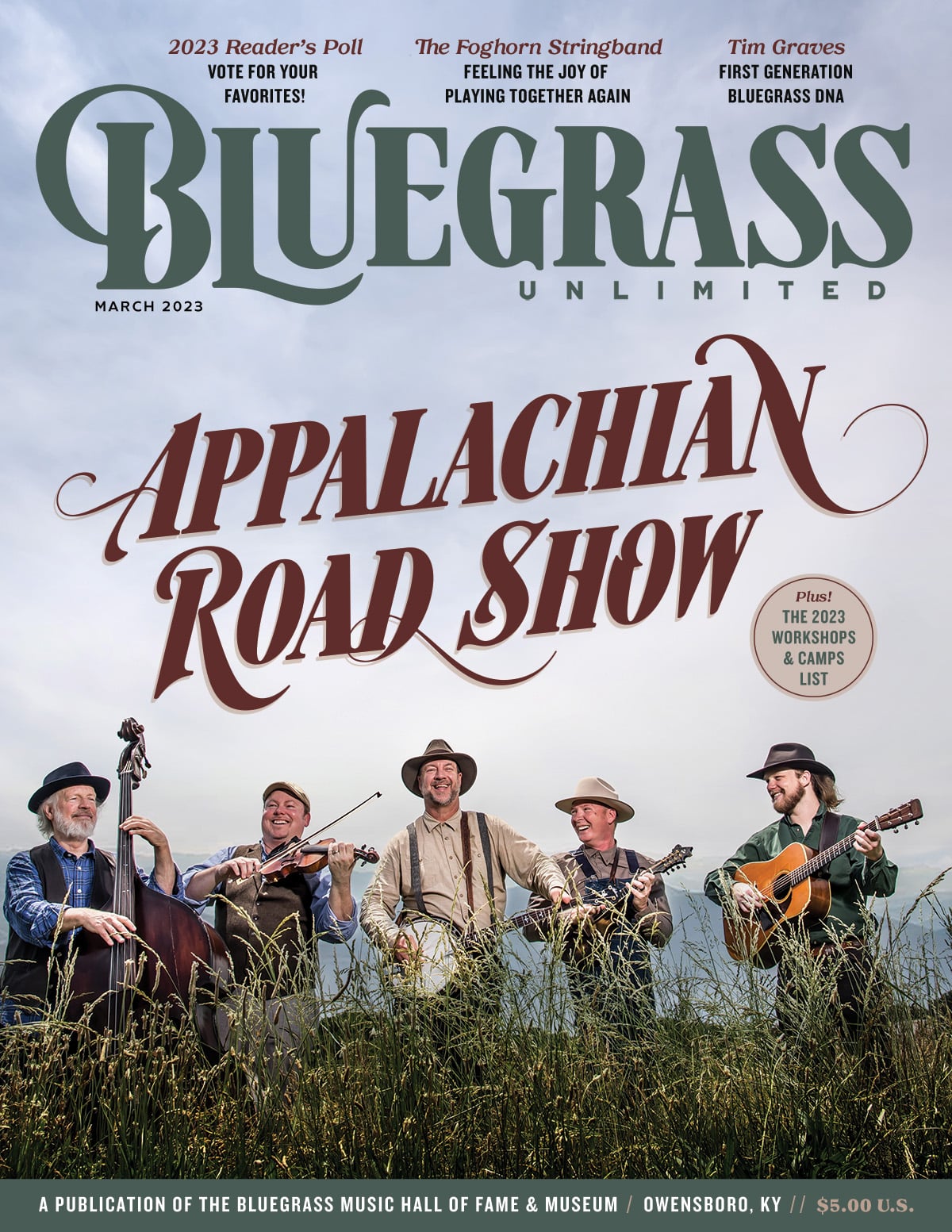
The Appalachian Road Show
Moving Forward with a Vision to Showcase the Roots of a Truly American Genre of Music
Photos by Erick Anderson
When I first heard the news of the creation of Appalachian Road Show, the idea of bringing together these five musicians made perfect sense. Yet, there was also a sense of their formation being too good to be true.
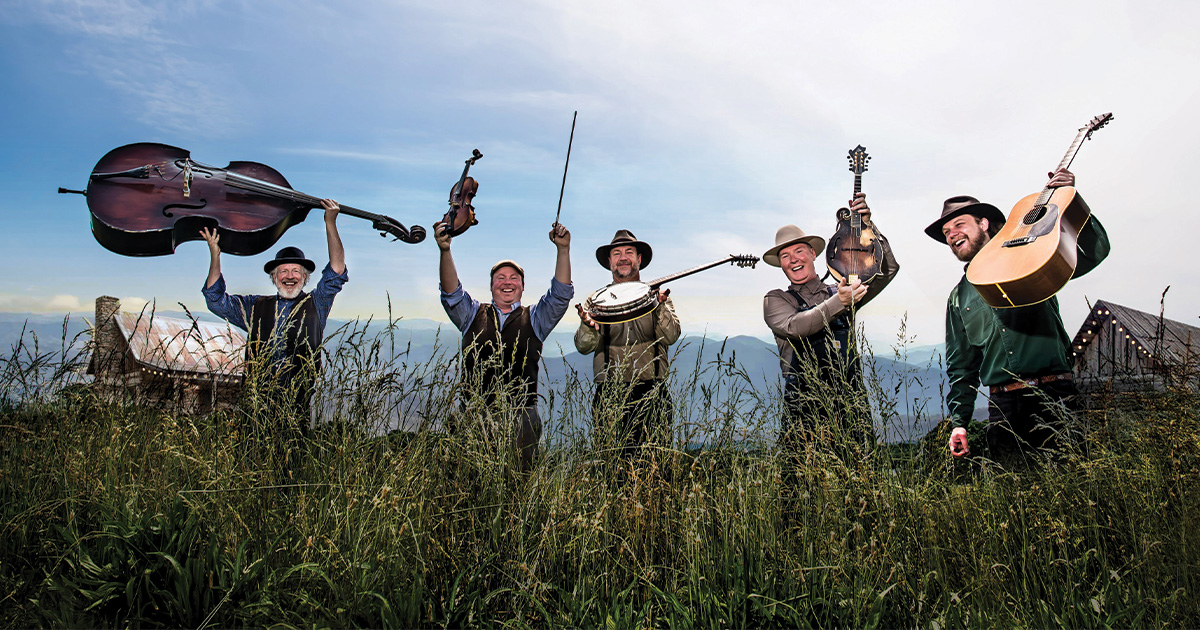
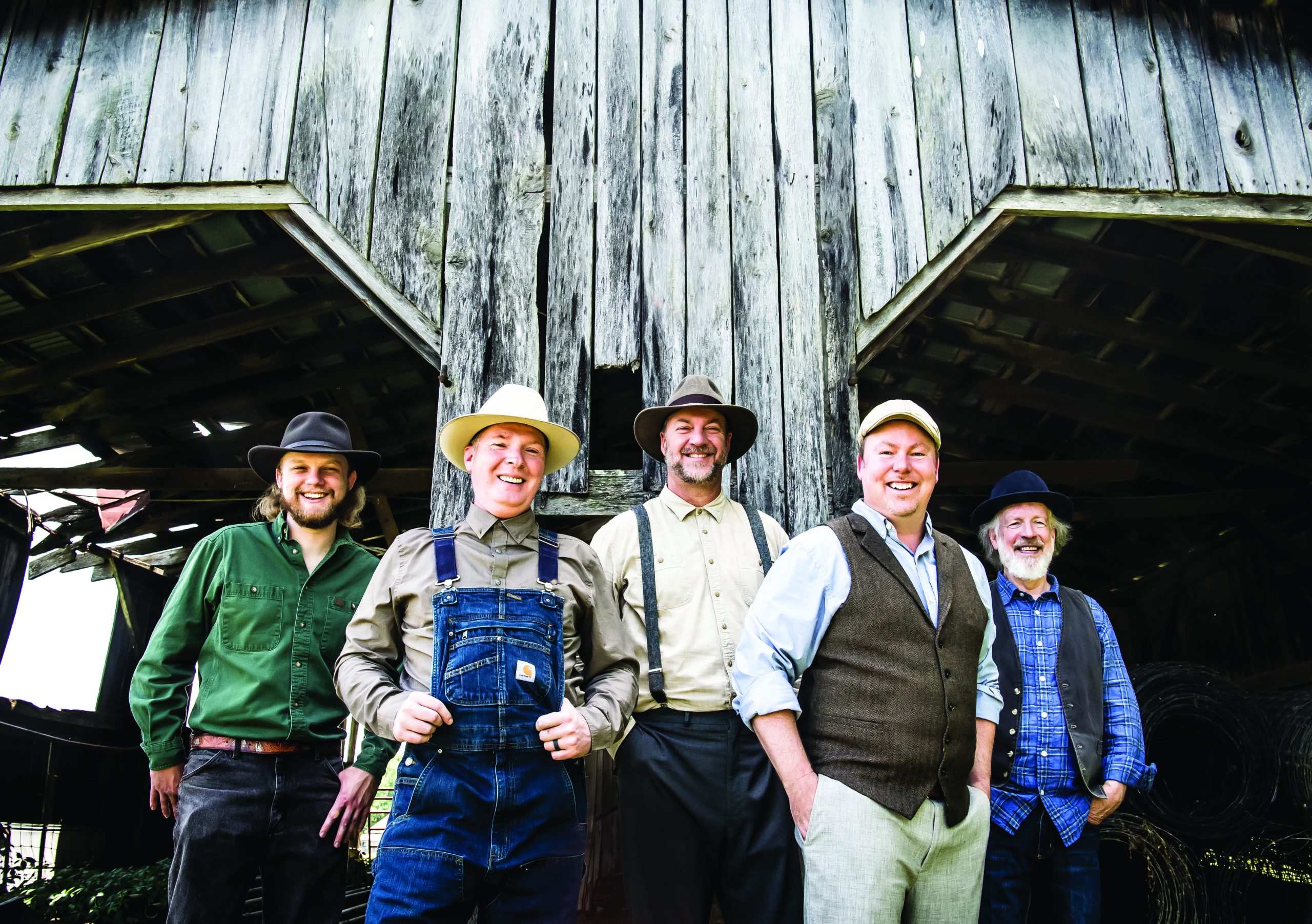
Combining former Mountain Heart bandmates Barry Abernathy and Jim VanCleve with a previous band leader Darrell Webb, the bass playing legend Todd Phillips and one of the best young guitarists in the business, Zeb Snyder, sounded right. But, in the bluegrass world exchange rates can be high when it comes to personal changes, retirements from the road, comebacks, break ups and new bands formed. Fans may wonder, “Is this too good to be true?”
Appalachian Roots
I first saw Appalachian Road Show perform in May of 2019 when I drove to Burnsville, NC, to watch them play in a venue in the Blue Ridge Mountains. Their show began the same way their first albums began, with the familiar voice of the great actor Sam Elliott doing a narration that sets the tone for the music and for the group itself. That ‘tone’ is based in the desire to tell the true stories of bluegrass music’s Appalachian rural roots.
There have always been moves in bluegrass music to take the genre uptown, to be able to play the music at Carnegie Hall without the musicians wearing overalls and sitting on bales of hay. In more modern times, many bluegrass musicians have come from the suburbs and the big cities as much as the rural areas, and they grew up with computers in their hands instead of farm implements.
Bill Monroe heard and embraced the blues and the swing music of his day via the radio, and the New Grass Revival would bring in touches of rock and reggae into their sound as music diversified exponentially in the 1960s and 70s. Other bands since have made a move towards making rootsy music more modern and relevant. However, as bluegrass music’s first generation dwindles, remembering the roots of a genre like bluegrass becomes essential. In the same way that New Orleans is key to the history of jazz music, and how Bristol and Nashville are intertwined in the legacy of country music, and how the Mississippi Delta and Memphis are important to the blues; the Appalachian Mountain region has been important for the development of bluegrass music.
And, that is where Appalachian Road Show comes in. They are an all-star band that not only wants to tell the bluegrass roots story in their music, but eventually they want to present the true tale in a multi-media experience. The concept of creating a multimedia stage production has been stirring in the imaginations of the musicians in the Appalachian Road Show from the start. Although it hasn’t happened yet, new ideas are being captured and saved every day. Slowly, but surely, the parts are being put in place.
A big example of this band’s vision, and the first steps to the bigger things that are on the horizon when it comes to future productions, can be found in the on-album guest narrations done by acclaimed actor Sam Elliott. Elliot’s earthy and familiar voice was made famous in hit movies like Conagher, Tombstone, The Big Lebowski, and the recent highly-viewed TV series 1883.
“The Appalachian Mountains, more than a trail, Appalachia is a spirit,” says Elliott on the opening song of Appalachian Road Show’s second album. “That spirit is one of shared survival, and hardship endured.”
The prescient thing about those spoken words by Elliott is that they appear on the album that the group called Tribulation, a title that Appalachian Road Show came up with before the recording was pre-planned to be released in the spring of 2020, right as the whole U.S. was being shut down because of the covid virus pandemic.
Despite that unplanned moment of historically ironic timing, however, like the rest of the country, Appalachian Road Show decided to keep moving forward and they rebounded with the appropriately-named new recording called Jubilation, which was released in October of 2022.
On Jubilation, from Billy Blue Records, opens with spoken words by another legend. This time, it is expertly crafted words spoken by the Country Music Hall of Famer, and now Rock and Roll Hall of Famer, Dolly Parton.
“The people who have lived in these mountains over the centuries, the Native and the settler, the slave and the free, the farmers and the miners, the men, women and children; they are bound to this place and shaped by it,” says Parton on the cut called “In Time, Jubilation.” “They are loyal to the land, and to one another, because sometimes, that’s what it takes to survive here.”
Tribulation to Jubilation
“Covid killed a lot of good friends of mine,” said Barry Abernathy, banjo player for Appalachian Road Show. “I had a lot of people I knew that died of it. And that is why we called our new album Jubilation. The last record was called Tribulation and we recorded that album in the late summer, early fall of 2019. By the time it was slated to come out, our release date was March 27, 2020, and that was the time that the country shut down. We didn’t have any idea that we would be in a literal time of tribulation by that release date, as we were just focusing on the hardships, trials and tribulations of the Appalachian people and our song selection reflected that theme. Even the happy songs on the Tribulation album were talking about losing a love and walking down the railroad tracks looking for them, and more historical-type of songs. So, by the time we were thinking about the theme for our third album, we thought that while we put so much effort into Tribulation, the title of Jubilation was just meant to be.”
When it came time to focus on the next album, Abernathy and crew wanted to uplift people as the world made its way out of the pandemic and the title Jubilation set the tone. “When we started this project, we said, ‘How can we make this album as happy as possible, especially up front with our first four or five songs?’” said Abernathy. “We started digging for songs and we wrote two songs as a band and tried to make them with a positive feel, and the album is a complete turnaround from the Tribulation record. And, so far, so good, as positivity was always the focus for this band.”
As everyone in the music world now knows, there are few things as positive as the sweet voice and personality of Dolly Parton, and her spoken word opening to the Jubilation album comes from the heart of a superstar who was that little girl growing up in the Smoky Mountains all those years ago.
“I had met Dolly a couple of times before, but I am sure it might not have stood out to her, although a few years ago I drove her tour bus,” said Abernathy. “Dolly had a tour bus driver named Tim and he asked me if I’d help him drive her to California. So, we split the driving up and she was very complimentary of the driving and she said, ‘Do I know you from somewhere?’ I reminded her that I saw her at the IBMA Convention one year it was supposed to be a secret that she was there, and right before we went onstage I introduced myself to her and when I walked out I said, ‘Well, I just got to hug Dolly Parton.’ Dolly said, ‘Are you the one that told everybody that?’ I said, ‘I am, but I didn’t know that I wasn’t supposed to tell anyone by that time.’ She just laughed.
“Anyway, later on, she had heard about Appalachian Road Show and she was in the studio recording her new album Run, Rose, Run (released in March of 2022) and her manager called us and asked if we’d be interested in singing trio harmony behind her on a song,” continued Abernathy. “So, me and Darrell and Jim sang harmony with her on a song called ‘Dark Night, Bright Future.’ After that, when we talked about getting another spoken word part for Jubilation and someone suggested Dolly, Jimmy got with Dolly’s manager and asked if she would do it and he said, ‘Send it on. We’re in the studio right now, she said she’d do it, so just send over what you want her to say.’ By the next day, they sent her recording to us, and she even did an intro for our live shows. After the Jubilation recitation plays, it pauses for a second and then Dolly says, ‘Ladies and gentlemen, Appalachian Road Show presents Jubilation!’ It is awesome.”
The Rest of the Band—Darrell Webb
Mandolinist and singer Darrell Webb is the perfect fit for Appalachian Road Show and its brand as a band. Not only is he a great player and a bluegrass veteran, Webb is also a native of McDowell County, West Virginia, and the son of a coal miner who died of black lung disease.
When Webb was just a kid and an upstart mandolin player, it was his father that took him to the Mountaineer Opry House in Milton, West Virginia, to meet J.D. Crowe. As fate would have it, Webb would grow up and play with the IBMA Hall of Famer Crowe and he would become his hero’s friend. Crowe, unfortunately, died not long ago on Christmas Eve in 2021. Webb’s time playing with Crowe will inform him for the rest of his career.
“I’ve learned a lot from every musical situation that I’ve been in,” said Webb. “I learned a lot about the music business from watching and playing with Rhonda Vincent. I learned most of the musical part of it by playing with J.D. Crowe. The biggest thing I have learned from being in the Appalachian Road Show is the branding and marketing part of it. We have developed a real brand and it is very marketable and you have to do everything you can do to keep from sacrificing your brand, and that is very important. I have sunk my heart and soul into this band and it is where I want to be.”
As for Webb’s time with Crowe, it will stay with him for as long as he can pick a string. “The one thing I enjoyed doing with J.D. was just going to his house and hanging out with him,” said Webb. “He’d be out in his garage and he had an antique Firebird car out there and he’d be shining it up, sometimes. We were out there in his garage one day and he had a bunch of record albums lying around in a bunch of boxes, and in those boxes was everything that he had recorded over the years, everything from the Bluegrass Holiday album by him and his Kentucky Mountain Boys to the Bluegrass Album Band records Volumes 1 through 4. I got to looking through those boxes and I said, ‘Crowe, what are you going to do with these records?’ He said, ‘Ah, man, just take whatever you want.’ So, I got all of those great vinyl records with Keith Whitley on them and both album covers of the Rounder 0044 album and more. That was a great day and one of my favorite memories of J.D.”
Zeb Snyder
Zeb Snyder is the youngest member of the Appalachian Road Show, and yet, considering that he began touring with The Snyder Family Band at such an early age, he can be called a bluegrass veteran as well. As he reached his late 20s, Snyder grew to appreciate the old school sounds of roots music guitar played by folks like Doc Watson and Norman Blake. So, when this band calls upon him to retrieve a centuries-old sound from his six-string for a certain cut, he is gladly up for the challenge.
“This band has always had great momentum behind it,” said Snyder. “Appalachian Road Show has been fun to be a part of because I’m just the guitar player and I get to watch Barry and Jimmy and Darrell killing it on the business side of things. And, this band has never lost its way. It is really consistent and there is a lot of positive force behind it. This has been a great experience for me because I have to play so specifically, because it is easy to fall into a rut.
“I kind of have a default way of playing bluegrass, and it is sort of a Tony Rice vocabulary and sort of a Carolina thing,” continues Snyder. “I have the Tony Rice influence, but I also have the 1990s, hard-driving, Lonesome River Band-IIIrd Tyme Out-type of thing that I do when I’m jamming somewhere. When you are learning how to play, you sort of have a spike where you go from the basics to jumping up to the more exciting progressive stuff. But now, I find myself rebounding a little bit and I’m always trying to sound older. What is fresh to me now is Lester Flatt, Larry Sparks, Jimmy Martin and Norman Blake.”
With the focus and the brand of the Appalachian Road Show intact, Snyder is happy to work towards a unified goal while still keeping his own unique playing style in the mix. “Over the past few years, it has been a great thing to have to be specific and deliberate and careful with every song,” said Snyder. “Barry and I will talk about what we want the guitar to sound like, although I may make a few unconventional decisions with my capo at times, and I play a lot in Open A with this band. But, I will also choose from my influences, as in I might turn up the Norman Blake on one cut and turn down the Tony Rice influence, or on another song, I might do the opposite. Or, I might bring Doc Watson into it, which gets to come out more often with this group. It makes every song special to me. It sounds a bit corny, but I really mean it. I’m not playing anything on autopilot. I’m focused every time and I’ll play it until it is exactly right. That is how I like to play music because it keeps you from getting burned out and complacent. That has been one of the best things about being in the Appalachian Road Show.”
Perhaps the most unexpected and intriguing aspect of the music side of the band is the symbiosis that has developed between Snyder and the legendary bassist Todd Phillips. “The other day, I was asking Todd how to count ‘Manzanita,’ because I’ve been trying to learn that tune and, of course, he played on it,” said Snyder. “Todd is probably the best instrumentalist I’ve ever played with, and I’ve learned a lot from playing with him, partly from conversations where I get to ask him about things literally, but I also think I’ve learned more from just playing with him and feeling him react and me reacting to him. He is the most in-the-moment reactive musician that I’ve ever played with, and that is how I like to play.”
Todd Phillips
Phillips not only played on “Manzanita” and other great Tony Rice cuts, but he also played and recorded with the all-star Bluegrass Album Band, played mandolin and bass on the first ground-breaking David Grisman Quintet albums, in the progressive super group Psychograss, and so much more.
Phillips is also aware and thrilled about the connection he has with Snyder.
“It is such a familiar groove to fall into, and I am really comfortable playing with these guys,” said Phillips. “Half the band has trained with great artists that I have learned from as well, like Doyle Lawson and J.D. Crowe, so I think we are coming from the same school, so it is real natural. Then, to have somebody like Zeb in the group, I mean, he grew up with it. I guess we are the old guys to him. But, he has been knee-deep in the music since he was a kid, which wasn’t the case for me. I learn from Zeb, too. Sometimes I can’t figure out how I grew up in California and ended up in this world. But, I’m glad for it.”
Initially, when Abernathy, VanCleve and Webb recorded the first Appalachian Road Show album, they had yet to hire a steady bass player. “I always say that they kidnapped me, and I’m glad they did,” said Phillips. “I went in to record the first project and there were other players on it, like Stuart Duncan and Bryan Sutton, but the band has come together slowly after the original album. I guess that I bring my experience to the band and what I can do on the bass and it all fits together. The thing is, with a lot of bluegrass bands, it’s about working on timing, timing and more timing. We don’t ever have to talk about that, and nobody even has to say ‘One, two three,’ in front of a song. That makes it easy and nice to do.”
Now, Phillips views playing alongside Snyder as a treat as well. “Zeb quizzes me all of the time about stuff he hasn’t heard yet,” said Phillips. “He is curious. Zeb wants to find out everything, and he’s smart, too, and absorbs it. He has great hands and a great mind and I’m really happy to be playing with him. I told Jimmy the other day that since working with Tony Rice, I haven’t had that kind of connection in decades.”
Jim VanCleve
A big part of the push behind Appalachian Road Show is its fiddler Jim VanCleve. VanCleve tries to stay active behind the scenes as well as onstage. He is a whiz in the studio and he is willing to do the hard work on the marketing side as well. Creating the Appalachian Road Show brand and growing the brand is an essential part of this group, and VanCleve is up for the task. Another essential aspect of this band is its relentless search for new songs to bring to the table.
“Barry and I wrote two songs on this new album and I wrote an instrumental tune as well, and writing within the overall scope and direction of this band is something that comes fairly naturally to me because I spent most of my childhood growing up in those Appalachian Mountains, as did Darrell and Barry,” said VanCleve. “As far as finding other songs, Barry has done a great job of stockpiling stuff and he loves cataloguing all of those songs just because he loves to do it. So, in the years leading up to the formation of the Appalachian Road Show, he was collecting material that he thought could work down the road. Right now, we still probably have 150 songs to choose from. Because there is so much culture to be found in what is such an expansive geographical region, there is a wealth of songs out there, including older ones. What is hard is trying to find good recordings and documentation of some of those older songs, and you have to turn over every rock and leaf to find them, sometimes. But, once you find that gem that really hits the mark, it is worth all of the effort.”
After VanCleve’s time spent with the group Mountain Heart, he produced high-quality solo albums and took on a lot of studio work. He also went out on the road with country star Josh Turner and enjoyed that experience as well. But now, with Appalachian Road Show, VanCleve has returned to his musical roots. “It is good to be in a band that has a unified purpose and goal, and that has kind of a collective soul to it,” said VanCleve. “We all get what this band is about and we all just resonate with it. Somehow, it’s a really natural thing. Before this, I was playing with Josh Turner and I came off of that tour and stepped into Appalachian Road Show right away.
“What is interesting is I’ve been a session player for years, and when you are a session player, you have to step into the studio and determine what musical hat you are going to wear that day, and how to best serve the material and the artist,” said VanCleve. “When you are hired to go on tour with a singer like Josh Turner, it is a job and it is a service and you provide it the best way that they have outlined it for you, and it is a great thing. It really is, and it’s a perfect fit for a lot of folks. I will have to say, though, that I feel so much more alive and feel like I’m where I’m supposed to be when I’m with the Appalachian Road Show.”
VanCleve and his band mates are happy to be in the midst of a truly creative process from the ground up, and to have Sam Elliot and Dolly Parton onboard is magical icing on the Appalachian Road Show cake. “I feel more like I’m where God meant for me to be when I’m able to be creative and express myself authentically,” said VanCleve. “Our motto for this band is, ‘Authenticity never goes out of style.’ We print that on every t-shirt, every album jacket, because it doesn’t go out of style. It’s not just our motto; it is the truth. That is what we are about, as in being authentically us, and it has been liberating and it’s been like coming home. It has also been exciting and we are all having a blast and we love hanging around each other. We are all buddies, and it feels like family.”
More information can be found at www.theappalachianroadshow.com.