The 2023 West Virginia Music Hall of Fame Inductees
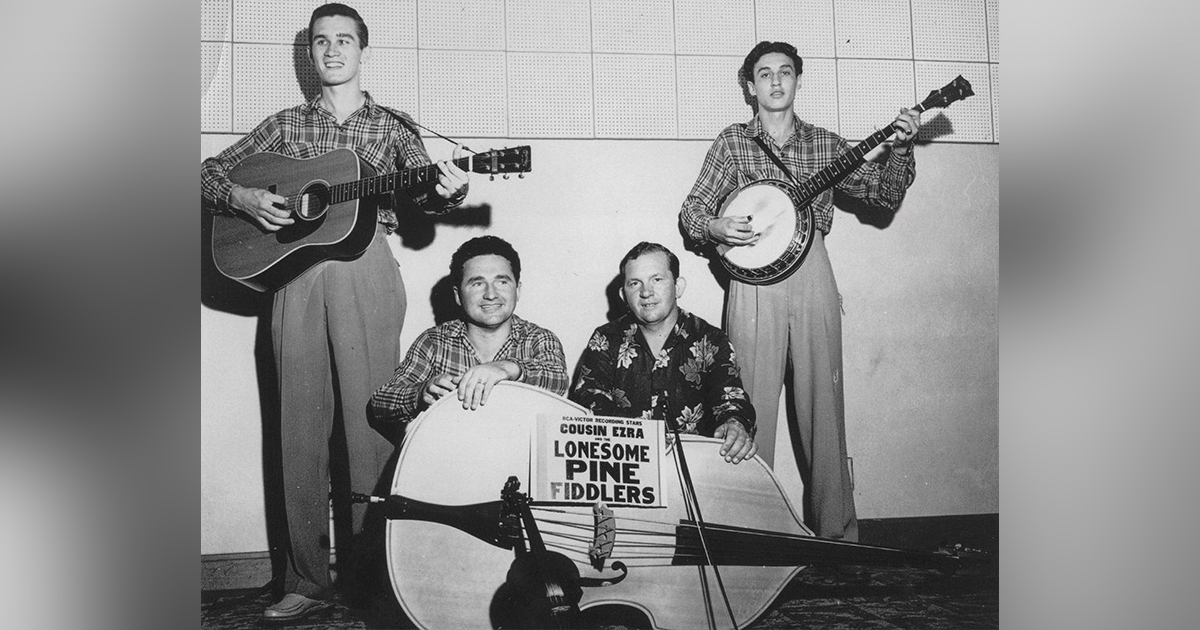
As John Mayall’s Bluesbreakers were to British rock guitar, Muddy Waters was to electric blues, and Miles Davis was to modern Jazz, West Virginia’s Lonesome Pine Fiddlers (LPF) were to bluegrass music. The group was a training ground, a triple A ball team if you will, for a genre that has grown exponentially since its beginnings in the 1940’s. The Lonesome Pine Fiddlers were among the first groups inspired by Bill Monroe’s Grand Old Opry performances featuring the exciting new sound we now call bluegrass. The legendary group, along with second-generation bluegrass artist Buddy Griffin, will be inducted into the West Virginia Music Hall of Fame on June 3rd.
The Lonesome Pine Fiddlers
In lieu of charging a price of admission, the Lonesome Fiddlers often sold small boxes of candy at their live performances. Leader and front man Ezra Cline was a natural-born salesman and a canny businessman looking for ways to put food on the table and gas in the tank. Each box of candy that the band members themselves packaged was essentially a raffle ticket, a few of which contained prize winning tickets.
Broadcasting from small coal field radio stations, Cline and his younger brothers Ireland, Ray, and Charlie mimicked Monroe in more ways than one. Adding Ezra’s upright bass and close harmony singing to music they played at home for their own enjoyment, they set up live performances in area schoolhouses, theaters, and even vacant lots which they advertised on their daily broadcasts. Soon they recorded their first 78 rpm discs in the bluegrass style with young sidemen Bobby Osborne and Larry Richardson imitating Monroe’s high tenor vocal, and Earl Scruggs rapid fire three finger banjo rolls. And like Monroe’s band, the LPF’s became an important training ground for aspiring pickers like Osborne and his younger brother Sonny, as well as for Paul Williams and his future boss man Jimmy Martin.
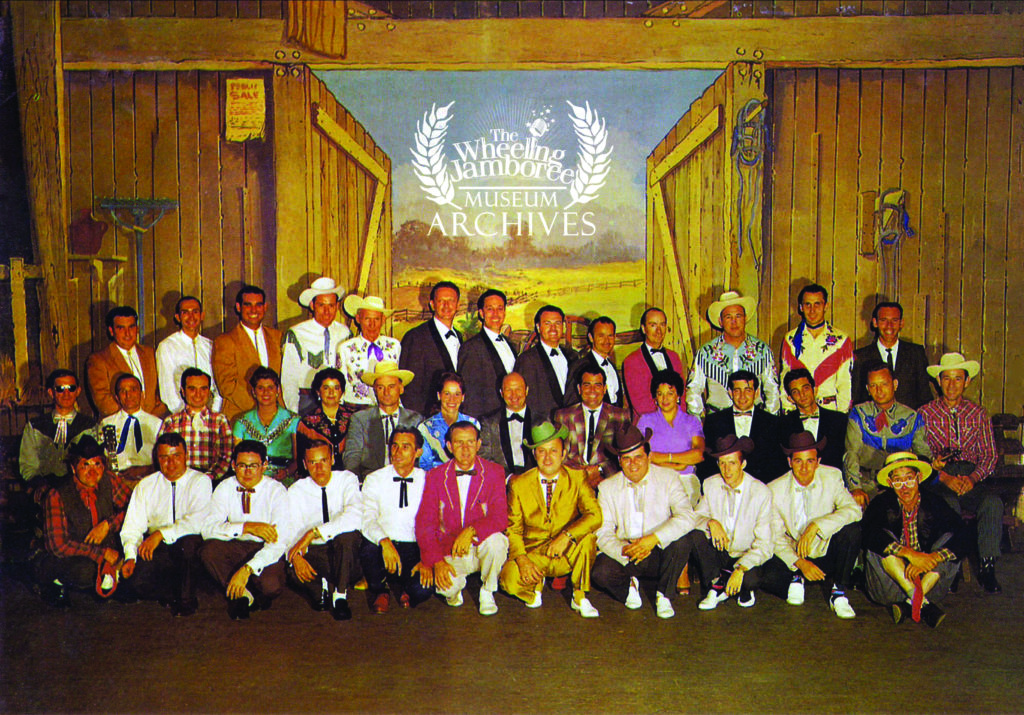
In a 1959 cast picture of Wheeling’s WWVA Jamboree you can, in retrospect, see what was happening. There in the front row is the now legendary combo of former Lonesome Pine Fiddlers Martin and Williams with banjo icon JD Crowe. To their right is Hylo Brown’s band with future LPF members Melvin Goins and Billy Edwards (as well as a very young Norman Blake). Look in far left of the back row and you’ll see future Grand Old Opry stars and LPF veterans the Osborne Brothers.
As a board member of the West Virginia Music Hall of Fame, I have often enjoyed phone calls to iconic musicians who are being inducted. I left voice mail with Paul Williams, and he called back the next day, March 30th, coincidentally his 88th birthday. Paul was happy to know about the inductions and said he hopes to attend. He drew from his sharp memory to speak of his days as a Lonesome Pine Fiddler and the “candy shows,” where Ezra would rent a ball-field for a performance venue, then “ballyhoo” the show by driving around announcing it through a bull horn mounted on the top of his car. Cline also pulled a special trailer that unfolded into a stage. He would buy taffey “by the ton,” then had band members fill small boxes with ten pieces each, adding winning tickets to a few of the boxes. Smaller prizes might be stuffed animals which were displayed on the back wall of the stage, while the grand prize might be a watch. After a 45-minute set, the band members would sell the boxes, wearing nail aprons to collect the coins. Once the prizes were awarded, the band would return to the stage and play a few more songs to end the show. Curly Ray recounted to Bluegrass Unlimited in 1981 that on one particular show, “the candy brought in $93.00.” Band members often stayed in Ezra’s rooming house on Raleigh Street in Bluefield, and generally played six days a week on radio. At 16 years of age, Paul had already written and recorded several songs for RCA with the band, and making $30 per week, felt like he was rolling in dough.
Ezra Cline and his cousins Ray and Ireland Cline, from Gilbert Creek in Mingo County West Virginia, along with guitarist Gordon Jennings, first performed as the Lonesome Pine Fiddlers in 1938 over radio station WHIS in Bluefield West Virginia. Ezra, the oldest of 15 children, became the family breadwinner when his father died. Inspired to play the bass after seeing a Clayton McMichen show at local high school, Ezra kept the band active through countless personnel changes into the 1960’s. During World War Two, banjoist Ireland, also known as “Lazy Ned”, was killed in the D-Day invasion, and the band was inactive for some years.
In 1949 a new edition of the band, with vocalist Bobby Osborne on guitar, Larry Richardson on five string banjo, and Ray Morgan on fiddle, emerged. This lineup, along with the Stanley Brothers and Flatt and Scruggs, were essential early practitioners of what came to be known as bluegrass music. Osborne brought a song he’d written called “Pain in My Heart” to the Fiddlers first session for Davis, West Virginia’s Cozy records, and that song became a regional hit, and was later recorded by Flatt and Scruggs. The group’s Coral sides were soon picked up by a Decca subsidiary (Coral), and in 1951 the band entered a fruitful relationship with RCA, eventually recording 14 sides for that label.
By now Curly Ray Cline had rejoined the group on fiddle, and along with “Cousin Ezra” remained a constant presence throughout the group’s history. With Paul Williams on lead vocals, the group had juke box hits with “Dirty Dishes Blues” and “My Brown Eyed Darling,” a song written by Williams with Ezra’s daughter Patsy, and dedicated to her fiancé Bobby Osborne, who was by then serving with the U.S. Marines in Korea. Williams’s real last name is Humphrey, but when he first joined the group, he had been performing with his cousin Jim Williams as one half of “The Williams Brothers.” With the Lonesome Pine Fiddlers, he became known as Paul Williams, and the name stuck throughout the rest of his career.
During the RCA years, the group relocated first to Oak Hill WV and then to Detroit, where they were regulars on WJR’s popular Saturday night broadcast, the Big Barn Frolic. The Fiddlers success in Detroit was repeated by Jimmy Martin’s subsequent residencies at the same station, first with the Osbornes, and then with Williams and young J.D. Crowe. Williams, who had honed both his singing and his songwriting with the Fiddlers before joining Jimmy Martin’s classic band, came to write or co-write many of Martin’s best-known songs.
In November of 1953, Ezra and Curly Ray moved to Pikeville, Kentucky with new members Melvin Goins on guitar and lead vocal and his brother Ray Goins on banjo and tenor vocal. Three months later, the group again traveled to Nashville for its fourth RCA session. In the liner notes to the Bear Family’s Lonesome Pine Fiddlers box set, Gary Reid quotes Melvin’s memory of his first time in a Nashville studio. Shaking, scared, and intimidated by the surroundings, with a gruff Steve Sholes producing, he and the group rushed through a four-song session in forty-five minutes. “It was a big step for a country boy following a mule through a field plowing to Nashville, Tennessee. … I went in there set for the kill, and man I got it done quick.” That group recorded once more for RCA, waxing what would become their signature tune, “Windy Mountain.” Credited to Curly Ray, “Windy Mountain” was actually given to Cline by its composer, Kentucky’s Hobo Jack Adkins, who like the LPF’s performed regularly on WLSI in Pikeville.
Curly Ray’s brother Charlie joined the group on banjo for a time in the early 1950’s before joining Bill Monroe’s Bluegrass Boys, playing fiddle, banjo, guitar, or bass in that group as needed. On our phone conversation, Paul Williams recalled an amazing recording Charlie made with engineer O.C. Young at WHIS, playing all the above-mentioned instruments as well as mandolin, and singing three separate vocal parts. Larry Richardson later played with Monroe for a time as well, as did one time member Udell McPeak. Other notable LPF sidemen through the years include Billy Edwards, Joe Meadows, Landon Messer, Lowell Varney, Ezra’s brother in-law Albert Puntori, and West Virginia mandolinist Charles “Rex” Parker. James Roberts, who was to make musical history with his wife Martha Carson, played mandolin on the group’s last session for RCA.
Of all the Lonesome Pine Fiddlers, perhaps the most well-known to second generation bluegrass fans was Curly Ray Cline, who’s mountain fiddling was a mainstay in Ralph Stanley’s band for more than 25 years until his retirement in 1993. Like Ezra, he was a born entertainer and salesman who sang novelty songs with the Clinch Mountain Boys and sold countless numbers of key chains from his well-stocked merchandise table. He played his great grandfather’s “seed” fiddle, bought from a seed catalogue, throughout his long career. A few more members of the Cline family participated in the Fiddler’s career, with Curly Ray and Charlie’s sister Margaret, who was married to Ezra, singing on early radio performances, and the disabled Kessler Cline co-writing songs like “Honky Tonk Blues” and “I’ll Never Change My Mind” with his cousin Charlie.
Through various personnel changes in the 50’s and early ‘60’s, the Lonesome Pine Fiddlers performed on TV in Huntington West Virginia, and on radio in both Pikeville Kentucky, and Bristol Virginia. Before leaving the group in 1965, Melvin and Ray Goins along with Ezra and Curly Ray recorded four albums for Starday, including one with fellow Starday artist Hylo Brown. Ezra ran a restaurant and a swimming pool in Pikeville, and Norman Blake recalled having his first look at a Gibson F-5 in the gravel parking lot of that restaurant. The instrument belonged to Bobby Osborne who Blake said “was sparkin’ Ezra’s daughter” Patsy at the time. The Fiddlers continued to perform part time until 1968, when Ezra moved back to West Virginia.
Buddy Griffin
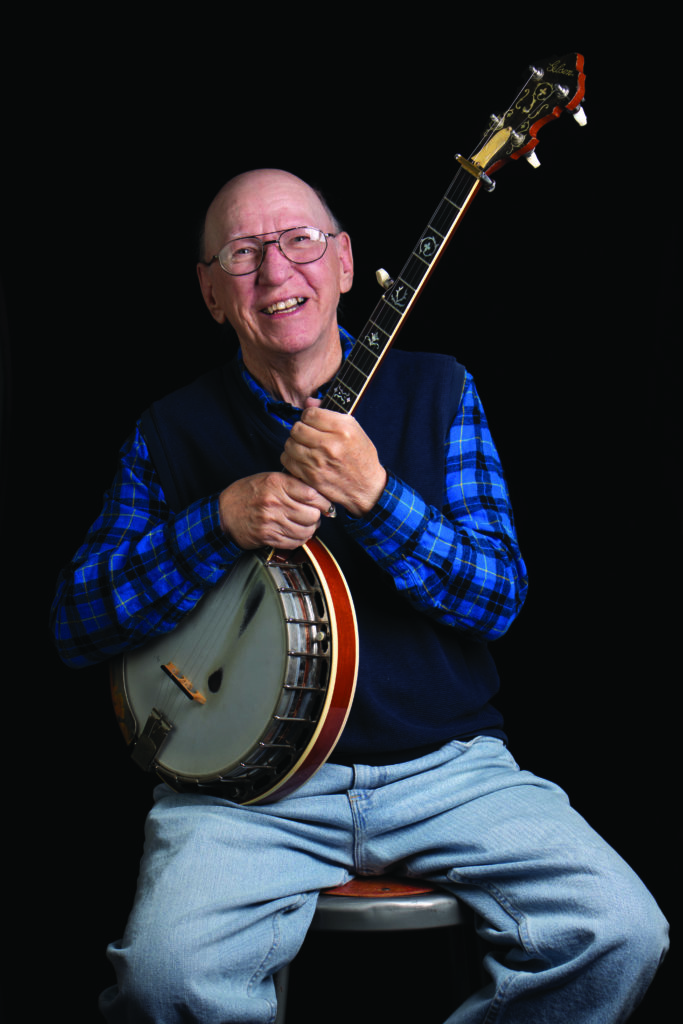
A generation later, young Sutton native Buddy Griffin played with several LPF veterans. He became a staff musician at WWVA before making Nashville, and later Branson, his base of operations. By Buddy’s time, bluegrass had split from country radio, positioning itself between country’s pop electric form, and traditional acoustic folk music. A circuit of festivals, clubs and college concerts had sprung up, promoted by local and national organizations and the burgeoning new network of public radio stations. Fiddler and banjoist Griffin, who had grown up in a musical family, found steady work after his college graduation with iconic artists like Jim and Jesse, as well as with former LPF members the Goins Brothers and Bobby Osborne. Returning to West Virginia in 1971, he founded and directed an innovative 4-year curriculum in bluegrass music at his alma mater Glenville State College.
I’ve looked at that 1959 Wheeling Jamboree cast picture countless times. When it was taken, I was in kindergarten. The next year, I got my first radio, a crystal set that came with a single earphone, and an antenna that attached to the radiator beside my bed. As I listened to it before going to sleep each night, I had no inkling that one day I’d become a musician. But by the time I was 13, I had heard Bill Monroe and Doc Watson, and started attending the Jamboree on Saturday nights. I learned the Flatt run from Jamboree staff member Roger Bland, and I remember hearing his replacement, Buddy Griffin, on his first performances there. From the cheap balcony seats, I watched bluegrass artists like Jimmy Martin and the McPeak Brothers, not knowing the history of the show or of bluegrass music. But after playing this music for more than 50 years, I can now see that I’m just following in the footsteps of the various members of the Lonesome Pine Fiddlers.
That pathway of tradition just keeps extending. Interestingly, when playing the Jamboree’s 90th anniversary show in April, I met the members of one of the other acts on the show, Harmony Scott. The group is made up of three daughters of Roy Scott, who stands right beside Big Slim in that 1959 photograph. Jamboree producer Dave Heath had requested that I perform some songs from the Jamboree’s earlier days, and it really felt right to sing Big Slim’s composition “Sunny Side of the Mountain”, which was recorded by his protégé and 50’s Jamboree cast member Hawkshaw Hawkins, and of course also recorded later by Jimmy Martin.
Today, bluegrass artists like Alison Krauss and Billy Strings fill arenas, but it’s important to remember that the music started in humble places like Buddy Griffin’s living room and Ezra Cline’s Bluefield rooming house, where he and his sidemen wrote and rehearsed. The Lonesome Pine Fiddlers and Buddy Griffin, along with founding members of Parliament Funkadelic Fuzzy Haskins and Calvin Simon, classical pianist Barbara Nissman, and R & B keyboard great Winston Wall will be inducted into the West Virginia Music Hall of Fame on June 3rd at the Cultural Center in Charleston.
More information can be found at www.wvmusichalloffame.com.