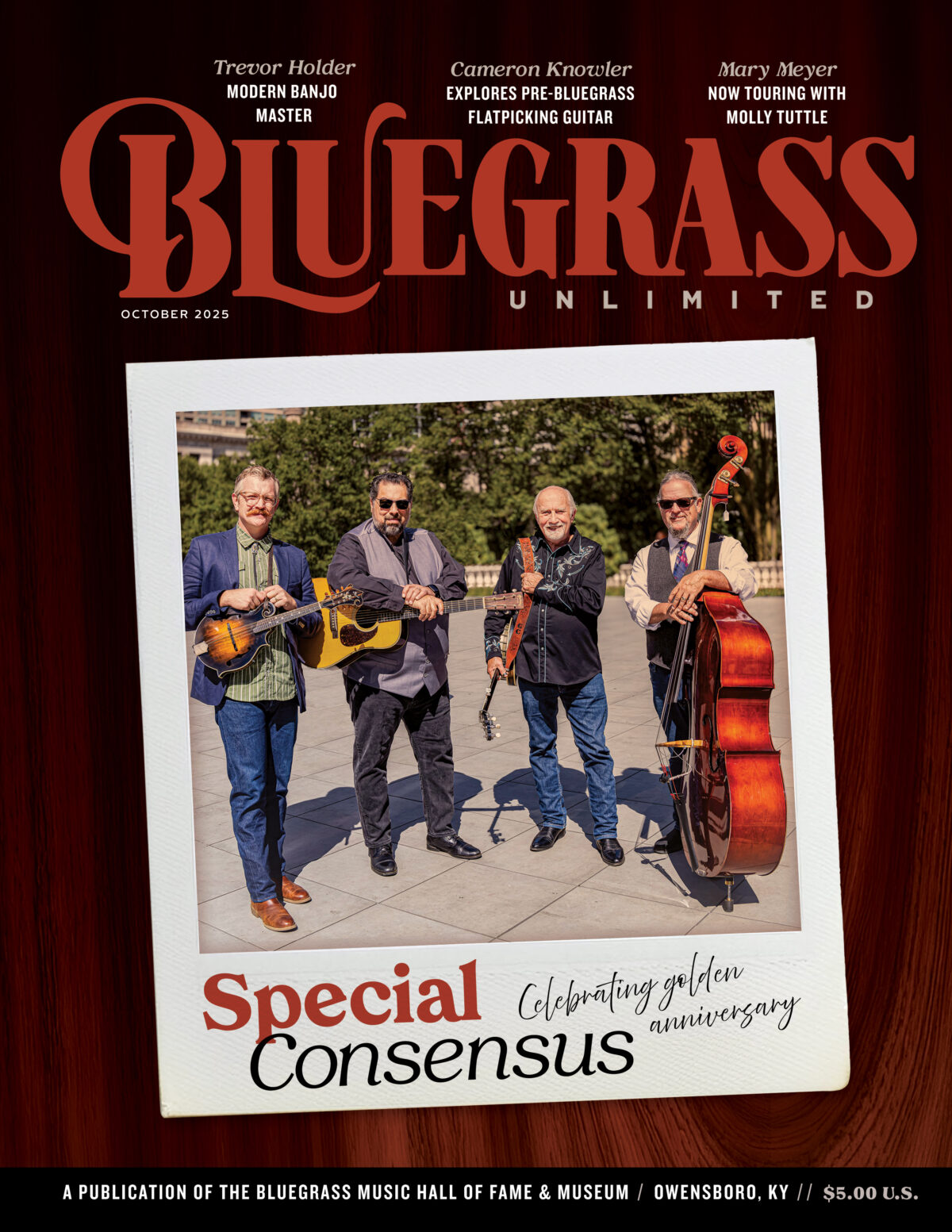
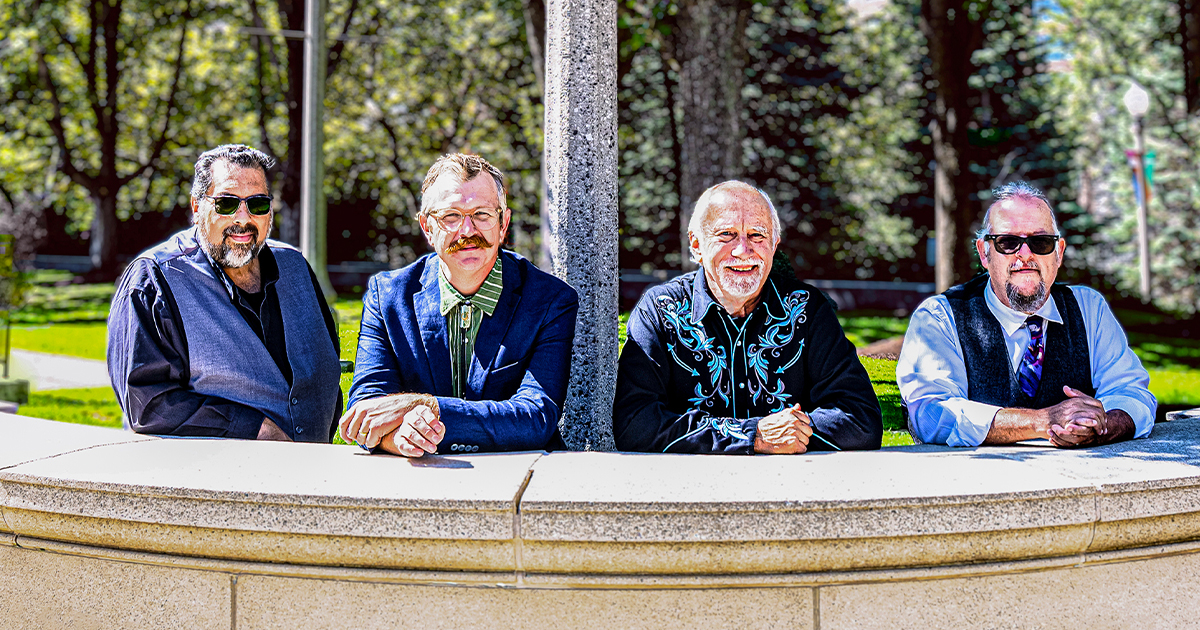
Special Consensus Celebrates Golden Anniversary
Just one more year. That mantra still runs through the mind of Special Consensus co-founder Greg Cahill. The banjoist and band leader who started the long-running bluegrass group wanted to play music for a living, but for many years, he had more bills to pay in one hand than dollar bills brought in from the music in the other.
“There were lots of ups and downs, that’s for sure,” Greg Cahill tells Bluegrass Unlimited. “We’re sleeping on floors and riding around in beat-up cars and buying used vans and sound systems.”
Cahill had a great job and a wife and young son to provide for in Chicago, but he loved the music too. He and bassist Mark Edelstein quit their day jobs in 1975 and decided they would give music a shot for two years before returning to the regular work world. “It didn’t work,” Cahill said. “We didn’t get it out of our system. It got worse.”
Millions of road miles and 22 recordings later, Special Consensus is celebrating the band’s 50th anniversary. “I have a hard time wrapping my head around it,” Cahill admits. “It feels like, OK, maybe 25. I’ve been incredibly fortunate to have great people come in and out of the band and to have the support of the bluegrass community.
“I love playing music to this day. I’m the guy who stays up late picking after the festivals. If I have friends there from other bands, then after the stage show, we’ll just sit around and play or sing songs. Beautiful music is a powerful thing!”
A Toast to 50 Years!
To mark the significant milestone anniversary, the band will host a golden anniversary show on October 18th in Chicago at the Old Town School of Folk Music. Ever since the band’s 15th anniversary, Special C has planned a reunion concert there every five years. “Everybody’s invited who had played in the band,” Cahill says. “We can’t get everybody on stage. Those concerts ended up being four and five hours just with people who had played on recordings.”
This year is an extra special occasion with band alums like Chris Jones, Dallas Wayne, and Rick Faris making a return appearance. “I haven’t got a set list yet, but I’m anxiously awaiting that because that is always kind of fun,” says Faris, who answered his R.S.V.P. long ago. “I like to help Greg out, too, if he’s got a player that can’t make it from a past session. It’s always a fun flex mentally to learn a bunch of tunes, and Greg’s doing it the whole time. You’ve got to remember these songs that he recorded 50 years ago.”
“Everybody wants to show up because it is old home week,” Dallas Wayne said. “It’s like a bad class reunion gone crazy. The dressing room stuff is as much fun as playing on stage because you get to sit down and visit, swap stories, and that kind of stuff, especially with newer guys in the band. They would say, “Hey, I heard this about you. Is that true? You kind of duck your head in shame and say, ‘Yes, that’s true.’”
“People come from all over the country, even from Canada, and some have flown over from Ireland and Germany for some of the shows,” Cahill says. “This is going to be our big anniversary, our crown jewel, because so many of the alums are coming back.”
Special Consensus also recently released a new album, Been All Around This World, to commemorate the occasion. Produced by Compass Records co-founder and Grammy-winning banjoist Alison Brown, the record explores music from the five decades that Special C. has been performing.
“When I first started imagining this record, I wanted to create a vibe like the Nitty Gritty Dirt Band’s Circle album, with a bunch of special guests in the room and a real collaborative, warm and casual vibe,” Brown said. “So rather than starting with a band only track, we jumped right in with a collaboration and had Chris Jones, Rick Faris and Dallas Wayne in the studio on day one. I loved the way different players and singers were able to spontaneously grab an instrument or a vocal part as we worked on the arrangements around the coffee table and then went in the tracking room and laid them down. It kept the whole process very energized and engaging.”
Faris sang the lead for the remake of the classic by the Marvelettes (1961) and then later recorded by the Beatles (1963). “It’s not the song I would have picked for myself,” Faris says, “but Alison’s a great producer, and she hears the potential. It was fun to hear, not only the gang singing behind it, but it was high energy and just a great arrangement.”
Some fan favorites and previous recordings from Special C’s catalogue were brought to life in new ways. One was “Like a Train,” which the band recorded on its debut album in 1979. “That’s the only song that Tony Rice ever wrote words to,” Cahill says. “Tony Rice being the phenomenal guitarist of the world.” The band, featuring Ashby Frank, did a revised version of “The Singer,” that Red Allen and his sons made famous, and Special C’s most requested song, “Carolina in the Pines,” which the band first recorded in 2002 with Josh Williams. “That version we actually got from a group called Classified Grass, which was an Indiana-based group at the time,” Williams says. “They held the vocals out over the end of the chorus, which was something I thought was really cool-sounding.
“You know what’s really cool is that because of that recording, I was able to later on perform the song many times with the writer of the song, Michael Martin Murphy. Through that song, Murph and I have become friends. He said that he loved our version of the song better than his own. Later on, when Murph started doing a little bit of bluegrass, that was one of the songs he ended up doing. He changed his version of it a little bit to match that one.”
Remarkably, Special C’s new album enlists six of their former lead singers to record, none of whom had been in the band at the same time. “We wanted to get everybody in the room together, and we sat around the table with each song,” Cahill says. “We did not have arrangements made up yet. We kind of knew who would sing lead on this or that song. Several of the songs have different lead singers for different verses in the same song. Just a way to show the love because we all love playing music together.”
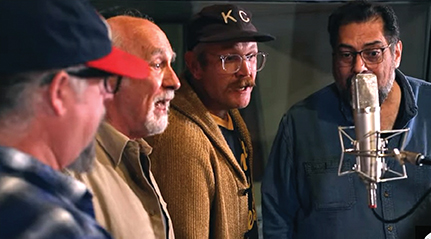
Most of the lead singers were there for five days in December, and the remaining past members joined for five days the following week. “We loved the time, and it’s the fastest we ever made a recording, especially without having any of the arrangements down before we walked in,” Cahill said.
“It was a very creative and fun experience, and I was so glad to be involved,” Chris Jones said. “It was fascinating to observe and participate in Alison Brown’s production and arrangement process in the studio.”
Jones helped out on a couple of songs. “I sang on the Monkees’ song that opens the album, “What Am I Doing Hangin’ ‘Round,” which was really fun, and my first time singing with Greg Blake. It’s a song that was done by the Seldom Scene, but we went back to the Monkees’ original for a different approach. I loved Alison’s arrangement of the song. I was also on the sentimental album closer, “I Wish We Had Our Time Again,” which featured a little bit of everybody. A special part of that for me was singing with Dallas Wayne in the studio for the first time ever, after being friends for many years and longtime fellow DJs on SiriusXM.”
Robbie Fulks joined the sessions with the main band, along with Josh Williams and Ashby Frank. “A high point for me was on that song, ‘I’ve Been All Around This World,’ where Josh is playing guitar, Ashby’s playing guitar, Greg Blake is playing guitar, and I’m playing a little guitar,” Fulks remembers. “That was like floating on a pleasant Mediterranean Sea or something. The feel of that was something I don’t get to experience that often and never have experienced in that form.”
Cahill says the band had already laid down their ten songs scheduled for the project when his producer spontaneously came up with the idea to have Fulks record the Roger Miller classic, “King of the Road.”
“To me, Robbie Fulks is like a modern-day Roger Miller,” Alison says. “The first day we had Robbie in the studio our plan was to record ‘Like a Train.’ But I woke up that morning with ‘King of the Road’ in my head and listened to it a few times before I headed to the studio. I really wanted to hear Robbie sing it and the band play it in bluegrass-style, but I also wanted it to be very spontaneous. So when we all got together at the studio, we decided that if we had extra time that day we’d just go for it. It only took a couple of takes to get the track and Robbie sang it live as the track went down. It was an ‘instant grat’ track in the best sense of the expression.”
“They threw it at me because I do have a Roger thing going on in my music,” Fulks said. “I’m always happy to sing a Roger Miller song. I do it in my sleep.”
“He went into the recording booth and sang it maybe twice,” Cahill recalls. “The rest of us just sat in back, and we played a little chordal thing here and there and snapped our fingers. My face hurt so hard from smiling through that whole thing! It was just so great. He sang it impeccably.”
Besides the music, when they were in the recording booth, the musicians enjoyed reminiscing. “They’re all legends in the industry, and they’re funny guys,” Faris said. “They’ve got great stories that some of them I’ve never heard from tour days with Greg. It’s really like an extended family where there’s always these secrets unfolding that are just fun and quirky and endearing.”
“The best part about it for me was just that camaraderie,” Williams said. “It’s like you walk into a room with current and ex Special C members, and it’s like you’re walking into your high school class or your family reunion. You love everybody that’s in there, and everybody feels the same way.”
“There was a lot of laughing going on,” Cahill says. “There were stories and stories and stories. It was just great!” An instrumental is featured on every Special Consensus album, and this time Cahill recorded “Red, Red Robin.” “I’ve heard it all my life,” Cahill said. “My mom would play it and sing it. She’d sing it after we took a bath when I was a little kid. She played it on the piano.”
Cahill had wanted to include the song on previous albums, and it took some convincing for his producer to go along with it this time. “She said, ‘Do you really think we can pull that off?’ I said, ‘I do.’ I had kind of a different concept of how to do it. So, she went home, and she wrote up a tab and said, ‘Here, what do you think of this?’ I was like, ‘Oh my God. It was great!’ Her big thing is to always keep people guessing. So, that’s kind of our joke with Alison. There’s either going to be a bridge written for a song that didn’t have a bridge in it, or there’s going to be a key change, or there’s going to be a change in who’s singing lead on the verse after the other verse. Just to keep people’s attention. There’s always something going on that you can’t take for granted. So, she did a key change with ‘Red, Red Robin,’ and I got to say it’s hard to play. But we had a great time again.”
Cahill and Brown played twin banjos while Ashby Frank and Brian McCarty played twin mandolins on the tune. All six singers joined with Cahill’s current band on the John Hartford song, “I Wish We Had Our Time Again.” “We all did the Monday Night Football thing on ‘I Wish We Had Our Time Again,’” Dallas Wayne says. “I really enjoy how that song got crafted just to do like a round at the end. Everybody tried to keep a straight face, and it was just too hard to keep from laughing. We’re all gathered around the microphone, trying to figure out where exactly we come in on the 5th and 6th time around. It just turned into a great musical moment for me.”
But it was also a sentimental moment for Cahill, who has witnessed a lifetime of musical moments with close to 50 musicians passing through his band since its inception.
Oh me-oh my, how the years do fly
It makes no difference, and we all know why
It’s all about friends in the by and by
And I wish we had our time again
“I was kind of half in tears when we were doing it, and I still get choked up [when I sing it],” Cahill says. It meant a lot that all those guys came back.”
Just One More Year
Cahill has enjoyed a treasure trove of special memories through his 50 years, but there was a time about midway through his musical journey when he thought about calling it quits. His parents had always been supportive of his career choice, but as an accountant, Cahill’s dad filed his son’s taxes each year. He knew all too well his son’s financial struggles, even after 20 years of hard work with the band. So, he tried several times to encourage his son to think about a career change. “Let’s just see. One more year—that was my mantra,” Cahill recalls.
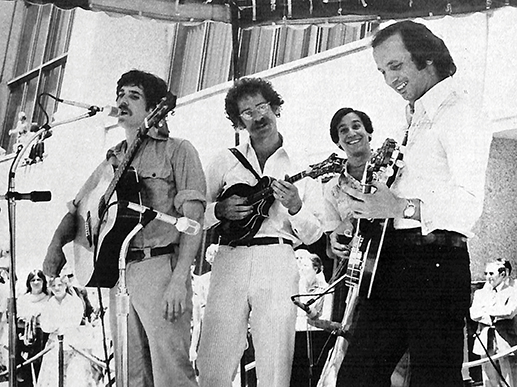
But in 1994, Greg agreed reluctantly and told his dad over lunch that he probably needed to throw in the towel. “And he said, ‘You know what? Just give it one more year. Just give it one.’ And I was like, ‘Oh, my God. Did you say those words?’ The next week, I was on the road in Lincoln, Nebraska, and he died of a brain aneurysm. Those are the last words that I heard from him. It was like, ‘Oh, well, that’s it. I’m not even going to think about not doing this anymore. That was a really powerful thing for me.’”
Thirty-one years have passed, and Greg is still going strong. Since teaming with Compass Records, Special Consensus has garnered even more support from the music industry. The band now has two Grammy nominations to its credit and eight IMBA awards. Greg is a recipient of the IBMA Distinguished Achievement Award and an inductee into the Society for the Preservation of Bluegrass Music in America (SPBGMA) Hall of Greats.
Cahill credits his producer and record head Brown for the band’s recent successes. They first teamed together for a ‘best of’ release for the label in 2010.
“We’ve been working together for 15 years!” Brown says. “I’ve been a Greg Cahill fan for much longer than that and had the honor of serving on the IBMA board when he was President. I really admired his leadership style in addition to his banjo playing and when I found out that Special C hadn’t received any IBMA awards I really wanted to try to help the band get that recognition. So, I set about trying to help ‘design the outcome’ – thinking strategically about material and collaborations that would help the band hit that mark. Over the course of the seven albums I’ve produced for Special C, it’s been incredibly rewarding to see them pick up two Grammy nominations and eight IBMA awards.”
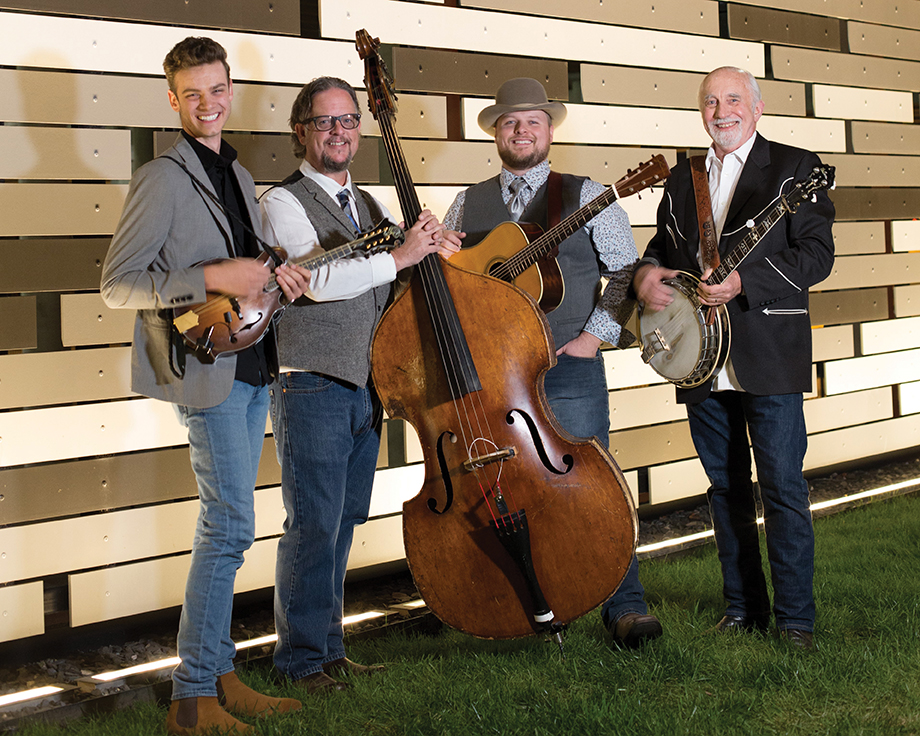
Cahill’s one-of-a-kind banjo style fuses with his latest band line-up. The 2023 IMBA Male Vocalist of the Year, Greg Blake from West Virginia, has been with the band for four years. “He’s one of the top male vocalists … and a great guitar player too,” Cahill says. Brian McCarty from Kansas City, Missouri, sings tenor and plays mandolin. “He’s so tasteful!” Cahill says. “He doesn’t do a lot of wild and crazy stuff. When you sit there and listen to him play, it’s perfect fruit for the song.” Lastly, Dan Eubanks from St. Louis, Missouri, is the band’s bassist. “He’ll play a fiddle tune note for note, just picking the strings. He doesn’t bow with that. He can bow, but I mean, he plays just as if it’s a fiddle under his chin, and he’s standing there playing the bigger acoustic bass note for note. He’s a phenomenal player.”
Greg remains a grateful and modest man. He’s thankful to the musicians and support staff through the years that have kept Special C moving forward, and to his wife and family for being supportive and understanding when he missed some of the special moments in their lives. But there are also numerous musicians and fans who are grateful to Cahill and Special Consensus. As a band leader, he has helped many musicians grow and develop. He has blessed faithful followers who have soaked in the rich musical sounds Special C has produced over the years. For half a century, Greg Cahill has created a legacy of music. One more year!
The Special Consensus Family
Greg Cahill has given many a leg up to young musicians who passed through his band since 1975. They created beautiful music, lasting memories, and cherished friendships.
Dallas Wayne
Membership Years: May 1988-1992
Special C Memory: Robbie Fulks was the guitar player in the band. We were playing in Ohio somewhere, where there was a reflective pool out front. Robbie was notorious for stage diving at the end of the set. Robbie stage dived into that pool. Luckily, he set his guitar down before he jumped into the pool. We were scared he was going to break his neck. It wasn’t very deep, but luckily, he survived that. He came back up on stage, and he’s sitting there dripping.
On Greg Cahill: “Greg Cahill is the only musician I’ve known to offer health insurance. Back in the 80s, that was a big thing for me. It was just how he planned to take care of his people. He was always a great boss.”
Robbie Fulks
Membership Years: mid-1987 to January 1990
Special C Memory: Greg and Tim were almost a generation older than me. So, I had a different point of view on music than they did, I would say, and I tried to push them in my direction, heedless of the fact that they’d been a band for more than a decade before I joined up and heedless of the fact that they were my elders and probably knew more than I did. I think the attitude that I had brought something fresh to the band. It feels a little bit awkward looking back at how I aggressively inserted myself into their thing. I mean, the punk rock thing of jumping off the stage and insulting the audience. It wasn’t really classic Special Consensus vibe.
On Greg: We’re still friends. I think we actually appreciate each other more than ever now that we’ve been through the fire and out of it. I’m always grateful to Greg for letting me into his band … showing me the ropes and teaching me how it’s done because I used that to my advantage when I got out of there.
Rick Faris
Membership Years: December 2009-January 2021
Special C. Memory: We showed up to a festival in Pennsylvania and he had to use the PortaJohn after the long drive. After he got settled in there I moved the Sprinter Van right next to the door keeping him in there. When we finally let him out, he came out laughing and beet red showing us the bird while we filmed the whole thing. I think it was his birthday that weekend.
On Greg: It was some of the best years of my life, and I learned so much from him, so much of who I am as a musician, but also what I’m capable of because of them. He just stays so young, and I don’t mean that in a demeaning way. He’s got youth about him. He’s always willing to pick, always willing to have fun. He’s always going to be that guy out there jamming ‘til 3:00 or 4:00 in the morning.
Josh Williams
Membership Years: January 1999-December 2003
Special C. Memory: I got to meet Greg when I was an aspiring banjo player as a kid. I was somewhere between 10 and 11 years old, and we had met at a little festival in Salem, Illinois. I got to be buddies with him even then because he knew so much banjo, and we got to pick.
I remember when he had Andrea Roberts in the band, and Colby Maddox, the mandolin player at the time, was leaving the band. She told Greg, “We should call Josh and get him in the band.” Greg’s first response was, “What are you trying to say? I’m the banjo player. She said, “No, he plays mandolin great!” He said, “Oh well, let’s try it out.”
On Greg: Greg Cahill is the best, and I’m glad to see him getting the recognition that he has deserved for many years. The man is unstoppable. He just won’t quit. Can you imagine trying to run a single bluegrass band for 50 years? I can’t! God bless him.
Greg has, for 50 years, made a living, but not just that, he made sure that every other person in his band has made a living. That’s absolutely amazing because I know a lot of guys that are out there that are really only concerned with the living that they’re making and not so much the guys that they have traveling with them. So, that speaks a lot to his character alone.
Out of all the people that I could have started with, I had the absolute best teacher. I learned the value of hard work. I learned the value of how you treat people. You show respect, and you always conduct yourself in a manner as if you’re representing the band 24-7. Those are the things that I still carry with me to this day. He’s a true gentleman in every sense of the word.
Chris Jones
Membership Years: 1981-1985
Special C. Memory: I have fond memories of our long-running weekly Monday night gig at a north side club called Minstrel’s, and some of the characters who were regulars there. One night after 2:00 a.m., a famous Chicago voiceover artist, Ken Nordine (known for his Word Jazz albums), showed up and sat in with us. I think we played “Carter’s Blues” while he improvised his monologue.
I have great memories with the band, too. In those days, we played for weeks at a time in Austin, TX, where we met people and musicians who are friends to this day. One of those people was Marshall Wilborn, who I ended up playing with off and on in three different bands through the years.
On Greg: 50 years is such a momentous milestone that I wouldn’t have missed a chance to be involved. The band was a very important formative time for me—my first full-time music job—and Greg Cahill is a really important person and mentor in my life. He’s accomplished so much, and I think all of us who were in on the recording felt proud of him and were grateful for the bond we all have through him.