Songs Move Mountains
Louisa Branscomb Marks 36 Years of Songwriting retreats
March 2025 marked the 36th consecutive year of songwriting workshops, usually twice a year, hosted by veteran songwriter Louisa Branscomb. Louisa founded Woodsong Farm Songwriting Retreats in 1989, at her farm in Georgia, and continued to hold 2 to 4 retreats a year for the next 30 years. She relocated to Asheville just in time for the pandemic, when she pivoted and hosted remotely, continuing to expand her own community as well as collaborate with such prominent organizations as Northern Bluegrass Circle in Canada.
When she moved to Asheville, North Carolina, Branscomb bought a farm in Black Mountain for which she renamed the workshops—Lyric Mountain—and continued the tradition. The most recent gathering was held at the historic Monte Vista Hotel in Black Mountain, with communal dinners, writer rounds, and a showcase held at the farm on Friday night. At that four-day workshop, attendees included returning workshop participants and first-timers, experienced and aspiring songwriters. This blend has been part of the chemistry that has kept Woodsong/Lyric Mountain so vital and fresh for all these years. With a 36-year tradition, Woodsong has nurtured 1200 attendees, which, counting returnees, has yielded an ongoing songwriter community of some 600 writers, many of them going on to teach and mentor themselves.
A successful songwriter since the early 1970s, Branscomb has two Grammys, and over 325 of her songs have been recorded. She says she learned a lot about successful songwriting as a performer, paying close attention to her audiences, and noting what resonated and what did not. While she evolved her songwriting approach on her own, she felt strongly that in a carefully curated environment, she could guide others to develop their songwriting practices.
Branscomb started songwriting at a young age, composing songs as early as age five for the pure joy of writing. Entering into a fantasy world to tell the stories about life around her made life an intimate, charmed experience for her. “Not all songs were happy,” she notes. “They also gave me a sanctuary from hardship I felt, or saw in others around me.” By the time she left college, she had 450 songs typed up, numbered, and categorized, but she had never talked to anyone about songwriting. She says she didn’t have any commercial goals; she wrote for the joy of the art, the fun of bringing people together to jam and sing, and the challenge of reaching others through stage performance.
A champion of the arts in general, Branscomb believes in the joy of approaching an act with creative intent, whether a conversation, a painting, a piece of pottery, or working in the garden, bringing one’s self to form and meaning. As a shy child, she approached everything she did, she says, with a little more introspection, as a safe way to have rich relationships and translate life into stories.
“When I was little, I loved having the hero, usually a girl, ride off into the sunset,” she says, “But when I got older, I realized happiness doesn’t sell as well as pathos. But truthfully, people hear music from wherever they are standing, so what is most important is the songwriter finding the deepest truth in the moment. If you go deep enough, you go through the rabbit hole to the universal, and that is the magic that is universal connection.”

While she also painted and wrote poetry, songwriting was the most natural form of expression for her. In her college years, she continued to write—folk songs, country songs, and songs not bound by genres, and after college, she co-founded possibly the first all-female band, Bluegrass Liberation (1972), playing guitar. She then co-founded the heavily touring band NC Boot Hill, playing banjo. “At 24, I was on top of the world. We played up to 200 gigs a year and recorded 3 successful albums,” she says. “Not many bands were doing their own songs, so that distinguished us. It evolved naturally, and suddenly I was being affirmed as a songwriter without trying to.” People hearing her songs began asking to record them.
In 1971, the McPeak Brothers recorded her song “Steel Rails.” Branscomb remembers the joy of hearing her song on a record. “They gave it the voice,” she said. “Their harmony and soul worked with the soul of the song and was pure honey to hear. I can’t think of any greater reason to be on earth. If the songwriter has captured something that touches other people’s soul, well, there you have it.”
One big turning point came when Louisa was 21 and her songs were brought to the attention of Mel Tillis, who published five of her songs and planned to release “Steel Rails” himself. He told her, “Nashville needs a woman who can write like this,” one a little further along than traditional country music. “You write country and bluegrass at the same time, like Dolly does,” he told her. But having “fallen in love with the banjo,” Louisa remained loyal to her touring band.
At the time, she says, “I’d been writing and recording for 15 years, but I had never spoken to anyone about the process. We didn’t have workshops or mentorships; IBMA began 10 years later. I was watching music as a songwriter, and I lived in the songs I heard in bluegrass, country, and folk. I was interested in how songs work, how they reach people. I began leaving the loner kid writing songs in the woods, and venturing into the idea of songs to build community. I thought, ‘Wouldn’t it be great, since songwriting is a language, to make it a more conscious process and learn from each other? What if we could use songwriting as a language to bring people together?’”
This inspired the first Woodsong Songwriting Retreat in 1989 at Louisa’s 124-acre farm near her Atlanta home. She considered the farm a living sanctuary for “soul time and creativity,” amid the 150-year-old cotton fields, horses, and forests. She learned the importance of a meditative state in artistry. Sunset time bush hogging on her John Deere tractor inspired as well.

Her goal for the workshops from the beginning, Branscomb says, was to bring people together in a carefully hewn environment of beauty and creative safety. She wanted to facilitate and empower others to find their own artistic voices. That first year, about a dozen participants came from nearby Atlanta. She had been performing there, with her band, and occasionally sitting in with the Indigo Girls, where she once performed her own songs at the historic Fox Theater.
Another quantum leap came in 1991 when Alison Krauss recorded “Steel Rails,” which she had heard on a Boot Hill album. This was, says Branscomb, “one of the most powerful affirming experiences in my life—when I accidentally stopped in at the Station Inn and Alison and Union Station performed ‘Steel Rails’ for me. I was the last to know.”
At that time, she had just started her workshops and told herself, “I’ve had more fortune than most songwriters have in a lifetime.” After waking from the shock of the news, she said to herself, “What do you do when you’ve been this lucky? You pay it forward.” The choice was simple.
Over the years, Branscomb has honed her approach, incorporating her training as a humanistic psychologist, with master’s and doctoral degrees in the field. She incorporates principles from learning about trauma and transformation into her workshops, something she says did not exist in songwriting. “My approach at the time was unique as it did address the soul, something other people may have talked about but did not try to create. I called my system ‘Transformational Songwriting.’ I learned from veterans and battered women, and I learned from such iconic thinkers as Joseph Campbell, Carl Jung, and Jean Houston.”
LeaLaine Harris has been coming to the workshops for several years. She had always written as a way to process her thoughts, something she learned her grandmother had done too. While Lea loved music, her sister Katrina Brake was more actively playing in jams and at festivals.
She told Lea, “There’s a songwriter thing and we ought to go. I think you could do something with your writing.”
“When we first signed up, of course, neither of us had done anything like this. We had not ever written songs. We told Louisa, ‘Look we’re not songwriters. I don’t even play an instrument regularly.’” Branscomb assured them, “You’ll be fine. Bring what you’ve written and come.”
Harris admits that she was in a bad place in her life that first time. They had just lost their mother, and she tried to back out, but her sister insisted. She said she spent much of the first workshop listening and taking it all in, but then, she said, “Louisa started talking about the [Hero’s journey] circle, and when she reached the bottom, the “dark night of the soul,” I was definitely in that place and didn’t see a way out of it.”
She said that Branscomb talked about using writing and creativity to come out of it and to make something good of bad experiences. That’s when it hit me. That’s what I want to do.” She said she also valued the connections with the other people in the workshops, a different combination each time, with a common interest and so much to share.

“I did get something about learning how to write songs,” she said, “but it helped my soul too: Refresh, reset, come home, and look at everything differently. It helped me mentally and emotionally.”
The Lyric Mountain’s overarching mission and theme is “Songs Move Mountains.” Each workshop also has its own theme relating to the natural environment and songwriting, introduced with Branscomb’s keynote address. Most recently, the workshop had the theme of “Elevation” The facilitators and staff drew from mountaineering, with retreat leaders serving as “sherpas,” and Branscomb helping the writers individually and collectively identify where their work is and how to raise it to the next level.
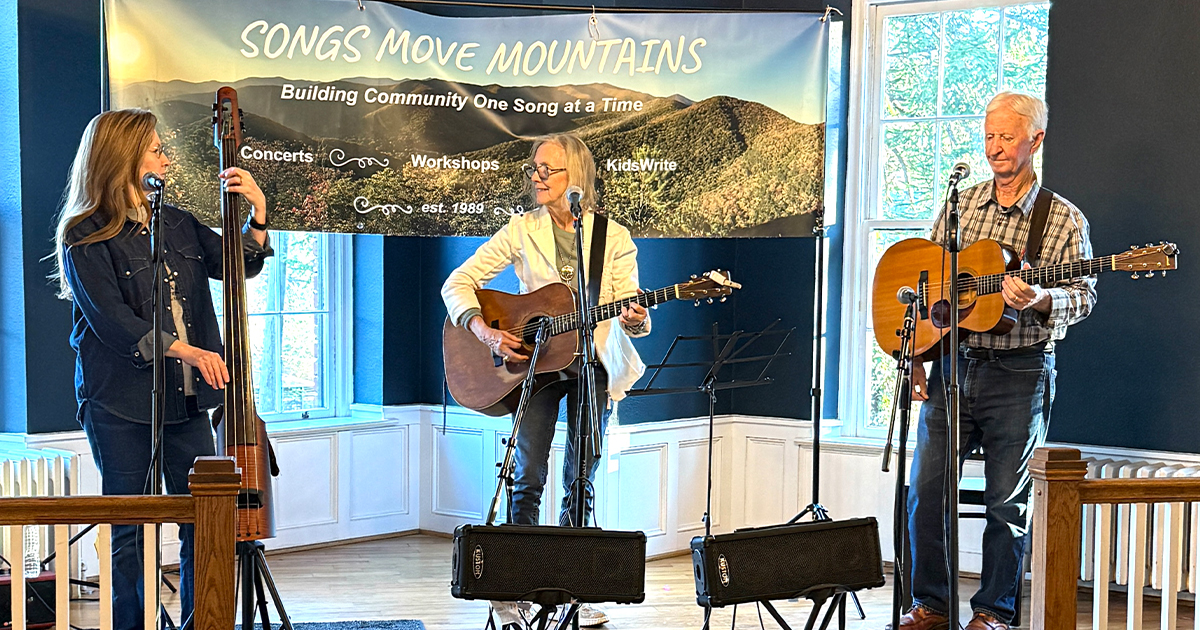
Branscomb has also brought other successful songwriters on staff. Over the years, those have included Claire Lynch, Becky Buller, Wil Maring, Brink Brinkman, and her regular master staff, Jeanette and Johnny Williams. Sometimes performing with Louisa as well, they have been a regular part of the workshop for more than a dozen years.
When Louisa talks about her workshops, the words “connection,” “mentorship,” and “community” continue to surface. Her secondary focus is commercial and business aspects of songwriting, which Louisa says, “you can learn in a book.” She heavily emphasizes craft and form in extensive feedback sessions but only after teaching the “soul work,” as she calls it.
Rather than teaching a prescriptive approach to writing songs, Jeanette noted, Branscomb’s focus on “choice points” is one of the strengths of the approach. Williams explained that instead of pointing out what was good or bad about a participant’s song, Branscomb’s approach is “gentle leading instead of stern…. She will say, ‘Here’s a choice point: You could change that chord right there’ or ‘You could go in this direction.’ It’s always encouraging.”
Johnny added, “I think that’s what makes people keep coming back, too. They get a taste in two or three days. They learn, and then they come back the next year and learn something else.” While the focus of the workshops is not on commercial success, he points out that many of the participants have gone on to write hit songs. He has had the opportunity to produce whole albums for several of the students from the Woodsong and Lyric Mountain workshops. Likewise, Louisa continues personally to mentor many of the Lyric Mountain attendees.
After participating in years of workshops, Jeanette observed that Branscomb keeps each workshop fresh by reading the room. “She has a really keen sense of what people need. She could talk about so many things, so she tailors it. Of course, the keynote is the bones of the workshop, and she does change that with the theme, but she is able to see what people need. She reads the current situation and gets a feel for what the group needs and what they want then gets in tune with that.”
At her heart, Branscomb considers herself a mentor, teaching from the standpoint of relationships and building community. She explains, “As long as I had music as a language since I was too shy to make normal conversation, I decided to commit to being a mentor.” She went about building the Woodsong Farm songwriting retreat with an intention that unfolded early in her career.
As another arm of her mentoring, Branscomb established Screendoor Alliance, a non-profit through which she has conducted writing workshops for veterans, at-risk teens, and in schools, most recently to help students in the areas hit by Hurricane Helene to process their experiences. The organization also provides scholarships for young songwriters and veterans.
Part of that teaching process involves establishing protocol. Early in the workshop, participants engage in warm-up activities, forming bonds and finding that safe space in which to create. At the most recent retreat, everyone was asked to bring hats, which were incorporated into narratives with titles or “hooks.”
Branscomb also establishes ground rules to make the most of the time together. This includes ensuring everyone has a voice so no one monopolizes the discussion. With a bit of humor, she also discourages self-deprecation. Whenever a participant prefaces a song with “Well, this is not very good but…” Branscomb uses humor to move them to a more positive outlook on their creativity.
In a whole group setting, songwriters have the opportunity to present their songs-in-progress for feedback from Branscomb and the songwriters on her staff. This approach gives all the participants a chance to hear the advice they can incorporate into their songs. Breakout groups, in which the participants can engage in more intimate circles, giving feedback to one another, have also become a favorite aspect of the workshops, and later became her model for the song circles at the World of Bluegrass sponsored by the IBMA songwriting committee, whose founding Branscomb spearheaded.
Often, those relationships continue long after the closing day. One group, primarily based in Canada, met during a Zoom workshop during COVID. They have continued to meet weekly in the years that followed. Other participants have gone on to co-write with fellow songwriters they met during the workshops.
“To me,” says Branscomb, “songwriting is a form of prayer. It starts with an attitude of prayer and meditation. For many people, that happens in nature and the farm is like a sanctuary. We have created a society where you have to wear defensive armor to get through the day. The retreat model helps you shed your masks.”
Branscomb believes the essence of the creative act is not found in offices and Music City studios. “What if, to find our essence, we move back in time when we lived as people connected to nature with the beauty around us?” she asked. “We are animals. We belong in nature. We evolved in relation to nature. That is why so many songs have nature metaphors. Nature has every lesson in it we need—life and death, holding on, coming back, and resilience. Nature reflects what is most deep and important in our lives.
She doesn’t just talk about the concept in workshops; she sets the physical stage. “I mow the fields, and we are outside a lot [during the retreat]. People naturally feel they shed stress and busyness. I add boundaries to create a sacred space. I don’t use a lot of fancy terminology. I just do it.”
The Georgia farm was the setting for the first 30 years of Woodsong retreats and, she says, “The mountains will be the second thirty years—” joking that she will be well over 100 if that works out.
Branscomb points out that, like a church, the farm has many “soul connections.” Her song “Walking Each Other Home,” building on the Ram Dass proverb was inspired by a scene of workshop participants walking down the hill, in small groups, after sitting up on the hill near the music barn. Her farm experienced a great deal of destruction when it took a devastating hit from a tornado in 2011. Ironically, she had just written the song “This Side of Heaven,” about the loss of a barn to a storm, which includes the lyrics:
This side of heaven there is heartache’
This side of heaven there is pain.
Sometimes you just can’t see the rainbow for the rain.
So if heaven sends down lightning and burns your building down,
There’s just more room to see the stars in heaven’s crown.
In her North Carolina farmhouse, she has a hand-hewn sign she brought from the Georgia farm that reads “This side of heaven.” Nothing sums up the workshop experience better.
What is the next chapter? “I don’t see an endpoint,” says Branscomb. “Writing more and more effective songs is like keeping your eye on a vanishing point. I don’t want to arrive; I just want to stay on the train.”
The train imagery evokes the reason Alison Krauss told Louisa that “Steel Rails” captured her attention: “I loved that line, ‘winding through the trees like a ribbon in the wind.’” And it is no surprise that these classic lyrics capture Louisa’s visionary soul as well:
I don’t mind not knowing what lies down the track,
‘cause I’m looking up ahead to keep my mind from turning back.
Share this article
1 Comment
Leave a Comment Cancel Reply
This site uses Akismet to reduce spam. Learn how your comment data is processed.

A wonderful article about a brilliant writer, teacher and mentor. Songs do, in fact, move mountains and Louisa knows how to help others unlock the door that leads to the mountain-moving magic.