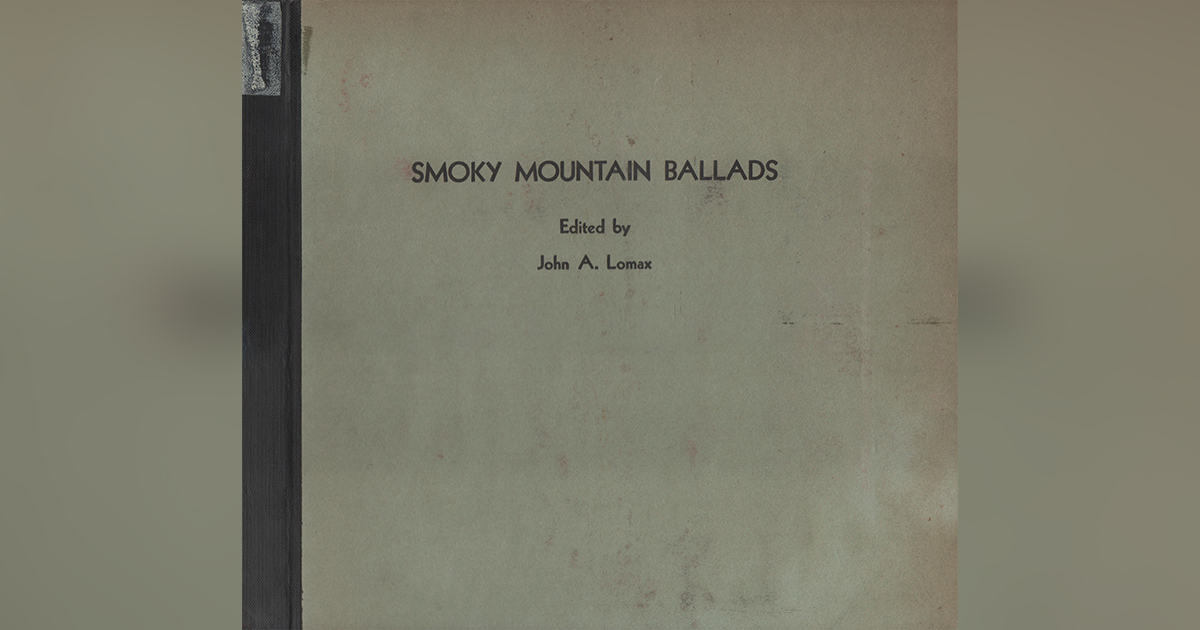
Smoky Mountain Ballads
For many new adherents to folk music in the early 1950s, one of THE go-to collections was the Anthology of American Folk Music that was assembled by Harry Smith. The 80-track set, complete with a well-annotated booklet, served as a roots music primer for a generation of folk music enthusiasts. Less well known, and perhaps a little less lavishly produced, was a 1941 album that was released by Victor Records. It was called Smoky Mountain Ballads and was, in the best sense of the word, an album. It consisted of 10 songs that were pressed up on five 10” 78-rpm discs, each of which was housed in its own sleeve as part of a bound “album,” very much like a photo album.
Performers and songs making up the collection include: 1. Wade Mainer – Zeke Morris – Steve Ledford, “Riding On That Train Forty-Five;” 2. Monroe Brothers, “Darling Corey;” 3. The Carter Family, “The East Virginia Blues;” 4. Uncle Dave Macon, “Cumberland Mountain Deer Race;” 5. Dixon Brothers, “Intoxicated Rat;” 6. Arthur Smith Trio, “Chittlin’ Cookin’ Time In Cheatham County;” 7. J.E. Mainer’s Mountaineers, “On A Cold Winter Night;” 8. Gid Tanner & His Skillet Lickers, “Ida Red;” 9. The Carter Family, “Worried Man Blues;” and 10. Wade Mainer – Zeke Morris, “Down In The Willow.”
Smoky Mountain Ballads was curated by folklorist John A. Lomax. In addition to selecting the tracks from the massive Victor catalog of old-time songs and tunes, he also drafted an insert that gave context to the music and overviews of the performers and selections. The March 1942 edition of the Southern Folklore Quarterly seemed mildly dismissive of the set by characterizing it as “Re-pressings of out-of-print commercial recordings of hill-billy bands and singers.” In the end, however, it was opined that the collection was “More important as examples of instrumental folk music than the contents of most folksong albums.”
In contrast to old-time music releases of the 1920s and ‘30s that were marketed to a mostly Southeastern audience, Smoky Mountain Ballads was pitched to a nationwide audience. Reviews from across the country were an interesting mixed lot. Baltimore’s The Evening Sun told its readers that “You’ll like them because they are plain, unadorned She’ll-Be-Coming-Round-the-Mountain type of hillbilly ballads, every one of them tuneful and buoyant, even the sentimentally sad ones. They are recorded in their native state by appropriately nasal-voiced mountaineers, completely unspoiled by the fancy devices of the studio.” One has to wonder what sort of “fancy devices” were available to recording studios in 1941.
A syndicated review called “The World of Music” by Louis F. Keemle appeared in well over a dozen papers including those in New York City; Roanoke, Virginia; Spokane, Washington; Oshkosh, Wisconsin; South Bend, Indiana; and even Vancouver, British Columbia. Keemle observed that “Of the current recordings, the most refreshing is Victor’s album of ‘Smoky Mountain Ballads,’ edited by John A. Lomax and presented on five, 10-inch records. It is authentic Americana of the first order. Lomax is an authority on the subject and estimates that he has traveled more than 300,000 miles in his folklore research. Pieces like ‘Chittlin’ Cookin’ Time in Cheatham County,’ to name only one of the 10 selections, are priceless. They breathe a fresh spontaneity which is a welcome relief from more formal music.”
Fredson Bowers of the Richmond Times-Dispatch reminded us that debates about the authenticity of the music have raged for decades. Nearly 85 years ago, he wrote that “The subject of what is a folk song is always sure to provoke an argument, and purists will object to the name of folksong given to ‘Smoky Mountain Ballads’ . . . let us more kindly say, [they] are folk song in the making.”
A number of reviewers gave only a cursory glance to Lomax’s write-up about the collection (again, assembled from 1930s studio recordings in the RCA vault) which led to some inaccuracies. One paper from Duluth, Minnesota, wrote that Lomax has “made available 10 of the best songs he collected in a tour of the North Carolina and Tennessee mountains, sung in traditional style by hillbilly performers.” Bruno David Ussher, writing in the Metropolitan Pasadena Star-News, advanced the notion that John Lomax had “gathered [these songs] in Bosque County of his home state of Texas.” Paul Affelder of the Richmond News Leader waxed poetic that “If you like authentic hillbilly music, you’ll go for this album in a big way. . . the performances are all by the mountaineers themselves. This is not the terrible commercial hillbilly music that one hears over the air; it is the real, unspoiled music of the mountain folk.”
It’s impossible to say today just how much influence Smoky Mountain Ballads had on bluegrass. But, it’s worth noting that ALL of the songs in the collection have been covered at one time or another by a variety of bluegrass artists. A few examples are “Darling Corey” (Seldom Scene, Country Gazette, and Earl Taylor); “East Virginia Blues” (Stanley Brothers, Country Gentlemen, Red Cravens & the Bray Brothers); “Intoxicated Rat” (Doc Watson, Hylo Brown, and Bill Clifton); and “On a Cold Winter Night” (aka “Wreck of the Number Nine” – Doc Watson, Jim & Jesse, and the Stoneman Family).
In 1964, RCA Victor issued the package as a 12” long-play album with six additional tracks. As the original package had done nearly a quarter century earlier, it opened up a world of old-time music to new generations of roots music enthusiasts.
Over Jordan
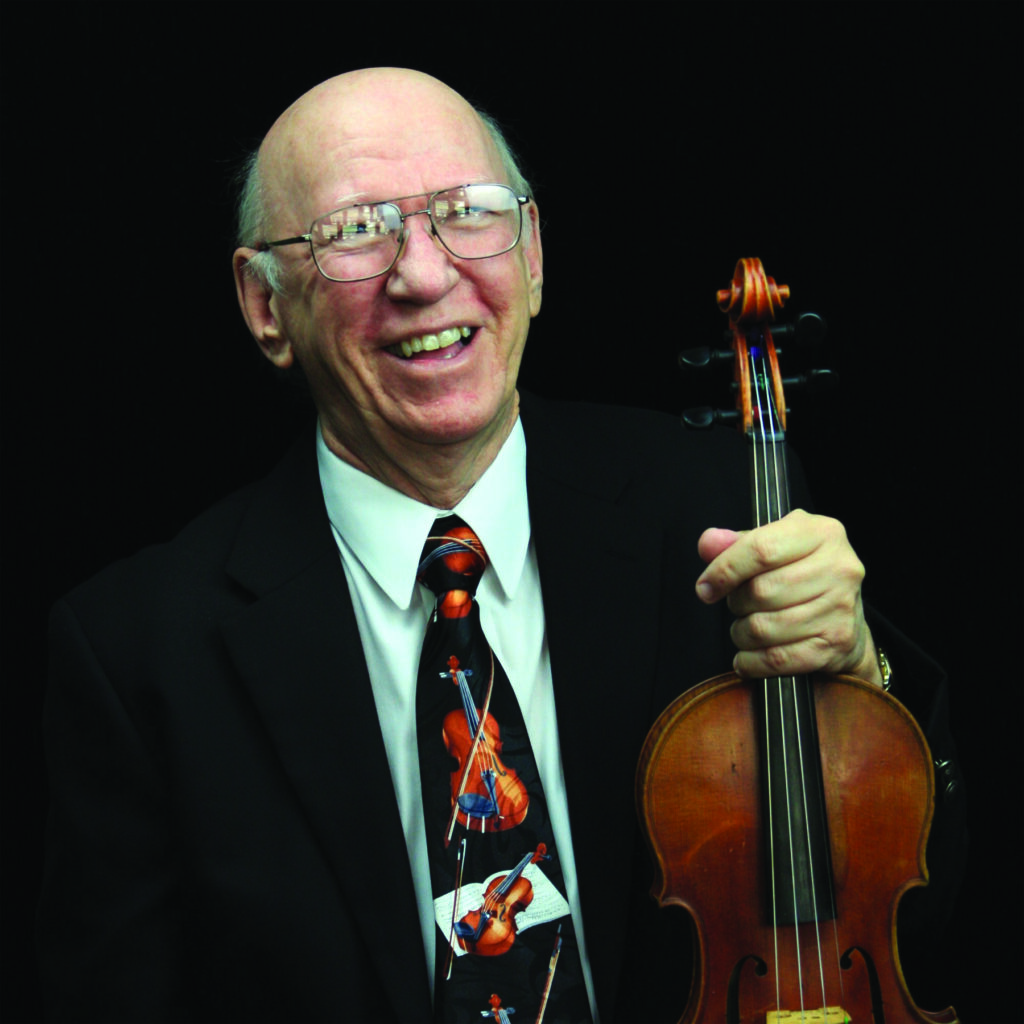
Buddy Mason Griffin (September 22, 1948 – February 2, 2025) was a multi-instrumentalist who, over a 50+ year career, performed with many of the top names in bluegrass, at times fronted his own band, and developed a four-year-degree program in bluegrass at West Virginia’s Glenville State College. He also appeared on numerous recordings as a sideman/guest musician.
Although born in Richwood, West Virginia, Griffin spent his formative years in nearby Summersville. He was raised in a musical family that played Carter Family-style music. In 1977, he told the Cincinnati Post that “If you were old enough to hold an instrument, you were expected to play it. Otherwise, you were a black sheep.” He considered this early exposure as being critical to his authenticity as a bluegrass player. He related that “You have to grow up in the country to play bluegrass. It’s the exceptional bluegrass musician who can give the music the feeling it’s supposed to have without coming from there.”
Griffin’s musical journey started with the Griffin Family, performing at local events and dances. They gained popularity and appeared on various radio programs in Oak Hill, Sutton, Richwood, and Weston, West Virginia. In April 1963, the group made its television debut on WOAY-TV in Oak Hill, West Virginia, and by June 1964, they were semi-regulars on the Buddy Starcher Show on WCHS-TV in Charleston.
In the mid-1960s, Griffin joined the Sunny Valley Boys, further honing his skills as a fiddler and banjo player. During his high school years, he taught string music in elementary schools and decided to pursue a career in teaching. He attended Glenville State College where he graduated in August 1971. While teaching, he continued to play music with his family and another group called The Heckels.
Griffin’s talent was recognized when he won both the West Virginia State fiddle and banjo contests in October 1973. In April 1975, he joined the Goins Brothers, contributing to several albums, including Live! at McClure, On the Way Home, Take This Hammer, and Wandering Soul. He also helped bluegrass legend Curley Lambert record the album Bluegrass Evergreen.
Throughout the mid to late 1970s, Griffin worked with the Katie Laur Band in Cincinnati and did session work with notable artists like Earl Taylor and Mac Wiseman. In 1979, he returned to teaching but continued to play music on the side. He appeared with the Griffin Family in the Carter Family documentary Keep on the Sunny Side and on the radio show Prairie Home Companion. He also served as the director at Camp Washington Carver in Fayette County, West Virginia, for the State’s Department of Culture and History.
Griffin’s career took him to Branson, Missouri, where he performed as part of Albert Brumley, Jr.’s daytime show and was a band member at the Ozark Mountain Hoedown in Eureka Springs, Arkansas. Still, he found time to appear with Katie Laur at the Kennedy Center and, again, on Prairie Home Companion.
In July 1997, Griffin joined Jim & Jesse, appearing on their Our Kind of Country CD. By August 1997, he became a part-time string music instructor at Glenville State College. His dedication to bluegrass education led to the development of the nation’s first full-fledged four-year-degree program in bluegrass at Glenville State College. In 2002, the college introduced a Bluegrass Music Certificate Program, followed by a bachelor of arts degree in 2003. Griffin also formed the Glenville State College Bluegrass Band in 2003.
Griffin’s contributions to bluegrass music extended to the film industry, where he added banjo to the Disney film The Fox and The Hound 2 in 2004.
Griffin’s lifetime of dedication to bluegrass received notice from several organizations in his home state of West Virginia. In 2011, the West Virginia Department of Arts, Culture & History bestowed the state’s highest folklife honor, the Vandalia Award, to Griffin in a ceremony that was held on the stage of the Cultural Center theater in Charleston. In 2023, the West Virginia Music Hall of Fame inducted Griffin as one of “many important musicians who have helped shape the rich spectrum of American music.”
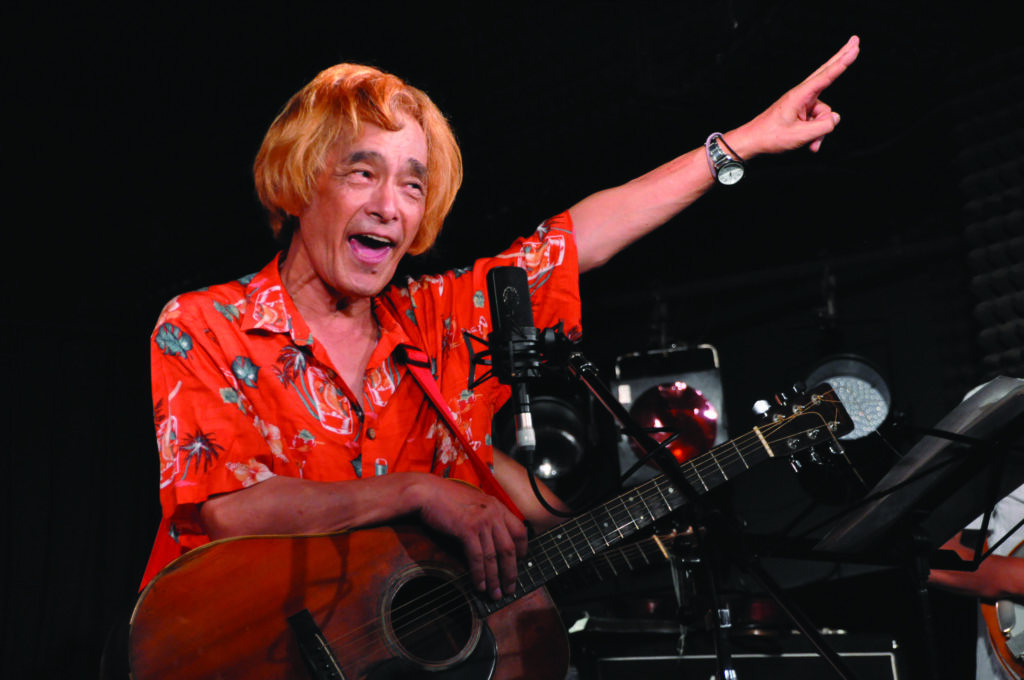
Tsuyoshi “Josh” Otsuka (July 26, 1944 – January 26, 2025) was a mainstay of Japanese bluegrass for well over fifty years. He is best known as a co-founder, guitarist, and frontman for the group Bluegrass 45; he also maintained another long-running group called Leaves of Grass.
Otsuka began his musical training early in life by taking violin lessons as a child. But it was while in high school that his attention began to shift towards country and bluegrass music. A recording of Grandpa Jones, which an older brother, Yutaka, had bought, whetted Otsuka’s interest in the music and was reinforced with additional bluegrass albums that were then available in Japan. Soon afterward, Otsuka began learning to play guitar, mandolin, and banjo.
Otsuka’s first performance experience was in the early 1960s as a member of Yutaka’s group, the Bluegrass Ramblers. Through various personnel changes, the group lasted for fifteen years. Among Otsuka’s early influences were the Country Gentlemen and the Stanley Brothers. Not surprisingly, the guitar work of Charlie Waller and Carter Stanley made an impression on him.
Otsuka’s stint with Yutaka’s Bluegrass Ramblers was pretty short. In 1964, he entered Kobe University and, during his sophomore year, formed a Pop Music Club there and became the first president. He also formed the Bluegrass Travelers with which he played the instrument that was his real love, the banjo.
The Bluegrass 45 got its start in 1967 when several Japanese musicians gathered at a venue in Kobe called Lost City. Realizing a shared love of bluegrass, the pickers united to form a group. The band went through several name changes before finally arriving at Bluegrass 45. Original members included Josh Otsuka and his younger brother Akira, brothers Toshio and Saburo Watanabe, and two Chinese musicians: Hsueh-Cheng Liao and Chien-Hua Lee.
With Sab Watanabe handling the banjo chores in Bluegrass 45, Josh switched to guitar and lead vocals. However, his passion for the 5-string remained strong and pickers such as Earl Scruggs and Eddie Adcock were at the top of his list. He even undertook the process of transcribing banjo tablature for the Flatt & Scruggs album Foggy Mountain Banjo. And, even though he wasn’t playing banjo in Bluegrass 45, he devised banjo arrangements for tunes such as “Turkish March,” “Take Five,” and “Foggy Mountain Breakdown (in Eb).”
In 1969, Josh and his bandmates could hardly have imagined the longevity of the music career that lay ahead of them. With four members slated to graduate from college the following spring (and ostensibly obtaining music-restricting day jobs), the group decided to finance and record an album as a keepsake of their time together. Only 210 copies of the album, called Run Mountain, were pressed. County Sales mail order chief Dave Freeman called it “the best non-American bluegrass album that has been issued anywhere so far.”
The discovery of the Bluegrass 45 by Rebel Records owner Dick Freeland led to a successful tour of the United States in the summer of 1971. From June through September, the group appeared on a half dozen bluegrass festivals, appeared on the Grand Ole Opry, was filmed on stage as part of a film that was released a short time later called Bluegrass Country Soul, and recorded two albums – one of which was produced by John Duffey – for Rebel Records. Otsuka’s work as an arranger was demonstrated on such pieces as Mozart’s “Turkish March,” an old Japanese tune “Sakura,” and with unusual rhythm patterns in “Take Five,” and “Unsquare Dance.”
Other highlights from the 1971 tour included the opportunity to perform on country music package shows that were staged by legendary promoter Carlton Haney. One event in particular was a tour that was headlined by Conway Twitty and Loretta Lynn. In Richmond, Virginia, Josh and the Bluegrass 45 performed between sets by Twitty and Merle Haggard! Later that same day, the group served as the opening act for Jerry Lee Lewis at a concert in Alexandria, Virginia.
From the middle 1960s through the early 1970s, Otsuka attended Kobe University where he worked towards a degree in Business Administration. It was near the end of studies that he and the Bluegrass 45 – with three new members – made a return trip to the United States. As before, the group appeared at numerous bluegrass festivals and recorded masters for two more albums (only one of which was released). Upon his return to Japan, Otsuka formed another group called Leaves of Grass. It remained active in Japan for many years and was oftentimes the closing act of the long-running Takarazuka bluegrass festival.
The Bluegrass 45 enjoyed celebrating important milestones in the group’s career. The year 1996 was witness to the band’s return to the United States for a tour that commemorated 25 years since the group’s first tour there. Performances were also scheduled in Japan. The occasion was marked with the release of a compact disc called Once Again, From Kobe, Japan, and with the production of a film entitled That’s The Time. A 45th-anniversary tour in 2012 set the scene for an appearance at the Wintergrass Festival in Belleview, Washington, as well as nine shows in 12 days in Japan. Lastly, 2017 landed the group back in the United States where it recognized its 50th anniversary.
As much as Otsuka enjoyed performing bluegrass music for others, he also enjoyed giving back. His university’s Bluegrass Club, which has been in existence for more than 50 years, boasted a pre-covid membership of more than 100 active members. Josh was a frequent visitor at the organization’s clubhouse and donated his time in teaching students to play bluegrass. He also lent support by attending many of the club’s concerts.
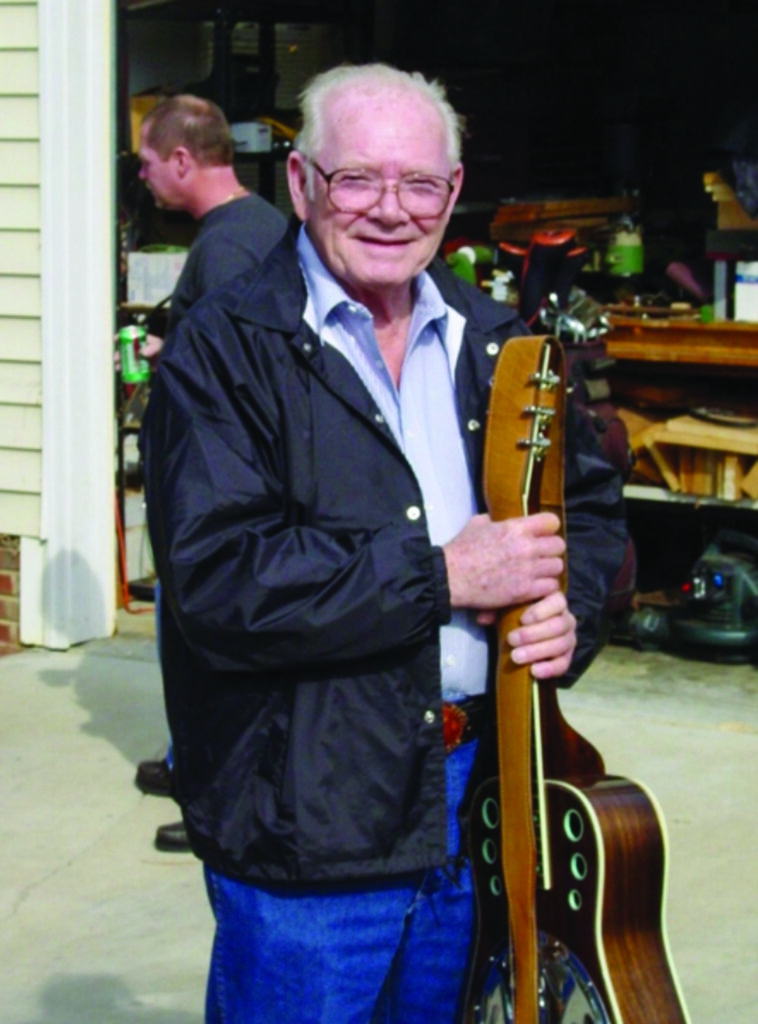
Bobby Glenn Wolfe (March 14, 1930 – January 4, 2025) was a North Carolina instrument maker who specialized in resophonic guitars. Over a span of 36 years, he produced a total of 234 instruments. He was also an expert repairman. Wolfe’s passion for the instrument extended to researching its history and writing about many of its leading practitioners; he was a frequent contributor to Bluegrass Unlimited in the 1980s and ‘90s. Lastly, he was among a dwindling handful of astute observers who witnessed first-hand the creation and evolution of our music.
Wolfe became aware of the Dobro by hearing it on broadcasts of the Grand Ole Opry in 1939 or ‘40; it was played by Bashful Brother Oswald as a member of Roy Acuff’s Smoky Mountain Boys. It was another eight or so years later before he got to actually see one in person. In 1948 Wolfe was in the Army and was stationed in Texas. While there, he attended a rodeo at which Roy Acuff, with Brother Oswald, was a featured attraction.
Smitten as Wolfe was with the Dobro, it wasn’t until 1964 that he acquired his first one. He purchased it from Buck Graves, the era’s reigning Dobro player who was then a member of Flatt & Scruggs’ Foggy Mountain Boys.
Through meeting with other Dobro players at festivals in the 1970s, Wolfe developed a reputation for being a first-class repairman. In 1994, he told the Charlotte Observer “My nuts-and-bolts background caught up with me. I hadn’t been fooling around with Dobros for a year or two until I was taking them apart to see what was making them tick and to see what I could do to make them sound better. I ended up spending more time working on them and seeing what made them work than I did practicing, so I ended up being a hacker picker and ended up being a pretty good repairman.”
Eventually, Wolfe’s repair work morphed into actual instrument construction. Starting in 1982, he had a process of building four instruments at a time, which took approximately three months. By 1994, he had 57 constructs to his credit. As one of only a handful of independent luthiers who built Dobros, Wolfe was selected to display his wares at the Dixie Frets: Luthiers of the South exposition that was held in Chattanooga, Tennessee, in the fall of 1994; he was one of 20 participants. A 1993 advertisement for his work boasted that Wolfe had “28 years of experience in the development of his Custom Resonator Guitars – select hardwoods – Brazilian wood, walnut, maple, etc, – gold plated engraved hardware. Instruments designed for the ‘picker,’ loud, full bass response, will be heard over the banjo.”
Wolfe’s talent as a writer – almost exclusively about the Dobro – became evident starting in the middle 1980s. One of his first articles appeared in the Spring 1986 edition of American Luthier magazine: “America’s Second Native Instrument – the Bluegrass Dobro.” It was later reprinted in the January 1988 edition of Bluegrass Unlimited. Nearly a dozen other articles for BU soon followed: “Tut Taylor – One of the Legends” (January 1988), “Josh Graves – Father of Bluegrass Dobro” (parts one and two, October and November 1990), “The Jerry Douglas Story” (August 1991), “Mike Auldridge – Mr. Smooth and Tasteful” (April 1992), “The Best Dobro in the World” (October 1993), “Tom McKinney – The Banjo and the Banjo Guru” (November 1995), “History and How it Repeats Itself” (November 1988), “The History And Evolution Of The Resonator Guitar Capo According To Wolfe” (March 2002), and “I Can Build A Better Reso Guitar – A Condensed History Of Ten Post-WWII Reso Builders” (March 2004).
Additional writing came in the form of an 80-page book that Wolfe published in 1993: The Resophonic and the Pickers. It featured “full-color photos of rare and unique resonator guitars, life story interviews with Josh Graves, Tut Taylor, Mike Auldridge, and Jerry Douglas, a complete section on Dobro history, set up and repair.”
In 2002, Wolfe introduced some of the first modifications to be made to resophonic guitars since they were first introduced approximately 70 years earlier. The changes resulted in what became known as the Wolfe Ported model. It featured “an increase in volume, exceptional tone over the entire scale, and a large improvement in midrange and bass response.” Wolfe produced this model exclusively until his retirement in 2017.