Smilin’ Jim Mills
A Banjo Master Gone Too Soon
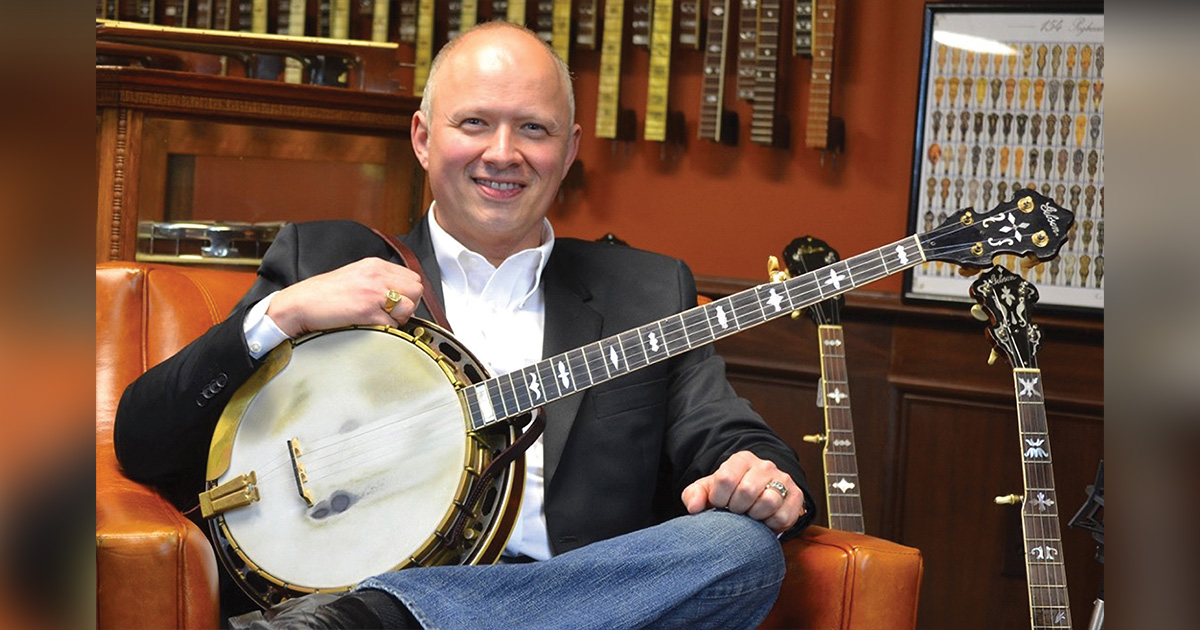
James Robert “Jim” Mills (December 18, 1966 – May 3, 2024) was one of the most celebrated bluegrass banjo pickers from the last forty years. His early resume included stints with several regional bands such as Summer Wages and the Bass Mountain Boys while later entries observed high-profile jobs with Doyle Lawson & Quicksilver and Ricky Skaggs & Kentucky Thunder. He also recorded and performed with Dolly Parton. As an adherent of all-things-Scruggs, Mills positioned himself as the reigning expert on Gibson pre-World War II flat-head banjos and was also a collector of early bluegrass music memorabilia.
Mills came by his banjo immersion honestly; his grandfather played the old-time clawhammer style banjo while his father (sometimes referred to as Big Jim) played two-finger style. Geography played a big part as well. In 2000, Mills told Jack Bernhart of the Raleigh News & Observer that “I was born in the heart of banjo-playing country in North Carolina. I think that had a lot to do with me turning out like I did because it’s almost a heritage. So many great banjo players have been from here.”
Mills’s “ah-ha” moment with the banjo came at a very early age. He described it to Bluegrass Unlimited’s Casey Henry: “My brother had a record (by Flatt & Scruggs), the Mercury record, (it) had the original ‘Foggy Mountain Breakdown’ on it. That’s one of the first things I remember, when I was four or five. I could hear that in another room he had it on the turntable, and I’d quit whatever I was doing . . . playing with Tinkertoys or whatever. I’d come in that room just to hear that banjo. It drew me to it somehow. I don’t know how to explain that.”
Despite being surrounded by banjos and banjo music as a youth, it wasn’t until Mills was 12 or 13 years of age that he developed a serious interest in the instrument. From that point forward, he was like a sponge, soaking up everything banjo-related that he could. He attended his first bluegrass festival (in Amelia, Virginia) a year or two later. One of his most beneficial regular outings was a series of picking get-togethers at the home of Wayne Watson in Mills’s native Durham, North Carolina.
The first band Mills played in was called Bluegrass Revue. As soon as he graduated from East Wake High School, he joined a relatively new group from Mount Airy, North Carolina, called Summer Wages. He appeared on the group’s third and final album, Can’t Stop Now. Bluegrass Unlimited reviewer Frank Godbey noted that “The only person who doesn’t sing on this album is banjo and occasional fiddle player, Jim Mills, but his contribution is significant nonetheless. Playing a style based on J.D. Crowe and Terry Baucom, he punches out lean but forceful banjo throughout the recording.”
Album title notwithstanding, Summer Wages disbanded about the time of their June 1988 album review. It was only a short time later, September 1988, that Mills received a life-altering phone call from Doyle Lawson. A spot on the banjo had opened up with the departure of Scott Vestal and Lawson called to offer the job to Mills. He accepted without hesitation and spent the next five years as a member of Lawson’s Quicksilver.
Lawson gave Mills ten of his albums with instructions to learn all of the material. Coupled with that were singing lessons. In a 1990 Bluegrass Unlimited article by John Sullivan, Mills related that “they taught me to sing from my diaphragm instead of my throat.” He modestly added, “I didn’t know I had a good baritone voice, but they tell me I do.” Fresh out of the chute, Mills’s first road trip with Lawson was a six-week tour of ten South American countries.
During his tenure with Lawson, Mills helped with the recording of four CDs: I Heard the Angels Singing, 1989; My Heart is Yours, 1990; Pressing on Regardless, 1992; and Treasures Money Can’t Buy, 1992.
After five years of life on the road, Mills was ready for a break. He turned in his notice to Lawson and secured a job as the shipping manager with Sugar Hill Records. In addition to his shipping duties, Mills also previewed demos of wannabe recording artists. One of his choice discoveries was 12-year-old Chris Thile! The 9-to-5, Monday through Friday, nature of Mills’s work at Sugar Hill afforded him time to play music on weekends. A prime musical outlet was the nearby Bass Mountain Boys. Mills appeared on the group’s 1994 release, Love of a Woman.
The most fruitful period of Mills’s career as a performer got underway in 1997. That’s when Ricky Skaggs brought him into the Kentucky Thunder fold; he stayed there for 13 years. During that time, Mills was named the IBMA Banjo Player of the Year on six separate occasions: 1999, 2000, 2001, 2003, 2005 and 2006. Mills was a member of Kentucky Thunder when that group won the IBMA Instrumental Group of the Year award (1998-2000, and 2002-2006).
It was while working with Skaggs that Mills released all three of his own solo recordings. The first of the lot was 1998’s Bound to Ride. It was a mixture of not-overly-done instrumentals and deftly chosen vocals. The disc’s support team was an A-List of bluegrass pickers and singers. Instrumentalists included Tim Stafford, Adam Steffey, Barry Bales, Stuart Duncan and Jerry Douglas while Ricky Skaggs, Alan O’Bryant and Don Rigsby provided vocals. The album received the IBMA’s 1999 award for Best Instrumental Recording.
In 2002, Mills followed up with My Dixie Home, a collection that the News & Observer’s Jack Bernhardt characterized as a collection of “good old Scruggs-style picking” where Mills “masterfully distills 50 years of bluegrass wisdom into one of the year’s most enjoyable traditional recordings.”
In press for 2005’s Hide Head Blues, Mills’s third and final solo outing, he related that “I’m probably one of the biggest collectors in the country of original five-string flathead Gibson banjos.” The disc featured four different banjos from Mills’s collection, many of which featured their original animal skin heads (as opposed to plastic ones which were introduced around 1959).
Working with Ricky Skaggs positioned Mills to be in the right place at the right time for several important recording opportunities. Chief among these was a set of bluegrass releases by Dolly Parton: The Grass is Blue and Little Sparrow. He even appeared with Parton on events to promote the releases, including a guest spot with Jay Leno. Other outings included playing banjo for James Price’s Southern Flavor, 1998; for Dan Tyminski’s Carry Me Across the Mountain, 2000; Alan Bibey’s In the Blue Room, 2000; Bobby Osborne’s Where I Come From, 2002; and two Huber Banjos projects: Team Flathead, 2004 and Cuppa ’Jo, 2006.
Mills retired from the road again in 2010, this time to concentrate on what had been his side business, trading and selling vintage Gibson flathead pre-war banjos. The basement of his Durham home was a showcase for his growing banjo inventory. Also on display were decades worth of rare photos, posters, stage clothing and more that once belonged to first-generation performers. Mills received guests and curiosity seekers from around the world, especially during World of Bluegrass week. His collection even impressed Emily Epley, the executive director of the Earl Scruggs Center. In an article printed in a 2017 edition of the Asheville Citizen-Times, she told David Menconi: “The first time I went through Jim’s space, seeing all the wonderful treasures he had, gave me serious Earl Scruggs object envy . . . I don’t know anybody else who has anything like it, both the quality of what he has and the stories behind it all.”
As a collector, Mills put his years of knowledge to good use with the 2009 publication of his book called Gibson Mastertone Flathead 5-String Banjos of the 1930’s and 1940’s. In addition to detailing the general history of these banjos, Mills honed in on 19 specific instruments that once belonged to Earl Scruggs, Don Reno, Snuffy Jenkins, Sonny Osborne, J. D. Crowe and others. Also included were never-before-seen photos, bills of sale, factory shipping labels and more.
In addition to being a world-class picker and a dogged collector, Mills was very personable. Never without a smile on face, his good-hearted nature earned him the nickname “Smilin’ Jim.” Any passing of a member of the bluegrass family is heartbreaking. Mills’s death, which was sudden, unexpected and at the relatively youthful age of 57, was especially so.