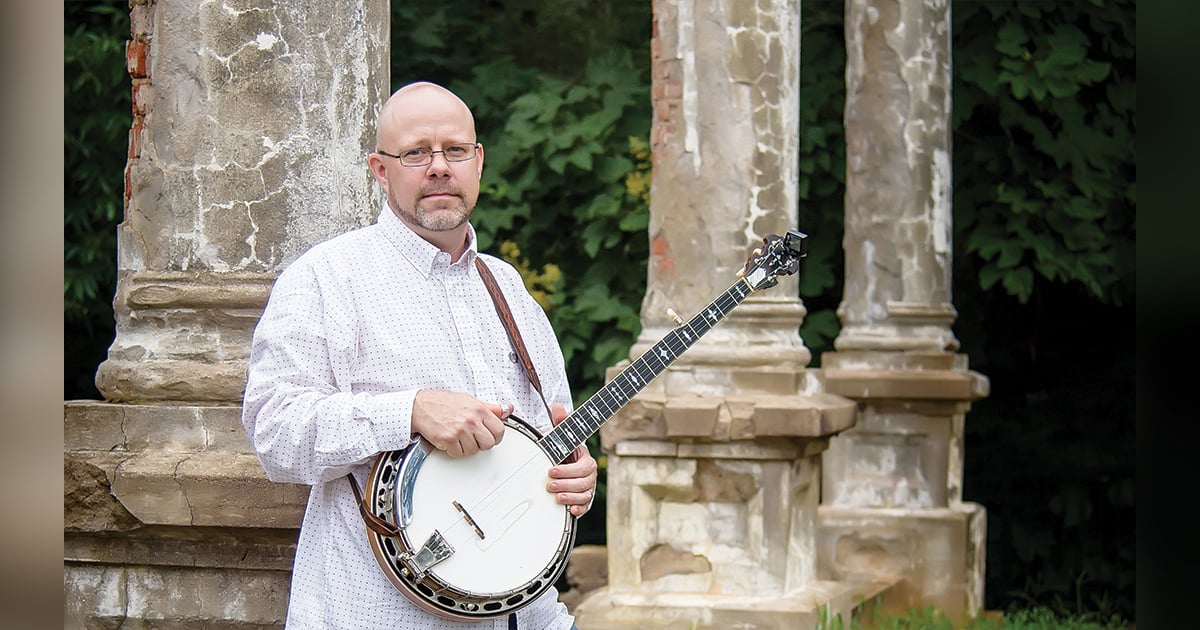
Six Degrees of Separation
Photo by Robert Nix
After becoming an empty nester, Steve Wilson left upstate New York for the beautiful foothills of the Blue Ridge Mountains in South Carolina. He expected to keep his fishing line wet in Lake Hartwell a good deal of the time and pick banjo with the local bands on the weekend. Instead, his life has taken a series of twists and turns that has left the founder of Wilson Banjo Company awed.
“I never dreamed the music would go in the direction it’s gone over the last seven years,” Wilson told Bluegrass Unlimited on a zoom call from his home in Westminister, SC.
Since the move, the banjo luthier has started his own band, cut three albums, become a sideman for Dale Ann Bradley and Deeper Shade of Blue, and Lead Recording Engineer/Producer for Bonfire Records, the sister label of Pinecastle Records. The journey started when Wilson built a no ring tone banjo he named The Guardian for its angel inlay on the head stock. He took it to a festival in Chattanooga, TN where David Parmley and Cardinal Tradition were playing, and Dale Perry was intrigued.
“He said, ‘Let me play this on our next set.’ When he came back, he said, ‘You take my banjo home; I’ll take this one.’ I said, ‘I’ve got to play this tomorrow. I can’t.’” Eventually, Perry became the owner. To promote the sound of the banjo, Wilson cut a five-song EP, titled The Guardian, under the Wilson Banjo Company in 2014.
“We started getting a lot of radio airplay, and my wife started promoting it a little bit and people started asking where’s the band playing,” Wilson recalls. “This started happening quite a bit to the point where I finally decided I better put a band together.”
In 2017 Wilson released his second CD, Spirits in the Hills, on Bonfire Records. The company was so impressed with his studio production work on the album that he was offered an engineering job with Bonfire. “I didn’t have any of this stuff in mind when I came down,” Wilson says. “It’s all sort of snowballed. I’m so glad the way things have gone.”
Wilson’s interest behind the control board began when his son took an audio engineering class in high school. Being a supportive dad, he bought Pro Tools equipment for his son to learn at home. His curiosity was piqued and he began teaching himself how to use the gear.
“Looking at it now, I’m thankful that I didn’t have any training. I take that approach in the studio of not putting things in a box and listening and really being open to where things are going to go and how they make sense. Not trying to guide things too much. Not trying to say this has to be like this. You have to mic a guitar right here, and you have to use this EQ on this, and you have to set this here and that there. Who cares what the settings are? How does it sound? Not having that structured training helped me to be open and just listen, and if things are right, it sounds good.”
He dove into high waters with his first studio job, helping Flashback cut the Denver Snow album. Wilson has since cut two more albums for the group along with Gena Britt, The King James Boys, Shawn Lane & Richard Bennett, the Jake Bartley Band, and Dale Ann Bradley’s The Hard Way.
“We were working in the studio on her The Hard Way album, and we had most of the recording done and it was time to send out some tracks. Scott Vestal, Alison Brown, and Gena Britt cut banjo on a couple of songs. She said why don’t you go ahead and put banjo on this one and put banjo on this one. I stopped in my tracks. What?!? You want me to put banjo on your album? I took a deep breath. I was blown away and kind of scared a little bit.”
“Once she left, I locked myself in the studio and said, no problem. I started playing and listening back. That was a big turning point for me as a musician. With Dale Ann Bradley and her vocals, you don’t just play banjo. You have to play music. You have to fit in, and you have to find a place where you belong. That was a big eye opener.” Thirty minutes after hearing Wilson’s banjo work, Bradley asked him to go on tour to support the album.
“I was even more scared,” Wilson admits. “That was a really amazing experience. The very first show that I played with her was in Connecticut. I hadn’t played a single note with any of the band members or her. She sent me music, I learned it, and we got up there and got on stage. I was a little spooked. I was standing to her right, and the energy that came off of her, you could just play off of. I had never felt that before. As soon as she started her show, it was like this force came off of her. I was in awe the whole time. I don’t even know if I hit the right notes. That was a huge turning point in my musical career. The first time I had ever done anything at that professional level.”
From his year tenure with the band in 2018, the newcomer to touring learned road life is much different than he expected.
“You think everybody goes there, and they just know everything. They get up on stage, and they do their thing. No matter whether you know the songs or you don’t, everything changes due to all the things that are going on around you whether it’s how the band is feeling that day, the weather, the crowd if they’re very interactive or they’re not. Every single time that you play could be different. I learned to just be open, see how things go and learn to flow with it. Never lock yourself down into this is what you’re going to do and this is how you’re going to do it. Always keep yourself open to move and change.”
Wilson was at the Christmas in the Smokies Bluegrass Festival in Pigeon Forge, TN when he met Deeper Shade of Blue, who was playing there, in December 2018. He loved the band’s sound and harmonies. Steve said, “That’s one of the biggest things that I like as a banjo player is to play behind vocals. I don’t care if I ever play an instrumental tune. I just love playing behind really good, strong vocals.”
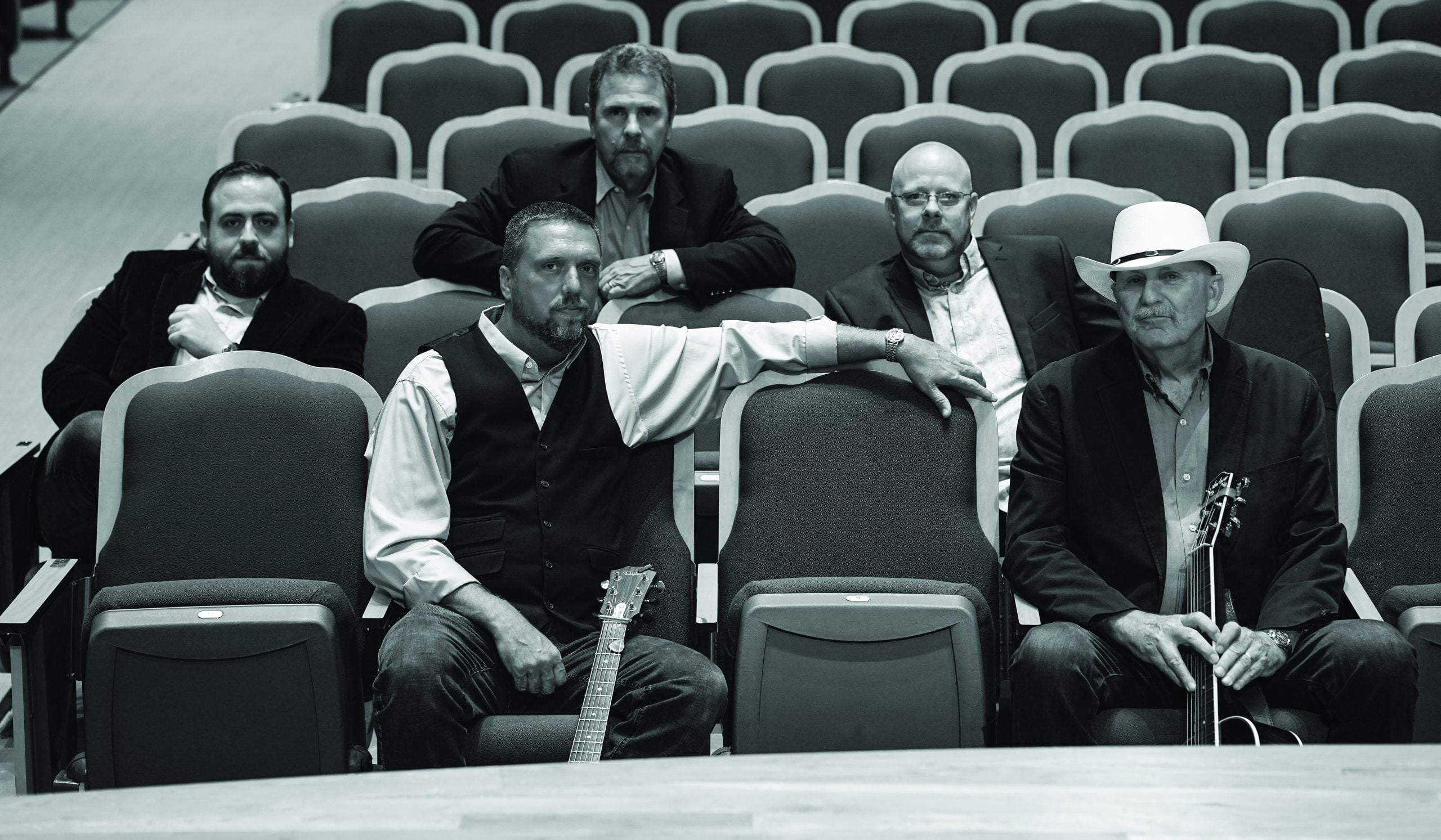
It wasn’t long before the group’s lead singer/guitarist Troy Pope asked Wilson to fill in with his five string skills when banjoist Jimmy Fraley had health problems. When Fraley stepped down from the group in 2020, the band gave Wilson, who had filled in for a year and a half, the permanent job.
“It was a perfect fit. The camaraderie between the five of us and traveling up and down the road and the time off the stage is as good as it is on the stage.”
Wilson says his confidence as a musician has grown since joining Deeper Shade of Blue. “With Dale Ann I had to be more reserved and know what notes I should play and not play to not interfere with her melody. You had to really tiptoe around a lot of her vocal and her music because of the kind of music it was.”
“I didn’t have the confidence yet to get up on a microphone and say this is me. The way that their music is delivered, when they step up and they sing, it’s with confidence. You’re going to hear these vocals; you’re going to hear these harmonies. As a side musician, you have to support that with the same kind of feeling. At that point I didn’t have that kind of confidence yet. I’m starting now to say, ‘OK. This is me; here it is’.”
No Expectations
By looking at Steve’s life resume, there probably wouldn’t have been any early expectations of a music career. Growing up in Casper, WY, Steve learned a few chords from his dad who played classic country music. When the family moved to New York during Wilson’s high school days, his dad bought a banjo and taught him a few lessons. Still, the teenage boy’s interest was tuned in more to fishing on the Salmon River, in Pulaski, NY. During a six-year hitch in the Navy, Wilson learned patternmaking, a precise specialized form of woodworking. After the service, he returned to New York working as a carpenter while dabbling with music. In the late 1990s, his family packed their bags for Nashville, TN, and Steve started building custom guitars for Gibson. Meanwhile, he immersed himself in the plethora of jam sessions in Music City.
“Anywhere you went there was a jam session going on,” he says. “I really got intrigued then. I’ve got a banjo too! I took the banjo to jam sessions, and I wasn’t really accepted very well. I couldn’t understand what was going on. Then, I realized, ‘Oh, you don’t have a clue how to play the banjo’,” he recalls with laughter.
Determined to improve, he knuckled down and began to learn his instrument. “I was listening to Blue Highway, IIIrd Tyme Out, and Lonesome River Band. Sammy Shelor’s playing really struck me. I really dug into what he was doing and started learning a lot of his stuff.”
In time, Steve’s skills improved, and he had a much friendlier reception when he returned to the jam sessions. He also began playing in the parking lot at Cherry Tree Orchard, a picking barn on the outskirts of the city, until one day he was asked to perform in the house band on Saturday nights.
“A few times I’d start to get off stage, and the next band would say, ‘We don’t have a banjo player. Come on!’ It got to where I was playing on stage all night with people I didn’t even know and songs I didn’t even know. It was sink or swim. It was a great learning experience.’
“The most challenging part for me, I guess, was learning how to fit in with a lot of other people and not be out of place. A banjo is loud and can be very annoying,” he says, laughing. “I would go to a lot of jams, and I would hear that banjo just cranking across everything, and a lot of times I wouldn’t be able to tell who was singing or what was going on otherwise. That was a hard thing to do to learn how to play an instrument that’s that intrusive to where it fits in with the band. That takes a lot of time, and it takes a lot of experience playing with different people and learning how to fit with different rhythm sections and different singers. I’m still developing that today. It’s a constant learning curve for sure.”
Now, he focuses more on those critical 3 T’s—tone, timing and taste. “When you sit at the house and you’re playing along with the CDs, it seems like you have a good concept and you can control your tone and your timing and your technique. Then, when you get into that live setting on stage, the adrenaline gets going and you lose that a little bit. That’s what I’ve been working on the last few years is trying to take the things that I practice at home and be able to take them to stage and keep control of everything. That’s kind of a tough task.”
After his stay in Nashville, Wilson moved his family back to New York in 2002, and over the next 12 years, he played music festivals during the summer with various bands including Plexigrass. Steve owned a Scruggs model banjo at the time, but he wasn’t satisfied with the way it performed and sounded. Employed in a mill workshop, Wilson took some the leftover thick mahogany along with a few other hardware parts and applied the skills he had learned working with Gibson. Voila! He created his first banjo.
“I was playing at a festival with Plexigrass, and some guy came up to me after the festival and said, ‘What’s that you’re playing?’ I said, ‘That’s one I built.’ He said, ‘Can I play it?’ He played it and ended up buying it. That kind of kicked it off so I had to build another one.”
“It’s [building banjos] a passion of mine. I don’t set out to build a whole bunch of them. If somebody gets a hold of me and says, ‘Hey I want you to build me a custom banjo, then I build them one.’ We build it right to their specs. I don’t want to get to a point where I’m building them for a living. Everything I do is by hand. It’s all handcrafted so it takes me a long time. I don’t want to lose that passion for that.”
Six Degrees of Separation
Building banjos was the impetus that kicked off a chain of events for Steve Wilson including his founding the Wilson Banjo Company. While WBC will not tour as a band any more, that name is still the vehicle that he wanted to use to drive his recently released album, Six Degrees of Separation. The title comes from an old concept that all people on average are six, or fewer, social connections away from each other.
“Where I’ve ended up in this business now was not a predetermined path,” Wilson says. “I just ended up where I am, and I thank the Lord every day for it. It’s got me to a point in this business where I’m in the studio recording albums for great artists, playing on stage with great artists, building banjos for people. I wanted to do an album that wraps up everything that I’m doing and everything that I’ve become into one package. I brought in people I’ve been on stage and played music with, people I’ve recorded albums for in the studio or recorded on their albums, people I’ve built banjos for.”
Thirty guests are featured on the album including Dale Perry, Gena Britt, and Tony Wray, who each play one track with their own Wilson banjos, Michael Cleveland, Richard Bennett, Dale Ann Bradley, Alan Bibey, Troy Pope, Deanie Richardson, Shawn Lane, Sarah Logan and several more.
“What I really enjoy about bluegrass and acoustic music especially, even though you may have something in mind, when you get with good musicians, things take on their own life and their own shape. I love to see where things go and how they develop and be able to mold and let that grow in whatever direction it’s going to go. I guess that’s why I like studio work so much too. I’ve seen a lot of musicians come out of the studio going, ‘Man I’ve got to go home and learn to play that now!’”
This new 12-track album is full of diverse songs “from spooky alternative to straight up traditional bluegrass to straight four-part harmony gospel.” The banjoist showcased five of the lyrical songs he co-wrote. “Up until this point I had mainly written instrumentals. My wife [Melanie] and I have dug into writing a lot of songs.”
Making that transition to adding the written word was a tricky one for Wilson. “If you and I were to sit and talk and I wanted to tell you a story, I’d start telling you the story, and it would be no problem. I thought I can tell a story in a song. No! (laughs) It’s not that easy. How do you tell a ten-year story in three and a half minutes?
Wilson made his first foray into penning songs with “Shiner’s Mountain” for the Spirits in the Hills album. He started penning the tune while working years ago on his construction job site. “I had this vision of this guy walking on top of a mountain late at night searching around the mountain. The mountain is covered in moonshiners. He was in a lot of danger. I started telling this story, and it evolved as it went. It changed into him ending up being a revenue officer. He was in a lot of trouble when he got up on this mountain.”
Wilson co-wrote the first single, “Wrong Turn That Led Me To You” for the new album. “I had the idea of that song and what I wanted to say for probably two years,” Wilson recalls. “Every time I started thinking about writing about that song, there were too many words coming out. I kept putting it away. Then, one morning I sat out on the back deck with my coffee, and that song came to mind. The whole thing started pouring out in probably 20 minutes.”
For Wilson, his wrong turn would have been to front a band. Rather he envisions a mixed bag for his musical future. “I love producing music and recording music and the whole creation process of that. I would really like to see that grow. If I was to say, where am I at in 10 years I would say me and Deeper Shade of Blue are going crazy on the weekends and all week long I’m sitting in the studio making records and producing music.”