
Shelby Means’ New Solo Album
Shelby Means had nothing to prove to anyone but herself when she set out to record her first solo self-titled album. Her bluegrass credentials are solid. In fact, bluegrass brought her to Nashville in the first place. A native of Wyoming, she grew up going to festivals and played in the Alaska bluegrass band Bearfoot at the end of her college journey. Odessa, a member of the band, moved to Nashville and was looking for a roommate. Means only knew two people in town, but the rent was reasonable and that seemed like a good place to start.
“I wanted to be surrounded by other musicians that were better than me and to get better at playing music,” she said.
Building her bluegrass resumé, Means had a good run playing bass with the all-female band Della Mae from 2012 to 2015, after which she started performing with husband Joel Timmons as the duo Sally and George. “We were touring a lot when the pandemic hit,” said Means, “and everything stopped. We were scratching our heads wondering, ‘What are we gonna do? What’s gonna happen with live music?’” Then, she says, she got a call from Molly Tuttle. “We had been friends and neighbors when I lived in Nashville, so it was great to get that call to be on her list for one of the coolest bluegrass bands out there.”
Means spent the next three and a half years touring with Molly Tuttle and Golden Highway, playing on two Grammy-winning albums. “I am so grateful to have been asked to join that band and tour at that level to experience the ups and downs of road life.” She says that experience led to professional growth and lasting friendships with the members of the band.
Means’ decision to cut a solo album came, in part, from watching the process as her husband Joel Timmons recorded his solo album Psychedelic Surf Country. He started recording the album three years ago and released it this February. Watching his process, with Maya De Vitry as producer, got Means to thinking about a project of her own. “I watched his process working with Maya. She was wonderful and very comfortable in that leadership position but still wanted to honor the sound of his record and his goals with the songs.”
She kept the idea in the back of her mind because, she says, “finding a producer that makes me feel comfortable was important to me.” She knew DeVitry had experience making records. Means had also enjoyed the experience of making Molly Tuttle and Golden Highway’s City of Gold album with Jerry Douglas. She had a co-write on “Next Rodeo” on that album and enjoyed the process of arranging the songs as a band and then getting into the studio.

When Golden Highway bandmate Bronwyn Keith-Hynes told her she wanted to make another solo album, that lit a fire in Means. “Just being surrounded by other artists that are empowered to share their voices in their songs was inspiring.”
Once DeVitry signed on for the project, Means felt some pressure, which, she says was “a good thing, because I’m deadline-oriented.” She needed to have thirteen songs ready to record. She had written the opening track “Streets of Boulder” while still in college and had played on tour. Other songs were still incomplete in her notebooks. “Some of them I finished right away, but others took a long time and some dedication,” she says. DeVitry came to Charleston, where Means and Timmons had moved during the pandemic to be closer to family and the ocean, to wrap up Timmon’s project. While there, she and Means had a pre-production meeting. They started going through Means’s notebooks, finding songs she had written right after moving to Nashville.
Having some distance helped to finish those songs, Means says, as she considered “who I was when I started a song versus the lives that I’ve lived and all the experiences I’ve gained in the time that passed. It helped to inform the rest of the song, and something would click in place usually to help finish it.”
While she had started several of the songs on her own, she found co-writers helpful in finishing others. Means had started writing “Suitcase Blues,” a song about the challenges of a touring musician. “I had the idea on my own, at least for the first line and some of the melody,” she says, “Then Joel helped, as we were talking on the phone and working through some lines, actually feeling some of the things that I was writing about.”
“I would say something,” she explained, “and he’d be offended by it, so I said, ‘I can’t help the way I feel,” and he said, ‘That’s a good line. Write that one down.’ We went back and forth, trying to stay open and not edit at first. Then Maya when came in, we sprawled out on the floor, relaxing and comfortable, just trying to think. That freedom to move to wherever I need to in the room or lie down helps the co-writing process, funnily enough, but having the appointment is good.”
Means find having structure, such as deadlines and appointments, helps her to be productive. “When Joel and I co-wrote for [our duo] Sally and George, we would set up time for our appointment, a block of four hours, and try to write a song in that time.”
DeVitry took her role as producer to heart, something like a doula, with a goal, she says, “of helping somebody’s dream come true.” She added, “One of the things a producer can do is try to help you get the songs you want for the album.” She set up a co-write for Means and songwriter Brennen Leigh, the first time the two had worked together because, she told Means, Leigh was “a great song finisher.”
“There’s something about Brennen’s energy and her songwriting that I felt would be a good match for Shelby.” On a Zoom co-write, using a shared Google doc, the pair quickly completed “5-String Wake-Up Call,” one of the most humorous songs on the album, based on Means’ own father. “Brennen and I actually met on Zoom,” says Means, “and I explained to her about how my dad used to wake me up with the banjo and how annoying it was. I told her, ‘I think there’s a song in there.’”
“Up on the Mountain” is another track that Means started more than ten years ago, during a mountain getaway. She had some ideas for the song and could imagine her friend Langhorne Slim playing on it, so she shared the partial lyrics, he wrote another verse, and she moved them around and added a third verse. The song, about a family’s loss, was finished and recorded in the spring before Hurricane Helene hit North Carolina. Means says she “will never be able to hear the song in the same way.”
Firmly rooted in the bluegrass community, Means was able to assemble a star-studded group of musicians and vocalists to play on the album. The album credits read like a who’s who in bluegrass: Brian Sutton plays guitar, Ron Block plays banjo, Jerry Douglas plays Dobro for the entire album, and either Sam Bush or Means’ brother Jacob play mandolin throughout. Means said she couldn’t pick just one fiddle player, so she enlisted bandmate Bronwyn Keith-Hynes, Michael Cleveland, and Billy Contreras. “I love so many fiddle players, and I’m so lucky to have three amazing fiddlers on the record. They all bring something a little different, their own style to each song,” says Means. Part of organizing the sessions for Maya and me was figuring out who would be the best on which song; they all could have done the entire session easily.”
DeVitry said, “We picked them because we knew certain songs instinctually matched their strengths. One of the exciting parts of my job is asking ‘How can we best shine a light on their strengths?’ Billy Contreras plays on the wild, jazzy happenings, and we had Michael Cleveland on some of the classic bluegrass.” Means’ working relationship with Keith-Hynes made her the go-to fiddler on several of the tracks, including the ballad-inspired “Fisherman’s Daughter.”
All three fiddlers will also be playing at Means’ album release show at the Five Spot in Nashville on June 25. Once they got into the studio, DeVitry drew from her own experience recording albums. “I know what it’s like to lead a band in a studio or navigate the way you physically feel—up and down through the day—and I know what it’s like to have all those people looking at you,” she explains. “I’m the producer sitting behind the glass with the engineer, but everybody’s looking to Shelby for the energy.” DeVitry’s goal, she says, was to support Means in a present, but quiet way. “I have less involvement once the record is mastered, but I can still be a sounding board. I’m not an engineer; I’m not the one moving the knobs. That’s not my strength.” Her strength, she realizes, is identifying what help the artist needs.
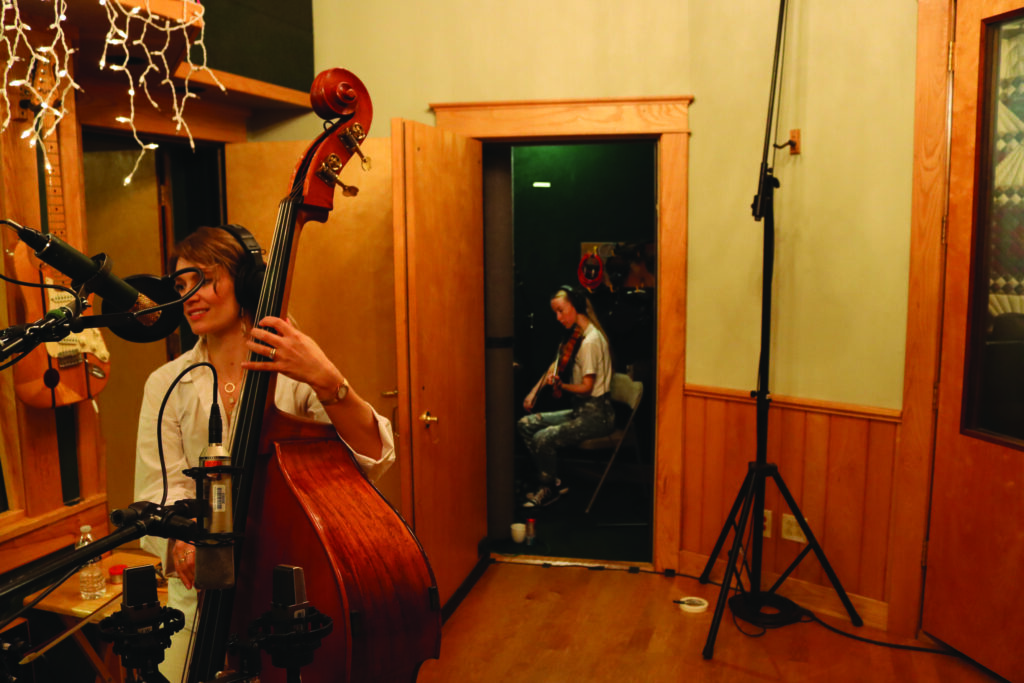
In the studio, Means was able to take the lead. Jerry Douglas said, “Shelby holds sway over whatever band she’s in. When she has an idea, I listen. She knows what she wants, and she’s good at explaining it, so we can do a lot more playing than talking.”
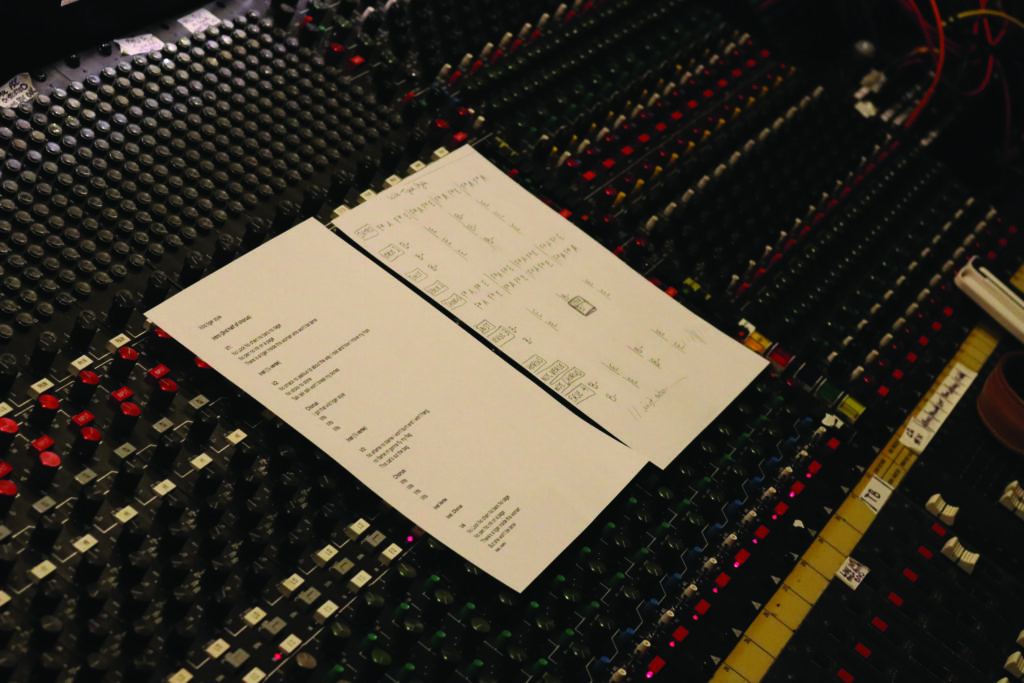
With three days in the studio to record thirteen songs, Means said, “We were on a pretty strict schedule, but of course, I didn’t want it to feel too strict. We would all gather in the morning; everybody would get their coffee and come into the engineering room and I’d play the demo tape and pass out the charts.” When there was no chart, she said, the musicians made their own. “They have such great ears, and they were all so open. Even on some of the songs that weren’t super straight-ahead bluegrass, they came at it with a playfulness and an openness that helped me feel less vulnerable because playing my demos for those guys was scary,” she admits. On day one, though, she said the antics of Cleveland and Sutton, took off the pressure, a reminder, she said, “we’re here to have fun, not just to be serious about playing music.”
Pacing, says DeVitry, was also important, deciding, “Which day is the Michael Cleveland day? What songs are we going to do on that day and in what order, so the energy of the band is a perfect ride all day?” They ended up cutting four or five songs a day, she said.
Just as crucial as the selection of the instrumentalist on the tracks was the pairing of harmony vocalists to songs. DeVitry and Timmons, who have had plenty of experience singing together, formed a core part of the harmony sound, but for others, Means was also deliberate. She knew she wanted Tim O’Brien to sing on “Up on the Mountain,” explaining, “Tim O’Brien and Billy Strings were kind of big asks, but getting Kelsey Waldon and Rachel Baiman to sing “Farm Girl” was definitely my dream, because we’d sung and played together when we were all first living in Nashville, so we had some history. If felt like, ‘Oh, let’s get our little band back together.’” On “Streets of Boulder,” with Keith-Hynes on fiddle, Means was joined by Molly Tuttle and Kyle Tuttle on harmony, representing at least half of Golden Highway.
The harmony and instrumental pairing on the different tracks produce a texture to the album. O’Brien sang harmony on “Up on the Mountain,” and Strings sang on the road song “Suitcase Blues.” Means also felt the selection of Ronnie McCoury and Sam Grisman on “5-String Wake-Up Call” was particularly fun. She chose them after asking herself, “Who else is a son or daughter of a musician that might have been annoyed to wake up to them playing? Del probably could never be annoying unless you’re his kid and he’s trying to wake you up with guitar.”
Lady Gaga’s “Million Reasons” was one of the singles released in advance of the album. Though perhaps the least bluegrass song on the album, it showcases Means’ vocal range and nuance as she makes the song her own. “That one I was the most on the fence about … but I love that song, and I’d been performing it live for a few years with Sally and George. It’s always a fun moment because I can put the bass down, take the microphone, and add a little performance drama.” She and Timmons made a demo and shared it with DeVitry, who considered all the songs they’d include and felt it would fit the project lyrically and Means vocally.
Though Means couldn’t have predicted, the timing of the album landed perfectly, as Molly Tuttle announced her decision to retool. Golden Highway will play their last gig together at RockyGrass in July. Means says that, in her early days with the band, “every night my mind was being blown because each person would step up to take a solo, feeding off each other. I felt like the luckiest girl in the whole world, the luckiest bass player to get to anchor a band like that.”
With her own album to promote, Means may need an inoculation against “suitcase blues,” with a busy schedule on tour with a little help from her bluegrass community.