

Santa Cruz Guitar Company Turns 45
With A Lot of Help from Its Friends
Shaken by tragic personal loss and global economic turmoil, the Santa Cruz Guitar Company and its founder, legendary luthier Richard Hoover, have come through a perfect storm of emotional and business challenges over the past two years and emerged stronger than ever as the company celebrates 45 years as one of the world’s leading boutique guitar makers.
Long known for their close association personally and professionally with Tony Rice, the bluegrass legend’s sudden death on Christmas Day 2020 triggered a profound reaction from Hoover, who knew Rice as a dear friend, not just an endorser. Hoover spent three days writing and rewriting the eulogy he says he was honored to deliver at Rice’s funeral. The piece was published by Bluegrass Unlimited in our March 2021 edition dedicated to Rice’s life and career.
And like everyone in the music industry, COVID-mandated shutdowns and medical restrictions, coupled with the massive global supply chain issues caused by the pandemic and the enormously disruptive extended blockage of the Suez Canal and port blockages due to labor shortages, led to supply chain challenges for SCGC and virtually every other business. Everything from meeting rising international demand for high-end guitars to sourcing basic, but utterly essential components such as tuning machines and guitar cases that the company must purchase on the open market posed potentially company-killing risks.
Through it all, SCGC focused on what it has always done best: serve as a custom guitar shop hand-crafting some of the finest acoustic guitars ever built while maintaining its skilled workforce despite the upheavals and uncertainties of surviving as a boutique guitar maker.
Richard Hoover, who founded the legendary custom guitar shop in 1976, is a lot like the acoustic guitars his company crafts. Sensitive but focused, delicate yet resilient, his guiding hand has kept the company afloat amidst troubled seas more than once. So when Rice died, Hoover knew what had to be done.
“Personally, this was a profound moment,” Hoover says. “I spent about three days writing about Tony and really thinking about our relationship. It was a necessity. I had to do that for my own emotional well-being and sort out my thoughts on that. The gist of this is when Tony died, I had the advantage of seeing (Tony’s physical decline) incrementally. I knew the trajectory he was on, so even before his death there was loss of hope that there was not going to be a miracle. So I was more prepared than most that it was inevitable. The other thing, we’re gentlemen of a certain age, (Hoover will soon be 71, Rice died at 69). And when Tony died, I had to face my own mortality. If Tony Rice died, what chance do I have (chuckles)? But it was true; I could not but see my mortality. How fleeting, how fragile life is, and you better pay attention to what’s important and what isn’t. So I did have the advantage of being prepared, and I took those days for reflection and to feel closure, and ultimately to have hope for the future rather than despair.”
On the business side, Hoover sees a bright future, not one of decline and despair, despite the economic and logistic challenges his company faces. “Looking at the other end of COVID, we had a lot of miraculous near-misses, and everyone has stories about how hard it was and the supply chain stuff. Looking at the other end now, we have a lot of gratitude, miraculous near-misses, lessons learned. Everyone has a story,” he reflects.
As California enacted stay-at-home mandates and other stringent public health restrictions due to the pandemic, a small business such as the Santa Cruz Guitar Company had to endure and overcome multiple business disruptions. “There were state mandates to shut down, then self-imposed actions to keep people from getting sick,” he adds. “We aren’t a grocery store chain that can hire someone, put them through standard training, and they can go to work that day. Our training is so highly involved, and we demand such high skill, that if people get sick it could be fatal to the company. So we took every precaution to keep people safe. Self-imposed shut-down, updated (biological) barriers, filters, masking, whatever we could to get through it. We had one serious two and a half months where we were forced to stay at home. What small business can have prudent reserves for that?” he asks. “We survived because my job became scrounger for hardship funds, PPP, disaster loans, grants. I was a grant writing fool, but we did get enough support to get through it.”
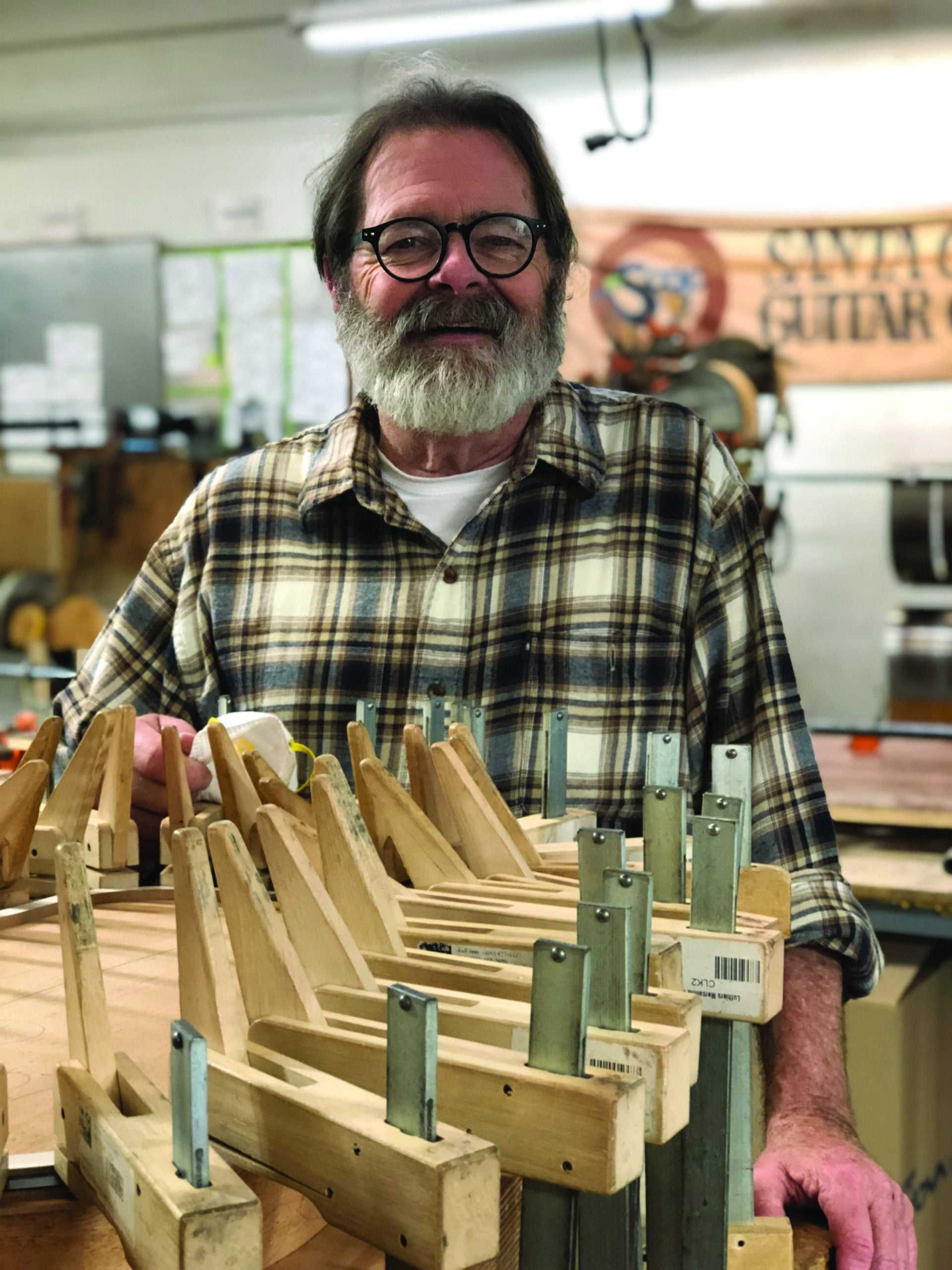
Looking in the rearview mirror, Hoover likens the last two years to “a near-death experience. If you ever have the misfortune to experience something like that, you end up prioritizing your life. You find out what’s important and what doesn’t matter at all. And that was the place the business was in. So we prioritized.”
Through strategic business planning and careful analysis, the company dropped a lot of programs that were “quite entertaining, but did not have quick results. We put stuff in place for quality of life, quality of our guitars, production efficiencies, and that kind of thing. We had time to think. And it brought our people together. We bonded after going through crisis,” he adds. One example of pandemic-driven innovation is how SCGC now uses NASA-level scientific analysis to evaluate and grade tonewoods, a technology that could revolutionize the acoustic guitar industry, Hoover believes.
Today, the Santa Cruz Guitar Company employs about two dozen exquisitely trained luthiers producing around 400 guitars a year, most of which are custom orders. “It took years and years to educate people that we truly were a custom shop. For years we had to make standard models stores would buy, and we competed with everyone in the world. But our strength was custom stuff, although people didn’t see those. They were ordered and sold before ever hanging on the wall. Before the internet, we couldn’t promote that,” Hoover tells Bluegrass Unlimited. “Back in 2019, we switched our business model to this new ‘custom shop’ mentality, and it benefitted us greatly when COVID hit. We offered our base model at a set price, and offered variations you could add within that price. It’s a bit of a paradigm twist, but that changed everything. Stores ordered custom stuff for their inventory, so they were not competing with another store ten states away (to sell an identical guitar). That really allowed us to do what we’re best at. We were not so efficient at just making another dreadnought and on and on. So that was a huge break for us.”
One other critical strength, Hoover adds, is the wealth of longtime business contacts and close relationships SCGC has built within the industry over its impressive 50-year run. “Our strength is in woods, and ensuring that we use natural, sustainably harvested timber. And therefore, we do business with small family operations, not the big ones,” he says. “For instance, we buy Indian rosewood from the Yogi family in India, and that’s the third generation of the family running that business. Because of that relationship, our communications and business transactions are very easy. We’ve built up decades of mutual trust that allows both parties to extend courtesies and favorable terms, and that kind of thing. And so they prioritize us. As far as the woods go, we have a lot of built-up goodwill. People don’t realize we’re in the wood business in a small way. We buy and sell wood so we can keep the good stuff for free.”
One critical lesson the COVID crisis taught Hoover is that “relationships are a much better savings account than money (chuckles). So we were able to get the woods we needed. What was difficult,” he emphasizes, “is where we didn’t have control over things, such as getting tuning gears, cases, materials for our strings. You know, you can’t ship a guitar without a case, that sort of thing. It created an added dimension because anything we don’t make ourselves that goes with our guitars, we have designed specially and have made to our specs, even our cases. That has been hard. But we had goodwill with a lot of companies we could call to borrow parts from. So there’s a really good community of sharing in that regard. But that doesn’t solve all the problems. Right now we’re in conference with a case company trying to circumvent that there are just no cases. We gotta have something. So it’s a struggle, and it’s costly, and I don’t have a solution yet.”
In addition, global demand for guitars and all musical instruments surged as locked-down people around the globe sought to make their confinement and lack of social connection more endurable by learning to play an instrument. Another prominent boutique acoustic guitar company has already sold every guitar it can make through 2024, Bluegrass Unlimited has learned. “The demand for nice guitars is something like when the Beatles played on (Ed) Sullivan. Demand is just nuts right now,” Hoover explains. “It’s a nice problem to have, but when you cannot source essentials like tuning machines and cases, that poses its own challenges.” So why, assuming those issues can be resolved, doesn’t SCGC scale up guitar production to meet that global demand? “We have a place where we work well, so there’s no reason to stretch that. I have no interest in quantity for quantity’s sake. My source of gratification is that we do the best we can and hopefully can charge enough for it to be profitable,” he replies.
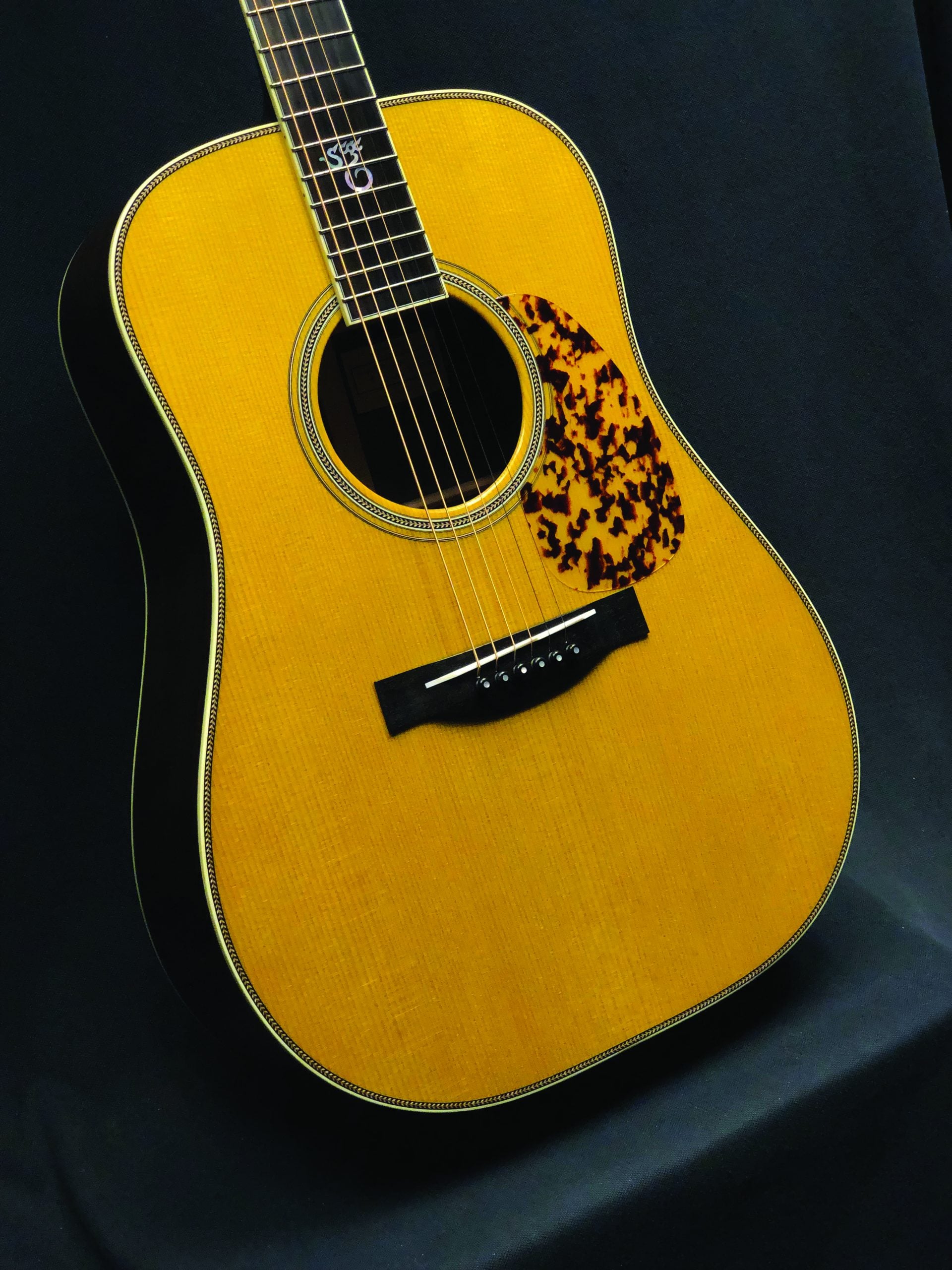
One key to the sustaining success of the company has always been its association with great guitarists, the most prominent and long-lasting being Tony Rice, of course. In recent years, however, Hoover has looked for ways to connect his company’s brand with new artists he feels are a good match. One contemporary example is Portland, OR-based guitarist Eric Skye, who migrated from an electric guitar background to emerge as one of the purest, most musical flatpickers of the 21st Century. In precisely the manner Hoover collaborated closely at every level with Rice himself during the ongoing evolution of the various Tony Rice signature models (see sidebar), Hoover and Skye have built a solid relationship that led to the release of Skye’s own model, a 00-18 style instrument with many subtle refinements.
“Richard and I have spent time over the years traveling around the country together to play and talk at guitar stores, and developed a friendship that I treasure,” Skye says. “We also developed a heck of a little guitar together. My 00 (00-Skye) is something that is not only a great fingerstyle guitar, but has also turned out to be quite the little flatpicking canon, as well. I prize a small body, lightly built steel-string guitar for its greater dynamic range. An acoustic guitar is not in the same universe as, say, a saxophone that can go from whisper-quiet to as loud as a truck horn in one note. So a guitar with increased dynamic range is just a much more expressive instrument for me.”
“Our Artist Relations is an evolution of who contacts us, who wants our guitars, and can we build them a custom guitar that has universal appeal,” Hoover adds. And as a company so closely tied to one of the greatest bluegrass musicians of all time, it’s no surprise SCGC lends the music and its institutions all the support it can afford. “We’ve sponsored Merlefest, the old Wintergrass, the California Bluegrass Association every year. We supply guitars for auction that people can bid on to support those organizations,” Hoover says. “We are big supporters of bluegrass. We promote the festivals and get-togethers, we pay for posters and advertising, and we also donate labor and resources.”
As he faces the future, Hoover maintains the realistic perspective that one day, he won’t be leading the SCGC team and has plans in place for that inevitable outcome. “Absolutely. It would be horrible and unethical not to have that in place. I don’t work every day now, but I come in and work every week. I’ve spent a career building the company and never speak in the first person about the culture and the company. I always promote the team effort, because it truly is a team. This is not an interchangeable workforce. That’s our strength.”