
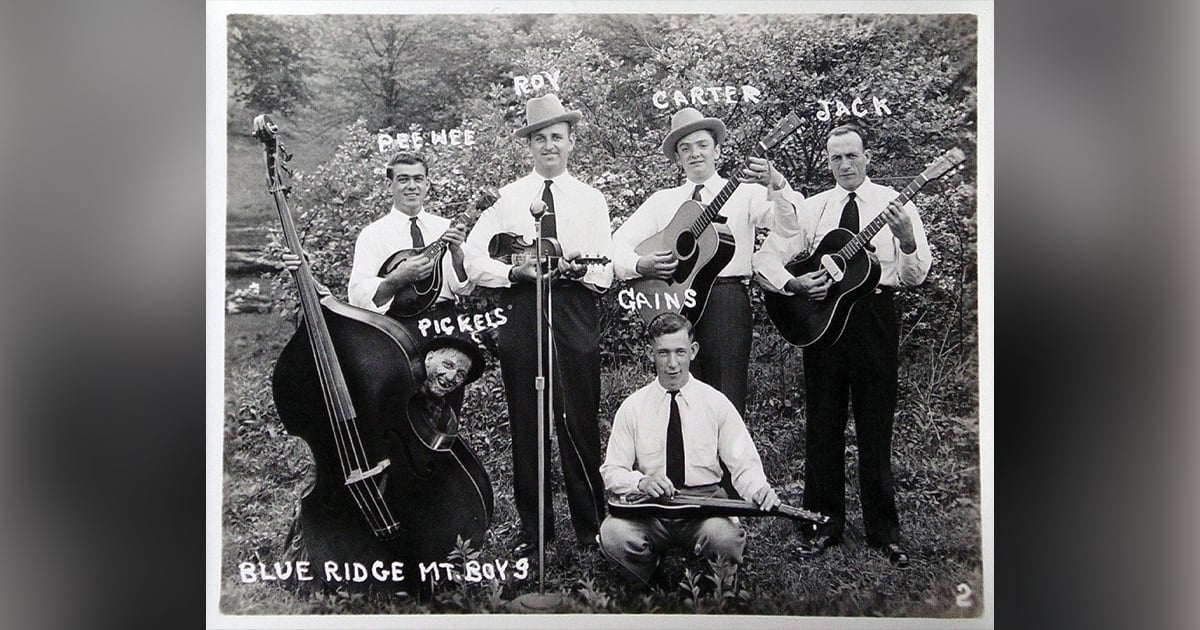
Roy Sykes
Bluegrass Incubator
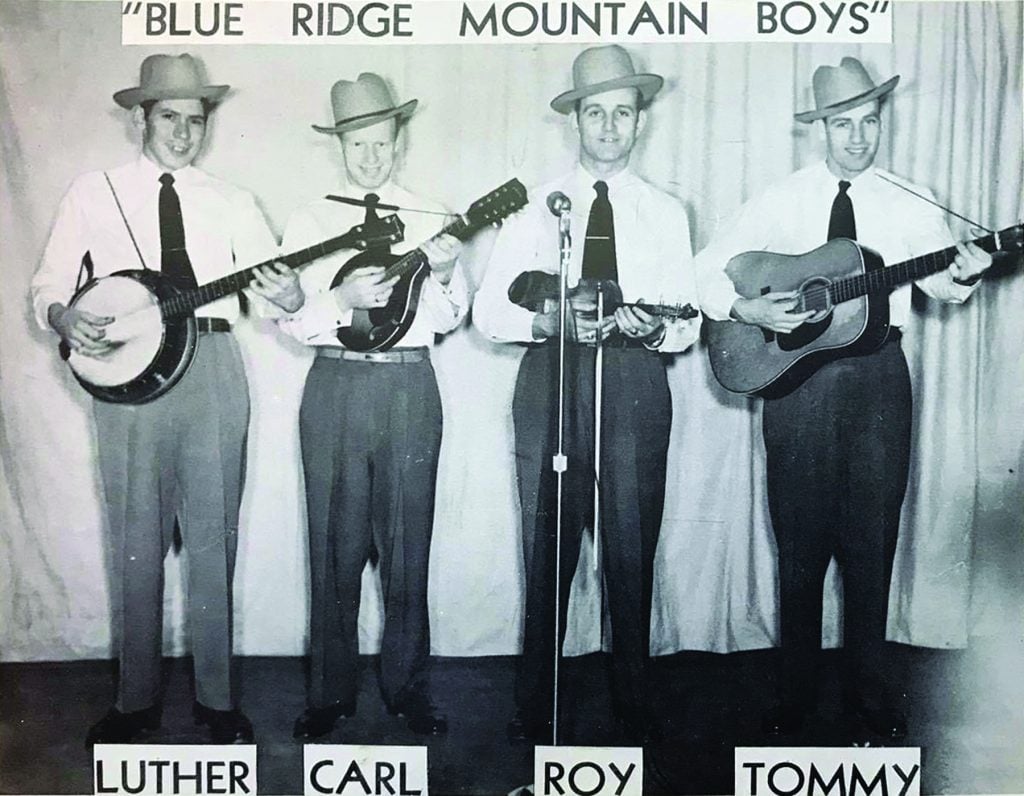
Many times, people who are known as but a footnote in history actually have vibrant lives that belie their postscript status. Such is the case with Roy Sykes, whose claim to fame is that his band, the Blue Ridge Mountain Boys, provided the career launch pad for Stanley Brothers. Less well known is the fact he gave bluegrass stalwart Jesse McReynolds his first job. Roy Sykes, a fiddling bandleader, had a robust, albeit local, career in the years before and after World War II.
Roy Eugene Sykes was born on March 8, 1921, and grew up in Finney, Virginia, a tiny hamlet in Russell County; the nearest post office was in Coulwood, Virginia. His mother, Vashti Ray Sykes, played fiddle and his father, Ira Dale Sykes, played clawhammer banjo. Roy recalled that his dad was “smooth on that banjer. He didn’t do too much rapping it like most of the clawhammer players does. He was picking out…noting it out. That’s what he always stressed, noting it out with the banjo. [At square dances he was] noting it out in the clawhammer style, which is very hard to do. He played a lot of those old hornpipes.”
Roy started out on banjo and made his radio debut in 1929, at age eight, on WOPI in Bristol, Tennessee. He noted that the radio’s studio occupied the same space where the Carter Family and Jimmie Rodgers had recorded during the famed Bristol Sessions a scant two years earlier, in 1927. But it was an older brother (Roy was the youngest of four boys) who got him started on the road to becoming a fiddle player. “I more or less picked it up from a brother of mine. He played the fiddle and played the mandolin. He’d lay his fiddle down on the bed and I’d catch him go out and I’d get his fiddle and snitch it and try to saw a few on it.”
Although radio was still in its infancy, it proved to be a source of inspiration in Roy’s musical development. His oldest brother, Paul, teamed up with a cousin and several friends to form a group which had a Saturday broadcast (most likely on WJDW) in Emory, Virginia; the fiddle and banjo were part of the aggregation. In the summertime, after the broadcast, the group would gather in a neighbor’s yard for more music making. The picking would stop in time for the broadcast of the Grand Ole Opry.
“That was back in the first days of radio when they had the old battery sets,” Roy recalled. “There wasn’t over five or six radio sets in the little town where I lived. The old man [the neighbor], he’d go up to Honaker and have the battery charged up that week so that they could hear the Grand Ole Opry on Saturday night good and strong. There’d be 50 or 75 people gathered up there in the yard because very few people had radios in those days. [They] had a big living room and they’d fill the room full…on the porch and out in the yard still. They’d have the doors open and turn it up.”
Other local musicians were a source of inspiration, such as Hayes Monk, “one of the best fiddle players I ever heared in my life.” Indeed, at a 1925 fiddlers’ contest in Bluefield, West Virginia, Monk won the honor for best all-around musician. And it was Henry Shell, a three-finger banjo player from Cleveland, Virginia, who gave Roy some of his first experience in a band setting. Starting at age 14 or 15, Roy played some dances with him in the area.
While in high school, making music in public settings usually took place on Fridays, Saturdays, and Sundays. The group featured Roy on fiddle, brother Paul on mandolin, and a boy named McGee from Richlands, Virginia. Occasional Saturday evening performances included a jamboree that was broadcast over WOPI and was emceed by Tennessee Ernie Ford.
Radio Entertainer
Roy graduated from high school in the spring of 1938 and eventually made his way to Williamson, West Virginia, and radio WBTH; the station had its first broadcast in April of 1939. It was there he was part of a band called the Virginia Liners. The group performed six days a week with an early morning program. In addition to Roy on fiddle, there was John Wilson on guitar, Jack Bess (sp?) on banjo, James Cox on guitar, bass and comedy, and another musician by the name of Gazo Ellis.
Also at the station were the Lonesome Pine Fiddlers (which consisted of Curly Ray, Ned, and Ezra Cline) and a group known as the Stepp Brothers. Esland Rex “Zeke” Stepp and Esmond “Ezra” Stepp performed with two guitars (one of them being a tenor guitar) and sported a sound similar to the Delmore Brothers. Additionally, there was Lynn Davis and Dixie Lee (who later gained fame as Molly O’Day).
At some point around the start of 1939, the Virginia Liners moved to WLAP in Lexington, Kentucky. They were featured on a program called Asa Martin’s Morning Round-up. Other cast members included a female group called the Sunshine Sisters (Irene Amburgey Roberts—aka Martha Carson (18), Bertha Amburgey (20), Opal Amburgey (15).
Towards the end of 1939, Roy relocated to Bluefield, West Virginia, where he appeared on WHIS as part of a group known as Joe Woods and the Pioneer Boys. Other musical entertainers on the program included the Buskirk Family and the duo of Lee Moore and Juanita. The Sunshine Sisters likewise relocated to WHIS about a month after Roy’s arrival there.
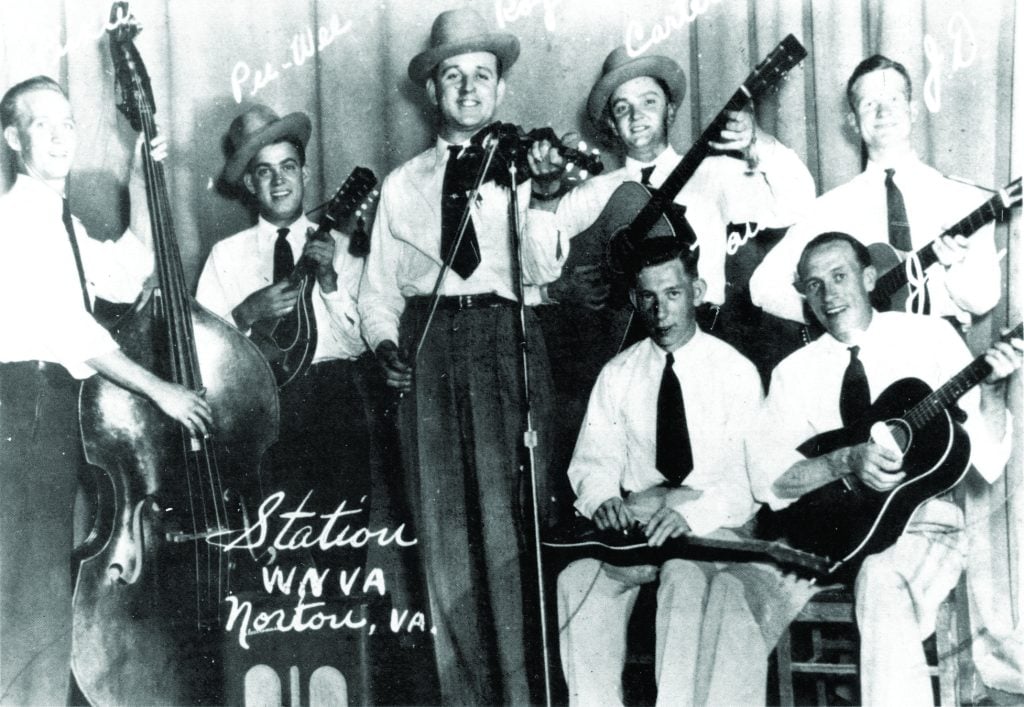
A chance encounter resulted in the formation of a new trio. On a Saturday morning drive into Williamson, Roy “met Pee Wee [Lambert on the] side of the road a-hitchhiking. [He was] going down to the Williamson radio station…had his mandolin and he was hitchhiking. I picked him up. My mother…when he came down to my home…give him the name Pee Wee because he was so small. She started calling him Pee Wee and he carried that name as long as he lived.” Roy later told Bluegrass Unlimited columnist Frank Godbey that “Pee Wee and Estil Dotson, a guitar player from Thacker, [West Virginia], had been playing together some…(We) went to Bristol to play…on WOPI. (It) was the only station down there then.”
After a period of time, Roy relocated to Baltimore to do carpentry work. Estil Dotson accompanied him and in short order the two were making music on Friday and Saturday evenings, including square dances at Stemmers Run near the Essex section of town. It was while in Baltimore that Roy purchased a then-new 1939 Martin D-28 Herringbone guitar. He paid $187.50 for it.
You’re In The Army Now
In July 1942, Roy received his call to join the military. He returned home from Baltimore and was mustered into service in Abingdon, Virginia. A number of assignments took him to Camp Lee in Atlantic City, New Jersey for basic training; Bowman Field near Louisville, Kentucky; Miami, Florida; back to Bowman Field (where he joined with other servicemen to perform on radio station WAVE); Baer Field near Ft. Wayne, Indiana; Camp Kearns in Utah; Killeen Field in Texas; Camp Shanks in New York; and from there to Liverpool, England.
Roy’s first two years in the Army were spent as an MP (military police). Once in England, he was part of the ground crew that supported the air force. He worked as a truck driver, carrying supplies back and forth from the air plane hangars. He assisted in the loading of airmen and supplies for the D-Day invasion.
Shortly after D-Day, Roy went to South Hampton and from there to Amiens, France. Once in France, as part of the truck company, he delivered supplies throughout the country. Given his musical abilities, he was also assigned to a Special Services unit and was in charge of an enlisted men’s club.
A short time later while in Frankfurt, Germany, Roy was “still running enlisted men’s club and we were playing radio programs out of Frankfurt, Germany on the Armed Forces Network. Six days a week we played 30 minutes in the afternoon and played a 15-minute transcription for early morning program six days a week. Mickey Rooney was there on the program with us five weeks; he was a known show at the service clubs. It was eight of us in all.”
Roy noted, “We had pretty good coverage there. We were operating on 100,000 watts.” The programs were “coming to the States [by] shortwave and going to the South Pacific [by] shortwave. There was some lady in Philadelphia that she wrote us regular. We drawed mail from Okinawa in the South Pacific; they were picking up the program 10,000 miles away from us.”
Known as the Ranch House Boys, the January 18, 1946, edition of the military newspaper Stars and Stripes touted the group as a “cowboy musical octet that plays over radio station AFT” and that they “have received daily reports that their program has a popular audience in America.”
The article continued, “The octet, under the direction of Sgt. Carl Sturgeon, consists mainly of men from the 766th Railroad Shop Bn. Other members of the group are Roy Sykes of Coulwood, Va., Jake Boyce of Nashville, Tenn., Joe McKonkey, “Red” Lilley of Portsmouth, Va., Leon Mitchell of Ky., Bill Gross of Mich., and “Blackie” [last name unknown] of Wichita Falls, Tex . . . Some of the most popular songs of the octet are: ‘Happy Roving Cowboy,’ ‘Way Down Yonder,’ and ‘When a Cowboy Sings His Song.’”
Carter Stanley
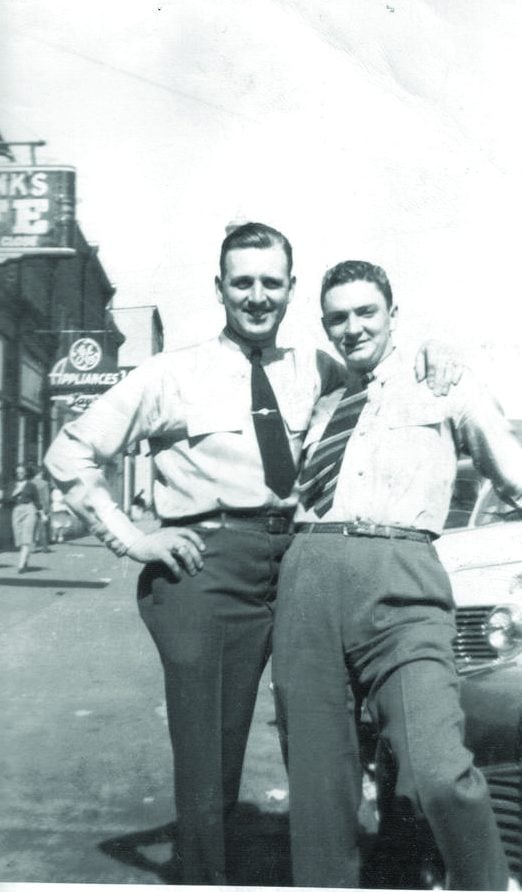
In February 1946, Roy was transferred to Antwerp, Belgium, and from there to Ft. Kilmer in New Jersey. A day later he was headed to Ft. Meade in Maryland for discharge. He noted, “When we came to Ft. Meade…we were in the barracks and some boys [were] making music two or three barracks over from us. I went over and listened to ‘em play a while…wasn’t anyone that I knew. But…that’s where I met Carter Stanley. Carter was there jamming with ‘em in the barracks…I listened to ‘em play a while…one boy had a mandolin and some boy had a banjo I believe…and three or four guitars.
“I got to talking with Carter…asked him where he was from [and] he said St. Paul, [Virginia] …his dad lived at St. Paul at that time…and we got to talking. I had that Martin of mine…I had [it] sent overseas to me and we were using it there over Armed Forces Network. I told him that I had a fairly good guitar over in the barracks. He hesitated on taking it out of the case. He strummed down on it…he just looked around and a big grin came on his face. There was so much difference to the guitar he’d been playing, you know. I told him I was going back in the radio business…ask[ed] him if he’d be interested. Four days after I got discharged, Carter came up to my home looking for me.”
Having been away in the service for most of the last four years, Roy didn’t own an automobile. With manufacturers having been involved in producing machinery for the war effort, it was pretty much impossible to purchase a new car. On a trip to Bristol with Carter Stanley, Roy secured a used vehicle. From there, the duo went to Norton, Virginia, where radio station WNVA was slated to being broadcasting on March 14, 1946. The station manager had been at WBTH when Roy played there in 1939; he readily agreed to give him two fifteen-minute time slots of his choosing, six days a week.
Blue Ridge Mountain Boys
Next came the task of assembling a new group. Roy noted that “we didn’t have a band at that time . . . Carter and I started looking. So, we went to Pee Wee Lambert’s home back in West Virginia and Pee Wee was gone down in Georgia…I left word with his mother to tell him to call me when he come back. I went after Pee Wee first…on the mandolin…because I knew that the style playing he did could team up with Carter good on the style we intended to play.”
WNVA signed on the air on March 11, 1946. An advertisement in the April 4, 1946, edition of the Coalfield Press announced that Roy Sykes was on radio every weekday morning at 7:00 am and that the band included Roy Sykes, Ray Lambert on bass and comedy, Carter Stanley on guitar and lead vocals, Gains Blevins, and Ivan Powell, a two-finger style banjo player from Roan Mountain, Tennessee. The group was sponsored by Kennedy’s Piggly Wiggly Stores. The month of April found them with two shows per day on WNVA, one from 7:00 to 7:15 am and another from 1:30 to 1:45 in the afternoon.
Eventually Pee Wee Lambert contacted Roy. “He called me one evening…he was in Bluefield and he was on his way to Norton. [I] had a boy with me that done Eddy Arnold and Ernest Tubb type songs and a steel guitar player that I picked …Gaines Blevins and J. D. Richards.”
At some point, Roy had a movie trailer made that could be shown in theaters in advance of their personal appearances. The film was about a minute in length and consisted of fourteen black and white frames that flashed different messages: “Hey Folks!” “Look who’s coming to our stage in person” “Roy Sykes” “and his Blue Ridge Mountain Boys” “You’ve heard them on radio…” “You can’t afford to miss…” Unfortunately, it was a silent film but the reel did contain a group photo that included Pee Wee Lambert, Roy Sykes, Ray Lambert, and Carter Stanley.
Work for the new group included high school auditoriums, public auctions, a recreation area opening, the Midway Jamboree (which was situated between Norton and Wise, Virginia), and a Kiwanis Club meeting.
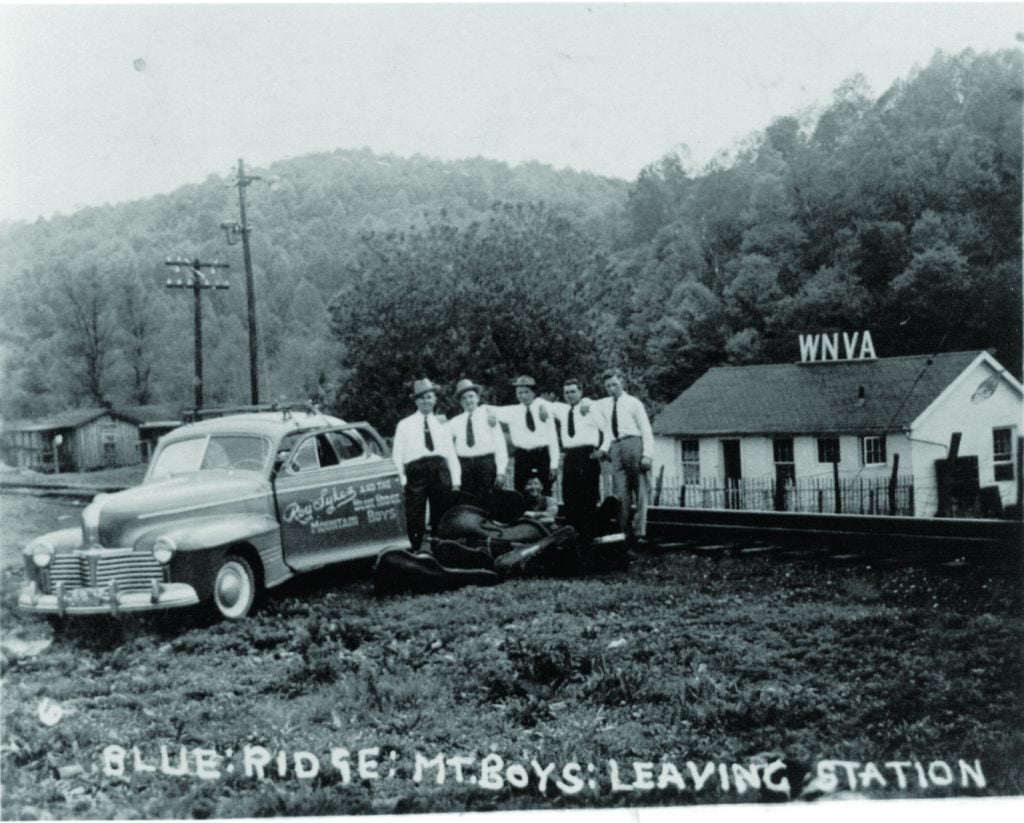
As the group continued to grow, Roy introduced new features. “Three or four others came and I wanted a quartet. I had Paul Prince, the fiddle player that played with Charlie and Bill Monroe and a bass singer…I got Paul and I fell back on the five-string banjo after I let Ivan go…he just quit on a friendly basis. Carter sang lead, Pee Wee Lambert [on tenor], and Paul Prince singing bass, and Ray Lambert singing baritone.
“Carter even did comedy with me after Ray Lambert left. That’s another thing that a lot of the public don’t know that Carter was a good comedian. That’s where Carter got the name of Cousin Winesap…that was the name that Carter went under when he was playing comedy for me. That [was] Carter’s thinking. Ray Lambert went as Sour Pickles and he didn’t want to take up a name that Ray Lambert had used so he thought him up the name.
“Then I got Leslie Keith. I switched over to banjo when Leslie was fiddling. Leslie played the banjo, too…he played a clawhammer lick, you know…played a few numbers. We’d just take turns ‘cause I wanted a banjo player in the band and [at] the same time I was holding the spot for Ralph [Stanley] when he come back from Germany. I sung a little bass and Leslie Keith sung a little bass in the quartet.”
Although Roy stayed plenty busy with his group, he still carved out time for romance. “In the mean time I had been a-going with what turned to be later to be my wife. I had been going with her before going in the service in World War II. Her younger sister, Mary, I got a date for Carter with her. They wound up getting married before me and my wife did. They married in the last part of ‘46 and I married [on] February the 14th 1947.”
Ralph Stanley
The months of September and October 1946 found the group with two shows per day on WNVA, one from 7:00 to 7:15 am and another from 12:00 to 12:15 in the afternoon. “‘Bout the next thing there…Ralph came back to us. Shortly after Leslie had been with us…probably two or three months…Ralph come back out of the service. Leslie left…I believe Leslie come to Harrisonburg if I’m not mistaken. I started playing fiddle and Ralph started picking the banjo.
Ralph Stanley related: “I think Carter was discharged from the army about six months before I was and he started playing with Roy Sykes and the Blue Ridge Mountain Boys. So, when I did come in why I know my dad met me at the bus station in St. Paul, Virginia, about one o’clock in the day and Carter was on this show in Norton, Virginia. WNVA radio station. And they had a daily program at about somewhere around three o’clock. And I know we…my dad took me on to the radio station and I sung some with Carter on that program that day. We went on by home and I went on that night with ‘em on a personal appearance and started right then with them.”
It was only a short time after Ralph’s discharge that Carter and Ralph broke away from Roy to start their own band and they took Pee Wee Lambert with them. As Roy noted, “That left me.” The Blue Ridge Mountain Boys were pretty much decimated.
Time to Regroup
Roy wasted no time in assembling a new group. Chief among his first recruits was a 17-year-old Jesse McReynolds. Others included Zeke Stepp of the Stepp Brothers, and the husband and wife duo of Clete and Dottie Cline. The new group left Norton and headed to Johnson City, Tennessee, and radio station WJHL which was home to the Saturday Barrel of Fun program. Other radio work also took place in Bristol, Virginia, at WFHG.
The stay at WFHG lasted from the spring of 1947 through the end of November, at which time the group moved to Bluefield, West Virginia. An advertisement for a December 23 show date at the Lee Theatre listed the personnel for the group. On hand were Bobby Sumner with “Fiddling the Songs You Like,” Tex Baldwin who was a “Famous Singer of Mt. Songs,” and a comedian named Old Cousin Jasper “With a Barrel of Jokes.” Sumner was an excellent eastern Kentucky fiddler who had the distinction of being the first fiddle player to ever play with the Stanley Brothers. While in Bluefield, Sumner’s brother Marion joined the group and the two played twin fiddles. Elbert McKinley “Tex” Baldwin hailed from Richlands, Virginia, and, along with his brother Perry Lee Baldwin, logged time with Sykes in Bluefield.
The stay in Bluefield lasted until the middle of 1948, at which time Roy returned to Bristol. He talked with Jim and Jesse McReynolds about going with him to Detroit to do club work there. The brothers had a competing offer to go to work with Wade Mainer on WBBO in Forest City, North Carolina. Club work did not sound all that appealing to Jim and Jesse and they opted to go with Mainer.
In the fall of 1948, Roy secured another spot on WFHG in Bristol. Included on some of his show dates were Jim and Jesse, who had evidently returned to Bristol from their stint with Wade Mainer. After a brief stint on the Bristol station, Roy took off for several months.
In the early part of 1949, Roy headed to Pikeville, Kentucky, and—without a band—talked his way into a time slot on WLSI. In the two weeks before he was slated to start, he rounded up a trio known as the Bevins Brothers. Carl Bevins played mandolin while Alfred and Tommy Bevins played guitars. A recording session with this group was scheduled with Rich-R-Tone Records but a last-minute illness by one of the Blevins forced a cancellation. Eventually the Bevins brothers moved on and were replaced by Paul Fuller, Earl Miller, and fiddler Paul Prince.
In the summer of 1951, Roy secured a spot on Bristol’s Farm & Fun Time program. His band members at this time included Larry Richardson (formerly of the Lonesome Pine Fiddlers), Vic Daniels (a previous member of Curly King’s Tennessee Hilltoppers), and Charlie Lundy.
Another run at WHIS in Bluefield, West Virginia, was most likely the last serious work that Roy did in the years immediately following World War II. The band included some holdovers from WCYB plus a Scott County, Virginia, native named James Swanson “Swannie” Kendrick.
Lawman Roy Sykes
At times, during lulls in the music, Roy assisted his father in doing carpentry work. However, on February 1, 1952, he accepted a position with the Richlands, Virginia, police department. His work with the military police during World War II no doubt played into his decision to apply for the job. By May, he had transferred to the police force in St. Paul. And, by 1953 he had moved once again, to Pocahontas, Virginia, where he served in law enforcement for the next seventeen years.
Newspaper accounts over the years indicated that Roy’s police work involved trading gunfire with an active shooter, assisting in investigating a breaking and entering, arresting a husband for the shooting of his wife, and apprehending an escaped prisoner who had been on the loose for eight months. At one point, he was referred to as a deputy sheriff.
While in Pocahontas, Roy kept a hand in music with occasional appearances on WHIS radio in nearby Bluefield. He also filled in with the Stanley Brothers if they were in the area and in need of a fiddle player. (Roy and Carter Stanley were brothers-in-law, having married sisters shortly after the end of World War II.) For about a year, in 1965, he had a radio program in Richlands, Virginia, on station WRIC. Later, in 1966, he relocated to Ohio and did club work around Lima and Columbus.
Despite having been immersed in music for so long, Roy never made any commercial recordings. In fact, the only known surviving samples of his music come from a benefit concert for Carter Stanley that was held in April of 1967. Roy’s home county newspaper in Lebanon, Virginia, offered a very succinct recap of his achievements: “He was active in country music circles and played in Roy Sykes and The Blue Ridge Mountain Boys Band. He was formerly employed as a police officer serving in several area towns and also formerly employed as a carpenter.” He was a proving ground and a launch pad for luminaries including Carter Stanley and Jesse McReynolds and was an accomplished musician and bandleader in his own right. Roy Sykes passed away on March 30, 1985, at a hospital in Johnson City, Tennessee, after an extended illness. He was sixty-four.
A brief note about this article. The majority of the information presented here was extracted from an interview that long-time Bluegrass Unlimited contributor Walt Saunders conducted with Roy Sykes on March 4, 1977. Unless otherwise noted, all quotes by Roy Sykes came from this interview. In some cases where Roy was vague about exact dates or sequences of events, period newspaper advertisements and articles helped to fill in some gaps. Yet, a few assignments of dates remained as educated best-guesses. Hopefully what comes through is Roy’s legacy as a vibrant professional entertainer and as a mentor some of bluegrass music’s earliest practitioners.
Subscribed to magazine but can’t get digital access. Does not recognize nose my account number