Roland White
Roland White passed away on April 1, 2022, at age 83. All who knew him remember the standup guy he was—a warm, welcoming, humble, generous man of wide smile and sleeve-worn heart. And we all remember what an outstanding, innovative mandolinist he was. Having played for decades with many famous bands— with his brother, Clarence, in the Kentucky Colonels, with Bill Monroe in the Bluegrass Boys, to name two—Roland White is bluegrass royalty. I had the honor of playing music with him a dozen years ago.
June 2009
CBA Summer Camp, Grass Valley, California
Roland was teaching at the California Bluegrass Association Summer Camp along with Laurie Lewis, Bruce Molsky, Jack Tuttle (Molly’s dad), Keith Little, me, and a few others. It fell to Roland to lead the teachers who’d be playing the instructors’ set at the Fathers’ Day Festival following camp.
For the set’s finale, he rehearsed us in a medley: “New River Train,” “Y’all Come,” and “Orange Blossom Special.” It wasn’t until we’d played the show that I saw Roland’s choice of these three tunes was designed to end the set on a high note. In calling “New River Train,” first recorded in 1923, Roland was digging into the roots of American rural music, past bluegrass and country, into the hillbilly era, for this three-chord song of faux-cautionary lyrics:
Darling you can’t love one / Darling you can’t love one,
You can’t love one and have any fun / Oh darling you can’t love one.
Roland’s next verses warn against loving two (can’t love two and let your heart be true), three (can’t love three and still love me), and four (can’t love four and love me anymore). On the New River Train, you can’t win in love. Choosing this tune was something younger folks in the band would not likely have done. But Roland made it the right call.
Arlie Duff wrote “Y’all Come,” our medley’s next song, in the 1950s. Even if you don’t know “Y’all Come,” you know it. The song is in America’s genes. But a few eyebrows rose as Roland called this tune. Like a Normal Rockwell painting, the song portrays a time that was, but no longer is, a ghosted innocence. It is through this too-good-to-be-true phonograph record of kith and kin gathering for a lively dinner at Grandma’s, that we hear this song today. Its chorus begins with the singer hollering, “Y’all come,” at the audience, one that all the band and audience should respond to with a hollered, “Y’all come!” During the show, Roland’s gentle French-Canadian/Maine/California accent—he spoke French before he spoke English—his unadorned expression of the line, his coming from a place of “y’all come,” of openhearted welcome, was clear to the room. We heard Roland’s heart in his holler. The audience and band all shouted a boisterous “Y’all come!” back at him every time. Roland had hooked us.
He said that the last tune in the medley, “Orange Blossom Special” (OBS), had to end immediately after the first chorus. He knew that after the four-verse rendition of “New River Train” and the three-verse arrangement of “Y’all Come,” we should only touch briefly on OBS. This scorching instrumental, beginning in E, modulates up a fourth for a fiddle solo in A that shuffles up another fourth, a guaranteed musical lift. Sometimes the fiddler quotes Art Wooten on the Blue Grass Boys’ classic recording of this instrumental, but finally his success rides on leading an all-horses-at-full-gallop exit from the arena. Our fiddler, Paul Shelasky, rising to the occasion, rose up in his stirrups and brought the house down.
The set was a demonstration of Roland’s wise understanding of how music works, how to make it work for you, of performance and the arc of a show, of choosing tunes and ending tunes to create climax, and of directly involving the audience in your show with a shout-along. A shout-along? Who does that anymore? Roland had shown us impressive show savvy.
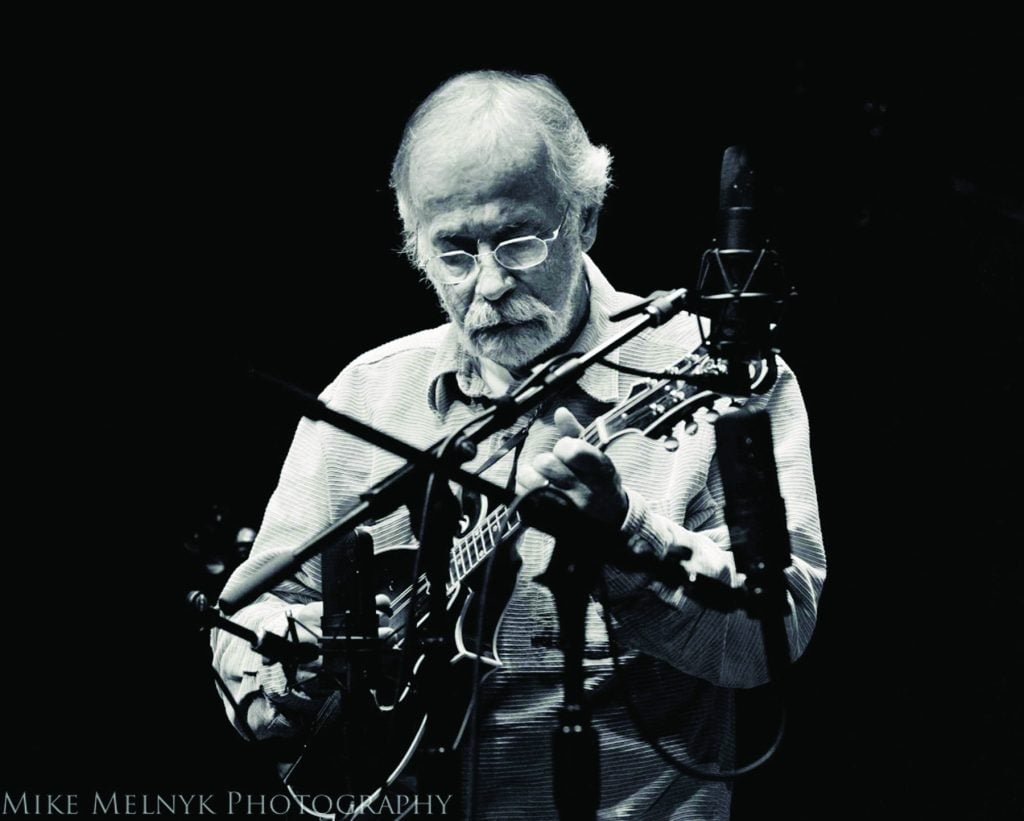
Wire-rimmed glasses frame Roland White’s eyes. His full, neatly trimmed white beard and slowly thinning white hair outline a gentle smile. He takes one step for every three that most of us take. This seems more about wisdom than economy.
Roland is generally an understated guy, another of his wisdoms. When he picks up his mandolin, one that Gibson custom-made to his specs in 2004, he plays with an easy, loose right wrist, his power coming from forearm and waving hand. His tone is both meaty and trebly. His left hand fingers crawl low over the fingerboard, also making one move for other pickers’ three.
February 2010
CBA Winter Camp
The CBA Winter Camp took place in February at the Walker Creek Ranch outside Petaluma, California. Roland was there, as was Keith Little. At the Staff Concert on Wednesday evening, the instructors joined in ad hoc groups to play a show for the students. Ingrid Noyes, the camp’s director and show’s M.C., introduced the group that included Roland and Keith with, “Roland is one of the two nicest guys in bluegrass today. The other is Keith Little.” What an honor she had paid them and what a truth she had told about them both. Everyone who has met these guys thinks warmly of them.
At this camp, I hosted a Q&A with Roland and Peter Rowan, both of them genuine Bluegrass Boys, though at different times. At the end of the talk, they played a couple of tunes, including Peter’s “Walls of Time.” The two, with mandolin and guitar (echoing Bill and Charlie Monroe), their voices sharpened by years of singing bluegrass and singing it with Bill Monroe, took us on a nostalgic visit to bluegrass of the late 1940s and early ’50s. It was a sharper-edged genre then, tougher, raw-er. Legacy bluegrass got no major 7ths. The lyrics were often about hard times on the farm, and the singers sounded like men who’d driven a horse-drawn plow, which they often had. If the song was about love, it was frequently unrequited.
Roland and Peter, veteran singers of the close harmonies and sawtooth intonations of bluegrass singing—the falsettoed 3rds and hollow 5ths—took us chin deep into the ancient tones of bluegrass. I could hear the room thinking, “So that’s how it’s done.”
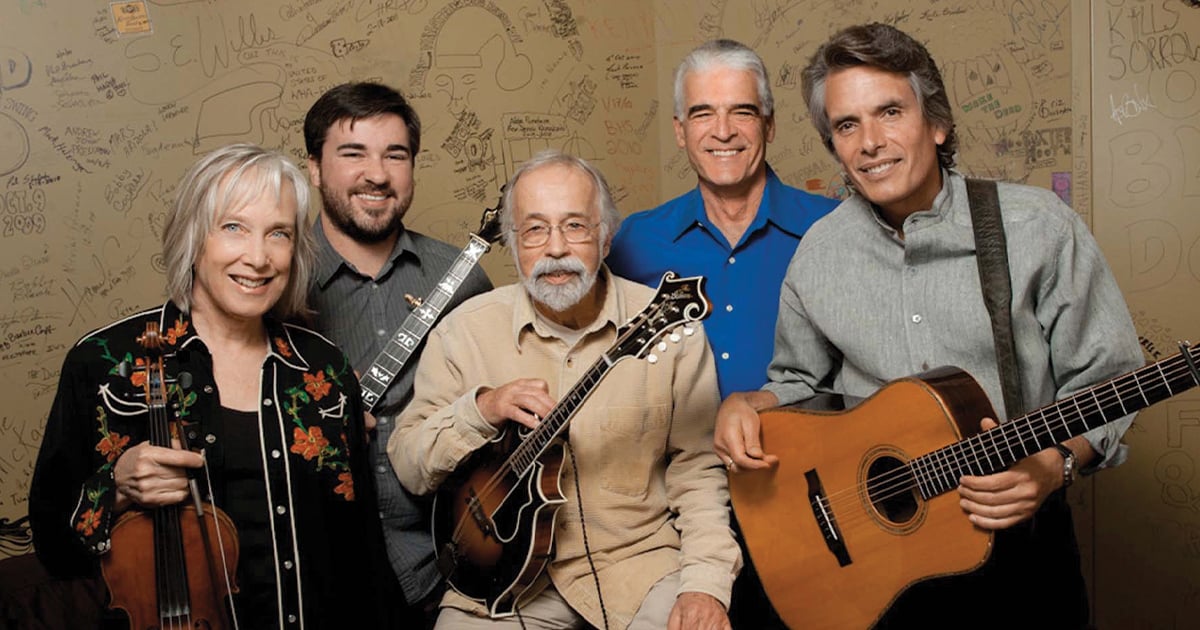
At the end of camp, Roland asked Laurie Lewis, Keith Little, Jim Nunally and me to play some California shows with him in February. Roland wanted to give the band a name that mentioned all our individual names, but Dave Fleming, owner of The Palms, one of the show venues, insisted on “Roland White And His All Star Bluegrass Band.” This bothered Roland’s humble nature, so he phoned me.
“Bill, I want to call this group by everyone’s name, but this guy Dave Fleming, he owns The Palms, he wants me to call it the Roland White All Star Band, or something like that. I’m awfully sorry about this, but is that all right with you?” He called us all to apologize for the “All Star” name and to get our okay. No one objected, because Roland’s name alone in the group’s title was the right thing, the only thing, to do. The five of us had never played together, and we were looking forward to rehearsing at The Palms, 3:00 o’clock that afternoon. I arrived five minutes early, and when twenty minutes had elapsed with no sight of Roland, called him on his cell. His voice sounded rough, like he was sick, or like I’d woken him up. “Yeah,” he said, “We’re on our way, running half an hour late.”
When they hadn’t showed in an hour, we felt something was up. Roland had been nursing a cold at Winter Camp all week and seemed sluggish. Late Thursday evening after camp, he drove north to Jim Nunally’s, and, lost on the way, passed a cold night sleeping in his car under a bridge. Next day at Jim’s, he fell down and couldn’t get up for fifteen minutes. Roland drove to The Palms gig with Jim, sleeping till my phone call woke him, and arrived with his chin on his chest, looking wobbly on his feet.
In the dressing room, Roland called his wife, Diane Bouska. “You get to a clinic for a checkup now,” she insisted. We walked him to the Winters Healthcare Foundation, three doors down from The Palms. They took Roland in on the spot and assessed his vital signs. Falling down gets low points from doctor types, so they recommended we immediately take Roland to the Sutter-Davis hospital, a half hour down the road. Whoever took Roland to the hospital would be easily two hours before getting back. Which band member was going to do that?
At this moment, Keith Little’s wife, Phyllis Polito, arrived—Heaven-sent, perhaps—and volunteered to drive Roland to Davis. As we bundled him into the car he leaned into my ear and said, “Gettin’ old ain’t for sissies.”
The four of us walked back to the dressing room to rehearse. It was Roland’s gig, so we decided to do his songs in homage to him. We went over “Darling You Played with a Toy Heart,” “I Might Take You Back Again,” “Satisfied Mind,” “I’m Blue and Lonesome Too,” and a few others Roland is known for.
During this rehearsal, Laurie, Jim and Keith showed what exceptional lead singers they are. But they also stood out as harmony singers, possessed of big ears, clear voices, as well as the feeling, the touch, for singing liquid harmonies.
As for my singing, bluegrass bass players live in one of two camps: those who sing while they play, and those who do not. Those who don’t sing are in the overwhelming majority, I believe. The non-singing bluegrass bass-player is bluegrass legend, and sometimes, unfairly, the butt of bluegrass jokes. I love to sing, and I love to play bass. But I don’t sing and play bass at the same time … unless the microphone is far away from me, it’s the last song in the second set, an “Irene Goodnight” kind of a song, the house is soused, and I’m swaying to the music. Then I will sing and play bass. So, I didn’t ask to join in the singing, and the three of them were diplomatic in not inviting me.
At the rehearsal, we stood or sat in a circle, Laurie straight ahead of me, Jim and Keith to my left and right. I listened while they sang and re-sang, honing the tunes to how Roland performed them. They worried the blues notes, tuned and re-slid them, tightened their phrasing, adjusted dynamics. They worked on the lyrics—“What are the words Roland sings right there? … You say what?” Listening at close range to these three singers working together was a delightful, ear-filling experience.
In the meantime, at Sutter-Davis Hospital, the doctors diagnosed Roland with pneumonia. “That’s not so bad,” someone said. “Pneumonia is treatable.” But then an x-ray pointed to bronchitis. No fun this bronchitis either, but the sawbones put you on antibiotics that do their job quickly, we reassured ourselves. Within 24 hours you bounce off the bottom, and in 48 you’re on the mend.
They started giving Roland the antibiotics an hour and a half after he arrived at the clinic. Phyllis brought him back in time for the second set and he slept in a wingback easy chair to the side of the audience. At gig’s end, Laurie collected and tallied the band’s share of the proceeds. We agreed that Roland should get an equal share plus a leader’s cut on top of that. Laurie divvied the dough that way and passed it around.
Roland went back to Jim’s house that evening and flew home Sunday. I called him at his home in Nashville on Monday. “I’m fine,” Roland said, “just fine. I’m so sorry I missed the gig. Thank you for covering for me. And thank you for the generous split. I didn’t deserve my cut.”
March 4, 2011
Redding, California
I was fortunate to play a North California tour with Roland this week, along with Patrick Sauber, Laurie Lewis and Keith Little. On Friday, March 4, with Mike Wilhoyte replacing Keith, we played at Bernie’s Guitar in Redding. Following the gig, late that evening, Roland, Mike and I drove to Linda and Bruce Wendt’s 100-acre ranch above Redding to stay the night. We arrived well after dark, and had no feeling for what lay outside the home’s insides.
We awoke the next morning to see we were in a country home overlooking a bright vista of cows, chickens, pigs, ducks, vegetables, and fruits. Bruce was in the kitchen cooking chilaquiles, a Mexican egg dish, and Linda was preparing the dining table for company. We took seats and Bruce served us the eggs. As we started wolfing down what may be the tastiest breakfast I’ve ever had, in walked the Wendt’s daughter and son-in-law, Tom, and their three kids. As a pot of strong coffee and a carafe of O.J. started around, a country breakfast party got under way.
Their neighbor down the road who runs the local coffee shop, dropped by for a cuppa joe—that says a lot about the Wendt’s coffee—and we all shook and howdied with him. Laurie, Patrick, and their hosts arrived and joined in. Then the gal who lived across the way—Tom’s sister—stopped by. We were a family of sixteen people, some related by blood, all related by love of music.
When an old Flatt & Scruggs tune came on the satellite bluegrass channel, Roland told a story about playing with Lester Flatt in The Nashville Grass. “We walked on stage at a Tennessee schoolhouse with eleven people in the audience. I said to Flatt, ‘I guess you don’t draw much here, Lester.’ “Flatt shot back, ‘This is your crowd, Roland.’”
Then Roland, Laurie and Patrick sang a gospel chorus that hushed the room. So, here was grandma and grandpa, kids, kinfolks and neighbors, sitting at a kitchen table overflowing with scrumptious food, telling stories and gossiping to make a mockingbird blush. The bluegrass channel was playing in the background, while in the living room, a traveling band was singing around an oak-fired fireplace. Outside the picture widow was a working, Northern California country ranch, cattle lowing and chickens scratching.
I was wrong about “Y’all come.” The body and spirit of this welcoming shout-out was loud and alive that morning in the Wendt’s home. If Norman Rockwell had been there, he’d have painted it. Thank you, Roland, for taking us there, and thank you Linda and Bruce for being such welcoming hosts.
Roland White was a solid sender, a blessing in the life of everyone who passed through his, a much-beloved guy. A gentler gentleman and finer mandolinist you’d be hard pressed to meet.
I imagine you pickin’ with Clarence again, Roland, making new music together, and singing duets with Big Mon. … Heavenly. We love and miss you, Brother. Your music and sprit play on in our hearts. Repose en paix, vieil ami.
Bill Amatneek’s book, Acoustic Stories: Pickin’ for the Prez and Other Unamplified Tales, won a Foreword Reviews “Best Book of the Year” award in Performing Arts & Music. In 2021, Vineyards Press published Heart of a Man, his anthology of men’s writings. His next book is One for Tee: Remembering Tony Rice. He plays bass with Jump House, a 17-piece rehearsal band, and Light Rain, a 4-piece belly dance band.