Rob McCoury
On the Road with The Travelin’ McCourys
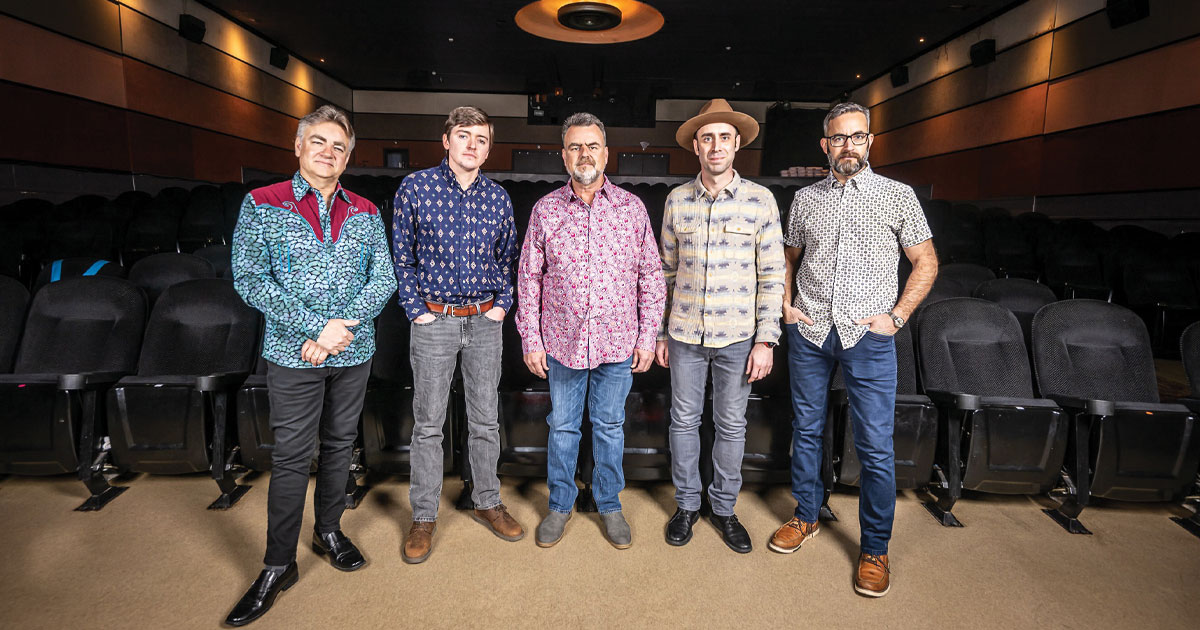
It’s 3:45 p.m. on Friday, April 11, and banjoist Rob McCoury of the Travelin’ McCourys is chilling behind the historic Park Theatre in McMinnville, Tennessee. Almost four hours remain before the band takes the stage, but much work needs to be done before the first note of the performance at 7:30 p.m. “Usually, we meet a couple of people that are here, and they point us in the direction of the dressing rooms, and we find if there’s a designated place to eat,” McCoury explains to Bluegrass Unlimited after sound check. Rob, his brother, Ronnie McCoury (mandolin/vocals), Cody Kilby (guitar/vocals), Alan Bartram (bass/vocals), and new fiddler/singer Christian Ward are preparing to begin the summer outdoor festival scene. Their previous gig was at the Southland Bluegrass Music Festival in Immokalee, Florida the Sunday before this show. “We’ll start setting up, putting our audio rig together. We tie in with the audio gear they already have in the house and the venue. We just kind of integrate together,” said Key Chang, the band’s audio engineer and production manager.
The band doesn’t come in blind to the audio setup. Before they arrive to a show, the venue sends a tech packet that lists all the gear, and at times, Key Chang says the band will need to bring supplemental audio tech to fit their needs. Once things are set up, he evaluates the sound in the front of the house. “I run what they call pink noise, sounds like TV static, through every zone—the front area, the subwoofers, and the mains and make sure everything sounds okay,” Chang says. “Alan Bartram, the bass player, will go through and help me check to make sure everything’s in the right spot, and then he’ll get on the mic and start talking and playing his bass. I’ll tune the P.A. system to him basically, and then we get the rest of the band out.”
“We really try to pitch in and help each other out,” McCoury says. “If we’ve got plenty of time, we’ll get a feel for the place and check out the room. Then, while everything’s getting set up, the rest of us will usually be tuning up, playing a little bit, and trying to figure out what we want to do that night.”
Rob says the set list changes with each show, and he says during sound check time is often when the band decides what songs to switch out. “We try and add new things as often as we can. A lot of times during sound check is when we’ll hash them out. We were running over one today we’ve never played [live] before. Cody was singing there. I’m sure we won’t do it on the show tonight, but it’ll be on the set list soon because it was feeling pretty good.”
For this theatre performance, Rob and the rest of the band had a luxury they often don’t get before a show—time. “A lot of times at a festival, they’ll have what we call a ‘throw and go,’ where you don’t have a sound check,” McCoury explains. “Key sets everything up, kind of has a moment of silent prayer and hopes it all works. They go through, tap all the mics and lines, and make sure they’ve got a signal, and you just hit it. But in a theatre like this, when we actually have time to do a sound check, it’s better for everyone. It takes the stress off of everybody.”
Even in those fly-by-the-seat-of-your-pants situations, a seasoned pro like Rob goes with the flow. “I guess it’s just part of the territory. I’ve been doing it for a long time; we all have. You just roll with it. I think the crowd understands things, at least our crowd. They’re generally pretty docile, friendly people. They don’t get too uptight about things. If there’s something major going on and we can’t even start, something’s wrong, they get it.”
Even with plenty of prep time before the show, the final sound tweaks for the performance can’t really happen until the band kicks off the show. “You’re sound-checking an empty room,” Chang explains. “Come show time you’re going to have hundreds of people in the room. It’s going to sound completely different. The first couple of songs you’re readjusting things. You don’t want to go too crazy when you’re sound-checking an empty room and start carving out a bunch of stuff, because you have to anticipate that change.”
As the audio kinks get worked out, Rob gets into his comfortable groove even more with his bandmates by his side. “With these guys or in Dad’s band, I think it’s really just the element of all of us being there together that’s very comforting,” Rob says. “We know we’ve got each other.”
It’s not like if somebody calls you [to fill in with another band], you don’t really know their music. You show up, don’t really have rehearsal time, and get up and play, that’s a little unnerving sometimes,” he says, chuckling. “You’re definitely flying by the seat of your pants. It can be fun. Sometimes that’s a good thing. It gets you excited and makes you really want to play that way too. When you’re real comfortable is great too because then you can play well then.”
Adding to that comfort level is something called a shout mic that is placed behind the musicians. During the shows, any of the band members can communicate clearly with the rest of the musicians through their in-ear monitors. “We generally have a set list, but sometimes you might want to skip one or do something else,” Rob explains. “You can step in there and say, ‘Hey, let’s do this one instead or whatever, change up things, or say something in the mic to rib your bandmates or whatever,” he says, laughing. “It’s handy. There have been times when that didn’t work for some reason, and you miss it! You can’t get over there and say hey, maybe somebody’s having an issue. Someone else do something. This ain’t working.”
Behind the scenes, other crucial essentials need to be handled too, which are covered in a band rider. It’s basically an addendum to the standard contract that is necessary for a successful performance like technical specifications and hospitality requests. “With us, it’s pretty simple—waters, something to snack on, a fruit tray, vegetable tray, maybe lunch meat, peanut butter and jelly, something like that,” Rob says. “A lot of places will either bring in a good dinner or like tonight, we ordered off the menu from a local place. They usually take pretty good care of you these days. In years past a lot of places we played, you were on your own,” Rob says with a laugh. “When you get there, you better have what you need because you’re not getting anything from the venue. But that’s come a long way.”
Last year the 2015 and 2024 IBMA Banjo Player of the Year performed close to 110 tour stops, 50 with his dad and 60 with his and his brother’s band. Keeping all that tour information straight could be confusing. “Thankfully, we have the same people booking [Reliant Talent Agency] both bands. If we didn’t, I’m sure it’d be a nightmare. I’m really shocked at how well through the years that we’ve been doing both things, that it has worked out, that there hasn’t been some kind of snafu. Uh-oh. We’re booked over here, and we’re booked over there.”
Rob and the gang are touring in support of their new album, One Chord That Rings True, and the Del McCoury Band’s new album, Songs of Love and Life. He says they have recorded more material with his dad and are probably going to tackle some Grateful Dead covers in the future to commemorate that band’s 60th anniversary this year. Plus, The Travelin’ McCourys want to record new music with the latest addition to the group, fiddler Christian Ward, who replaced longtime sideman Jason Carter. “He’s doing a great job,” Rob says. “He’s a great musician, singer, songwriter. He can do it all. Every show he gets better and better. You can tell he’s working at it too. When he’s not around us, he’s at home studying.”
Ward landed the gig with both bands after filling in a couple of times before the band change. “That kind of gave him a leg up because he did such a good job. One of the very first shows with Dad there was a song I know we had never done together. I told him the title. I forget what the song was now. I said, ‘I can kick it off if you want me to.’ He said, ‘No, I got it.’ And he did! Kicked it off just fine. If he hadn’t played it already, he had heard it already and remembered it. That’s another thing. That’s a lot to be thrown at one guy, two bands worth of material at the same time!”
Rob has been on the road with The Del McCoury Band since he first started on bass as a 15-year-old. In 2009, he and his brother Ronnie also founded The Travelin’ McCourys. “It keeps it a little more interesting,” Rob says. “It’s fun to do both things. With Dad, we’re working around a few mics, and we don’t have any amplification, monitors, or anything. We’re just playing off each other. Here, we’re plugged in, and we have in-ear monitors, which is nice too. With those in-ear monitors, the way we do it, we mix ourselves individually. We each have an iPad that we can turn up and down, whatever we want to hear, and set it like we like it. It makes it easy to play when you can hear what you need to hear. With Dad, the reason we play close together is because we kind of have to. We can’t spread out or we won’t hear each other. It would be hard to play.”
Come this July 4th weekend, Rob will have racked up 39 years as a road dog, and he has witnessed several changes in touring since his start in 1986. “The quality of the places you get to play, I think, is one thing and everything with it. The production these days at festivals or indoor events has come a long way from when I started. You would play some places with what they called a sound system, and it wasn’t much. Even festival production—they wouldn’t have enough P.A. to cover the people. That’s pretty scarce these days. The equipment these days is better than it used to be, probably more portable. You’d have to haul them in the back of the pick-up truck up to the stage and slide them off there just about. They were so big. Big things come in small packages these days and that holds true like with speakers and things for the venues. These aren’t that big,” he adds, pointing to the speakers on the Park Theatre stage, “And they have plenty of sound!”
With close to four decades of travel, Rob remains motivated to perform and to take their music to the next generation. “The crowds are what keeps you wanting to do it. When the crowd is really into it, and they like what you’re doing that really makes you look forward to doing it and going to different places like the unknown. We’ve played everywhere, but there’s places we don’t play often either. “Last summer we played an outdoor festival in downtown Missoula, Montana, and all the college kids were there. I don’t know if they knew who we were or not, but man, they loved it! And there were like several thousands of them, and they were having the best time. That’s what you need. You’ve got to have that young crowd. You’ve got to bring new ones in. Then, you really look forward to going back. You get your foot in the door somewhere you don’t play very often and the people show up. Man, you need to get back there pretty soon before they forget about you,” he concludes with a laugh.