Skip to content
Register |
Lost your password?
Subscribe
logo
  • Magazine
  • The Tradition
  • The Artists
  • The Sound
  • The Venue
  • Reviews
  • Podcasts
  • Lessons
  • Jam Tracks
  • The Archives
  • Log in to Your Account
  • Contact
  • Subscribe
  • Search
  • Login
  • Contact
Search
  • Magazine
    • Current Issue
    • Past Issues
    • Festival Guide
    • Talent Directory
    • Workshops/Camps
    • Our History
    • Staff
    • Advertise
    • Contact
  • The Tradition
  • The Artists
  • The Sound
  • The Venue
  • Reviews
  • Podcasts
  • Lessons
  • Jam Track
  • The Archives

Home > Articles > The Tradition > Road Trip with Jerry Garcia

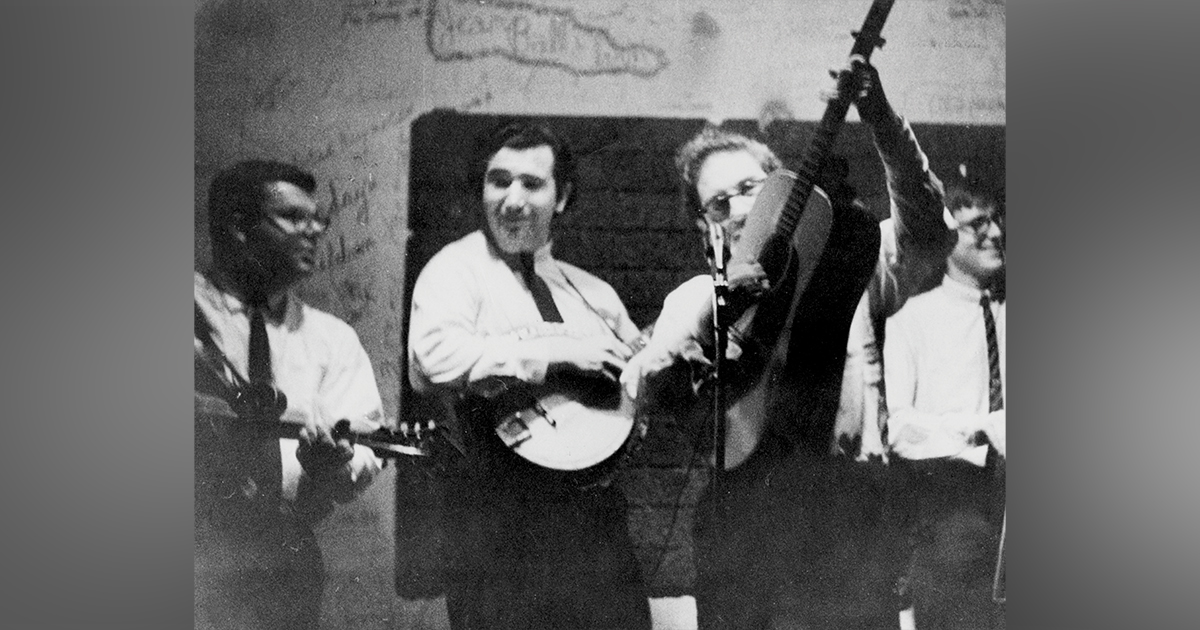
Jerry Garcia, Sandy Rothman, and Geoff Levin performing at The Offstage in San Jose, CA in early 1964. // Photo by Rob Levin, Bluegrass Music Hall of Fame & Museum collection.

Road Trip with Jerry Garcia

Sandy Rothman|Posted on October 1, 2025|The Tradition|No Comments
FacebookTweetPrint

Growing up in the San Francisco Bay Area, my late 1950s interest in folk music and blues turned toward bluegrass around 1958-9. By 1960, I had been “bit by the bug,” as they say. In August of that year, the Redwood Canyon Ramblers, the local college band, gave a concert where I met their singer and rhythm guitar player, Mayne Smith. Like his close friend, banjo picker Neil Rosenberg, he was a folklore student at Indiana University at the time and was home in Berkeley during semester break. Mayne told stories about seeing Bill Monroe and other acts at Bill’s country music park, the Brown Country Jamboree in Bean Blossom, not far from Bloomington and IU. He had even played his steel-bodied resonator guitar on a show with Charlie Monroe in the old Jamboree barn. The scene sounded magical.

Being in the Midwest had given these California boys a real perspective on the music, previously known to us only from records, tape recordings of live shows, and rare appearances by authentic West Coast proponents like Vern & Ray or the Country Boys (Kentucky Colonels).

After his summer break in Berkeley in 1963, Mayne invited me to ride back to Bloomington with him in the fall. I saw a lot of great music at the Jamboree and also traveled up to New England and New York where I saw the Lilly Brothers with Don Stover, the New York Ramblers with David Grisman, and other advanced pickers. All this bluegrass reality was tremendously energizing, and when I got back to the Bay Area, all I could talk about with my bluegrass friends was “the real thing” and how we all needed to experience it.

Everyone I spoke with had reasons not to go. Work, school, family, the draft, no money—many factors. Among everyone I tried to interest, only one person picked up the spark: banjoist Jerry Garcia. Although Jerry and his wife Sara’s daughter Heather had been born about four months earlier, Sara—a singer and musician—agreed with the idea of Jerry going on the trip and even said she’d be willing to relocate east if he found a music job requiring it. I wasn’t thinking that far ahead (although every aspiring bluegrass picker dreamed of playing with Bill Monroe). I just wanted to see, hear, and soak up more of “the real thing.” 

For a struggling banjo teacher Jerry had a surprisingly new car: a 1961 Chevy Corvair (“the most dangerous car in America,” as Ralph Nader called it), purchased from Sara’s father’s secretary. Also, from Sara’s father came a Wollensak tape recorder, although in long retrospect I learned Dr. Ruppenthal didn’t know the machine had been borrowed. We filled the small back seat with our instruments, the tape recorder, a bunch of cheap Shamrock and other blank 7” reel tapes, very few clothes, and headed for Los Angeles, where Jerry wanted to visit some of his Palo Alto friends (Robert Hunter, David Nelson, Willy Legate, and others). It was late April or early May of 1964.

It’s unclear now how we knew the Kentucky Colonels would soon be leaving on their cross-country driving trip to play the Newport Folk Festival, but somehow we did, and we arranged to follow them as far as Waynesville, Missouri, near St. Louis, where they were going to visit and stay with a friend and fan of theirs who knew them when he’d lived in Southern California. 

Bill Monroe and Sandy Rothman at Bean Blossom, Indiana circa 1971.  
Photo by Ron Petronko, Bluegrass Music Hall of Fame & Museum collection.
Bill Monroe and Sandy Rothman at Bean Blossom, Indiana circa 1971. Photo by Ron Petronko, Bluegrass Music Hall of Fame & Museum collection.

There were some antics along the way. Jerry and I would sometimes switch drivers while in motion…and occasionally one of the Colonels and I would switch places. We made up a silly routine where one of us in the Corvair and one in their Rambler station wagon would have an instrument out and be playing the same tune as we pulled up to truck stop gas pumps…I seem to recall “Old Joe Clark.” This was in the days before self-service gas stations. It never caught anybody’s attention.

We stayed with the Colonels a couple of days at their friend Slim Harrell and his wife’s place—played a lot of music and enjoyed her great cooking served on outdoor picnic tables. Finally, we decided to leave for our first destination and our home base, as it turned out to be…having been invited to Neil and Ann Rosenberg’s in Bloomington, Indiana. 

Before landing in Bloomington, we stopped first in Columbus, Ohio, for a couple of days. We knew of Robby Robinson (one of the earliest luthiers and instrument builders) and had heard of a good folk shop, the Columbus Folk Music Center. Neil had given us the name and address of banjo enthusiast Steve Gibbs in Columbus. We found his house, parked the car nearby, and promptly fell asleep in it. Gibbs directed us to the nearby Folk Center. We hung around there, met owners Roger and Carol Johnson, stayed with them a day or so, and found out which bluegrass bar Robby was playing in. We went there and introduced ourselves. We ended up picking onstage as guests. Jerry (21, on banjo) and I (18, on guitar) got a warm reception from the band and crowd. The other members, besides Robby and Sid Campbell, were likely Danny Milhon on resonator guitar and Don Van Loon (Edwards) on upright bass. It was our first experience at a genuine Ohio bluegrass bar, and we loved it. (The date has somehow been preserved as May 29, 1964.) After Columbus we went to Bloomington, to Neil and Ann’s.

Neil was working as manager of the Brown County Jamboree at Bean Blossom and playing banjo in the house band. He took us to Nashville, Indiana, to the home and TV repair shop of Marvin Hedrick, where he had his large collection of live radio and show tapes. I’d met Marvin the previous year. Sound engineer at Bean Blossom since the 1950s, he was a fine thumbpick rhythm guitarist in the style of his favorite Monroe guitarist, Edd Mayfield, an authentic Texas cowboy who had sadly passed away a few years earlier while on tour with the Blue Grass Boys. Marvin was very generous, offering us free access to his voluminous collection of tapes he’d made both at Bean Blossom over the years and also from live bluegrass radio. It was great good fortune for us—a goldmine of already-recorded tapes. Restrained from greed more than anything by our limited number of blank reels, we spent a lot of time trying to prioritize which tapes to copy with the Wollensak. Sometime later I heard from Neil that Mrs. Hedrick had told him about us: “They were nice boys, but they could’ve used a clean shirt.”

When we finally got to see Bill Monroe and the Blue Grass Boys perform at the Brown County Jamboree, Jerry and I got the idea of meeting Bill and, if it felt right, asking him for an audition. I asked Neil to introduce us to Bill. “Talk to him yourselves,” he counseled. By then well acquainted with Jerry’s banjo picking and my guitar playing, Neil may have judged that we weren’t very far along in our acquisition of a “bluegrass accent” and perhaps did not want to be responsible for recommending us to Bill as potential sidemen. (In my opinion, Jerry was well prepared to be a Blue Grass Boy banjoist.) Too shy to approach the great patriarch, we never did speak to Bill Monroe or work with him together.

The Osborne Brothers with Benny Birchfield at Ruby’s White Sands outside Dayton, Ohio on May 28, 1964.  Sandy Rothman, seated, is visible taping the show to the right. Jerry was there but is not in the frame. L-R:  Bobby Osborne, Benny Birchfield, and Sonny Osborne. 
Photo by Neil Rosenberg, courtesy of Sandy Rothman.
Osborne Brothers at the White Sands Bar, Dayton, ) OH, May 28, 1964. Bobby Osborne, [Benny Birchfield? Jimmy Brown?], Sonny Osborne (hidden); recording equipt at right, with Sandy Rothman, visiting with Jerry Garcia.

We did not go to Nashville, Tennessee. If we’d been more focused on speaking to Bill Monroe, we could’ve taken seriously the sincere invitation he always gave his fans and audiences to come and visit him at the Grand Ole Opry.

Jerry didn’t verbally articulate his reasons for deciding to go back to California, but I knew Sara was alone with baby Heather—how long could he prolong his absence?—and I’d seen his reactions when we encountered “White only” drinking fountains, rest rooms, and lunch counters, shocking things I’d seen for the first time the previous year. It was the spring before Freedom Summer, but focused so deeply on music we barely knew it. 

Jerry said he wouldn’t mind driving back alone if I felt I wasn’t done in Indiana. With some hesitation I accepted his offer, and we parted at Neil’s. Without Dexedrine or any other drug besides coffee, his ever-present unfiltered cigarettes, and youthful energy, Jerry—as he told me later—drove back without stopping except for gas, food, and occasional naps in the car. (I ended up touring with Bill for a couple of months. That’s another story.) 

As for the tapes we’d collected and recorded, we each kept some. Years later Jerry told me his had “slipped through the cracks.” Moving from place to place, I carried mine around for decades and still have some of them. (Gary and David Hedrick eventually digitized their dad’s entire collection. It should be available online.) 

Neither Jerry nor I had a camera, and nobody took our picture—not during our time with the Colonels or when we were around photographer Ann Rosenberg. There is not a single photograph of us anywhere on the trip. Neil took a stage shot of the Osborne Brothers at Ruby’s White Sands in Dayton, where we met him during our stay in Bloomington; I can just barely be seen at the side of the stage, monitoring the tape recorder and studying the band. Basically, there is no photographic evidence to prove the trip happened at all! 

FacebookTweetPrint
Share this article
Facebook
X (Twitter)
Linkedin

Leave a Comment Cancel Reply


This site uses Akismet to reduce spam. Learn how your comment data is processed.

October 2025

Flipbook

logo
A Publication of the Bluegrass Music Hall of Fame & Museum / Owensboro, KY
  • Magazine
  • The Tradition
  • The Artists
  • The Sound
  • The Venue
  • Reviews
  • Survey
  • New Releases
  • Online
  • Directories
  • Archives
  • About
  • Our History
  • Staff
  • Advertise
  • Contact
  • Subscriptions
Connect With Us
Facebook
Instagram
Twitter
YouTube
bluegrasshalloffame
black-box-logo
Subscribe
Give as a Gift
Send a Story Idea

Copyright © 2026 Black Box Media Group. All Rights Reserved. Privacy Policy
Website by Tanner+West

Subscribe For Full Access

Digital Magazines are available to paid subscribers only. Subscribe now or log in for access.