

Remembering the Ash Grove
A Year-Round Folk Festival
If Hollywood was the place to be, the place to be in Hollywood was the Ash Grove coffeehouse. Between 1958 and 1973, the Ash Grove was, arguably, the premier music venue in the country when it came to presenting folk, bluegrass, old-time country, blues and other forms of traditional American music. John Cohen of the New Lost City Ramblers called the club “a year-round folk festival.”
The Ash Grove opened on July 15, 1958, in an old furniture factory building located at 8162 Melrose Avenue in the West Hollywood part of Los Angeles. The club took its name from an old Welsh folk song. Ed Pearl, a folk music enthusiast in his early twenties, started the Ash Grove with only a few thousand dollars and no practical business experience. He had a vision though: he wanted the club to present “meaningful music.”
Pearl (1935-2021) strongly believed that music could play a significant role in effecting social change. He wanted the music he presented to further that aim. He also wanted the space to be a community center where people from different walks of life and political persuasions could come together. The first performance at the Ash Grove featured flamenco guitarist Geronimo Villarino, folk singer Guy Carawan and bluesman Brownie McGhee, a blueprint of sorts for the club’s next fifteen years.
Pearl initially booked folksingers to perform at the club, but then he crossed paths with the New Lost City Ramblers. Pearl always acknowledged the Ramblers—John Cohen, Mike Seeger and Tom Paley—for turning him on to bluegrass and old-time country music, for introducing him to many of the artists in those styles, and for facilitating the earliest Ash Grove performances by those musicians.
Over the next decade and a half, the Ash Grove was one of the country’s leading venues for bluegrass and old-time artists. In bluegrass, the club presented both pioneers like Bill Monroe, Flatt & Scruggs, the Stanley Brothers, Jimmy Martin, the Stoneman Family, Earl Taylor, Mac Wiseman and Vern & Ray, and such younger bands as the Kentucky Colonels, Dillards, Greenbriar Boys, Country Gentlemen and Country Gazette.
The club hosted a similarly distinguished roster of old-time musicians, including Doc & Merle Watson; Cousin Emmy; Clarence Ashley, Clint Howard & Fred Price; New Lost City Ramblers; Roscoe Holcomb; Hazel Dickens; John Hartford; Doc Hopkins; Jimmy Tarlton; and Maybelle Carter.
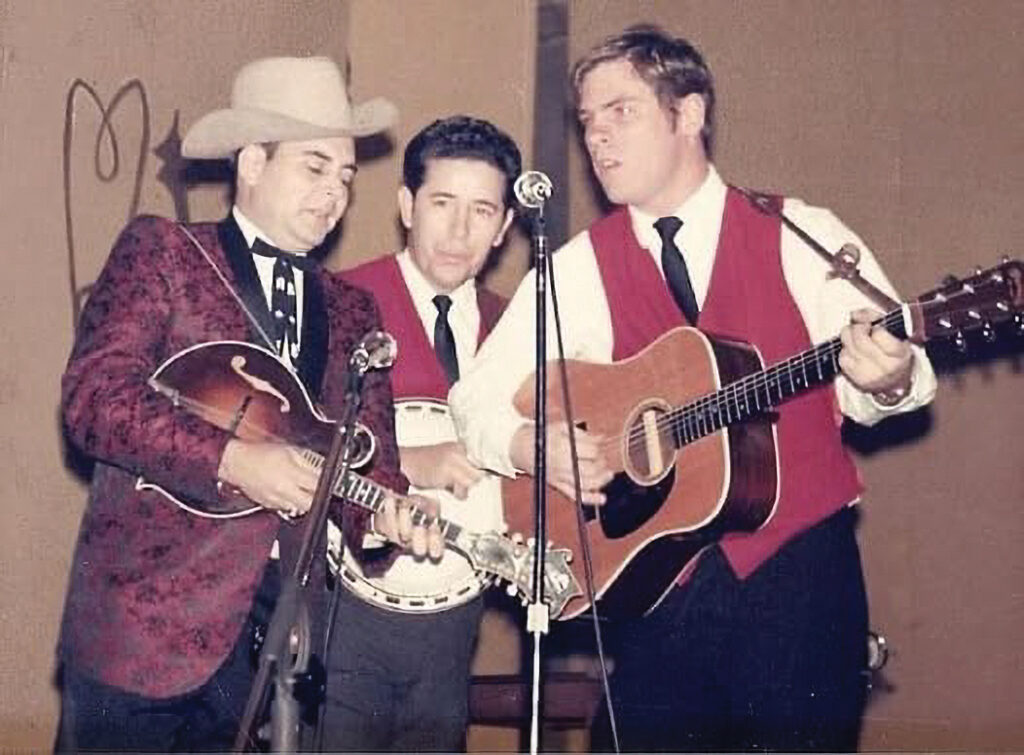
Pearl’s concept of “meaningful music” also included a healthy slice of blues—which was introduced to him by Chris Strachwitz of Arhoolie Records—including regular performances by legends including Muddy Waters, Sonny Terry & Brownie McGhee, Howlin’ Wolf, Lightnin’ Hopkins and Mississippi John Hurt and younger players like Freddie King, Luther Allison, Taj Mahal and Lonnie Mack. He also supported the local rock scene, booking such bands as the Byrds, Seatrain, Canned Heat and the Chambers Brothers.
What follows is a collection of reminiscences by some of the people who made the Ash Grove the place that it was. Almost all of them were frequent patrons of the Ash Grove, and several of them performed there. Those taking this stroll down memory lane include Mary Katherine Aldin, longtime office manager at the Ash Grove; Peter Feldman, old-time musician and owner of the Bluebird Café in Santa Barbara; Herb Pedersen, legendary singer and multi-instrumentalist who performed at the Ash Grove with Vern & Ray, the Dillards and more; Tom Sauber, old-time and bluegrass musician who performed once at the Ash Grove and later played with Corn Bred, Tom, Brad & Alice and more; Steve Pottier, Clarence White student and devotee who would later play guitar/bass with High Country, the Done Gone Band and more; Tom Mullen, guitar, mandolin and bass player who performed at the Ash Grove with Vern & Ray, the Town and Country Boys and Earl Taylor; Harley Tarlitz, musician, actor and bluegrass impresario; Darryl Boom, guitarist with Corn Bred who performed at the Ash Grove with the Town and Country Boys; and Chuck Erickson, owner of Erika Banjo in Van Nuys, California, who now, as the Duke of Pearl, is an internationally acclaimed source of mother-of-pearl and abalone shell for the instrument industry.
Herb Pedersen: The Ash Grove was one of the best audiences you could ever have, because they were such bluegrass junkies or blues junkies or whatever. It was strictly a listening club. They didn’t sell alcohol. It was more like tea and coffee, cookies and other snacks. We always sold a lot of tickets. It was a fun place to play.
Peter Feldman: You came in the club into a large linoleum-covered room. To the right was a small dressing room and a music store that sold records and strings. The showroom itself was a large, square room, basically painted black. The stage was in the corner of the room, a square within a square, about four feet off the floor. The closest seats, at the counters bordering the stage, were within about eight feet of the performers. The ceiling was open rafters. The soundboard was in a small loft above the room, with room for maybe two people to run the sound system and lights.
Mary Katherine Aldin: There were at least three incarnations of the music store in the front room of the Ash Grove. One was a branch of McCabe’s. Another was called Eagle Music, and another was called Ace Music. In addition, there were a couple of independent record shops in there, one of them run by a guy named Chris Peake. The very earliest occupant that I remember was Pablo Menendez, who sold earrings, bracelets and necklaces and leather goods that he created himself, circa 1960-63.
Chuck Erickson: The store I remember best was Eagle Music Exchange, run by Milt Owen and David Grishman. They had a pawnshop down in the skid row district of LA called Eagle Loan, and the store at the Ash Grove was an extension of that. Al Ross and Bob Page also worked there. They always had some good stuff, Martin guitars and Gibson banjos. They used to get some really good vintage instruments in. I bought a couple of old Gibson Mastertone tenor banjos there and built conversion necks for them.
Aldin: Ed would book acts in for a six-night run, Tuesday to Sunday. The acts had nothing to do during the day, so they often hung out at the club. During the day, we had the Ash Grove School of Traditional Folk Music, which was run by Bernie Pearl, Ed’s brother. We offered all the artists playing there the opportunity to take students and give lessons for some extra money. It was five dollars a lesson, and if you got four students, that was an extra twenty bucks, which was nothing to sneeze at in the early 60s.
Steve Pottier: The first time I saw Clarence White live was at a New Lost City Ramblers show. They called him up, and he played ‘Arkansas Traveler.’ It was a pretty amazing experience and very, very inspiring.
Tom Mullen: I saw where Vern and Ray were booked there for Friday and Saturday night [in August 1967]. I took a chance and showed up with my bass fiddle. They were in the dressing room with some young banjo player by the name of Herb Pedersen. I stuck my head in the door and asked if they needed a bass player. Ray looked at me—I was 18 at the time—and looked at my bass fiddle, and said “Yeah.” So, I followed them on stage and played two nights with them.
Tom Sauber: The only time I officially played there was in 1969. Ed Pearl used to invite the winners of the Topanga Banjo and Fiddle Contest to do a paid gig at the Ash Grove as an opening act. I won the banjo contest that year, so I went and did a short set of tunes. The headliner that night was an abbreviated version of the Kentucky Colonels. Roland was back east playing with Lester Flatt so it was Roger Bush playing rhythm guitar, Billy Ray [Latham] playing banjo and Clarence White was playing lead guitar and doing most of the vocals. Just the three of them. They were fabulous.
Aldin: Doc Watson was a regular and would come out a couple times a year, either with Clint Howard and Fred Price as a trio or by himself and later with Merle. Clarence would come in every time to see Doc play and sit in the front row, gasping for breath watching Doc’s hands.
Sauber: The stage was in the corner of the room, and there was a little countertop that bordered both sides of the stage, with seats there. It was so close you could set your drink on the stage. When Doc Watson came out with Clint Howard and Fred Price, I would be certain to stay for both sets, watching Doc Watson play from about six feet away. It was a great learning experience.
Erickson: I remember one show by the Colonels particularly well. The seats on the right side of the stage—where Clarence stood—were only about five feet from the stage. That entire row of seats was filled by Japanese men in business suits. Halfway through the first set, Clarence realized that one of them had a telescoping pole with a movie camera on the end of it. The camera was just a few inches from his left hand, filming his playing. Clarence turned around and played the rest of the set with his back to the audience.
Feldman: You never knew who was in the audience. Coming into the place, you’d recognize a lot of people known for their musical talent, and it made you play better. You were under a microscope there among your peers, and you really wanted to do your best there. The Ash Grove drew excellent performances from just about everyone who played there.
Aldin: We had what was then called a cabaret license, which meant we could sell only beer and wine. No hard liquor. We didn’t have to have an age limit, which was awesome. Ed was very big about kids getting educated about traditional music.
Feldman: The stage was carpeted, but I don’t believe it had been vacuumed since the Spanish-American War. I remember once in 1962 being there with my five-piece band, and we were carrying on up there. As a result of our stomping our feet, a cloud of dust slowly rose from the floor and got almost up to our waists.
Sauber: The Ash Grove was a continuous inspiration, one source of inspiration after another, one artist after another. There was no end of cool stuff there.
Pedersen: There was a big difference between the Ash Grove and the Troubadour. The Troubadour was like the Mighty Wind, you know. It had the flashy, well-scrubbed, young college-educated folksingers, quote unquote. But the Ash Grove had the real deal; they had people like Muddy Waters, Bill Monroe, Flatt and Scruggs, the Stanley Brothers and Mance Lipscomb.
Darryl Boom: The Stanley Brothers were there for two weeks, and I went every night. I was a big Stanley Brothers fan. They were in their prime then, and it was great. Carter would go outside on the breaks, and I’d get a chance to talk with Ralph. I was in heaven.
Pottier: One of the best shows I saw there was the Muleskinner band, or at least part of the band. I don’t remember if Bill Keith was there, but Clarence White, Peter Rowan and David Grisman were all there. John Hartford and Brantley Kearns played fiddles.
Sauber: I saw the New Lost City Ramblers there in 1963, the version with Tracy Schwartz, who had replaced Tom Paley in the trio. Tracy was a great tenor singer, and he and Mike sang great duets on songs like “Little Glass of Wine,” and John Cohen played “The Cuckoo Bird” on the banjo. They were very inspirational to me, the way they traded off instruments and parts and did so many different things.
Feldman: I saw Bill Monroe there in 1965. I got there early enough to get a front row seat. The band he had with him was his son James on bass, Peter Rowan was playing guitar, Lamar Grier was on the banjo, and Gene Lowinger on fiddle. When they got going, you could see Monroe taking a step back when he wasn’t soloing and paying very close attention to whoever was soloing. There was a tension there. Pressure. It was like ‘you god damn well better play good here.’ It was electric. Monroe took a break playing into a big old Electro-Voice microphone, and I swear I could see sparks of electricity going between the mandolin and the microphone.
Erickson: My first visit to the Ash Grove was in 1966, when a friend took me to see Bill Monroe. I knew a few bluegrass banjo players from my shops in Denver and Van Nuys, but I had never heard a live bluegrass band before. It blew me away. It was a real eye-opener. A very memorable experience.
Pedersen: Ed Pearl wasn’t that interested in ‘an act.’ He wanted the music. If you just stood there like a painting, he didn’t care. He cared only about the music.
Aldin: Ed was an idealist. If he wanted to book Bill Monroe and the Blue Grass Boys, it didn’t matter if he couldn’t afford to pay them. He never stopped to calculate if an artist would draw enough to make it work. If he wanted someone, he wanted someone. He wanted traditional music brought to an urban audience. He was definitely not a businessman, and, therefore, the club was always in financial trouble. Always. I’m frankly astonished it lasted as long as it did.
Harley Tarlitz: Doc Watson told me a funny story about when the Stanley Brothers played a gig at the Ash Grove. He told me that Carter told him that [Ed Pearl] wanted to pay them in future Ash Grove tickets. Naturally, Carter was not pleased.
Boom: The AG was a really nice venue. The best thing about it was that it was so small and you were so close to the action and the performers. It was a very intimate setting. And when the musicians would take a break, they’d go hang out in the lobby or the parking lot, and you could talk to them in between the sets. It was very cool.
Feldman: Monroe was by himself in the dressing room on the break, watching a minor league baseball game on a little twelve-inch TV. He looked up and saw me standing by the door, and I told him how much I liked his music. He asked me if I played anything, and I told him I was trying to learn the mandolin. So, he invited me in and had me sit on the couch next to him. He handed me his mandolin and said, ‘Pick me something.’ I played a little bit of ‘Nine Pound Hammer.’ He grabbed the mandolin back from me and said, ‘Now wait. Here’s what you need to do.’ He started showing me various things, and we spent more than half an hour passing the mandolin back and forth until he was satisfied I had gotten what I needed to work on.
Ed Pearl never tried to hide his left-wing politics, and, over the years, made some dangerous enemies. The last act for the Ash Grove began in 1969, with the first of three fire-bombings. The second came in 1971, and the third in 1973, which caused enough damage to close the club for good. All three were judged to be cases of arson, almost certainly committed by right-wing extremists angered by Pearl’s political activism and the fact that many radical leftist groups, including the Black Panthers and Students for a Democratic Society, held meetings at the Ash Grove on Mondays, when no music was booked.
The Ash Grove had a brief rebirth in the mid-1990s in a building on the Santa Monica Pier. The club never really caught on and closed after a few months. The times had changed, as had musical tastes, the music industry, talent and touring costs, and just about everything else relating to the presentation of traditional music. The Ash Grove’s time had passed.
The Ash Grove made a huge contribution both to the artistic and cultural milieu of the Los Angeles area and to the preservation and dissemination of all styles of traditional American music. Ed Pearl perfectly captured the legacy of the club in a 1993 Los Angeles Times interview. “The Ash Grove educated a lot of people to the cultures of America,” he said. “It legitimized the American potpourri and gave it a dignified stage.” The Ash Grove mattered.
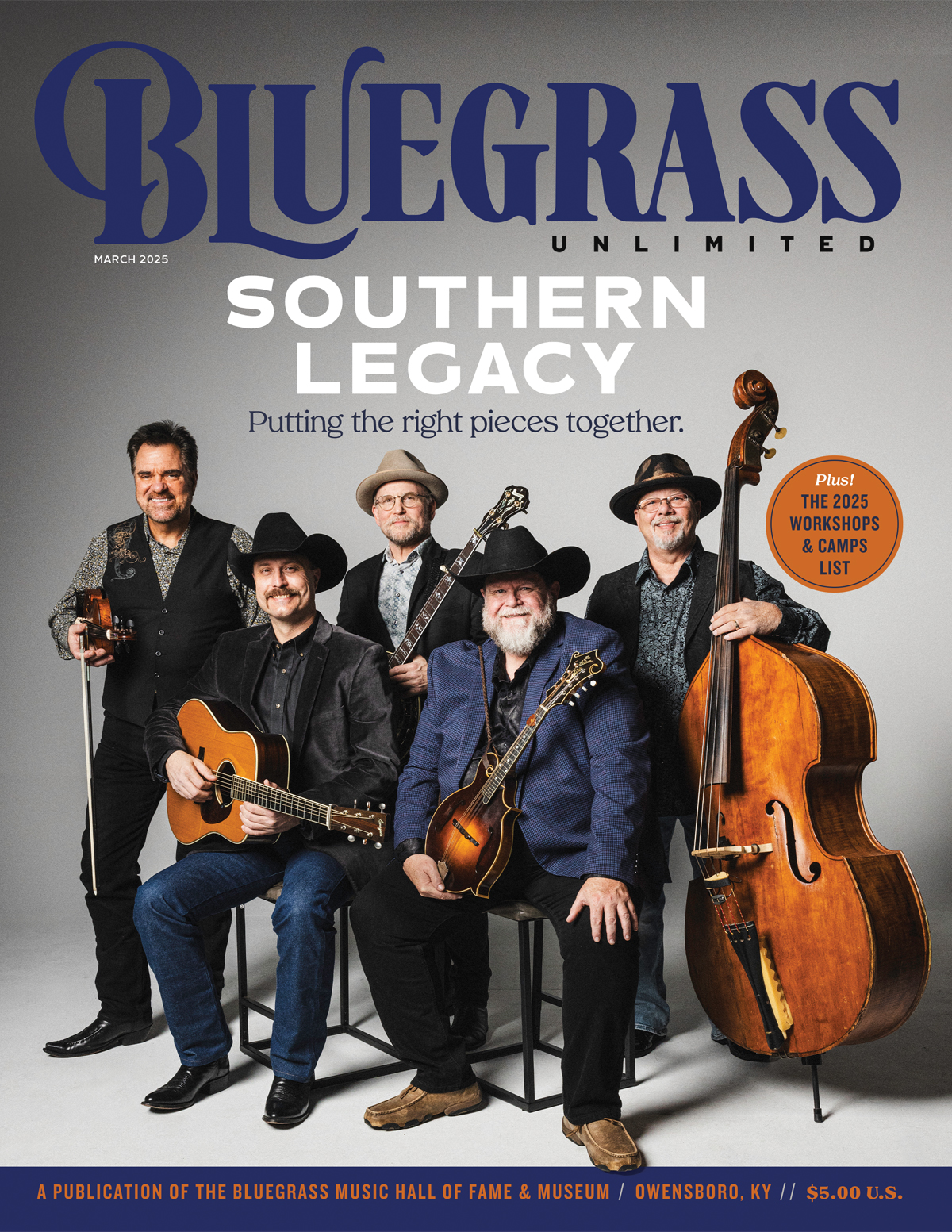
I’d like to order March magazine to add to my collection if I may. I’m sure my brothers are in the Ash Grove story.
Roland Eric and Clarence White…
The Kentucky Colonel’s maybe. If not would still like for my collection.
(Mary Katherine said she ordered a copy)