Remembering Robert Hutchison
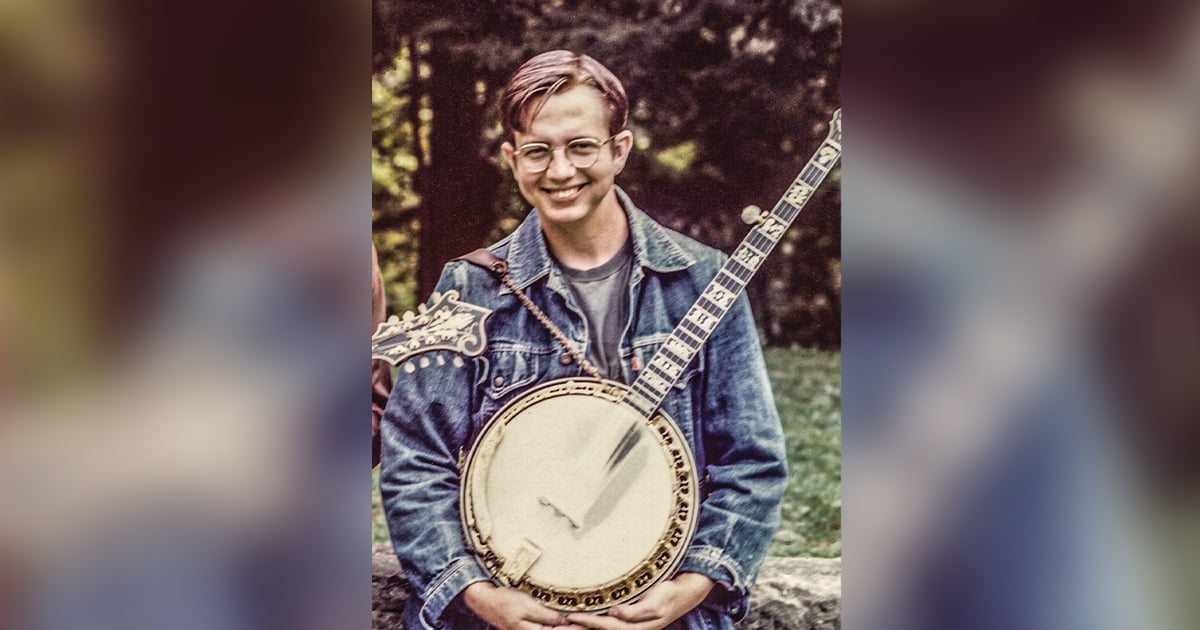
Robert Lewis “Zeke” Hutchison, banjoist, singer and family man, died August 2nd, 2021, after a long illness. Born on September 13th, 1948 (Bill Monroe’s 37th birthday) in Belmont County, Ohio into a musical family, he made a special mark on the music scene in the upper Ohio River valley as well as nationwide. He is survived by his wife Linda and three children: Robert (Zeke), John (Duke), and Lewis; two brothers: John and William; six grandchildren and two great grandchildren.
While most bluegrass players and fans hold the first-generation recordings as the standard of measurement and the bedrock from which to build, they tend to catch the bug when in the same room with a local player. Once infected, the new fan soon learns of other local players and makes a point of hearing the best ones perform live. Twelve-year-old Robert was infected one day when his father’s friend played a tenor banjo in their living room, and then not many years later, he became the five-string player that devotees in my part of the upper Ohio river valley went to hear whenever possible.
His father John (J.W.) and mother Emma Jane played guitar and sang country songs, and J.W. (his sons called him “The Seed”) was an accomplished old-time fiddler. The Seed knew about quality stringed instruments and helped Robert purchase an Ode five-string which was a very good value circa 1962. In anticipation of the banjo’s arrival, they also purchased Pete Seeger’s banjo method book which arrived a few weeks prior to the banjo. Robert studied it and his parents soon noticed his right-hand fingers moving in a roll pattern in his sleep. When just budding as a player, he met his bride Linda Pyles through the music. Her father J.S. Pyles played in the West Virginia Mountain Boys with Robert’s older brother John and other notable locals Roger Bland on banjo, and Snuffy McCartney on mandolin.
Once graduated from high school, Robert enlisted in the U.S. Airforce, serving as a medic in Wichita Falls, Texas. He and Linda soon married and started a family. Post Airforce they happily moved back to southeastern Ohio, settling along Captina Creek in Belmont County. They lived in a small cabin, reached by a footbridge, where Robert kept his coon dogs and planted their kitchen garden. They finally got telephone service in 1985.
Zeke was the number one fan of his older brother John (AKA Lost John, Losty, or J.D.), a multi-instrumentalist, singer songwriter, cartoonist, poet and actor. Their sibling relationship provided a strong bond along with the occasional frustration. In their early duo performances and later in the Hutchison Brothers Band which formed in 1975 and recorded two albums for Cincinnati based Vetco Records in 1975 and 1977, Zeke was the quietly brilliant younger brother who balanced Lost John’s comedic front man antics. The two brothers sang flawless duets.
Other members of the Hutchison Brothers Band included brother-in-law Tim Sparkman on bass, Greg Dearth on fiddle, and Tom “Peach” Hampton on mandolin. Some years after the breakup of the Hutchison Brothers Band in 1981, he entered into an enduring musical relationship with his son Robert Jr, who’s love for and ability with the mandolin mirrored his father’s on the banjo. The two performed locally as a duo and in bands and recorded as The Hutchisons for Vetco in 1993. To know the Hutchison family, you need to learn the various nicknames. By this time, Robert had dropped “Zeke” as a moniker (he was also known as “Sour Bob,” or just “Sour”) and handed it to Robert Jr, who had been known until then as “Zekey.”
While Robert’s ability would have made him a top sideman for any number of nationally touring bluegrass artists, he had little interest, preferring to make music with his family, and to live in what he termed a “colonial” lifestyle. Luthier Michael Kemnitzer, a close associate and occasional roommate of the brothers, acquired both the nickname “Nugget” and a profession as a mandolin builder through John Hutchison’s direction. In the early 1970s in Athens, Ohio, Nugget often accompanied Robert on his daily rounds—“That would typically involve visits to asparagus patches, country gas, bread, milk and egg places where he might be talked into playing a few tunes on his banjo which was always in the bed of the pickup. He often had an instrument or hunting related item to sell or trade and he was always on the lookout for barter items.”
His music was a very personal artistic pursuit, and after he’d chewed, swallowed, and digested Earl Scruggs, Don Reno, and Bobby Thompson, he came to identify Don Stover as his ideal model. With an artistic direction and a focused attention, he successfully reached the goal of forging his own sound and style. A muscular player, he used heavy strings, and took a cue from Don Stover in later years, settling in with a Paramount Style C with a raised head. While he viewed the first-generation bluegrass—Monroe, the Stanley Brothers, Flatt and Scruggs, Reno and Smiley, the Lilly Brothers—as the pinnacle of his kind of music, his influences ran wider and included Django Reinhardt, Wes Montgomery, Jerry Lee Lewis, and Irish button accordion master Joe Burke.
One track that illustrates Robert’s music is the instrumental medley “Tom and Julie Hines / The Banjo Tramp” from the Hutchison Brothers first Vetco release. Robert’s composition “Tom and Julie Hines” features an unusual chord progression and melody, while “The Banjo Tramp” is a traditional tune that Robert’s father learned from local fiddle master Ward Jarvis.