
Remembering Frank Wakefield
Photos by Jeromie Stephens
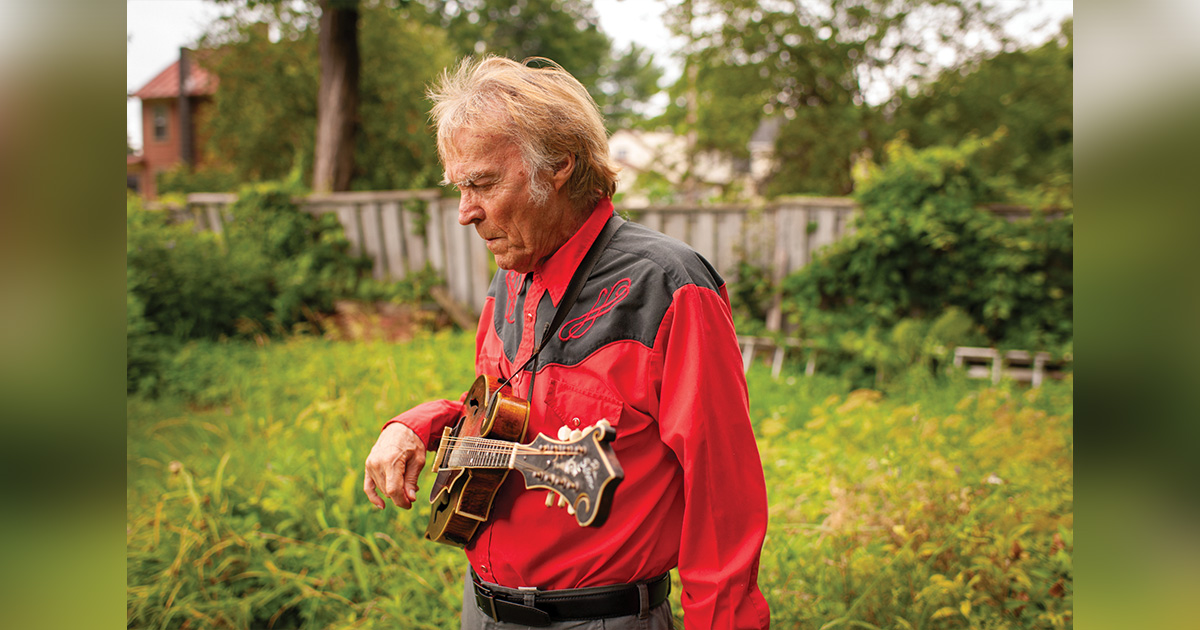
Franklin Delano Roosevelt “Frank” Wakefield (June 26, 1934 – April 26, 2024) was an “authentic certified musical genius. He is the only man to build a complete, original mandolin style on the Monroe base.” Columnist Bill Vernon made that assessment in the pages of Muleskinner News magazine in 1972 when he critiqued Wakefield’s first solo album. In 1964, David Grisman, then a budding 18-year-old mandolin player and nascent record producer, described Wakefield’s style as “extremely individualistic and original.” Among Wakefield’s many talents, Grisman singled out Frank’s ability to adapt licks from other instruments and apply them to the mandolin, his knack for being able to play any tune in virtually any key, and his use of modal and minor scales. At the time, Wakefield had some 40 original tunes to his credit, some of which were “bordering closely on classical music.” Grisman put forth these observations in his notes to a Folkways album he produced by Red Allen and Frank Wakefield called Bluegrass. He later declared that Wakefield had “split the mandolin atom!”
Frank Wakefield began life in Emory Gap, Tennessee, a tiny hamlet just west of Knoxville. It was in the middle of the Great Depression. He was the tenth of twelve children which consisted of ten girls and two boys. Times and circumstances being what they were, Wakefield attended school through the third grade. His early musical education consisted of an ill-fated attempt to play the harmonica and a brief flirtation with the guitar. But it was a round-bodied “taterbug” mandolin, acquired when he was about 17 years of age, that really captured his attention. He chose the instrument, in part, because no one else in his immediate area was playing one.
The year 1951 found Frank, still about 17 years old, living in Dayton, Ohio. While noodling with the mandolin on a front porch one day, passerby Red Allen heard him and soon afterwards asked Wakefield to join him in making music. The band, which included Allen, Wakefield and banjoist Noah Crase, billed itself as the Blue Ridge Mountain Boys.
Among Frank’s earliest influences on the mandolin were Bill Monroe, Jim & Jesse, and the Blue Sky Boys. Especially Monroe. Wakefield worked hard at emulating Monroe’s style, and Monroe acknowledged as much. But, he also encouraged Wakefield to develop a style of his own, which he did.
Around 1956, Wakefield found work in Detroit, Michigan, with a group called Marvin Cobb and the Chain Mountain Boys. In April of 1957, the group released a 45-rpm single that contained one of Frank’s original mandolin compositions, “New Camptown Races.” The tune, described by some as a “mandolin tour-de-force,” was unique in that it was played in the key of Bb. The disc had barely hit the street when the latter part of April found Frank working with Jimmy Martin at New River Ranch in Maryland. And, a month later, he teamed up with the Stanley Brothers for a show at Sunset Park in Oxford, Pennsylvania. Carter Stanley once quipped that “If we could only get Frank Wakefield, we’d really have something.” Wakefield’s stay with the Stanleys, like that with Martin, was short-lived. Ralph Stanley placed a call to Marvin Cobb and suggested that they trade mandolin players; the Stanleys would trade Wakefield for Cobb’s current mandolin picker, Bill Napier. Soon, Wakefield was back in Detroit with the Chain Mountain Boys. By year’s end, Frank collaborated with Buster Turner for a 45-rpm release with another of Frank’s songs, “Leave Well Enough Alone.”
Wakefield headed to the Baltimore/Washington, DC area in 1959. He reconnected with Red Allen and also worked some with the Baltimore-based Franklin County Boys. With Allen, Wakefield cut six selections for Starday Records in November 1961. Songs recorded included “Made Up My Mind,” “Trouble Round My Door,” “Thinking Tonight of My Blue Eyes,” “Bluegrass Mandolin” (also issued as “Mountain Strings”), “Will the Circle Be Unbroken” and “Beautiful Blue Eyes”; they appeared on various Starday singles and various artists’ albums. Helping out on the session was fiddler Chubby Wise and banjo legend Don Reno. Perhaps because all the songs and tunes never appeared together in one package, the material never gained a lot of traction, but “Bluegrass Mandolin” is a good example of Wakefield’s early work on the instrument.
Among Wakefield and Allen’s next trips to the recording studio was a 1963 outing where they cut two songs for Rebel Records: a masterful version of “Little Birdie” and “Faded Memory.” When the former track was selected for inclusion in the Rebel Records 35th Anniversary boxed set, Bill Vernon cited Wakefield’s work on it as “one of the earliest examples of his neo-modal mandolin innovations, which later would become seemingly extra-terrestrial at times.”
The biggest dose, and most widely distributed examples of Allen and Wakefield’s work to date came in 1964 when David Grisman and Peter Siegel recorded their Bluegrass album for Folkways. It was cut at two different sessions and included, in addition to Red and Frank, banjoists Pete Kuykendall and Bill Keith, and bass players Tom Morgan and Fred Weisz. Jon Weisberger and Mark Yacovone both contributed to a 2001 CD reissue of the album. The former wrote that “the sound was hard-edged, with some of the precision if not the smoothness of what was then contemporary country music; in its instrumentation and vocal arrangements, it followed squarely from the original Monroe template; in material – especially when the unreleased cuts are taken into account – it reflected the breadth of bluegrass’s influences, drawing from traditional sources, old commercial country artists, Monroe’s own pen and the creativity of the participants. In its impact, it reached more than one of bluegrass’s constituent audiences.” Yacovone cited the album as “one of the few bluegrass albums which could be considered indispensable.”
Grisman’s fascination with Wakefield began in 1961 when Ralph Rinzler took the teenager to New River Ranch to see Bill Monroe. Also on the bill were the Franklin County Boys, with Frank Wakefield. Grisman got to see two mandolin legends in one day! On this and other outings, Wakefield made Grisman believe that “all bluegrass mandolin players were fantastic . . . I couldn’t believe the sounds he was getting out of the mandolin. He was a proponent of Bill Monroe’s style, but he departed from it to create his own. Frank was my big influence and he taught me about Bill Monroe.”
Wakefield and Allen parted ways by the end of 1964. Frank soon hooked up with the Greenbriar Boys, who were made up of urban pickers and singers from the Northeast. His rural upbringing notwithstanding, Frank fit in well with the group. He appeared on one album with the group: Better Late Than Never. The notes to the Vanguard album acknowledged that “the newest member, Frank Wakefield, comes from way up-country with his mandolin and fiddle and his singing. Together they just make their own music. City—country—the name doesn’t matter, just the happy, exuberant sound of the music that they make together.” Two of Frank’s originals appeared on the album: “The Train That I Ride” opened the disc; instrumentally, he added “Morning Train.” Along with John Herald and Bob Yellin, Frank was a contributor on a third selection: “Up to My Neck in High Muddy Waters.” Although not credited as such on the album, Frank crafted arrangements of two other songs: “Shackles and Chains” and “Different Drum.” Proving that imitation is the sincerest form of flattery, the first single release for Linda Ronstadt’s group, the Stone Ponies, used two songs (and their arrangements) from the Better Late Than Never album: “Different Drum” and “High Muddy Waters.”
Adding to the variety of his musical performances, Wakefield performed with Leonard Bernstein and the New York Philharmonic at Carnegie Hall in New York, New York, in 1967 and made a guest appearance with the Boston Pops orchestra in 1968.
After leaving the Greenbriar Boys in 1968, Frank set out on a solo career that continued off and on until his passing. In 1972, he released his first solo album. With a catalog number of Rounder 0007, Frank’s self-titled disc was a very early release in the Rounder Records’ catalog. Backing Frank on the recording was another early Rounder group, the progressive bluegrass band Country Cooking.
Jack Tottle’s notes to Frank’s solo album detailed the development of Wakefield’s classical tunes. “Frank moved to Saratoga Springs, New York . . . Caffe Lena in Saratoga has been his home base and it was at Lena’s that his unique classical style largely developed. He was messing around at Lena’s one night while doing a show and Lena was upstairs. ‘She hollered down to play that again. And she got me interested and so I just started.’ At the time, Frank was doing a lot of shows alone and this necessitated a style which would enable him to perform alone. Thus, largely through a lack of bluegrass musicians in the area, Frank developed one of the most unique contributions to mandolin playing ever.” A good example of this from the album is “Jesus Loves His Mandolin Player, No. 2.”

At the urging of David Nelson, co-founder of the country rock group New Riders of the Purple Sage, Wakefield ventured to California to record an album called Pistol Packin’ Mama. The assembled group of talent on the album – Nelson on guitar and vocals, Wakefield on mandolin and vocals, Don Reno on banjo and vocals, Chubby Wise on fiddle and Pat Campbell on bass – billed itself as The Good Old Boys. It was produced by Jerry Garcia and was manufactured and distributed by United Artists. Wakefield said the album (along with enough material for a second release) was recorded in six and a half hours! In its first month of release, it had sold 30,000 copies.
The making of The Good Old Boys album prompted Wakefield to relocate to California. He mentored a number of musicians including a young Kathy Kallick, who credited Frank with teaching her to be a bluegrass guitar player.
Wakefield eventually returned to Saratoga Springs. At times, he had a band but had trouble finding musicians who understood his music and could keep pace. Oftentimes, he worked as a solo. Either way, he was an energetic performer who delivered an entertaining program.
The most prolific period of Wakefield’s career, recording-wise, came late in life. From 2000 to 2016, he released seven projects on Rockville, Maryland-based Patuxent Records: Midnight on the Mandolin, Don’t Lie to Me, Ownself Blues, A Tribute to Bill Monroe, Frank Wakefield-Taylor Baker and Friends, The WDON Recordings (1963 tracks with Red Allen), and Frank Wakefield & Leon Morris.