
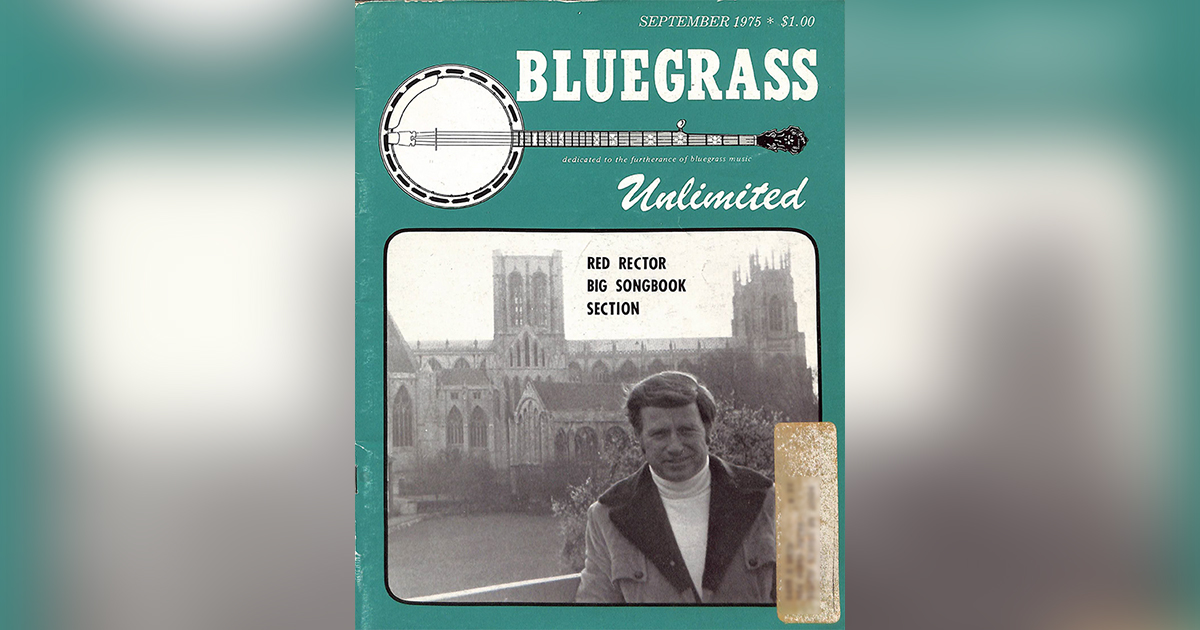
Red Rector: Mandolin Virtuoso
Reprinted from Bluegrass Unlimited Magazine
September 1975, Volume 10, Number 3
The mandolin became a part of bluegrass at basically the same moment as Bill Monroe which is to say, in the beginning. Other bands which took on elements of bluegrass also began to include innovative mandolin pickers. Among them was a young North Carolinian named William Eugene “Red” Rector whose style developed over thirty years into one of the most tasteful and original in the music. Through his long career as a sideman, in record sessions and as a radio/television solo and duet artist, Red’s name has become a household word among his thousands of admirers.
Born in Marshall, Madison County, North Carolina on December 15, 1929, young Red Rector – like many other noted musicians- grew up in an atmosphere of music. His mother played piano and organ and his father once sang in a quartet. However, the radio groups on WWNC in nearby Asheville such as the Morris Brothers and Wade Mainer and the Sons of the Mountaineers attracted young Red’s attention. At about the age of ten, Red saw his first live show at the local grammar school when Wiley, Zeke and George Morris together with Steve Ledford and Hoke Jenkins gave a performance. Red first, played guitar but developed a great interest in the mandolin after hearing the Monroe Brothers’ recording of “New River Train.” About 1942, Red heard Bill Monroe at a tent show in Asheville and “really went wild over the mandolin.” Bill cautioned Red about playing with a stiff wrist and the youth took the advice of the acknowledged expert.
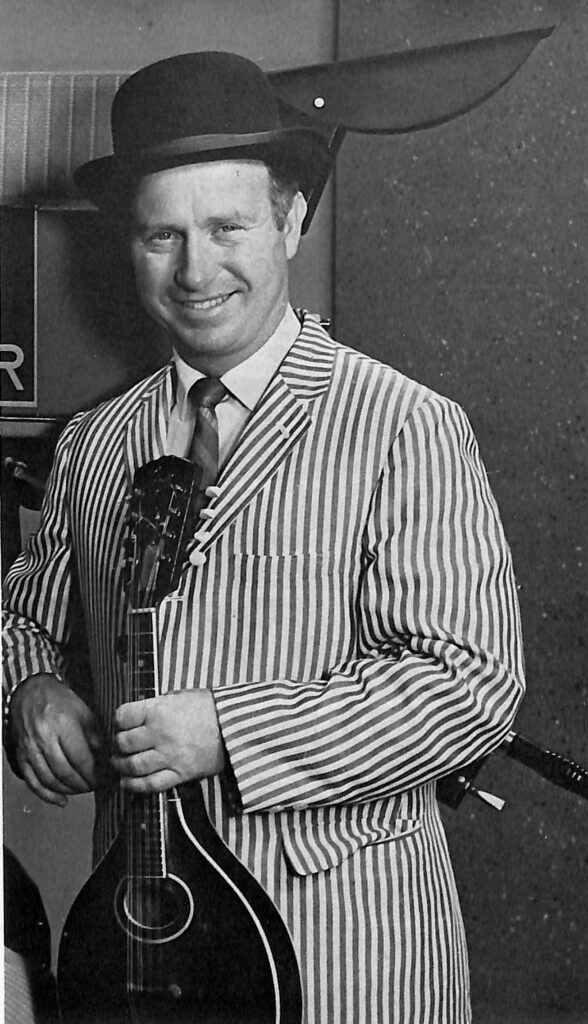
Shortly afterwards, Red and some other area youngsters began playing a fifteen-minute show on WISE in Asheville with Jimmy Lunsford on fiddle and Dempsey Cothran and W.J. Waddell on guitars. As a result of his mandolin work on this show, Wade Mainer hired Red to go to New York with him to appear in a radio drama for BBC, “The Chisholm Trail,” in 1943. In addition to Wade and Red, J.E. Mainer and Fred Smith also made the trip. In New York, they were joined by the Coon Creek Girls (Lily, Rosie and Minnie Ledford) and several urban folk – performers such as Burl Ives, Woody Guthrie, Cisco Houston, Lee Hays and Sonny Terry. Red primarily helped furnish background music but also got to do some vocal work on singing cowboy songs. After a week or so of practice, they did the show.
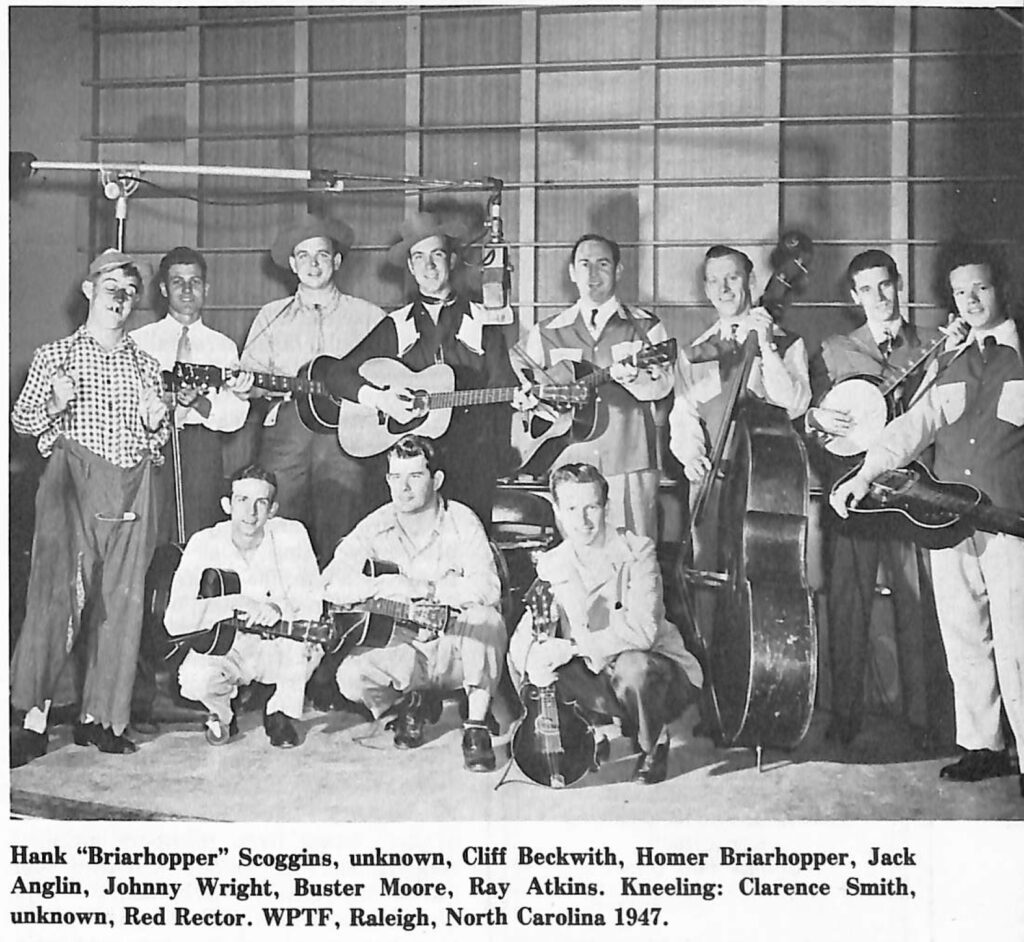
Red returned to Asheville with a little bigger name than before and continued on WISE. Soon, however, he and Jimmy Lunsford got the chance to move over to the larger station, WWNC and the popular Western North Carolina Farm Hour. Here Red played guitar in a group known as Oscar Turner and the Farm Boys which included another pair of pioneers in bluegrass – Carl and J.P. Sauceman. He also began to play more often with Fred Smith whom he had known for years but had seldom worked with musically because of Red’s being six years younger. He and Fred then associated with a group known as the Blue Ridge Hillbillies headed by a comedian, Tommy “Snowball” Millard. Red Smiley and the Saucemans worked in the band. Fred, the two Reds and Howard Thompson also went to WJHL in Johnson City and worked with Zeke Morris. When they came back to Asheville early 1946, Red received a call from Ray Atkins in Raleigh who asked him to join Johnny Wright and Jack Anglin’s Tennessee Hillbillies at WPTF. A guaranteed salary of $35.00 weekly sounded good to Red and he immediately accepted.
By this time – although only sixteen- Red had acquired considerable musical experience. He also began to realize the necessity of developing a more original musical style. Although greatly admiring Bill Monroe, he worked to develop his own manner of mandolin playing. Like others with unique styles, however, Red did borrow and acknowledges the influence of Paul Buskirk as being quite important. Buskirk who had an extensive career in radio that stretched from his native West Virginia to Texas, developed expertise on a variety of instruments including the Dobro, fiddle and tenor banjo (he has recently recorded on the Stoneway label) also influenced the mandolin work of others.
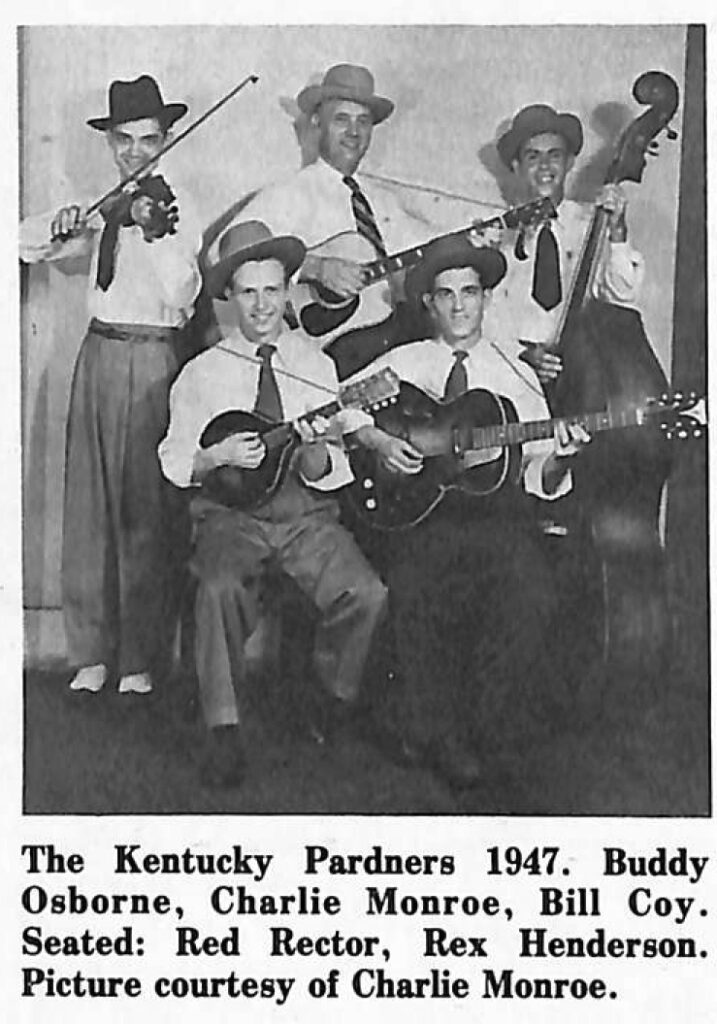
When Red went to Raleigh and joined Johnny and Jack, their group included Paul Warren of later Flatt and Scruggs fame on fiddle; Buster Moore on banjo; Ray Atkins on Dobro and Johnny’s wife Muriel (Kitty Wells), as featured vocalist. Although their string of hits on Victor did not come until several years later, the Tennessee Hillbillies were nonetheless a popular radio and personal appearance band. After ten months at Raleigh, Johnny and Jack received the chance to join WSM. Red, however, decided not to go to the Opry and instead joined Charlie Monroe and the Kentucky Pardners at WNOX in Knoxville.
Charlie Monroe enjoyed a very high popularity rating in an area extending from North Carolina to eastern Kentucky. After a couple of months, on November 7, 1947, the Kentucky Pardners went to New York and cut twelve sides on RCA Victor – Red’s first recording session. The sides waxed that day included some of Charlie’s more popular numbers like “Walking With You In My Dreams,” “When the Angels Carry Me Home,” “End of Memory Lane” and “Shenandoah Waltz.” Other band members included Rex Henderson, Buddy Osborne and Lavell Coy. Later, Charlie and the boys moved on to WBOK in Birmingham where they became one of the first acts on a newly opened station.
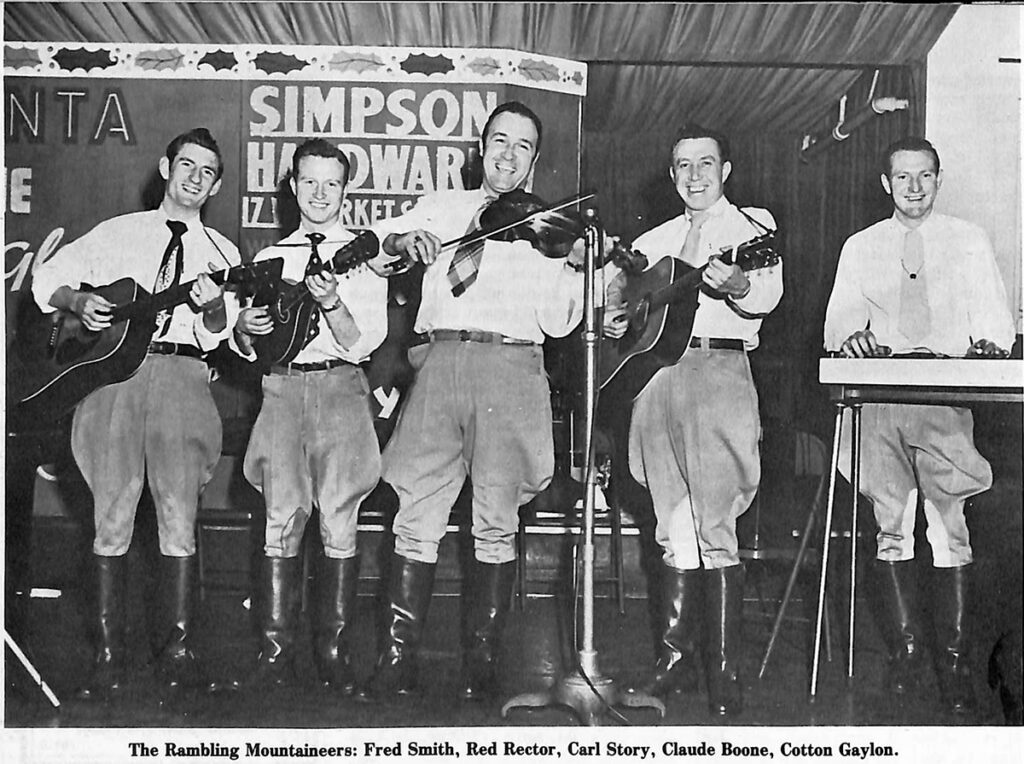
In the summer of 1948, Charlie took a long vacation and after a brief period of inactivity, Red and Fred Smith went to work as a duet with Carl Story and the Rambling Mountaineers replacing the Johnson Brothers. Claude Boone and Cotton Galyon rounded out the group at that time. Red stayed with the Rambling Mountaineers for about seven years and recorded several sessions on Mercury and Columbia. They recorded a lot of gospel quartet numbers and also such secular songs as “Have You Come To Say Goodbye?” and “Love and Wealth”; the latter featuring Red’s lead vocal.
After a time, the Carl Story group left WNOX and went on to Bristol and Atlanta for short stints and then spent three highly successful years at WAYS, Charlotte, where they started the Tar Heel Barn Dance. Ray Atkins who had previously worked with Johnny and Jack at WPTF when Red did, played with the Rambling Mountaineers during much of this period following the departure of Galyon and Smith. Red worked with the band until 1955 when they returned to Knoxville.
These years covered the last part of the great age of live country music on radio. Nightly, the Rambling Mountaineers played school houses, court houses, or theaters to packed audiences. Few artists carried their easily breakable seventy-eight rpm records on show dates, but made considerable extra cash selling souvenir pictures and song books.
While employed with Carl Story, Red Rector took advantage of two additional opportunities to do session work. The first came on February 1, 1949 when he journeyed to Atlanta and cut eight more sides with Charlie Monroe on Victor including “Rosa Lee McFall,” “Red Rocking Chair” and “Time Clock of Life.” The second occurred in Charlotte in 1953 when Red worked on Don Reno’s and Red Smiley’s second King session together with his boyhood friend, Jimmy Lunsford on fiddle and also Tommy Faile and Nelson Benton. The twelve songs included “Talk of the Town,” “Springtime In Dear Old Dixie” and such instrumental classics as “Choking the Strings” and “Tennessee Breakdown.”
When Carl Story returned to Knoxville, Red Rector left the Rambling Mountaineers and teamed up as a duet with Fred Smith. Fred had worked with a variety of other Knoxville artists like Archie Campbell, Speedy Krise (See BU, May 1975) and Jack Shelton in the years since leaving Story. They worked together for about three years adding comedy routines to their act. Then in 1958, the Mid-Day Merry-Go-Round terminated and Red went to work for Martha White Flour’s second unit as part of Hylo Brown’s Timberliners
Hylo at that time worked a series of television shows in Jackson and Tupelo, Mississippi and Jackson, Tennessee. After a few months, they traded places with Flatt and Scruggs and then worked on five stations in the Appalachian region. The band also included Tater Tate, Jim Smoak and Joe Phillips. Together, they cut twenty numbers on Capitol which included some of the most classic bluegrass numbers ever waxed. In addition to the Hylo Brown album which was largely made up of traditional songs, they cut eight original songs released as singles including “Shuffle My Feet,” “Thunderclouds of Love” and “I’ve Waited As Long As I Can.” Red left the group about a month before it broke up when he got the opportunity to go back to Knoxville and work with Fred Smith again- this time on daily television for Cas Walker, the Knoxville supermarket owner.
The Cas Walker Fun Time Show on morning TV has been Red’s mainstay now for more than sixteen years. During much of the sixties, he did not play out a great deal although he did guest on the Opry a few times and played some personal appearances. He also worked on some Nashville record sessions including a Tommy Jackson fiddle album on Dot and Walter Hensley’s Capitol effort, “The Five String Banjo Today.” An outstanding album which featured both Red’s vocal and instrumental work was “Grandpa Jones Remembers the Brown’s Ferry Four” with Merle Travis and Grandpa recreating their original roles in the legendary gospel quartet with Red and Ramona Jones replacing the Delmore Brothers.
In the last few years, Red has worked a lot of festivals as a solo act giving examples of his virtuosity on the mandolin both in the workshops and concerts. He has worked some festivals with Fred Smith, his television partner, doing both duet numbers and comedy routines. They also work on some country package shows.
Red’s work on the Cas Walker show pits him with a variety of country and bluegrass personalities. In addition to Red and Fred Smith, the show includes banjoist Larry Mathis, Danny Bailey of the once famous brother team and Claude Boone, a country music veteran who has worked with both Cliff Carlisle and Carl Story. A few years ago, country superstar Dolly Parton worked on the show. A recent addition. Honey Wild, once constituted half of the famous blackface comedy team of Jamup and Honey.
Red has also expanded his recording activities. In 1969, he and Fred Smith did an album for County Records with the aid of Bill Chambers and Kenny Baker on banjo and fiddle respectively. The LP consisted of nine old-time country duet numbers such as the old Molly O’Day, Lynn Davis number, “This Is the End,” “One Little Word” and “Are There Tears Behind Your Smile?” plus three outstanding instrumentals featuring Red and Kenny Baker.
A couple of years ago, Red did his first solo album on Old Homestead with seven ballads and seven instrumentals. On this recording, he received able backup from Doug Green, Vic Jordan, and Buck and Cheryl White. Buck, an outstanding mandolinist in his own right, played lead guitar except on “Flop Eared Mule” and “Red Wing” on which Red did the guitar work. This was the first time in a quarter of a century of recording that Red had played anything except mandolin on a session. He has since recorded an all instrumental album for Old Homestead, which at this writing has yet to be released.
Red has also extended his session work as a guest artist. In recent years he has again recorded with Carl Story on both Jessup and Atteiram. He also has helped Rual Yarbrough, Bill Clifton, Ramona Jones and Wade Hill.
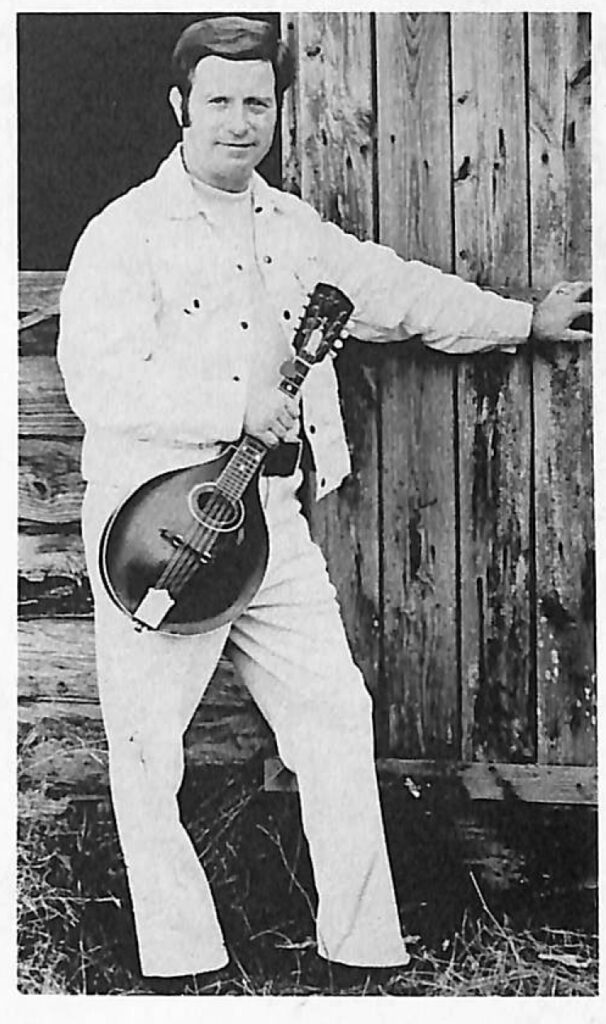
Although continuing to work on the Cas Walker show, Red Rector has begun to work personal appearances with other groups more frequently. Red and his wife of nearly thirty years, Ernestine, have reared a family of four children and as they have all reached adulthood, he has accepted opportunities to play farther from Knoxville. In 1974, he worked with Bill Clifton on his festival appearances and more recently has worked often with Rual Yarbrough and Joe Stuart. In February 1975, he spent a month in England and various nations of western Europe giving concerts with Bill Clifton. This summer he will again be playing on numerous festivals – either as a solo act or with various bands.
In more than three decades in country and bluegrass music, Red Rector has been a prominent, creative and influential figure. His original mandolin work in the pioneer days of bluegrass with such persons as Charlie Monroe, Carl Story, Hylo Brown and Reno and Smiley helped to put the music on a solid foundation and his current high-quality efforts are assisting in its steadily increasing popularity. Among mandolinists, only Bill Monroe and perhaps one or two others have contributed more to bluegrass music.
