Ralph Stanley Museum and Traditional Mountain Music Center
Photos Courtesy of Ralph Stanley Museum
Nestled in the beautiful Appalachian Mountains about eight miles northeast of Ralph Stanley’s birthplace, McClure, Virginia, sits a bastion of traditional mountain music.
Old familiar dirt roads wind through the piney glade
Where all the longings of childhood dreams were made
Where we passed the mossy mounds where I could run and play
Never a care to cross my mind all the livelong day.
(Lyrics from “Hills of Home”)
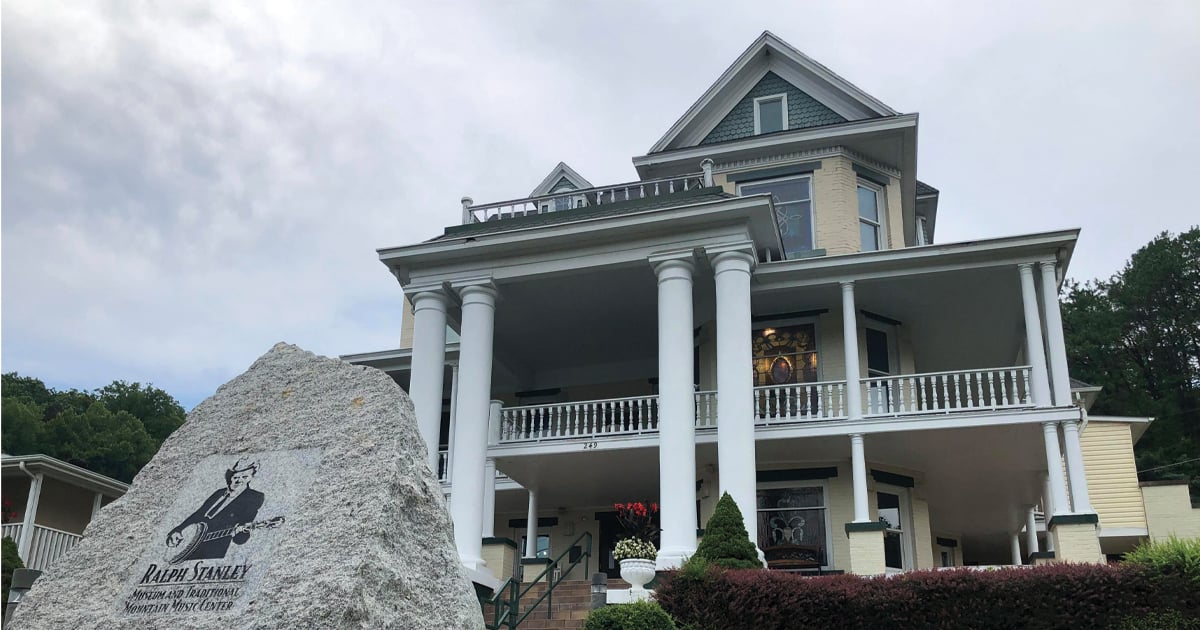
Songs like Dr. Stanley’s classic “Hills of Home,” play as a musical backdrop throughout the immaculately-manicured grounds of the Ralph Stanley Museum and Traditional Mountain Music Center. Visitors are transported into the music past as they first come upon the century-old four-story home called the Chase House, once known as a Virginia Mansion. Located in Clintwood, Virginia, the museum opened in October 2004 with the desire to continually preserve and promote bluegrass music. Stained-glass fills the window panes throughout the first three floors, and as tourists walk through the door, they see a unique front desk that’s shaped like the bottom part of a banjo.
Museum Director Dora Wallace greets everyone with “Hello! Come on in this house!” in a thick Appalachian accent. “I like to make people feel comfortable when they come in,” she says. “Then, I say, ‘Where in the world are you coming from?’ Usually, when I say it with a joking manner, people will say ‘I’m just coming from down the road right now.”
“On the left side of the museum you’re introduced to the Crooked Road which is Virginia’s Heritage Music Trail,” Wallace explains. “I tell them they’re actually on the last stop along the Crooked Road if they decide to follow that to come visit us. If they come to us first, they’re on the first stop,” she adds, laughing.
To the right is a gift shop packed with a huge selection of recordings from Ralph Stanley and the Clinch Mountain Boys as well as the Stanley Brothers covering the time from the Starday-King Record days until Ralph passed away. The musical collection includes music from Ralph Stanley II, and former Clinch Mountain Boys Ricky Skaggs and Keith Whitley from their days with the band.
The remaining part of the first floor delves into the history of the IBMA Hall of Famer’s vocal development. “I go through a little bit about Ralph’s Primitive Baptist music background and what we call the Dickenson County sound and how Ralph developed his high lonesome sound. That kind of introduces people to who he was, where he came from, how he developed that specific tonality and way that he sang. Then, we go into what we call our chapel or church house, depending on what neck of the woods you’re coming from. There’s a 10-minute video on the wall that takes you through Ralph’s life from the beginning until when the museum was built. Behind that is a video about the movie, O Brother, Where Art Thou? We have a real movie script from the movie, Dapper Dan cans and props on display.”
Using a combination of immersive design and modern technology, visitors can don plug-in headphones for an interactive experience as they dig deeper into Stanley’s past. Ralph personally shares stories of his own history and other major milestones in mountain music.
One room on the second floor features information on the beginning of the men’s career, another room explores Carter and Ralph’s success on their own while another hones in on Ralph’s musical life after his brother’s death. “We really try to pull out that mountain music heritage and what made Ralph and Carter who they were with that influence from mountain music,” Wallace said. “We have extended exhibit galleries that highlight the beginnings of country music to modern bluegrass. There’s a memorial to Carter upstairs, and you can hear Ralph tell stories when you walk up to it. There’s a lot of memorabilia donated by Ralph personally from his personal collection. The show, American Pickers on the History Channel came and donated several different things from Hyder Kiser’s collection that are on exhibit that we didn’t have.”
Stanley’s donated items include some of the clothing that Ralph and Carter wore. “In the beginning Ralph and Carter wore matching suits to some of their bigger events. His mother’s banjo and bonnet are there. We have her purse or pocketbook as they say around here. With that Primitive Baptist background we have on display, we have one of the original hymnals that were used at the church that he attended in McClure. I get that out and let people see it if they want to. So, they can see how he sang and some of the songs that he sang. We have some awards on display that he’s received over the years. There are some unique black and white pictures you’ll only find that are not on display anywhere else. We have some of him on stage with Carter and Ralph on stage with other musicians in his early years. Some people don’t know that he ran for Circuit Court Clerk in Dickenson County, and we were donated some memorabilia like a matchbook and one of his posters. We have some of his hats on display. ‘The Pickers’ donated a couple of unique photographs, Ralph’s baptism (when he was coming up out of the river).
“We have one of Keith Whitley’s suits. We have Curly Ray Cline’s actual fiddle case. He had a big horn. He was known as the Old Kentucky Fox Hunter, and we have his horn that he used to blow on stage. It was given to the museum exactly the way Curly Ray left it. There’s a receipt inside of the fiddle case that’s hand-written where he purchased some things, resin in there that’s never been opened, and extra keys and tuners of Curly Ray’s.”
Tourists come to the museum from 15 different countries including Japan and China, but most flock to the Appalachian haven from Virginia, Tennessee, Kentucky, North Carolina and Ohio. “I tell everybody after they’re finished [the tour] if they want to have a flatfoot lesson, I will teach them. Then, I do a little jig, and they laugh.”
An employee of the Town of Clintwood, Wallace has a special kinship with the area and museum. “The reason that I personally have an attachment to it is I was raised by my grandparents, and I grew up watching the Grand Ole Opry and Hee Haw. I had an upbringing surrounded by traditional mountain music and bluegrass. I can remember as a child flatfooting on this old green carpet in the living room with my bare feet. I learned to flatfoot by watching these old programs that my grandparents watched. I feel like I belong there [at the museum] because I’m connected to home and these are my roots. I love the music as much as I love to see the people come through who love the music.”
Since taking over the reins, Wallace has been striving to make the museum a thriving reminder of Ralph Stanley’s legacy. She continues to provide rotating exhibits and is working to build up the museum’s social media presence on Facebook to share about Ralph and Carter’s life and family. “I study the books, I study the memoirs, I study the things that people have written about the brothers, and Ralph especially. I tell people that it tells the story of life here in these mountains. When you listen to Ralph’s music, you understand who the people are that surround you when you come to visit the museum. I think there’s a place for it still in our world to tell the stories of life here and what that high lonesome sound and life really meant.”