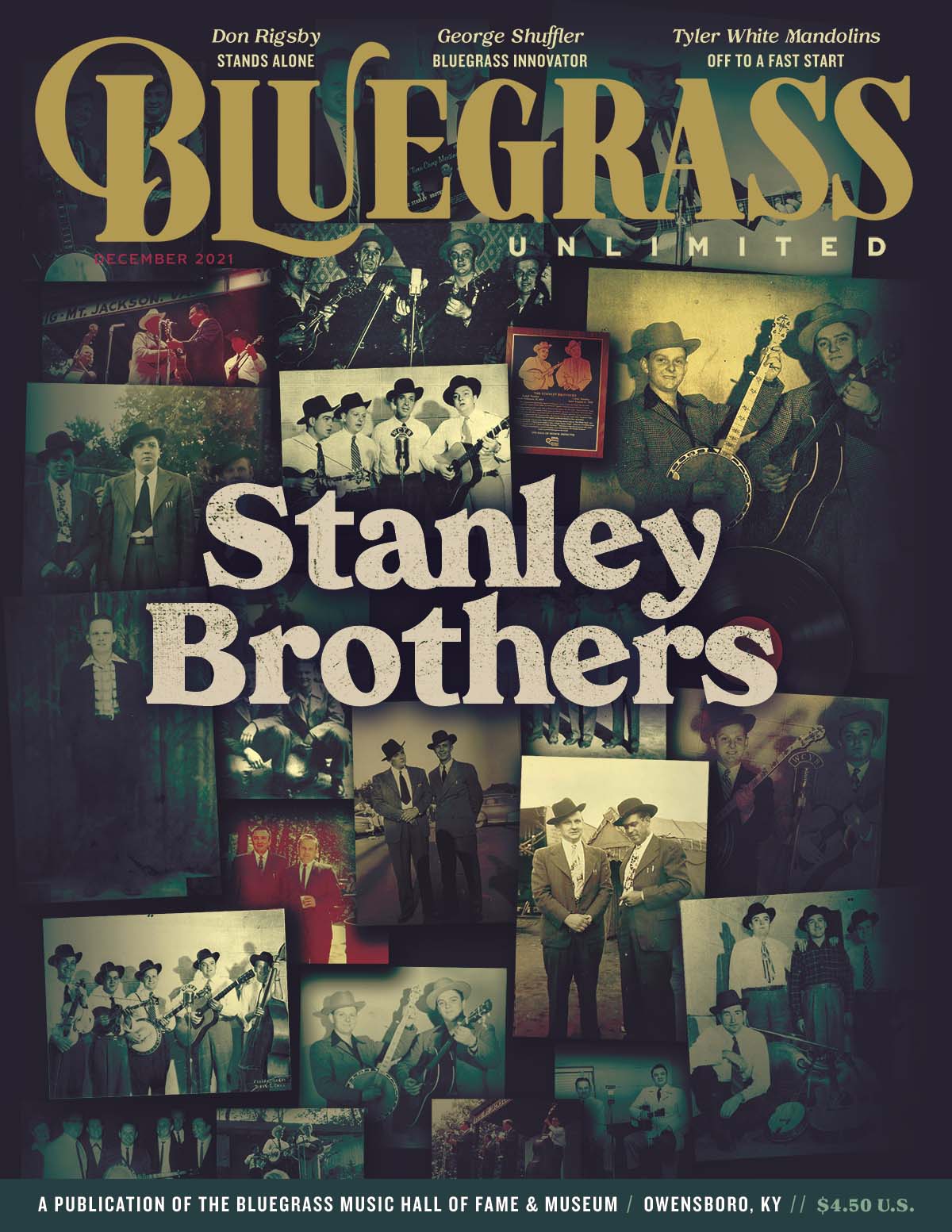
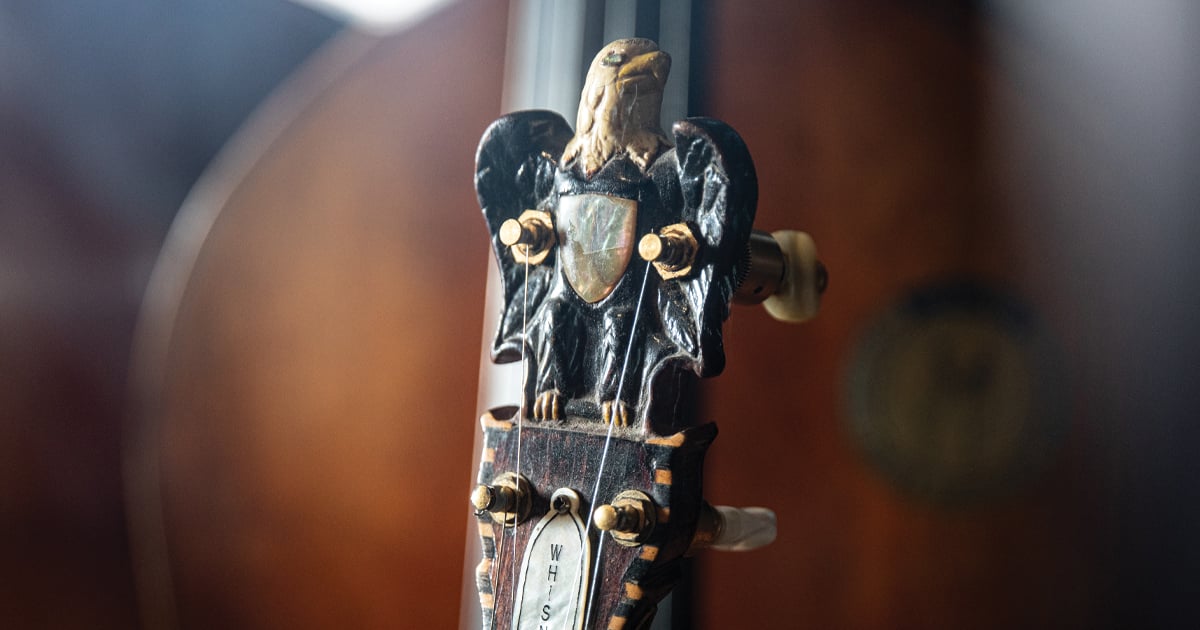
Ralph Stanley and the Whisnant Eagle Banjo
Photos by Jamie Alexander
For many of us, the first-generation bluegrass pioneers were the link that pulled on our heart strings and gave us a lifetime infatuation for bluegrass music. Whether it be Flatt and Scruggs, Monroe, The Stanley’s, Reno and Smiley—or whoever it may have been—it seems that each individual connects in some way to one of these heroes and that is the foundation for the inspiration in one’s style playing. In 1987, that exact scenario happened for me at a show I attended with my father, Bob Smith. Ralph Stanley and the Clinch Mountain Boys took the stage at Brady’s Run Park in Beaver Valley Pennsylvania and at that point I found my hero. I fell in love with Ralphs style of mountain music. I happen to have one of those personalities that can’t let a stone go unturned, I must find every slice of information I can about what peaks my interest. In this case, at age 13, it was everything Stanley and the mystery that surrounds Ralph and Carter would take me on a life-long journey that I enjoy almost daily. This article is a small piece of that journey.
I was very fortunate to become quite close with Ralph. As my family would take vacations to the Blue Ridge Mountains frequently in the late 80s, dad would drop me off at Ralph’s house. Soup beans and cornbread dinners were a regular. My favorite times were riding around the hills of Southwest Virginia with Ralph in his old 4-wheel drive Chevy Luv truck.
Our banjo heroes have all played different banjos through the years and settled on one that became their staple. Earl had his Hearts and Flowers, Don had Nellie, and Ralph had the Deluxe 5. During the festival at Brady’s Run, I made it over to Charlie and Doris Chases record store that they always set up at the festivals. One album sparked my attention, Ralph Stanley and the Clinch Mountain Boys Live in Japan. The album cover is a painting, done by Frederick Carlson. It shows Ralph playing a strange looking banjo with an eagle carved in the headstock.
After spending the next year of my life learning everything Stanley related, I asked Ralph at a show about the strange looking banjo. He told me that while on a trip to Sweden in 1966, with brother Carter, he took his Deluxe 5 and the airline—possibly not realizing the significance of the instrument, or not caring—had turned the case upside down during the flight and collapsed the bridge. He vowed never to fly with the banjo again and opted for borrowing an instrument when he flew. That is what he did when he traveled to Japan in 1970.
In 1990 I asked Ralph what ever happened to the banjo that he was playing on the cover of the Live in Japan album. He said he hadn’t seen it in 20 years and didn’t know what ever happened to it. I thought the banjo was long gone, until one day on Facebook a picture appeared from the Bluegrass Music Hall of Fame and Museum, and low and behold, there it was!
The banjo, now owned by Christopher Harnett from Morgantown, West Virginia, was on loan for display in the museum. I was able to contact Christopher on Facebook. I sent him a message and a friend request. Months went by. Four to be exact. I began to lose hope once again thinking he never gets on his Facebook, or something had possibly happened to him. On February 6, 2019 my phone made the famous Facebook messenger ding and there he was!
As gracious and friendly and welcoming as most of our bluegrass family is, Christopher was all that and more. We spent an hour on the phone talking about the banjo and his life. It still amazes me, almost on a daily basis, how things like a banjo from 49 years ago connects people and builds new friendships. Bluegrass is just the most powerful thing in the world when it comes to music. At first glance, one might think that the banjo is a Gibson All American; that’s surely what I thought. It wasn’t until a couple years ago when my Facebook friend Bob Roberts posted a picture of Ralph and the banjo from the 1970 Japan trip that I found out it was not a Gibson. A Gibson All American banjo has an eagle in the headstock just as the banjo Ralph was playing did, only the eagle’s head was turned to the right. On a Gibson, the eagle’s head is turned to the left, as if looking at the person playing.
The eagle banjo has always been attributed to famous banjo picker and lover of all thing’s bluegrass, Johnnie Whisnant. An Ashburn, Virginia native, Whisnant was a banjo teacher, builder, and picker. Sometime in the late 60s, Johnnie had built four Eagle banjos. All of them are accounted for to this day. After a story that I wrote about this banjo originally appeared on the Bluegrass Today website in 2019, I was contacted by Virginia bluegrass legend, Al Jones who shed more light on the mystery. According to Al, the rim of the banjo was made by a French immigrant in Virginia by the name of John Ganzinger who worked at a wood shop and was friends with Johnnie. The metal hardware is all stainless steel and was made by a machinist that Whisnant knew that worked at Westinghouse by the name of Frank Guzzly. The tone ring is a confirmed prewar Gibson flat head. The inlay was done by Al Jones, and the neck, resonator and carving were done by Whisnant.
I asked Al if he recalled how Ralph ever became aware of the banjo in relation to taking it to Japan. “There was a fellow that lived in Bristol, Virginia by the name of Elmer Harr. Everyone in bluegrass knew him and he was a big instrument trader. He would buy and sell and try to make a few bucks, but all the big boys in bluegrass knew him. One day Ralph took Keith Whitley and Ricky Skaggs to Elmer’s house to look at some instruments. Ralph saw the Eagle banjo and grabbed it and started playing some on it. He really liked the sound; it had that Stanley sound. When the time came for the Japan tour, Ralph remembered the banjo and asked Harr if he could borrow it for the trip. Elmer obliged.”
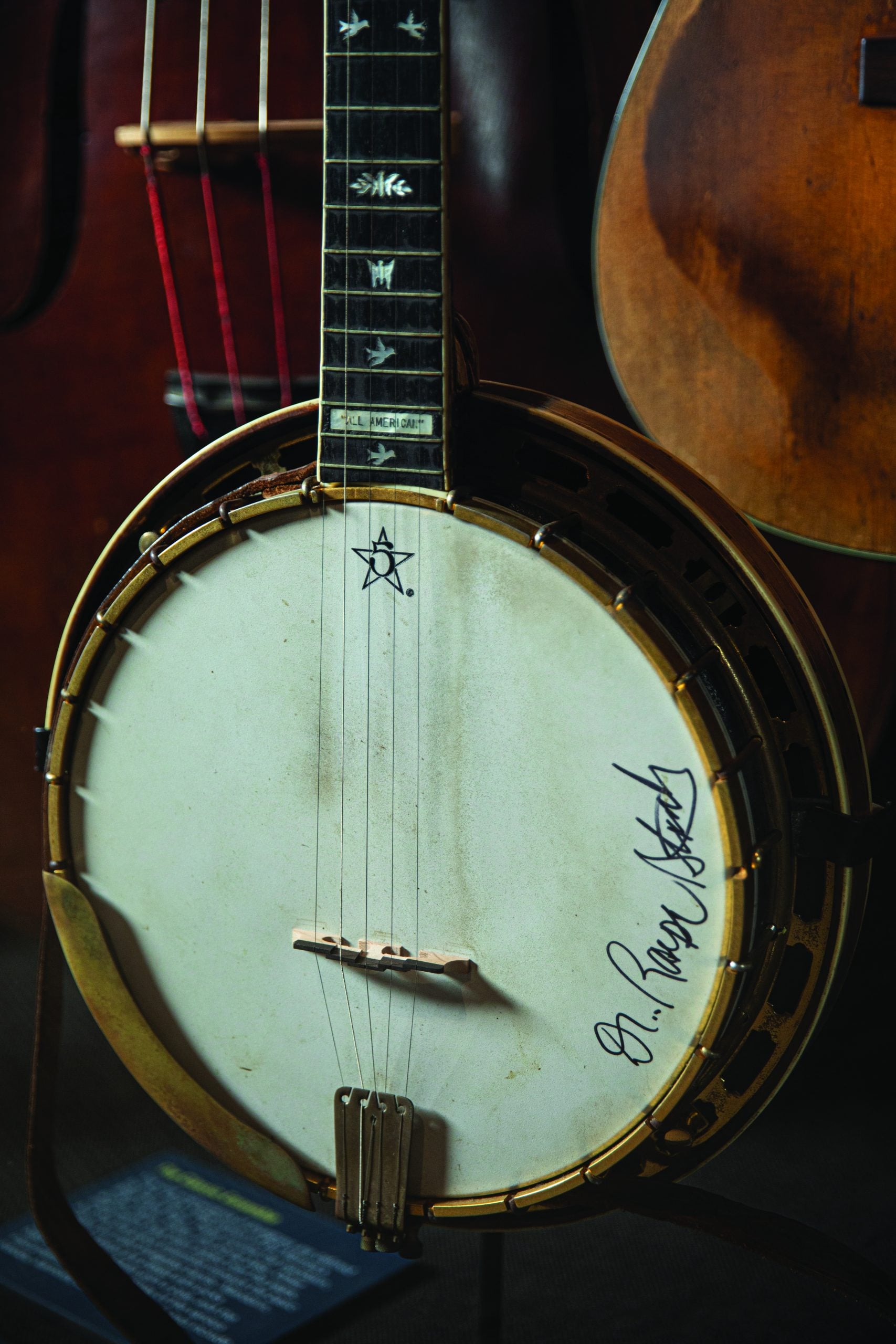
When Ralph returned home from Japan, Harr waited for the banjos return. Weeks passed, and one day Elmer and his wife Ethel hopped in the car and drove to Ralphs house. They pulled in and Ralph was sitting on the front porch. Elmer asked Ralph why he hadn’t returned the banjo, and Ralph said “Well I really like it and was planning on buying it.” Unfortunately, while Ralph was in Japan, Harr had found a buyer for it and the banjo was already promised. Who the buyer was or where it went at this point is unknown, but shortly after, it ended up back in the hands of Al Jones.
Whisnant had a banjo student by the name of Sue. Her and her husband were both veterinarians. She was looking for a banjo a little better than what she had. Whisnant had remembered that Al had the Eagle banjo and called to see if it was for sale. Johnnie set the deal up, and again it changed hands. Eventually it came back to Whisnant. In 1972 a young man by the name of Christopher Harnett, and his dad Mike, from Sterling, Virginia, went to Johnnie’s house for Christopher to begin banjo lessons. In 1973, Mike Harnett purchased the banjo and kept in under lock and key, only bringing it out for Christopher to play banjo contests and for special occasions. In 2011 Christopher inherited the banjo after his father’s passing.
In 2012, in Shepardstown, West Virginia at the Opera House, Ralph Stanley and the eagle banjo were reunited after 42 years. Christopher took the banjo to Ralph’s show that evening as it was Ralph’s 85th birthday celebration. Two albums were made using the banjo, Ralph Stanley Live in Japan and John Henry, an album that was recorded while the group was in Japan. It was released on the Seven Seas label and is extremely rare. I’ve been told that the John Henry album was given out in Japan as a promotion when you bought a set of tires. The album cover featured a picture of a topless woman. Ralph had a copy of the album at his house, but no cover. I asked him, while in his office one time, what happened to the cover and he said “Jimmi asked me to throw it away.” I’ve also got a bootleg copy of Ralph and the CMB in San Francisco, at the Freight and Salvage, doing a show on their return to the states after the Japanese tour. The eagle banjo is on this recording as well. The eagle banjo is now in The Bluegrass Music Hall of Fame and Museum in Owensboro, Kentucky. It will be on display for the next 3 years, courtesy of Christopher Harnett.