Piedmont Council Of Traditional Music
“Never doubt that a group of thoughtful, committed citizens can change the world. Indeed, it is the only thing that ever has.”
– Margaret Mead
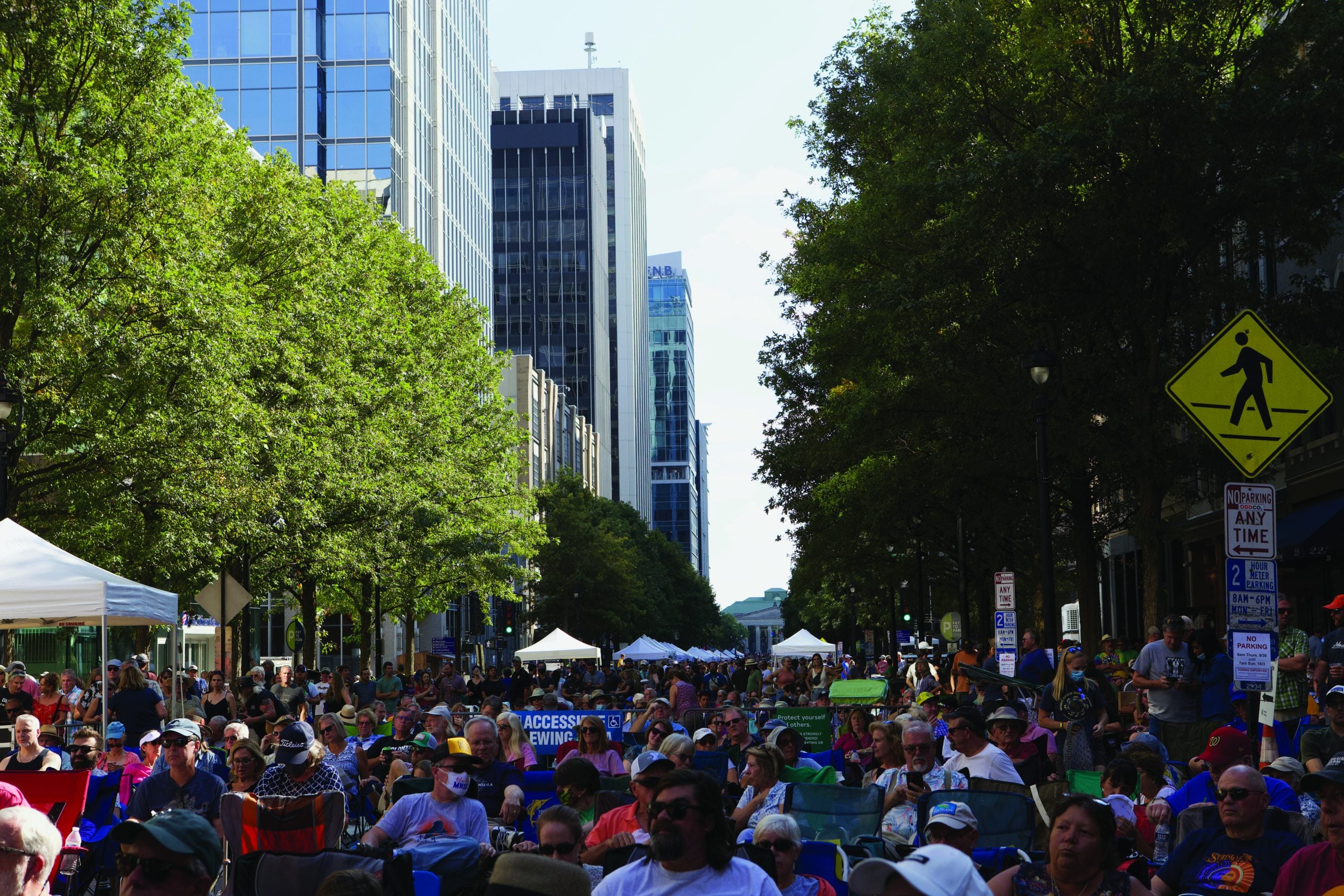
From September 27 through October 1, Raleigh, North Carolina, hosted the International Bluegrass Music Association’s World of Bluegrass for the 10th consecutive year. Some 200,000 musicians and fans will visit the City of Oaks for concerts, workshops, panel discussions, jam sessions, and fellowship. The conference is made possible through the combined efforts of IBMA, City of Raleigh, Raleigh Convention and Visitors Bureau, and Raleigh-based Piedmont Council of Traditional Music (PineCone), which served as host for the 5-day assembly.
World of Bluegrass is PineCone’s most elaborate annual production. Yet, it is only one aspect of PineCone’s mission to discover, promote, and present the diverse community of traditional music of North Carolina and beyond. From small beginnings, PineCone has evolved into a majestic cultural resource serving Raleigh and surrounding communities. The nonprofit organization presents more than 200 programs annually, including more than 30 concerts, youth programs, participatory jams and a weekly bluegrass radio show.
PineCone was founded in 1984 by traditional musicians Wayne and Margaret Martin, Apple Chill clogger Ron Raxter, and square dancer Beverly Young. At the time, Raleigh was a traditional music desert overshadowed by neighboring communities rich with venues supporting the music they loved.
“One night, we sat around lamenting that we had to go to Chapel Hill or Durham if we wanted to listen to traditional music,” recalls Raxter, a former member of IBMA’s Education Committee and Leadership Bluegrass alumnus. “We were young and figured if we put enough time and effort into it, maybe we could get a little concert series here.”
As visiting artists with the NC Arts Council, the Martins were acquainted with older musicians who were still active in the state. Former director of the NC arts council Wayne Martin notes that people play music for different reasons. For some it’s the lure of stardom, for others an expressive pastime. The Martins wanted avocational artists “spotlighted because they had a connection to place, and that place was North Carolina. I wanted to make certain that people who weren’t necessarily doing it for a living could be part of it [PineCone].”
Energized by their passion for traditional music and desire to bring it closer to home, the friends began reaching out to others, sharing their vision and enlisting support. Raleigh TV station WRAL donated seed money, and Raxter and friends applied for state funding. “We happened along at a time when people were looking to spend money on traditional arts,” Raxter says.
“The reason we called it the Piedmont Council of Traditional Music was that we wanted to be the resource. If somebody…wanted to do traditional music, we were the people they needed to come to in order to ensure they were getting an authentic act.”
A board of directors was elected with Raxter as PineCone’s first president. To guide its mission, the board issued its Statement of Purpose with an operational definition of traditional music as: “fiddle tunes, bluegrass, gospel ballads, blues, swing, folk and all the various combinations and derivations that our culture has nurtured and evolved. It is the musical spice that gives North Carolina its own taste…It is music that can increase the attractiveness and uniqueness of our community and contribute to a cohesive cultural identity.”
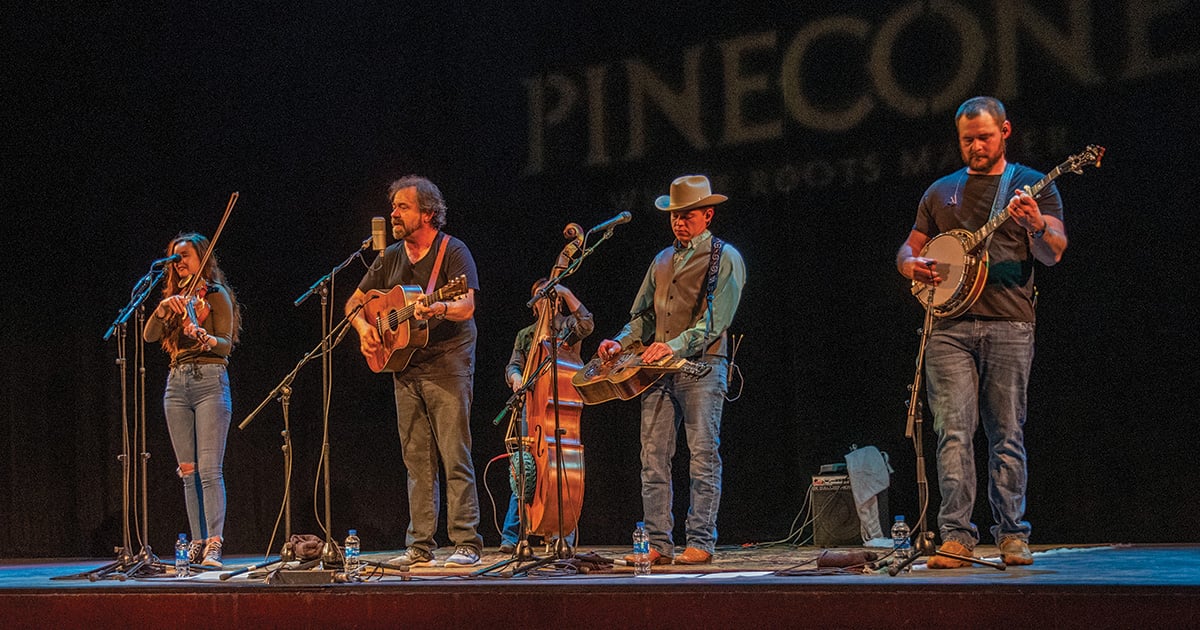
PineCone initiated a concert series at Raleigh Little Theatre (RLT) and Rose Garden. The first year featured a variety of regional and national acts, including Norman Blake, bluesman John Dee Holeman, WBT (Charlotte) Briarhoppers, and the Badgett Sisters gospel trio.
In 1987, North Carolina State University offered PineCone use of its 800-seat Stewart Theatre. With twice the seating capacity of RLT, PineCone was able to present larger national and international acts, while retaining its focus on North Carolina. A partial list of artists who performed at Stewart Theatre includes Ricky Skaggs and Kentucky Thunder, David Grisman Quartet, Hazel Dickens and Alice Gerrard, Old Crow Medicine Show, Riders in the Sky, Bill Monroe and His Blue Grass Boys, Doc Watson, Taj Mahal, Alison Krauss, Sones de Mexico, and Mary Black.
Susan Newberry served as executive director from 1996 to 2007. Under her leadership, PineCone partnered with the Ulster American Folk Park in Omagh, Co. Tyrone, Northern Ireland. The Folk Park is dedicated to documenting and presenting the global influence of the Irish diaspora. Each Labor Day weekend, Omagh hosted the Appalachian and Bluegrass Music Festival, one of Europe’s most prominent music gatherings. The festival featured top U.S. acts along with many of the finest European bands, and helped IBMA with its mission of serving an international sweep of bluegrass music.
Newberry assisted festival director Richard Hurst in recommending and coordinating U.S. talent. Artists who performed there include Doyle Lawson and Quicksilver, Danny Paisley and Southern Grass, Laurie Lewis and Her Right Hands, Steep Canyon Rangers, Italy’s Red Wine, Ireland’s Niall Toner Band, Malpass Brothers with Clyde Mattocks, Netherlands’ Blue Grass Boogiemen, and Czech Republic’s Sunny side.
In 2005, PineCone moved its offices into the Duke Energy Center for the Performing Arts. The building houses three prime concert halls: the 23,369-seat Memorial Auditorium, 1750-seat Meymandi Concert Hall, and 600-seat Fletcher Opera Theatre. PineCone is now able to book acts of varied size and popularity, including Billy Strings, Molly Tuttle, and Merle Haggard.
In 2004, William Lewis was hired as PineCone’s program assistant. When Newberry retired in 2008, Lewis, who holds a master’s degree in folklore, assumed the position of executive director. Under Lewis, PineCone continued to present a range of traditional music acts. In 2013, PineCone teamed with the IBMA and the City of Raleigh and brought the first World of Bluegrass to the capitol city.
It’s been a good fit. Raleigh has an estimable history with bluegrass. The Monroe Brothers, Flatt and Scruggs, Ralph and Carter Stanley, and other notables had performed on the city’s radio stations and in nearby schoolhouses and theaters. PineCone’s bluegrass show began broadcasting in 1989 and serves some 8,000 listeners each week. Today as in yesteryear, North Carolina’s Central Piedmont is indeed a hotbed of bluegrass passion.
Lewis says interest in bringing IBMA to Raleigh originated with Laurie Okun, Director of Sales, and Loren Gold, Executive Vice President, of the Greater Raleigh Convention Center and Visitors Bureau. “Laurie had met an IBMA member at a trade show and suggested Raleigh as a possible venue for World of Bluegrass. PineCone got wind that she had that interest and thought we could be involved. PineCone has the presenting history, knowledge of bluegrass in this area and 400 volunteers. We said, ‘We have these resources. Let us help you.’”
Importantly, Raleigh has the infrastructure to support the popular activities that make World of Bluegrass a success. Prior to arriving in Raleigh, World of Bluegrass was held in downtown Nashville, Tennessee. The awards show, showcases, and panels were restricted to the Nashville Convention Center. As Lewis recalls, “Some artists were leaving the hotel and offering unofficial concerts at Nashville venues. People were going because it was more interesting than hearing music in the tiny rooms of the hotel. We thought we could embrace that and started thinking about what became the Bluegrass Ramble. IBMA liked the idea of breaking the conference open and spreading it out.”
Most IBMA activities take place within the Raleigh Convention Center, while across the street stands the 5,900-seat Red Hat Amphitheatre which accommodates IBMA Bluegrass Live! festival. The Duke Center for Performing Arts, which hosts the Awards Show, and free street festival are within easy walking distance of the convention center. And the 3-night Bluegrass Ramble showcases up-and-coming artists in six accessible downtown venues.
“I think PineCone is a unique organization that’s managed to bubble up and sustain itself and find a service it can provide,” says PineCone executive director, David Brower. “Right now, that’s IBMA in Raleigh. That’s our focal point and that’s a huge part of how we serve the city and how we serve the music.
“PineCone has proven through its partnership with IBMA and the City of Raleigh that banjos and fiddles can be a genuine economic driver. Over these past 10 years World of Bluegrass coming to town has brought an annual economic impact of $17 million or more.
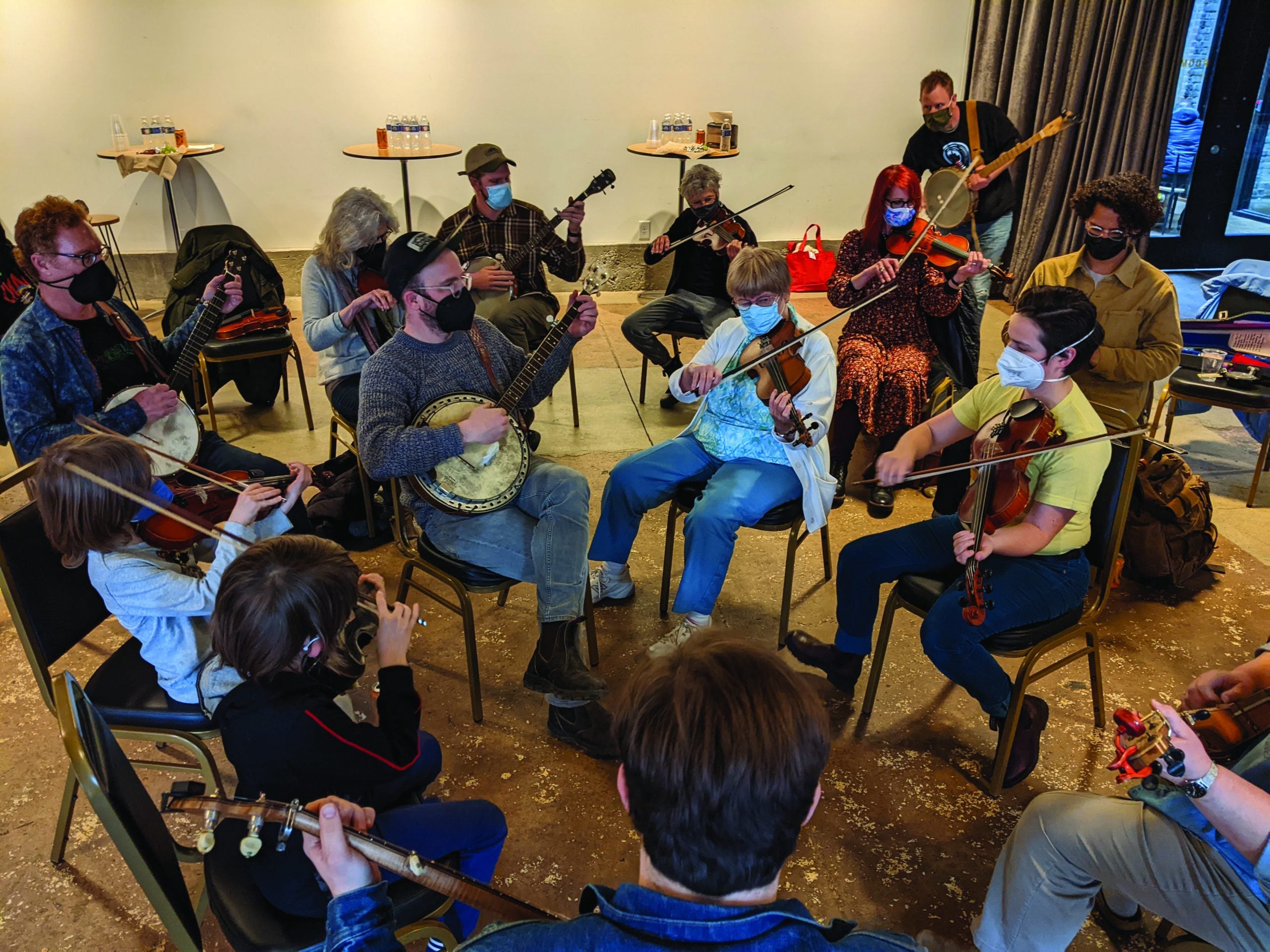
“The three pillars for PineCone now are Play, Perform, Preserve. The Play part is the participatory events—summer camps, workshops, jam sessions. The perform part is festivals and the ticketed concerts we do in the Duke Energy Center. Preserve is the non-folkloric work we do to keep traditional music part of the cultural landscape.
“One of the ways we do that is by being a resident company in the Duke Energy Center with the North Carolina Opera, Symphony, Theater Company, and Carolina Ballet. There are not many communities across the country where that’s the case. I think that has a lasting influence on the music’s presence.”
Like other programming organizations, PineCone was challenged by the COVID shutdown. Brower credits the commitment of the City of Raleigh for helping PineCone weather the COVID storm. “It was a really sad time for people in music,” he says. “It was a very isolating time that diminished our reason for being, which is to bring people together and to share the music. We told ourselves that getting online was getting together. It was, and it wasn’t.
“I think it’s absolutely remarkable that the mayor [Mary Ann Baldwin] and Raleigh City Council really stepped up. They provided full funding for their arts nonprofits. You don’t find that level of dedication everywhere.”
Adds Lewis, “Everything PineCone does is a collaboration. That’s the only way you can expand the bandwidth of three full-time people. PineCone was perfectly positioned to take on partnership with IBMA and to work with local partners year-round to support an event that large. PineCone did it and did not lose any of their other programming. They do bluegrass, but also gospel, blues, old-time—that is, traditional music. They did not abandon their mission wholly for IBMA.”
Nonetheless, World of Bluegrass is the jewel in PineCone’s resplendent crown. A newly-signed three-year contract will bring WOB to Raleigh through 2024. In the meantime, PineCone will continue to serve the community with the quality programming that has defined its mission since 1984.
From small concerts to World of Bluegrass, PineCone’s history is exemplified by the 14th Century proverb, “Mighty Oaks from little acorns grow.” Fittingly, PineCone found its home in Raleigh, the capitol city that proudly proclaims itself, “The City of Oaks.”
For more information, go to