
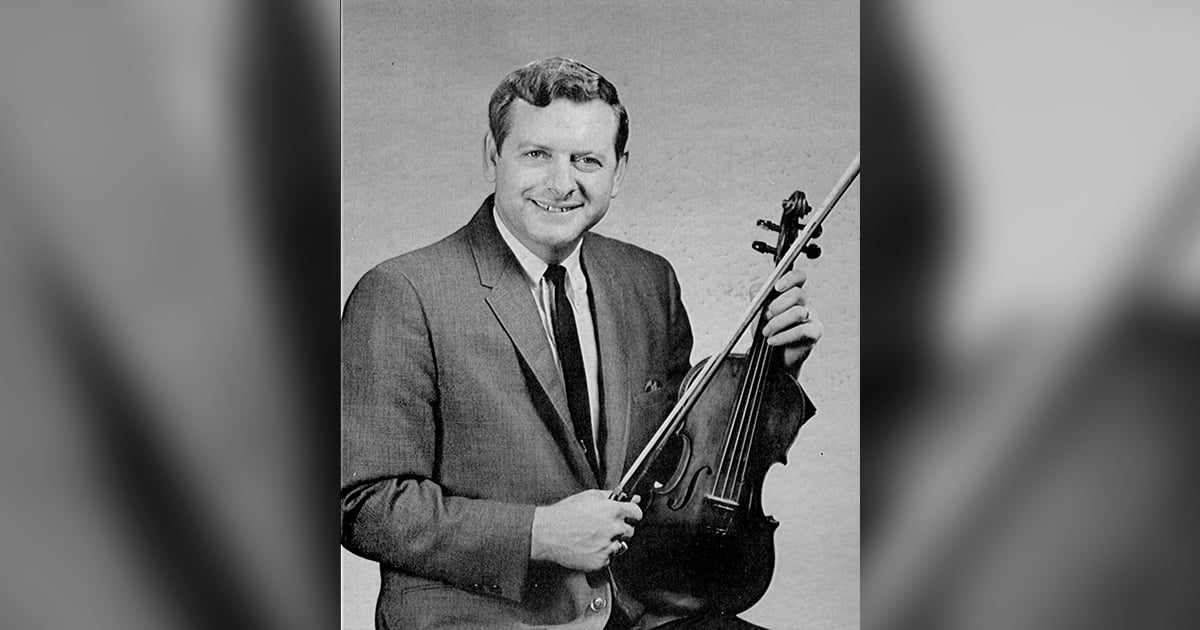
Paul “Moon” Mullins, Legendary Broadcaster
This is an excerpt from Industrial Strength Bluegrass: Southwestern Ohio’s Musical Legacy (edited by Fred Bartenstein and Curtis W. Ellison, © 2021 by the University of Illinois Board of Trustees. Used with permission of the University of Illinois Press.). The book chronicles the important roles Cincinnati, Dayton and surrounding areas played in the development of bluegrass music between 1947 and 1989. A companion CD with the same title (Smithsonian Folkways label) features well-known current bluegrass and country artists reinterpreting great music originally recorded in that era and in that region. Daniel Mullins, a broadcaster and widely read columnist, is the grandson of Paul “Moon” Mullins (1936-2008) and son of broadcaster/bandleader Joe Mullins.
The nationwide popularity of the bluegrass sound increased as it established footholds on the radio airwaves of Appalachia, Nashville, the Deep South, the Washington/Baltimore area, and southwestern Ohio. Among these regions, none has experienced the consistently high level of bluegrass radio programming that southwestern Ohio has enjoyed since the 1940s.
Everything related to bluegrass in southwestern Ohio can be connected directly or indirectly to Appalachian migration. Transplants from the rural South went looking for jobs in the industrialized North for most of the twentieth century. Tens of thousands of families moved to southwestern Ohio from mountain regions of Kentucky, Tennessee, Virginia, West Virginia, and southeastern Ohio. By 1975 a large proportion of the population was either from or had family ties to Appalachia. Transplanted from the familiarity of the “hills of home” to industrialized communities of the North, the migrants sometimes felt like aliens in their own country. Through their music, they were able to maintain both a positive identity and a connection to their former home.
The newcomers were also an underserved consumer demographic. In stark contrast to today, when companies use internet-accessible data to identify a tailor-made audience within a geographic area, the needs and desires of the migrants were often overlooked. Radio became a primary means for business to tap into the large Appalachian market throughout southwestern Ohio.
Radio was a cheap form of entertainment and for those struggling to make ends meet perhaps their only luxury. Feeling alone in the big city, away from family and friends left behind, listeners felt a special connection to on-air personalities who gave them a little taste of home through familiar music and dialect. They truly felt like “friends and neighbors” of the man behind the microphone.
In the late 1940s, a gentleman named Paul Braden began to notice the immense success that hillbilly music programs were having on Cincinnati’s WLW and WCKY. With the goal of focusing business efforts directly toward migrant communities, Paul Braden founded Middletown radio station WPFB in 1947. While the station’s call letters actually stood for Paul F. Braden’s initials, they became affectionately reworked as “We Play For Briars.” “Briars,” short for “briarhoppers,” a slang term used to reference Kentuckians, became a badge of honor for those who would rather die than be thought of as “Yankees” or “Buckeyes” (a nickname for Ohioans). WPFB’s success surpassed all expectations.
Middletown may have been so named because it is roughly halfway between the larger cities of Dayton and Cincinnati. Not only was Middletown itself a hotbed of migrants looking to put down new roots, but WPFB’s signal reached both of the city’s big brothers, allowing it to cover two of the region’s major industrial centers while still maintaining a local flavor in its delivery.
Not long after WPFB began operating in the late 1940s, Paul Braden erected a large tent near the station’s studios (housed in a farmhouse) and began hosting the WPFB Jamboree on Saturday nights, broadcasting the ensuing shindigs live. The music made under the shelter of a tattered old tent in front of a few hundred eager fans proved to be some of the best country and bluegrass the nation had to offer. Red Allen, Hylo Brown, Noah Crase, J. D. Crowe, Jim and Jesse, Jimmy Martin, the Osborne Brothers, and Frank Wakefield all spent significant time at WPFB as part of the weekly on-air entertainment. At a time when bluegrass was still in its infancy, and regarded as a style of country music rather than its own genre, it is staggering that no less than seven future Bluegrass Hall of Fame members spent some of their formative years at the same radio station in Middletown, Ohio, a city whose population had yet to exceed fifty thousand.
In the mid-1950s, bluegrass music’s presence on southwestern Ohio airwaves fell into decline. WPFB, like other radio stations, started to feature records they hoped would have more mainstream appeal. Bluegrass and twang were displaced by the lush strings and syrupy background choirs of the “Nashville Sound.” Country music went uptown and left bluegrass and Appalachian music lovers hungry for their favorite sounds.
In 1964 a radio personality from eastern Kentucky named Paul Mullins came to work at WPFB. His beginning in the radio business involved moonshine and a bet. One night during the winter of 1960, Mullins and a buddy were sharing a quart and listening to a local radio station. Elbowing his friend, Mullins said, “I bet you ten dollars I can go get that fellow’s job.” They shook on it, and within a matter of weeks Paul was live on the radio at WGOH in Grayson, Kentucky. He adopted “Moon” as his radio nickname, after the popular Moon Mullins comic strip character of that era.
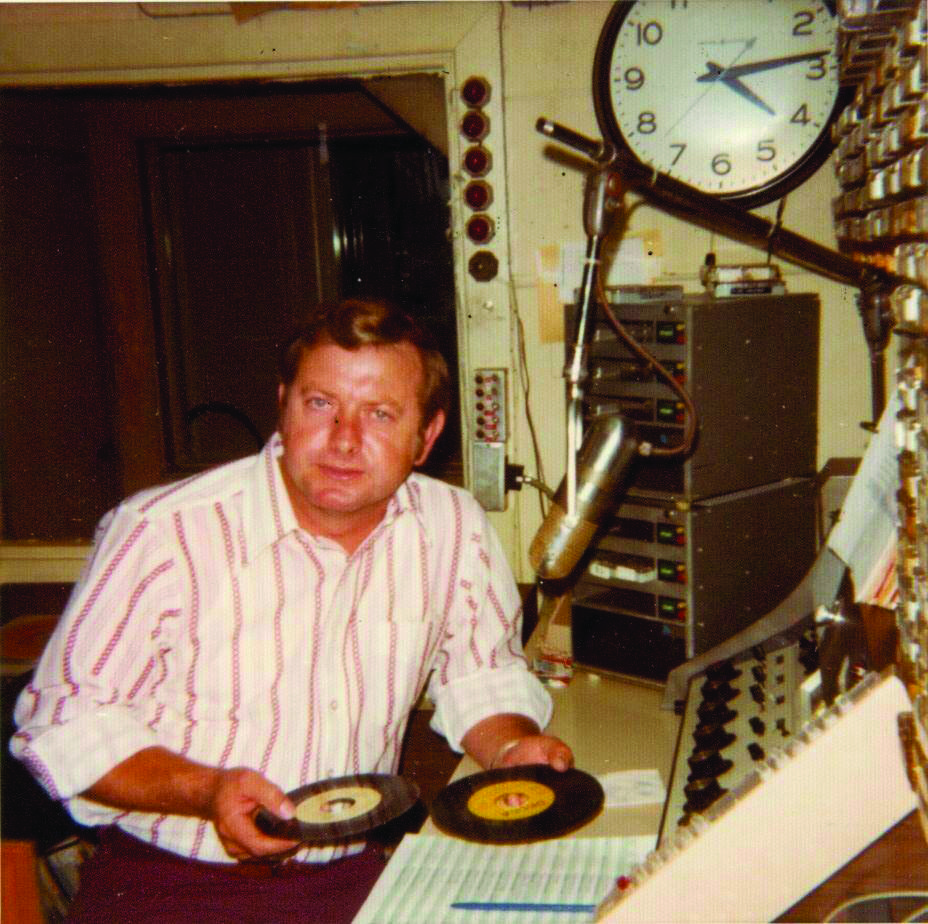
Although his assertiveness was to be commended, it had been aided by liquid courage. Moon actually struggled with crippling stage fright. He was known as a fiddle player and had even worked for a time with the Stanley Brothers. Stage fright had cost Mullins his gig with those bluegrass legends, although they would remain close friends. Mullins viewed radio as a less threatening way to overcome his fears of being on stage. After a few weeks on the air, his confidence grew and his fears subsided.
After the initial stint at WGOH, he worked for a short while at WMST in Mt. Sterling, Kentucky, followed by WTCR in Ashland, Kentucky, and a return engagement at WGOH before crossing the river to Ohio in 1964. Moon hit WPFB like lightning. His Kentucky heritage, ad-libbed commercials, and bluegrass pedigree were to make him the local Appalachian migrant community’s leading radio voice for the next four decades. A transplant himself, he developed a level of trust with the migrant community that was unmatched by any other area businessperson, radio personality, or entertainer.
Mullins regularly referenced Southern geography and lore that endeared him to fellow migrants and sounded fascinatingly exotic to non-Southerners. Unashamedly drawing upon the Appalachian language and humor of a bygone era, Moon’s frequent topics included working in his garden (a favorite pastime), growing tomatoes, hunting ginseng, and reading the mountain signs to predict the weather.
“The sun’s as warm as a biscuit.”
“The weatherman would do well to quit lookin’ at them little scopes and take a look out the winder every now and then.”
“It’s been dry as a shuck bean lately, ain’t it? . . . Have y’all noticed how the trees have been followin’ the dogs around?”
“It’s hotter than an old lady at a kissing party.”
“It’s cold. It’s like the backside of a witch’s lap.”
“If y’all have got pop a’sittin’ on the back porch, it’ll be alright this morning but by tomorrow those bottles’ll be froze and busted, don’t ya know.”
Mullins’s country dialect permeated everything he did on the air. Moon often began his radio programs with “We’re gonna plow all the way to the fence.” It was a recognizable reference for those who grew up looking at the back of a mule while preparing ground for tobacco, corn, or other crops. It was an Appalachian way of saying “Don’t cut any corners.” Mullins’s colorful expression told audiences that he and they were going to have a good time together, from the time he went on the air until he signed off, and that he was going to give it his all.
It was almost as though Moon had an inside joke with his audience, one that they were in on and from which everybody else was excluded. People would tune in just to hear him do a commercial or give a weather forecast. “In order to be successful, I find you have got to have more than just a record to play,” said Moon. “You got to make folks want to listen at you. That’s the reason I try to keep humor in my radio program—keep it in my commercials to where it don’t get boring.”
Moon’s listeners were certainly never bored. His audience never knew what he was going to say. One time a local department store had Mullins advertising custom-made bras. Moon reported taking his wife, Prudence, to the store to be fitted and advised male listeners to do likewise. As he put it, “Whether they look like Dolly Parton’s or two poached eggs, they’ll get ’em to look right.”
Moon’s audience trusted him and his judgment, so if Moon endorsed a firm, his listeners flocked to its doors. This old style of personal, ad-lib advertising was truly an art, and Moon was the master. His unique style of phrasing and his no-nonsense approach appealed to the sponsors almost as much as they did to listeners. WPFB management was willing to tolerate a lot of Moon’s quirks, as long as he continued to bring in business.
Mom’s Restaurant was an old-fashioned country kitchen in the community of Red Lion, a wide spot in the road between Franklin and Lebanon. “Mom” (Hilda Ratliff) bought some ads on Moon’s program. Once Moon started telling everybody to head over to Mom’s Restaurant to get her biscuits and gravy, the impact was immediate. “Mom” Ratliff recalled standing in the kitchen and crying because she had only one skillet and couldn’t keep up with the orders.
Bluegrass singer Dudley Connell recalled driving around southwestern Ohio in the 1990s. Like other fans of bluegrass and classic country, he tuned in to WPFB. Mullins was doing an advertisement for a local gas station that also had a deli serving everything from biscuits to beer. On this particular day Moon was talking about the bologna sandwiches. After listening for just a few minutes, Connell found himself craving a gas station bologna sandwich, leading him to credit Moon as “the greatest salesman who ever lived.”
Moon adamantly fought preconceived notions that many folks had regarding people from Appalachia (stereotypes that, unfortunately, persist in the twenty-first century). “I know that I am country,” he said, “and a fellow that don’t know what he is don’t know very damn much.”
Longtime disc jockey Chubby Howard worked with Mullins at WPFB and later at WBZI in Xenia. He remembers one of the salesmen at WPFB taking Moon, wearing a suit and tie, to meet a potential sponsor. “The big guy that owned the entire establishment stepped back a couple of steps and looked [Moon] up and down,” said Chubby. “He said, ‘You don’t look like a hillbilly.’” To which Moon retorted, “What do you think a hillbilly looks like, you no good . . .” followed by a string of choice words. The salesman thought for sure that any particular chance of closing the deal was over, until the business owner said, “Sign me up!”
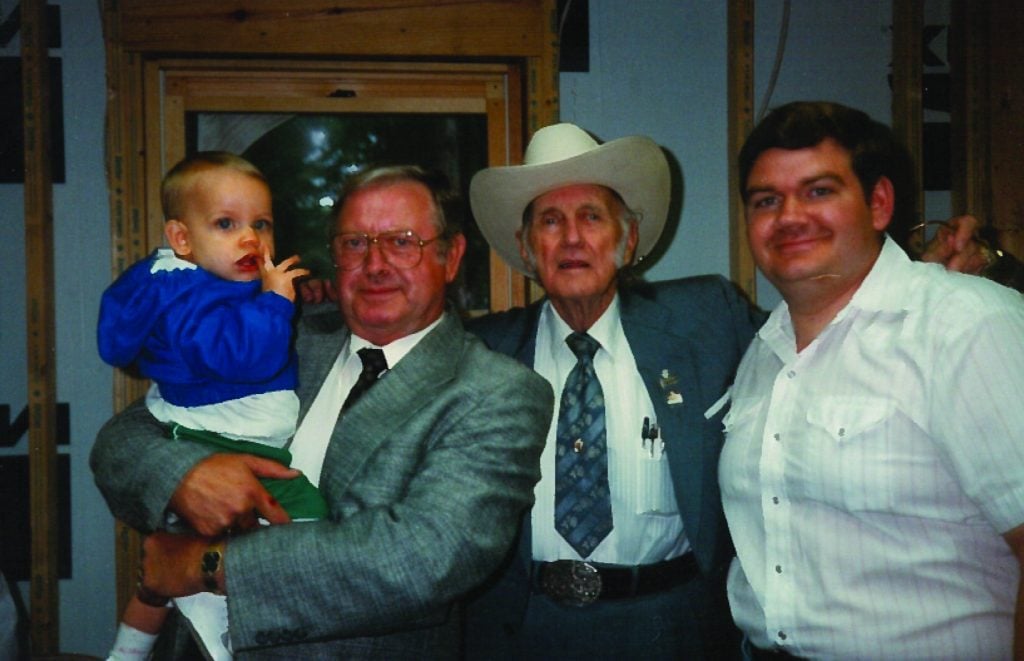
Moon Mullins was a bona fide country boy and a bluegrass expert. His pedigree as a professional musician added an important level of authority to his commentary about the records he played. His bluegrass performing career did not end after the short stint with the Stanley Brothers. In 1962, while on the air in Ashland, Kentucky, he founded the Bluegrass Playboys, a popular Kentucky band that for a short time included, on bass, future Country Music and Bluegrass Hall of Fame member Tom T. Hall. The band played frequently in eastern Kentucky, West Virginia, and in southern Ohio. With the Bluegrass Playboys, Mullins recorded “Katie Daley,” now a bluegrass standard. “Somebody gave me a poem one time,” said Moon. “I think there were 37 verses. The gist of the poem was a gal that made whiskey by the name of Katie Daley.” Mullins was the first American to record the old Irish poem, bringing it into the bluegrass canon. It became a jukebox hit in the early 1960s for the Bluegrass Playboys and would later be popularized by Ralph Stanley.
During his career as a WPFB disc jockey, Moon would moonlight as a fiddler at bars and nightclubs in the region that regularly featured bluegrass music. He worked in bands with other bluegrassers in the area, including Charlie Moore, Bill Napier, Harley Gabbard, Earl Taylor, and Jim McCall. He would even slip down to Lexington, Kentucky, to sit in on fiddle with J. D. Crowe and the Kentucky Mountain Boys. When his former bosses the Stanley Brothers were in the area for one of their frequent local performances, he introduced them to a local guitarist named Larry Sparks, who joined the band before becoming a star in his own right.
During the 1970s, while still working at WPFB, Moon Mullins was an integral member of the Boys from Indiana, a popular festival act of the day. Their signature song, “Atlanta Is Burning,” became a bluegrass classic. Moon continued his track record of successful bands by founding the Traditional Grass in 1983 with his son, Joe Mullins, and local guitarist Mark Rader. Throughout the 1980s and early ’90s, the Traditional Grass was among the hottest bluegrass bands going, with four albums on Rebel Records.
Moon did not make bluegrass successful on southwestern Ohio airwaves by his expertise alone; he was passionate about the music. When he liked a recording, he would say something like “Grab a hold of something, folks. This un’s gonna blow your hat in the creek and make you wanna pat your feet.” If it was a record he didn’t like, he sometimes simply broke it over the airwaves rather than suffer through listening to it again. If he was feeling generous, he would offer constructive criticism such as “I’d like to know who told that bass player that he could keep time, because whoever that was lied to him.” Moon summed up his programming philosophy this way: “I ain’t gonna play something I don’t like. Especially at 5:30 in the morning.”
Mullins believed in integrating bluegrass alongside hit country songs rather than keeping the genres segregated. By playing bluegrass alongside Johnny Cash, Merle Haggard, Loretta Lynn, Dolly Parton, and Ernest Tubb, Moon legitimized the music of bands like the Stanley Brothers and the Country Gentlemen. Mixing in bluegrass every third or fourth song was especially effective in introducing bluegrass music to new listeners who may have tuned in for the country hits or the weather forecast.
Moon Mullins’s legacy and impact on the bluegrass musical footprint of the southwestern Ohio region cannot be overstated. His ability to maintain a strong bluegrass presence on radio during the rock and roll era was vitally important to the music’s growth in the region. Had Moon not been on radio maintaining a steady pipeline of bluegrass and promoting bluegrass concerts and those of other local promoters, there may not have been a bluegrass market in the region by the time the bluegrass festivals rose to prominence in the 1970s. In 1979 Ohio hosted more bluegrass festivals than any state in the country, and by then Mullins had been at WPFB for 15 years.
After the Traditional Grass became successful in the late 1980s, Moon Mullins and WPFB parted ways. He reappeared on local airwaves in 1995 on WBZI and retired in 2005. In 2000 he was named the International Bluegrass Music Association’s (IBMA’s) Bluegrass Broadcaster of the Year and received their Distinguished Achievement Award. Before his death in 2008 from progressive supranuclear palsy, he received a 2007 Ohio Heritage Fellowship Award for Performing Arts.
The Mullins legacy on southwestern Ohio airwaves lives on, for three generations and counting. Moon’s son, Joe, began broadcasting at WPFB while a teenager and remained with the station until the late 1980s. In 1995 he purchased WBZI in Xenia, bringing classic country and bluegrass music back to prominence in the region. He would eventually add WKFI in Wilmington and WEDI in Eaton. In addition, Joe hosts the nationally syndicated and award-winning bluegrass gospel radio program Front Porch Fellowship, heard on over two hundred stations nationwide as part of the Singing News Radio network. He was named Bluegrass Broadcaster of the Year in 2016. Joe also fronts his own award-winning, nationally touring bluegrass band, Joe Mullins and the Radio Ramblers, and is an active leader in the International Bluegrass Music Association.
In 2018 Mullins’s Classic Country Radio network underwent a rebranding in order to better connect the roots music of classic country and bluegrass with a new generation. Today, as Real Roots Radio, the network features more bluegrass music than any other radio outlet in the Buckeye State, in addition to playing current and classic country, mountain gospel, and Americana music. This author, Daniel Mullins—Joe’s son and Moon’s grandson—appears on Real Roots Radio as well, in addition to hosting the Walls of Time: Bluegrass Podcast, continuing the family legacy of broadcasting bluegrass music to southwestern Ohio.