
Paul Beard Guitars
Photos By Chris A. Courogen
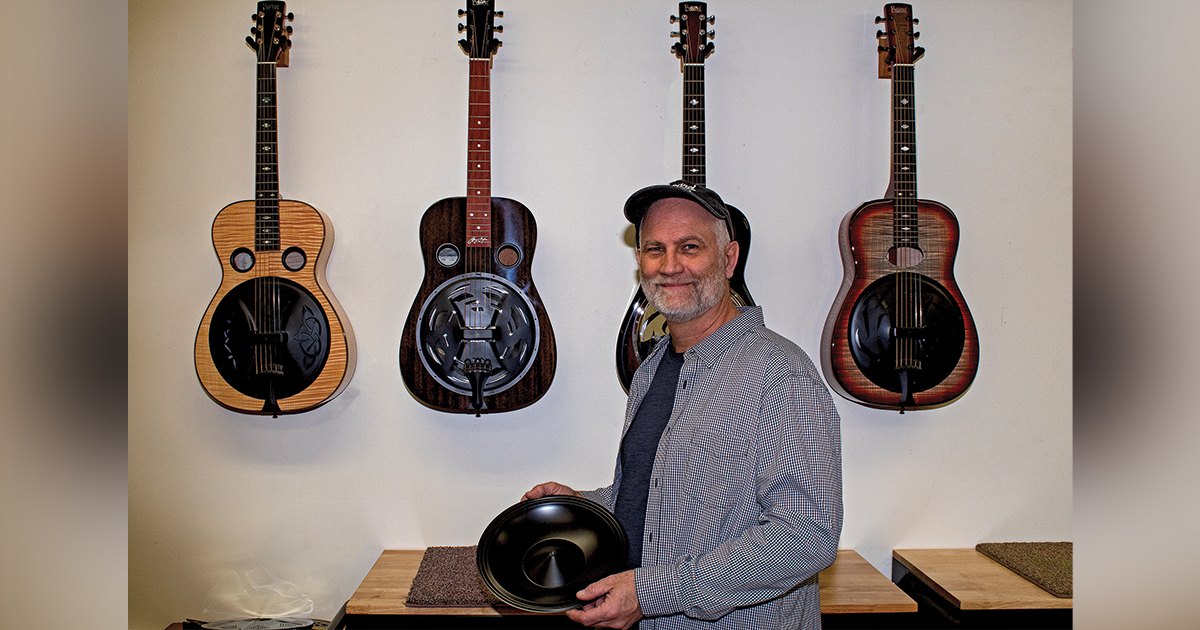
Paul Beard hasn’t always made squareneck resonator guitars. It just sort of seems that way to him after almost 40 years doing it. “I’ve been doing this for so long,” says Beard, who built his first one in 1985, after a peak at the insides of the second hand OMI Dobro he had picked up. Disappointed by what he considered poor construction, he decided to build his own. And down the rabbit hole he went. “I’ve spent my whole career on just constantly trying to make a better resonator guitar,” he says.
Beard’s original career plans were different. After high school he went to an aeronautic school and learned to work on planes. He added a degree in mechanical engineering before his career took a musical detour. Beard played a little guitar himself, and was picking a little in a local music store when the owner asked if he’d like to give lessons. That led to a sales gig at the store. Soon he was working on guitars, something that came naturally with his mechanical inclination.
He was mostly doing setups on electric guitars for local hair metal bands when he first heard Seldom Scene on the radio and fell in love with the sound of Mike Auldridge’s Dobro. When he learned a little more about the instrument, he was hooked. Beard later became a student of Auldridge’s and many of Beard’s innovations came as a result of collaborating with him to build Auldridge a Dobro that had the exact tone Auldridge was seeking.
“I fell in love with this instrument because it’s the goofiest instrument on the planet. It’s half wood and half metal and it’s an ugly duck. It’s just weird and it’s very mechanical. This is a super mechanical puzzle. And that is one of the things I was attracted to,” says Beard.
There is another thing about the Dobro that is markedly different than other bluegrass instruments. Beard says, “It’s probably the only instrument, especially in bluegrass, where modern instruments are preferred. Everybody wants a vintage old pre-war Martin, a Lloyd Lore mandolin, a pre-war Gibson flathead banjo, old violins, old Kay basses. But the, the resonator, the Dobro, has changed so much internally to get more sound out of it that nowadays, honestly, there’s hardly anybody that plays an old Dobro professionally.”
Beard’s mechanical aptitude has been behind many of those changes. Early on his engineering background helped him discover ways to open up the inside of the instrument and to refine how the cone is mounted, resulting in better sound. It’s what led him to study the speaker cabinet technology, leading to the development of the bass reflex baffle in his Auldridge and Jerry Douglas signature models. The baffle improves the efficiency of the guitar’s “box,” maximizing its sound.
Beard also played a role in the development of Hipshot’s “Doubleshot,” a tailpiece that allows you to change the tuning with the flip of a lever, and the Fishman pickup that allowed Dobro players to move away from the microphone.
“Paul is constantly thinking about how to make the instrument sound better,” says Tommy Mahrer, the Dobro player for Fireside Collective. “Paul is leading the charge right now.”
His latest development is what is called the “Vesper Cone.” For the uninitiated, the cone is the heart of the instrument, what gives the resonator guitar its unique sound (Technically, “Dobro” is a brand of resonator guitar, but “Dobro” has come to be used generically for all resonators, sort of like Kleenex and tissues). In simple terms it is a thin aluminum speaker cone, mounted in the top of the guitar body.
The cone is not the “hubcap” you see. That is the cover plate, which aside from looking cool, is mainly there to protect the cone underneath. Like a speaker cone, the cone in a Dobro amplifies the sound of the strings.
It is anything but simple, though. For many years, nearly all Dobro cones were made by one guy in California, a Polish immigrant who learned the skill in Canada from a German before then coming to the U.S. Beard even used the man’s cones in his early resonators.
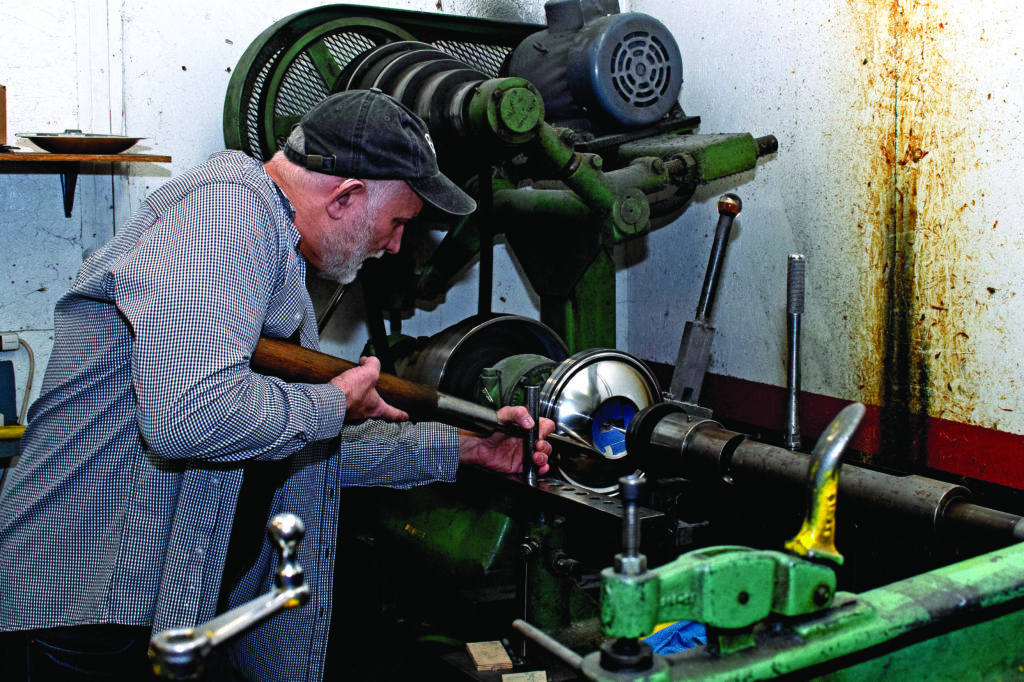
These days Beard makes his own cones, spinning thin discs of aluminum alloy on an old lathe, using a long, metal, pointed poker to mold it into shape. The lathe Beard uses is the same one that immigrant used. As part of his quest to unlock the sound, Beard apprenticed with the man and bought his equipment when the man retired.
Through experimentation Beard learned how to fine tune the sound of the cones. He found better aluminum alloys to make them with and he refined the technique he calls “Triple Spinning” to create the Legend cone, which is named in honor of Auldridge.
“Paul has been in search of the holy grail of cones for all these years,” says Jerry Douglas, a 10-time IBMA “Resonator Player of the Year” who has played Beard’s Dobros for 25 years. “He’s curious. He’s always curious about what could make it better. You couldn’t ask for more than that from somebody who builds these things. Who better to go forward with any innovation than Paul Beard.”
Beard’s Vesper Cone is the high-tech result of his quest to solve one of the biggest challenges of maintaining the tone of a cone — oxidation. It came as the result of Beard’s trying to figure out why Douglas needed his cones replaced every year because their sound deteriorated.
“I started looking at it from a mechanical aspect. And what it is, oxidation pits the surface of the aluminum. So your cone never sounds as good as the day that it’s first installed in the guitar. It’s in a constant state of decline, it degrades,” Beard explains.
The solution, apply a thin coating of a ceramic polymer to the surface of the cone. The polymer coating prevents the surface from oxidizing. The coating only goes on the top side of the cone, the side that is responsible for the high notes. Beard says the oxidation does not seem to impact the low tones, which come from the bottom side of the cone, the same way.
“I started experimenting with this ceramic polymer. It’s a very, very thin coating that is applied on the top side of the cone. This is a very thin coating because if you put it on too thick, it’ll hurt the sound of the cone,” says Beard. “The real secret to this is how do you get it to stick to the aluminum without changing the geometry of the aluminum.”
Treating the cone doubles its lifespan, lifespan defined as how long it sounds like new, not how long it functions. The name Vesper comes from the coating’s dark night black color. The coating is also available on his covers and on Beard’s #14 spiders. Beard owns the original design for the legendary #14 spider, having acquired the mold from the original manufacturer. Of course, he has tweaked it slightly, adding some arch to improve the tone and adjustable screws to hold the bridge.
Adding the Vesper coating to the spider and cover doesn’t impact the sound much. It is more cosmetic. “It’s more to match the coloring and everything for, so it looks nice. The spider’s oxidize as well. But it doesn’t affect the sound as much as what the cone does,” Beard says.
Beard’s shop also makes round neck resonators favored by blues musicians, lap steels, and regular acoustic guitars. All are made almost from “scratch.” Beard instruments start with sheets of plywood that are cut and shaped into bodies and blocks of wood that are milled into necks and fretboards. Every detail, right down to the Mother of Pearl inlay of Douglas’s autograph on his signature models, is done in house. The only parts Beard does not make himself are the strings and the tuning machines.
You don’t need to buy one of Beard’s Dobros to benefit from his innovations. In addition to his guitar shop, Beard also sells cones, spiders, and other parts to other builders. “Yeah, I sell all the parts. I have another business called Resophonic Outfitters that’s affiliated with Beard guitars. You can go online and order whatever you want to. There are a lot of hobbyists that build their own guitars so I supply them with parts,” Beard says.
Beard Guitars, and Resophonic Outfitters, can be found at beardguitars.com. Just click on “store” to go to the Resophonic Outfitters site.