On the Way Up with Never Come Down
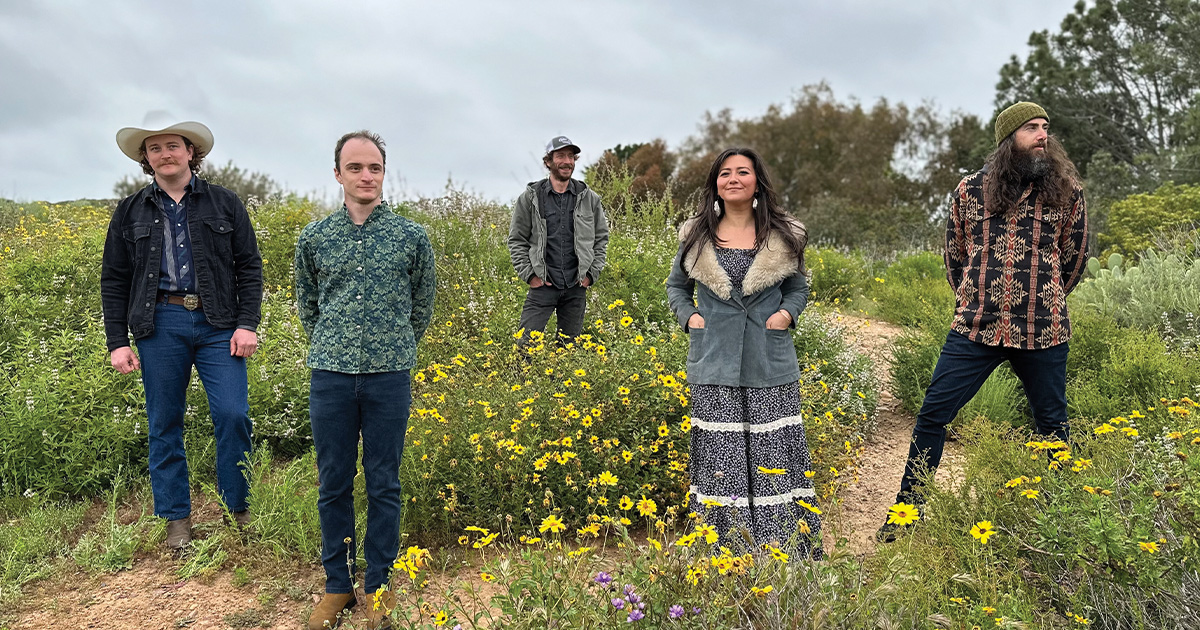
Never Come Down isn’t just riding high, they’re moving fast. One listen to their new album, Greener Pastures, out in June, or glance at their packed tour schedule and it’s clear this innovative five-member Portland, Oregon, band is going places. Yet it was only six years ago that band members Joe Suskind (guitar, vocals), Crystal Lariza (vocals, guitar), Brian Alley (banjo, vocals), Kaden Hurst, (mandolin, vocals) and Ben Ticknor (bass) first connected at a Tuesday night bluegrass jam at Portland’s late lamented music pub The Ranger Station. And in that six years, Never Come Down released a prior studio album, won the 2019 RockyGrass and 2021 FreshGrass band competitions, and have been audience favorites at the John Hartford Memorial Fest, Wintergrass, Americanafest, Hardly Strictly Bluegrass and numerous others as far afield as Iceland Airwaves in Reykjavik.
Both wildly eclectic and deeply traditional, Never Come Down pushes boundaries with exploratory playfulness while staying true to their musical roots. Elements of folk, rock, bluegrass and country come together in a rollicking musical stew thanks to the widely varying backgrounds of the five band members, who between them have played everything from Scottish jigs to country rock to soul. Watching their fingers fly, it’s easy to focus on the precision and sheer mastery of their musicianship, but it’s the sophistication and emotional depth of the band members’ songwriting and their intricate four-part vocal harmonies that have built the band such a loyal following.
“#42,” the first single off Greener Pastures, provides a perfect example of this triple threat. Focus on the dizzying fretwork and you might think you’re in store for a bluegrass hoedown of the highest caliber. Yet tune in closely as Lariza sings hauntingly, I’m growing old but I’d known you before I was young; I’ve seen ten thousand things, found out they’re all one, and you realize you’re on board for songs that go deep.
“I think as original songwriters, if you have an audience’s attention, you owe it not just to yourself but to them to think about what you’re putting out into the ether,” Hurst says. “We live in a world where everybody’s talking all the time, both online and in the real world, so if you’re going to put more music out there, then I think our job is to make people think about how they live and to create music that’s going to bring people together and find common ground.”
While Lariza takes the lead vocal on “#42,” the song was originally penned by Alley, providing an example of the band’s collaborative process, in which each member is free to contribute to a song’s development. “Our approach is that we all try to piece together the vision of what a song is, and that tends to mean that we whittle down the idea to its core and then let it grow,” Suskind says. “So just because I brought the idea doesn’t mean I have to sing it, or that it has to be the right form that I brought it in. We get to reflect ownership while at the same time we all own it, you know, and I think that helps us separate ourselves and not be so personal and attached. I think whatever musically allows the song to be the clearest is what we try to get to. And it takes a lot of trying.”
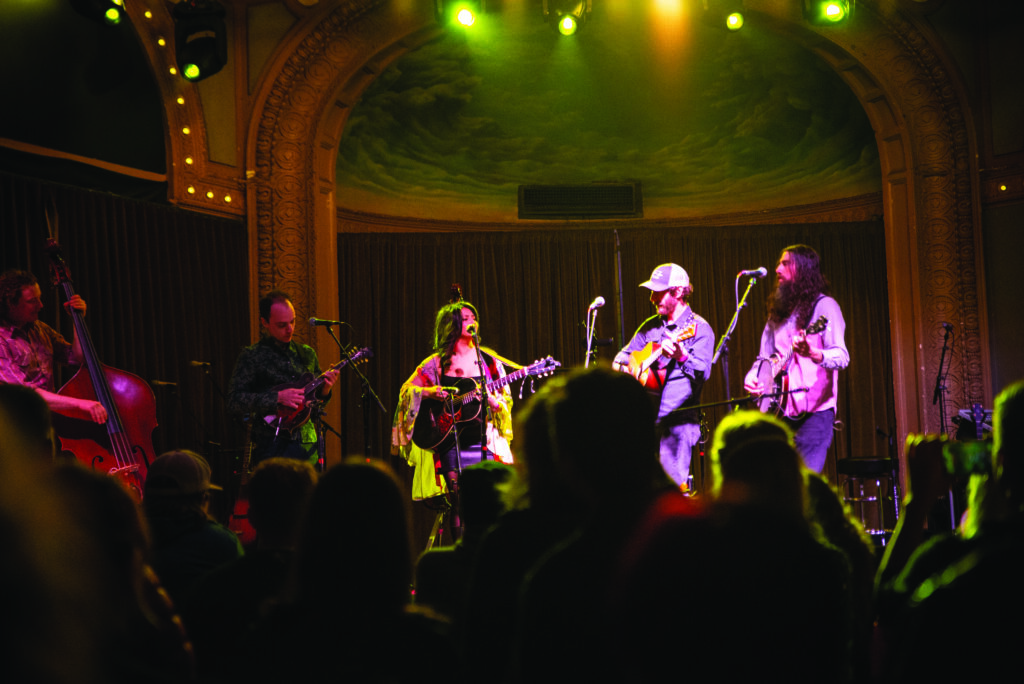
Another thing listeners will immediately notice on Greener Pastures is the lack of covers. Every song on the release is an original with every member contributing songs, an aspect the band is particularly proud of. “The traditions are not lost on us, but it’s not our job to be a preservation band,” Alley says. “From the beginning we’ve had as an ethic that it’s our job to express ourselves. That has given us an opportunity to trust ourselves in the songs and be an alternative to what has been done already.”
Both the band’s eclecticism and songwriting prowess make sense when you consider their diverse backgrounds. Suskind has been performing since high school, when he would hit the road during the summers with his father, Robin Suskind, an early member of Pure Prairie League best known for his searing pedal steel. Lariza too got an early start, playing solo as a teen and then teaming up with her sister Angela to form the folk-rock band Corner, a mainstay of the Portland music scene beloved for lilting two-part harmonies. The two Oregonians are joined by Brian Alley, who grew up in Arvada, Colorado, and began a love affair with the banjo at festivals like Rockygrass and the Telluride Bluegrass Festival. “My uncle and grandma were pretty into bluegrass and they would take me to festivals where I learned about this magical thing called jamming,” Alley says. When his father gave him a banjo and the Earl Scruggs book, he was hooked.
Mandolin whiz Kaden Hurst hails from the foothills of California, where they studied classical music and discovered a lifelong passion for Scottish fiddle tunes while attending Alasdair Fraser’s Sierra Fiddle Camp, to which they still return as a teacher. Bassist Ben Ticknor hails from northern New York. He moved to the Mt Hood area, where he’s in high demand for his ski patrol and avalanche mitigation skills while playing in numerous groups.
All five band members continue to be sought-after teachers, both instrumental and vocal. “I grew up taking voice lessons every week for four or five years and my vocal coach, who was very young and hip and cool, became my friend and my mentor, and then we were in a band together,” says Lariza. “I do a lot of vocal empowerment stuff and really love getting people in their bodies and getting them to sing out. We all also do band coaching where we’ll sit in with people and talk about how to tighten up, tighten up harmonies and make more interesting arrangements.”
Respect for the sophistication of the band’s harmony skills was on full display at Wintergrass 2024, where Lariza, Suskind, Alley and Hurst were tapped to give a vocal harmony workshop, breaking the standing-room-only crowd into four groups to learn the parts to one of their most popular songs, “Mother.”
Finding Togetherness in Covid Isolation
Paradoxically, the band credits the pandemic with playing a key role in their rapid transformation from a loose group of pickers and singers to a close-knit ensemble. At first, it seemed the timing couldn’t have been worse; the band was just wrapping up recording their first album when the shutdown set in. But what could have proved a devastating loss of momentum instead became a much-needed creative outlet and opportunity to build an audience in new ways.
“At the end of February and beginning of March 2020 we were in the studio and we had just finished up recording everything we needed to record and then Covid happened,” Suskind says. “So we thought well, we have this thing, we have a project that we still care very much about getting out into the world, and we just started doing the livestream thing every week. A lot of bands broke up during Covid but having that record that we knew we needed to get out in the world was very gluey. So looking back, I think the timing was very kismet as far as giving us something to do, to be playing music and be together in some way.”
In 2021 the band finally put out that first studio recording, Better Late than Never, an eclectic collection that announced their expansion beyond traditional bluegrass and command of a variety of styles and genres. Many of those songs, from the sassy rocker “Catch Me” to the yearning, twangy “Sleepin’,” and especially the haunting title track, remain anchors of their live sets. In a nod to the popularity of Better Late than Never, the band released a high-wattage live version of the song in December 2023.
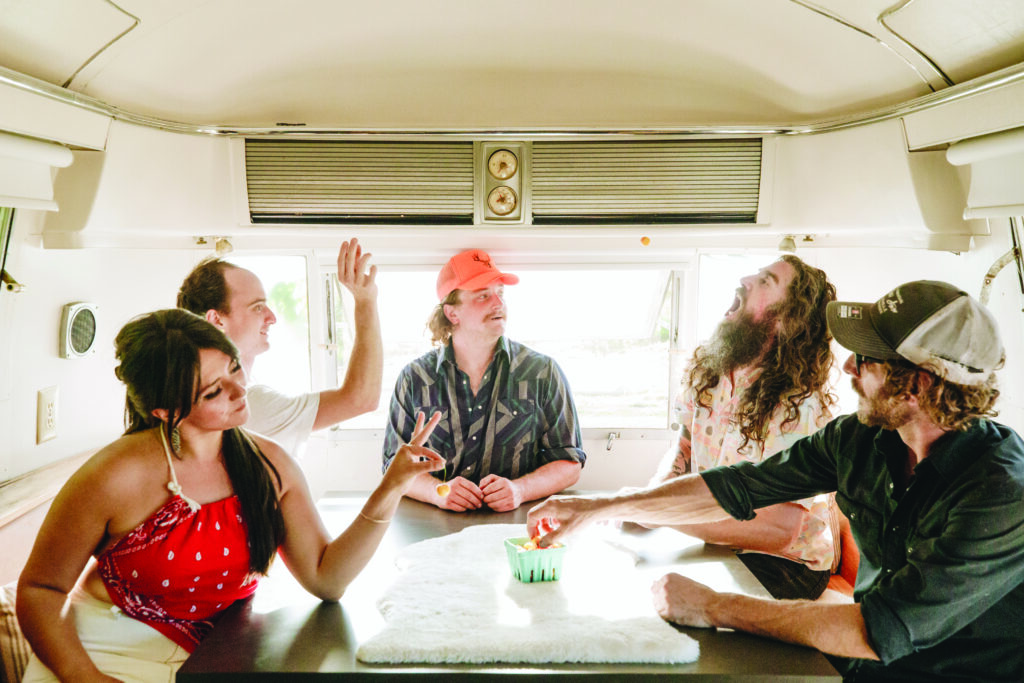
The months at home also, paradoxically, helped prepare the band to handle what has come to be an ambitious—and almost constant—touring schedule. “During the pandemic we bought a bus because we thought, man if we had a generator and could be self-contained, then even if this Covid thing goes on forever, we can bring our music anywhere to anyone in the world and just play,” Alley says. “So when the pandemic ended, we hit the ground running harder than we ever had before. It was like we’d been preparing for this all along, unbeknownst to ourselves, getting ready to do these demanding tours.”
Now mainstays on the festival circuit, they rack up the miles and good times in their trusty bus, touring tirelessly across the west and putting in regular appearances up and down the coast. This spring and summer will see the band featured at the Berkeley Bluegrass Festival; the Wildflower Arts & Music Festival in Richardson, Texas; the Mountain Air music series in Ouray, Colorado; ROMP in Owensboro, Kentucky; and Dead on the Creek in California. The past year has also found them touring with Yonder Mountain String Band and The Travelin’ McCourys and sharing the bill with fellow innovators Stillhouse Junkies, Henhouse Prowlers, and AJ Lee and Blue Summit.
Taking it Pro
While originally planning to self-produce Greener Pastures as they had done successfully with Better Late than Never, the band began to think about the benefits of working with a producer. The turning point came when the band opened for The Infamous Stringdusters and developed a friendship with banjo player Chris Pandolfi, who also runs a recording studio. Ready with a batch of songs, they reached out to Pandolfi to ask if he had a suggestion for a producer. “He listened and got back to us in about a day and said, ‘I think you guys have something here and I’d like to produce it myself,’ and that was very exciting,” Suskind says.
Heading to Lexington, Kentucky, the band recorded for five straight days and were ready to wrap up, when disaster struck. The audio file for one track, “Don’t Fight the Feeling,” was missing. “I was just crushed—it’s my song, and it seemed like we were just going to have to drop it from the record,” Lariza says. Despondent, the band prepared to go home until Pandolfi suggested there might be time to re-record the song if they could do it live. The band and crew stayed up all night, and three hours later they had the track. “That pretty much summed up the whole experience—everyone pulled together, and it just felt so right,” Lariza says.
The band has taken a “wait for it…” approach to Greener Pastures’ release, building anticipation by dropping a track a month throughout the spring, starting with the album’s first single, “#42,” in February. The title track, “Greener Pastures,” hit the airwaves in March, “Rise Up and Sing” came out in April and “Gimme Time” was released on May 9th before “Mother” and the full album releases on June 7th.
Even while officially unreleased, however, “Mother” could already be considered a hit when it comes to the band’s fans. “‘Mother’ is probably our most requested song,” Lariza admitted after the Wintergrass vocal workshop, when one participant after another came up to thank the band and tell them how much the song means to them.
And it’s no wonder, given the song’s addictive melody and Lariza’s powerful lyrics expressing the longing we all feel for the connection and wisdom of a parent. Oh Mother, won’t you call me, won’t you call me and tell me what I should know. It’s even more poignant when at the end of the song she turns the lyric around to convey a mother’s desire to keep a child safe: Oh daughter, won’t you hear me, won’t you listen before you go; Oh daughter, won’t you hear me, there’s things that you should know.
That power of connection is evident in Never Come Down’s phalanx of dedicated fans, who follow them from gig to gig and check festival lineups for their presence. And it’s a sure thing that their new album will do just as the title suggests and spread their message to greener pastures.