On The Fringe
Bands Blurring the Lines of Bluegrass
The genius of Cris Jacobs has always been his chameleon-like ability to float between genres and musical styles, making each his own. From the rambunctious jamband energy of his first band The Bridge, to New Orleans funk and his collaboration with Ivan Neville, to his soulful brand of rock, Jacobs has explored American roots music in all that he does, but at his core he is bluegrass. Over the past few years Jacobs reached a point where he says, “I was burning out, going through some mental health issues, and not really sure what was next for me in music and life.” His struggles were beginning to manifest themselves physically as he was not sleeping and suffering from massive headaches. Jacobs knew he needed to find his way again, to be reinspired by music and rejuvenated in life. “I wasn’t feeling the spark with writing music and moving forward, I needed a centering musically.”
As he struggled to make sense of a changing world and his place in it, Jacobs began to look at the things most important to him: his family and making music. He was burned out by the notoriously tough music industry and overwhelmed with the countless options involved in making music. “Music used to be just sitting down with my acoustic guitar,” says Jacobs, “and now it’s let’s fire up the software and get all the microphones going. It was too much.” He was “beat down” by the music business and beginning to feel jaded and pessimistic towards music. Jacobs wanted to find the joy he experienced when he first began playing music and to fall in love with writing songs and making music again. He needed to find a way to reignite his musical passion.
“I went back to the well of what inspired me when I first started,” says Jacobs, “bluegrass and old-time Americana roots music.” Bluegrass was the music that Jacobs first discovered at sixteen and had blown his mind. Hearing Tony Rice for the first time, “blew the doors open” for Jacobs and sent him down a path of “excitement and inspiration.” With its deep roots and traditions, and the organic nature of the music, bluegrass became the center for Jacobs.
The inspiration for Jacobs’s rebirth in bluegrass took place the prior year at Delfest. During his set he noticed the legendary Jerry Douglas watching him from the side of the stage. After the set, Douglas introduced himself and the two chatted briefly. “He was very complimentary,” says Jacobs, “which was huge for me as I have always been such a huge fan. I got a wild hair and thought if I stay in this world (bluegrass) for a minute longer and dig back into this well this could be what lights my fire.” Jacobs reached out to Douglas and asked if he would be interested in producing an album for him. Douglas agreed. With Douglas’s commitment, Jacobs then remembered a conversation he had with the Infamous Stringdusters. “I had done a song with the Dusters and we had a good time in the studio. I had joked with them that I should do a bluegrass album and they would be my band. They laughed and said yeah that would be fun. Then I really approached them about it and they were into it. So that was the germ of the idea.”
Jacobs began immersing himself again in bluegrass. He spent long days in his barn with no phone, no computer, no studio equipment, no distractions—just his acoustic guitar. He rediscovered his love for music through bluegrass and began writing songs again. Jacobs says, “I guess it was the box I needed to be in. It helped me feel creative again and reminded me how much I love that music. It really snapped me out of the creative funk I was in and pointed me in the direction where I could feel confident writing songs.”
Jacobs is a songwriter of astounding quality. His songs defy genre. They can live and breathe and flourish no matter how he plays them—electric, funky, bluesy, stripped down, acoustic—whatever form they may take. Some of his songs have lived lives in all those various states, but Jacobs needed to get back to his bluegrass center and write. He knew he wanted to have that traditional element—the sound of Dobros, banjos, fiddles and acoustic instruments. “The fact that I could sit in my barn and play or sit on the porch and play was important,” explains Jacobs. “There is no pretension. Maybe it’s the fact that we have gotten so caught up in technology and studio equipment.” His forced seclusion in his barn with his acoustic guitar proved beneficial. “It was like a huge weight lifted off me to feel that inspiration again.”
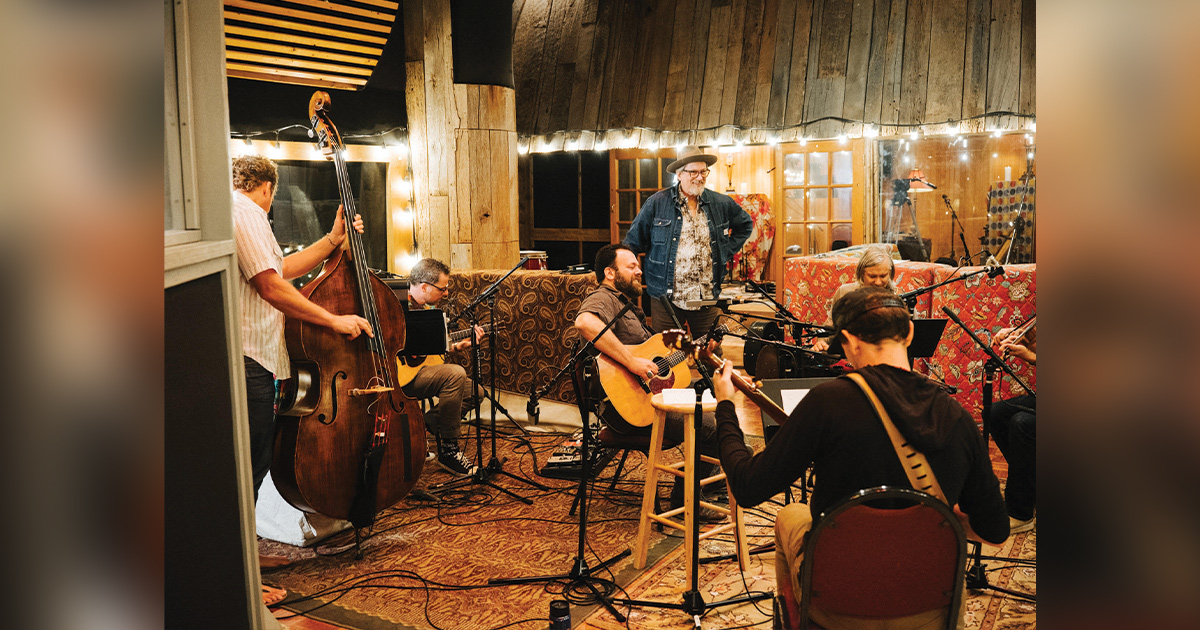
With an arsenal of songs written in his barn and fine-tuned with Douglas, Jacobs, Douglas and the Infamous Stringdusters decamped to Nashville to record the album. Douglas created a unique atmosphere in the studio for Jacobs and the Stringdusters. He set up an area where they could all gather together and run through the songs, live in a circle, before recording. The songs, including most of the vocals and solos, were done live, which was not something Jacobs was entirely used to doing in the studio, but a process he enjoyed immensely and one that helped shape the personality of the album. “Jerry is the best,” says Jacobs. “Not only is he a legendary musician with an impeccable ear and taste, has played on everything, knows how to put a song together, and what makes a good track, but he is also the coolest guy, so fun and loose. It was honestly one of the most fun sessions I have ever done. I’ve made records that have really felt like work, but this was a magical week where every day I went back to my hotel glowing.”
The inclusion of the Infamous Stringdusters as the house band had a massive, positive impact on the sessions as well. “The Dusters were invested. They were pros,” says Jacobs. “It was a free-flowing thing. The songs were fully formed and Jerry was probably the main person we deferred to on arrangement ideas, but ideas were flying in from everyone. It was so cool. We would sit together as a group and run through the songs and then go cut them.” Chris Pandolfi, banjo-picker for the Dusters, agreed with Jacobs about the positive, creative environment that was present during the session and credits Jacobs for helping to foster that. “It was a very immersive, concentrated process. We were in Nashville for a week, working long days, learning, arranging, performing and basically living inside all this new music and ultimately bringing it to life. I love doing it that way, and I really have to tip my hat to Cris and Jerry for creating a great creative environment while this session was going down. We were working hard and having fun and I think everyone brought their best stuff. Cris was really leading the charge. When it was time to put the chart down and go play the song for real, he always raised the bar. He really has something to say on this record.”
In addition to the Infamous Stringdusters, the album is loaded with an all-star roster of guests including Sam Bush, Billy Strings, Lee Ann Womack, the McCrary Sisters and Lindsay Lou. Jacobs says the addition of guests was very organic. He had ideas of what and who he heard in his head for certain songs and Douglas helped facilitate those guests. “Nothing felt forced,” says Jacobs. “I think with these guests it felt like they belonged on the tracks.”
Working from what Jacobs calls his “home base” of bluegrass, the resulting album, One of These Days, is a powerful statement of purpose from one of this generation’s most thoughtful and compelling songwriters. It is a dynamic album powered by Jacobs’s storyteller’s eye and utterly truthful songwriting that delivers timeless tales of life which we can all relate to. One of These Days features everything from a modern take on a murder ballad “Poor Davey” (the true story of a multi-day manhunt in Jacobs’s Baltimore home), to the heart-wrenching, anti-gun warning of “Daughter, Daughter,” to the the uplifting hope found in the grueling work of Eastern Shore crab pickers in “Work Song.” Albums that are lyrically honest and musically emotional are a rare breed, and One of These Days is both. Like Jacobs it is an album that at its core is bluegrass, but on the surface is so much more. Just as Jacobs can, One of These Days stands shoulder to shoulder with any bluegrass album, but more importantly it stands shoulder to shoulder with the best of American roots music. Jacobs and his music have long refused easy labels and avoided being boxed in, instead relying on Jacobs’s ability to channel the heart of roots music in all that he does. Like the forefathers of roots and traditional music before him, this has allowed Jacobs to craft music that echoes the past, but continually looks to the future as it blazes new paths across the untouched frontier of the musical landscape.
One of These Days is an album that was born from the dark, and grew into the light, allowing Jacobs to find his inspiration, joy, passion and center again. “Honestly, I was pretty depressed and there was a lot going through my head. As soon as I got rolling on the album all of that went away and I felt normal again. For whatever reason it helped me and that was the key. It was something I needed to do for my own mental well-being and creativity. I am super proud of this record. I feel it is some of my best work.”