On The Fringe
Bands Blurring the Lines of Bluegrass
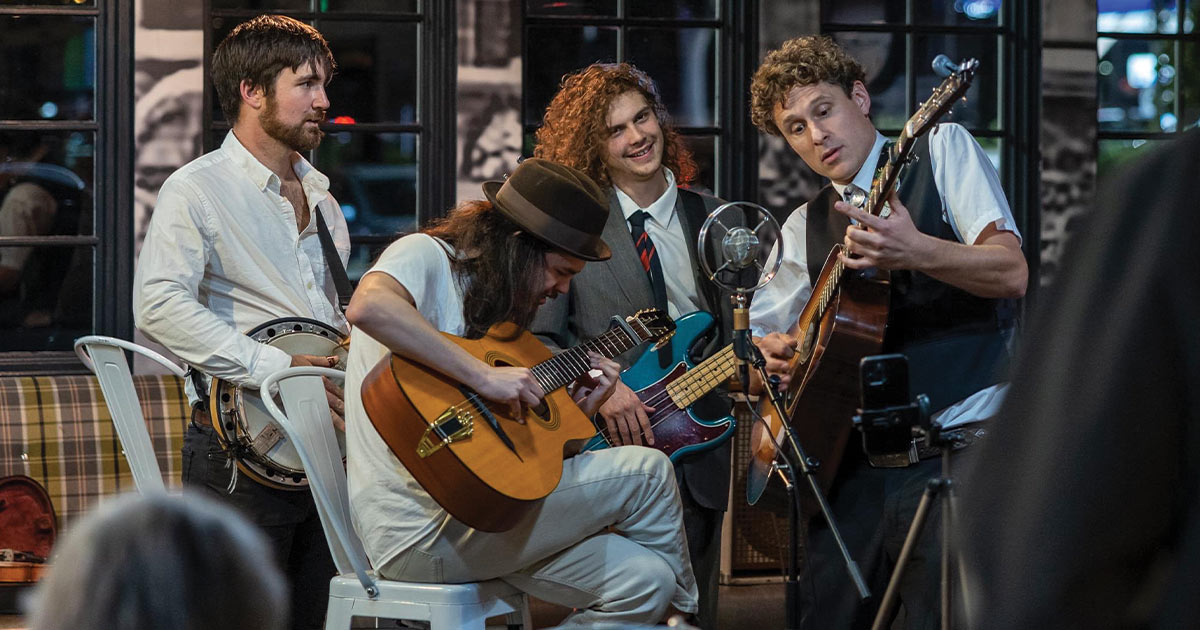
“I tell people we are the tradition of bluegrass, the attitude of punk rock and the culture of hip hop,” explains Kenny Feinstein (singer, multi-instrumentalist) of Water Tower. That declaration perfectly sums up the unconventional musical personality of Water Tower, a Los Angeles-based string-band that is keeping old-timey, traditional music alive in their own, unique way. The disparate nature of those three musical styles might cause the most staunch traditionalist to cringe and turn away, but then they would be missing one of the most exciting young bands playing bluegrass today. Water Tower is a band that plays with the soul of their traditional forefathers, but delivers with a carefree, devil-may-care attitude.
California has long been home to progressive bluegrass from Jerry Garcia’s banjo to Tony Rice’s guitar to Clarence White and the Kentucky Colonels. With roots like that, and their Los Angeles home, it is easy to understand how Water Tower fits into the larger bluegrass world, and how their progressive take on bluegrass can have punk legend Ron Reyes from Black Flag singing on a souped-up bluegrass track, as he does on Water Tower’s “Anthem,” from their debut album, Fly Around. Water Tower finds the sweet spot between Bill Monroe and Rancid and makes it their own. If Earl Scruggs was a skater from Portland, who had a passion for the free-spirited thrash of NOFX and fell in love with the community and earnest nature of bluegrass, you would have Water Tower.
That sweet spot finds Water Tower exploding with the energy and loose, reckless-abandon of punk music, while tackling topics not usually found in the bluegrass songbook. When Feinstein sings “Take Me Back,” a heartfelt ode to the harsh realities of addiction, the full scope of the band’s distinctive approach is on display. For Feinstein those lyrics are a testament to his life and struggles, sung with a straightforward sincerity that finds comfort in the honest confines of bluegrass. “Take Me Back” is a clear-eyed reflection of both Feinstein and Water Tower’s struggle and rebirth from addiction.
This rebirth is evident in the band and the joyful lust for life permeating through every live performance. Feinstein, who in conversation is engaging, upbeat and infectious with his enthusiasm, laughs as he says, “Water Tower is a new band, but with a lot of history.” The band first formed when Feinsten was in high school in Portland, Oregon, in 2004 as the Water Tower Bucket Boys, named after the water tower behind Feinstein’s house that was the hangout and party spot for him and his friends and for the washtub bass player the band had at the time. The band played a punk rock version of the old-timey music Feinstein had become enamored with. He discovered it at 16 when he went to a square dance hosted by the Foghorn String Band. “They are an amazing old-time bluegrass string band,” Feinsten says excitedly. “After I went to their square dance my life changed. I was exposed to fiddle music. I saw hundreds of people dancing together. The energy, to me, was similar to punk rock. My life just took this turn after that. It became all about old-time music. I didn’t abandon punk rock but I went all in on bluegrass and old-time music.”
On the surface the connection and similarities between punk and bluegrass may seem miles apart, but they are actually like cousins who have never met, and who share strong familial bonds. Musically there is a drive and energy present in both genres that comes through in the speed and passion with which they are played. They also both rely on a D.I.Y. aesthetic, the ability Feinstein says to, “create a scene from the friends around us, to schedule our own square dances and house shows, to train-hop and to learn how to play and sing through the aural tradition.”
Over the ensuing years Water Tower evolved with lineup and name changes, but always staying true to their punk-rock roots and old-time soul. During this time they recorded a handful of self-released albums and EPs, including one produced by Mike Herrera from punk bands MxPx and Goldfinger. In 2012 the band was beginning to move in a more punk rock direction when they were given the opportunity to open for Against Me! on their U.S. tour, “So we kicked the bucket for that tour and became Water Tower,” says Feinstein.
“That tour was our only real tour and then we imploded due to addiction. We were all dealing with it, and I was dealing with it especially.” As the band was imploding they relocated to Los Angeles and finished recording an album, produced by punk legend Don Bolles of the Germs, and featuring Willie Watson from Old Crow Medicine Show, Ariel Pink and Black Flag’s Ron Reyes on on the album-closing punk bluegrass rave-up, “Anthem.” As the band dealt with their own personal issues, the album, Fly Around, was shelved and not released until 2020. “I was in and out of trouble and couldn’t get things together during that time,” says Feinstein. Eventually Feinstein and the band got themselves together and recovered. As they did Water Tower experienced a rebirth, finding a new lease on life, which they poured into their music. Water Tower established itself as the band that you have to go see if you only have one night in Los Angeles to see live music.
The band continued to grow and evolve with various lineup changes. For Feinstein they are not so much changes as additions to the ever-growing Water Tower lineup. While unconventional in many ways, Water Tower relies on one of the most important aspects of bluegrass: community. The band is built around the core of Feinstein and banjo-picker/guitarist Tommy Drinkard, but uses a rotating roster of musicians that currently numbers in the twenties, allowing for a lineup that can change from show to show. This fluidity allows for the band to change, adapt and experiment with their sound. It allows Water Tower to be more versatile and have a broader sound that can change with different accents and notes from all the varying interests and styles of the numerous individual members. They can have drums one night, be a stripped down trio another, an acoustic thrash band the next, and just about any other variation Feinstein and crew can imagine. “Water Tower is more family than band,” says Feinstein. “Let me put it this way, we have a new bass player, but one of our old bass players is my next door neighbor and one of my best friends who still plays with us occasionally. They are all members of Water Tower at one time, but they are just not playing with us now, but every now and then they may come in for a show. They are always family.”
With their West Coast origins and L.A. home base, songs of hollers, hills and the old home place have been replaced with a decidedly West Coast feel. Lyrical journeys to the convenience store (“AmPM”) and busking on freeway off ramps (“Fivers” and “Flow Tap”) fill up the musical conversation. “I have heard people say we have an urban or city feel as we talk about L.A. a lot in our songs,” says Feinstein. “Life in L.A. and the punk rock influence runs deep for us.” Just as L.A. influences Water Tower, Water Tower hopes to do the same for the city. “That’s part of why we moved to L.A.,” explains Feinstein. “In L.A there is a big old-timey scene, but it is fragmented, it’s less connected. We are working really hard to connect it all and bring it back together. People love it out here and I think that was a big reason we came out here was to remind people in L.A. and southern California that everyone loves bluegrass and old-time music, they just don’t know it yet.”
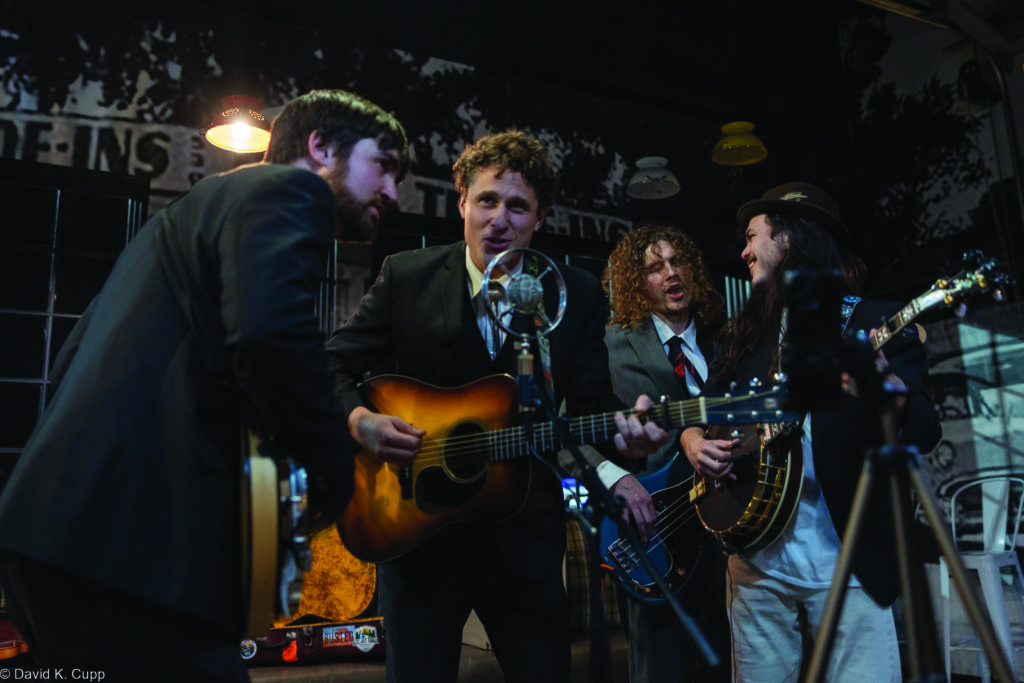
Their lyrical topics and the unique makeup of the band are not the only unconventional traits of Water Tower. Feinstein says they rarely practice, instead relying on regular busking sessions at freeway off ramps. Busking is something Feinstein has participated in since his teenage years, but took to a whole new level when Water Tower crossed paths with Old Crow Medicine show. “Old Crow really helped us throughout our career in getting gigs and in busking,” says Feinstein. “Our first tour in 2005, Gill Landry from Old Crow drew us a busking map from North Carolina to San Francisco and we went to every spot on that map to busk. We met Willie Watson on that tour. Our first time in L.A. was busking with Willie. We now spend a lot of time busking at freeway off ramps. That is how we have made our living as a bluegrass band for many years without having to get a job.”
These regular busking sessions have helped mold the band’s unique identity, as their songwriting and approach to live shows has taken form at the end of those freeways. “We write while busking at the freeway off ramps. So sometimes it’s five of us, sometimes six, sometimes two, but we are influenced by who is there at the moment because we write there on the street. Tommy and I will later go and record what has been written, but it is influenced by whoever was there at the time.” This in-the-moment feel also bleeds into their live shows. While busking for cars, Water Tower becomes attuned with the pace and flow of the cars moving off the ramp, and has learned how to interact with each car or personality that comes by. They have coined a term for the energy that comes from the different pace and makeup of traffic and cars they encounter, “flow tap.” Feinstein explains, “It’s like a crowd at a show, the only difference is the crowd is all together so it makes it easier for us because we can morph them and become one with them. The freeway really trained us to tap into the flow of the audience or elicit a response from the audience. We have learned what fiddle or banjo or guitar lick is going to resonate with certain cars and people because there are so many different cultures. Busking has influenced and trained us for crowds of all types of people and a way to get feedback immediately. We don’t write setlists, we just vibe the crowd the same way we do cars. Sometimes we write a new song on the spot for the crowd and they don’t even know it. It happens when someone in the band feels something and starts leading us in a new direction and then we all follow along. Those are some of my favorite musical moments that ever happen.”
For Water Tower, those musical moments and what comes from them, for both band and crowd alike, are at the core of the band. “When people hear it, they love it. It brings happiness. It brings joy,” says Feinstein. “We love being on the streets being able to spread joy through fiddle music to cars one by one or to a crowd at a show because we get to see their smiling faces and then they go out in the city and do their thing and they have had this experience of old-time music with a punk rock edge and it brings them a little happiness throughout their day.”