On The Fringe
Bands Blurring the Lines of Bluegrass
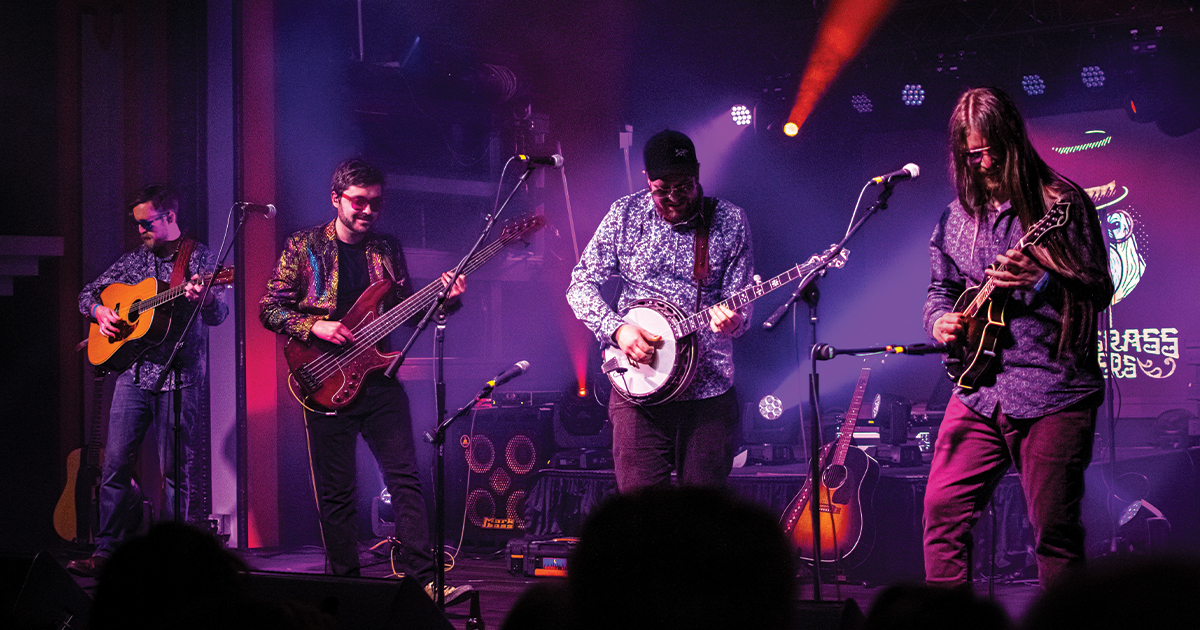
The idea of the grand voyager can invoke many images in your mind. It invokes the idea of travel, exploration, discovery and a journey. For Baltimore’s Dirty Grass Players it holds all those meanings and more. “Grand Voyager” is a track from their first album, Beneath the Woodpile. The track is a Tony Rice-inspired explosion that stakes out new sonic territory for the Dirty Grass Players. Grand Voyager is also the name of the venue where the band first honed their chops as a young band and discovered who they could be musically. Both song and venue have played a pivotal role in the development of the band and point to a new progressive direction for the Dirty Grass Players: Alex Berman (banjo), Ben Kolakowski (guitar), Connor Murray (bass) and Ryan Rogers (mandolin).
Grand Voyager the venue was a crystal shop/art gallery in Baltimore owned by friends of the band. Every other week for a year the band played shows there. “It was like punk rock shows,” says Rogers. The freedom they found there allowed the band to experiment and develop their sound and style while discovering their musical path. For a band who did not grow up steeped in bluegrass like many of their peers, the chance to play in front of a live audience and hone their own unique sound was priceless. Rogers says those underground shows “really shaped the Dirty Grass Players early on.” Word spread and the shows became must-see events. “That’s really how we grew our home base,” says Rogers. The shows also proved beneficial from another standpoint for the band. At each show the band would buy a couple hundred dollars worth of beer to sell. The idea to sell beer went beyond just trying to make a couple of bucks. “We sold the beer so we could pay touring bands to come play and we would gig swap with them. We definitely did not sell the beer legally, but it worked. We made a lot of friends,” laughs Rogers. Those friendships with many other like-minded bands translated to gigs in their new friends’ hometowns.
“Grand Voyager” the song is a growth and an evolution for the band that indicates new horizons for the Dirty Grass Players. That is even more evident on their latest album 2023’s Shiny Side Up, produced by Travelin’ McCourys guitarist Cody Kilby. Shiny Side Up furthers the expansion of bluegrass with its hard-driving sound that showcases the progressive, dark side of bluegrass with its non-traditional playing and songwriting. “Working with Cody was easily one of the best experiences in our musical career,” says Rogers. “We all went into it with this idea that it was a high-pressure situation, but he somehow made us feel at home and relaxed while really pushing us to get better takes or change an idea here and there. He even helped us get Jason Carter on a few of the tracks. People always say not to meet your heroes but I don’t think that applies to bluegrass.”
Musically the band’s unconventional roots lie in their diverse backgrounds and hometown of Baltimore. Rogers explains, “Being from Baltimore impacted our music by bringing some other musical elements to our sound. We have a good scene of bluegrass pickers and we also have a jam scene, jazz scene and even metal and punk scenes.” The band all agree their shared love of the Seldom Scene was influential in their development and they admitted to trying to emulate them when first starting. “I could listen to the Live at the Cellar Door album on repeat everyday,” says Kolakowski. Berman agrees, “That’s what I grew up on, that seventies bluegrass—J.D. Crowe and the New South, the Seldom Scene, New Grass Revival.”

The roots of the Dirty Grass Players first came together when Kolakowski met Berman at a small festival in 2015. They found instant chemistry during an all-night jam session around a campfire that sparked the formation of the band. They soon added Rogers who had recently begun to play the mandolin. The newly-formed band’s background in bluegrass was limited. Only Berman, who began playing banjo as a teenager after going to open jams at the legendary Friendly Inn in Ellicott City, Maryland, had a background in bluegrass. The Friendly Inn had a long-rich history in bluegrass, and Berman, who remembers being blown away by 2013 IBMA banjo-player of the year Mike Munford who played there regularly, soaked it all up on every visit. For the rest of the band, what they lacked in practiced skill, they made up with hardworking effort. Rogers says the band originally began “as a weekly excuse to get together and pick, grill food and drink some beer,” but in those informal picking sessions they realized they had something special together.
The newly-christened Dirty Grass Players were soon booking their first shows. “We played shows at local farmer’s markets, or anywhere that would take really bad bluegrass,” says Kolakowski with a laugh, before adding, “Let’s be honest—we were still learning how to be a band and play our instruments.” Their skills developed at a rapid pace and they were honing them while building a fanbase at their Grand Voyager residency. They were soon hitting the road and playing dates regionally. On their road trips they tried to take as little as possible because it was five guys and an upright-bass packed in a Honda Pilot.
The learning curve for the Dirty Grass Players proved to be short and just two years after forming they entered the Charm City Bluegrass Festival Battle of the Bands. Despite only having been a band for a couple of years they won, earning a spot on the mainstage. It was a huge milestone for the band as it was an acceptance into the bluegrass community. “That was the first festival we played as a band where we were not the only bluegrass band with a bunch of other rock bands,” says Kolakowski. They followed up with a showcase at IBMA that fall. The exposure from both those events found the band in Colorado the following year to take part in a right of passage for so many young bluegrass bands: the band contest at the Telluride Bluegrass Festival.
The Telluride Band Contest is a nationally-recognized contest that has launched the career of a number of winning bands including The Chicks, Magraw Gap, Greensky Bluegrass, Front Country, Trout Steak Revival and others. “The whole reason we did Telluride was we were already in Colorado for another show,” says Kolakowski. The other show was the night before the preliminary round of the band contest and six hours away. Their show stretched into the wee hours of the morning, after which the band hustled into their van for the long-trip to Telluride to make the 8am sign-ups. They coasted into Telluride on fumes with an hour of sleep and made the sign-ups, only to discover they were not as clear on the rules for the contest as they thought. Each band would play three songs: a slow vocal, an instrumental, and a fast vocal and each had to be three minutes in length. For a band like the Dirty Grass Players who takes just as much inspiration from the Grateful Dead as they do the Seldom Scene, that proved to be the toughest rule to meet. “We were at the rules meeting and heard that and were like, uh what?” says Kolakowski. “We had to rework all of our songs in less than an hour to be three minutes long. And we never did that with our songs.” The new arrangements, combined with the lack of sleep, resulted in a less-than-desired outcome. “We did not do very well,” laughs Berman. “We were all just so tired.”
Their experience and result might only have been rivaled by the Salmon Spankers in 1989, a pick-up band put together the day before the contest that included future members of Leftover Salmon and who finished an unremarkable sixth out of seven bands. Not many bands can have what Kolakowski simply summed up as a “terrible experience,” yet come out on the other side with more opportunities. The Dirty Grass Players did just that, proving that anyone can win, but not everyone can show up with an hour sleep, not know the rules, and still impress, as shortly after the contest they were offered a series of gigs in Telluride. As the Dirty Grass Players grew and evolved, their setlists and repertoire reflected their diverse backgrounds with traditional tunes like “Salt Creek” and “Red-Haired Boy” sounding right at home alongside a smattering of rock covers including everything from Bob Dylan, Pink Floyd, the Grateful Dead and even a mind-bending version of Lorde’s “Royals” that they remade in their own unique rock ‘n’ roll bluegrass style.
Through all of it the Dirty Grass Players exhibited a willingness and proclivity to explore the outer realms of the bluegrass world and experiment with what is possible on string-instruments. “Our music fits into the tradition of bluegrass because we try to keep the hard driving feel that you get from Bill Monroe, Flatt and Scruggs, or the Stanley Brothers and carry it through everything we do,” explains Rogers, “but a lot of what we play doesn’t fit into the bluegrass purist’s example. We play contemporary covers and have some pretty out-there jams and arrangements but we always try to keep that traditional drive and feel alive in our music.”
This diverse palate is on full display on the band’s recently-released EP of covers that highlights their anything-goes approach. They tackle songs by everyone from Johnny Paycheck to Queen to Talking Heads and showcase how the band lives in between musical worlds. “Our sound comes from our love of hard driving bluegrass mixed with a little bit of dirty rock ’n’ roll. We don’t take anything too seriously,” says Rogers.
The idea of the grand voyager can invoke many images in your mind. It invokes the idea of travel, exploration, discovery and a journey. For Baltimore’s Dirty Grass Players it holds all those meanings and more. “Grand Voyager” is a track from their first album, Beneath the Woodpile. The track is a Tony Rice-inspired explosion that stakes out new sonic territory for the Dirty Grass Players. Grand Voyager is also the name of the venue where the band first honed their chops as a young band and discovered who they could be musically. Both song and venue have played a pivotal role in the development of the band and point to a new progressive direction for the Dirty Grass Players: Alex Berman (banjo), Ben Kolakowski (guitar), Connor Murray (bass) and Ryan Rogers (mandolin).
Grand Voyager the venue was a crystal shop/art gallery in Baltimore owned by friends of the band. Every other week for a year the band played shows there. “It was like punk rock shows,” says Rogers. The freedom they found there allowed the band to experiment and develop their sound and style while discovering their musical path. For a band who did not grow up steeped in bluegrass like many of their peers, the chance to play in front of a live audience and hone their own unique sound was priceless. Rogers says those underground shows “really shaped the Dirty Grass Players early on.” Word spread and the shows became must-see events. “That’s really how we grew our home base,” says Rogers. The shows also proved beneficial from another standpoint for the band. At each show the band would buy a couple hundred dollars worth of beer to sell. The idea to sell beer went beyond just trying to make a couple of bucks. “We sold the beer so we could pay touring bands to come play and we would gig swap with them. We definitely did not sell the beer legally, but it worked. We made a lot of friends,” laughs Rogers. Those friendships with many other like-minded bands translated to gigs in their new friends’ hometowns.
“Grand Voyager” the song is a growth and an evolution for the band that indicates new horizons for the Dirty Grass Players. That is even more evident on their latest album 2023’s Shiny Side Up, produced by Travelin’ McCourys guitarist Cody Kilby. Shiny Side Up furthers the expansion of bluegrass with its hard-driving sound that showcases the progressive, dark side of bluegrass with its non-traditional playing and songwriting. “Working with Cody was easily one of the best experiences in our musical career,” says Rogers. “We all went into it with this idea that it was a high-pressure situation, but he somehow made us feel at home and relaxed while really pushing us to get better takes or change an idea here and there. He even helped us get Jason Carter on a few of the tracks. People always say not to meet your heroes but I don’t think that applies to bluegrass.”
Musically the band’s unconventional roots lie in their diverse backgrounds and hometown of Baltimore. Rogers explains, “Being from Baltimore impacted our music by bringing some other musical elements to our sound. We have a good scene of bluegrass pickers and we also have a jam scene, jazz scene and even metal and punk scenes.” The band all agree their shared love of the Seldom Scene was influential in their development and they admitted to trying to emulate them when first starting. “I could listen to the Live at the Cellar Door album on repeat everyday,” says Kolakowski. Berman agrees, “That’s what I grew up on, that seventies bluegrass—J.D. Crowe and the New South, the Seldom Scene, New Grass Revival.”
The roots of the Dirty Grass Players first came together when Kolakowski met Berman at a small festival in 2015. They found instant chemistry during an all-night jam session around a campfire that sparked the formation of the band. They soon added Rogers who had recently begun to play the mandolin. The newly-formed band’s background in bluegrass was limited. Only Berman, who began playing banjo as a teenager after going to open jams at the legendary Friendly Inn in Ellicott City, Maryland, had a background in bluegrass. The Friendly Inn had a long-rich history in bluegrass, and Berman, who remembers being blown away by 2013 IBMA banjo-player of the year Mike Munford who played there regularly, soaked it all up on every visit. For the rest of the band, what they lacked in practiced skill, they made up with hardworking effort. Rogers says the band originally began “as a weekly excuse to get together and pick, grill food and drink some beer,” but in those informal picking sessions they realized they had something special together.
The newly-christened Dirty Grass Players were soon booking their first shows. “We played shows at local farmer’s markets, or anywhere that would take really bad bluegrass,” says Kolakowski with a laugh, before adding, “Let’s be honest—we were still learning how to be a band and play our instruments.” Their skills developed at a rapid pace and they were honing them while building a fanbase at their Grand Voyager residency. They were soon hitting the road and playing dates regionally. On their road trips they tried to take as little as possible because it was five guys and an upright-bass packed in a Honda Pilot.
The learning curve for the Dirty Grass Players proved to be short and just two years after forming they entered the Charm City Bluegrass Festival Battle of the Bands. Despite only having been a band for a couple of years they won, earning a spot on the mainstage. It was a huge milestone for the band as it was an acceptance into the bluegrass community. “That was the first festival we played as a band where we were not the only bluegrass band with a bunch of other rock bands,” says Kolakowski. They followed up with a showcase at IBMA that fall. The exposure from both those events found the band in Colorado the following year to take part in a right of passage for so many young bluegrass bands: the band contest at the Telluride Bluegrass Festival.
The Telluride Band Contest is a nationally-recognized contest that has launched the career of a number of winning bands including The Chicks, Magraw Gap, Greensky Bluegrass, Front Country, Trout Steak Revival and others. “The whole reason we did Telluride was we were already in Colorado for another show,” says Kolakowski. The other show was the night before the preliminary round of the band contest and six hours away. Their show stretched into the wee hours of the morning, after which the band hustled into their van for the long-trip to Telluride to make the 8am sign-ups. They coasted into Telluride on fumes with an hour of sleep and made the sign-ups, only to discover they were not as clear on the rules for the contest as they thought. Each band would play three songs: a slow vocal, an instrumental, and a fast vocal and each had to be three minutes in length. For a band like the Dirty Grass Players who takes just as much inspiration from the Grateful Dead as they do the Seldom Scene, that proved to be the toughest rule to meet. “We were at the rules meeting and heard that and were like, uh what?” says Kolakowski. “We had to rework all of our songs in less than an hour to be three minutes long. And we never did that with our songs.” The new arrangements, combined with the lack of sleep, resulted in a less-than-desired outcome. “We did not do very well,” laughs Berman. “We were all just so tired.”
Their experience and result might only have been rivaled by the Salmon Spankers in 1989, a pick-up band put together the day before the contest that included future members of Leftover Salmon and who finished an unremarkable sixth out of seven bands. Not many bands can have what Kolakowski simply summed up as a “terrible experience,” yet come out on the other side with more opportunities. The Dirty Grass Players did just that, proving that anyone can win, but not everyone can show up with an hour sleep, not know the rules, and still impress, as shortly after the contest they were offered a series of gigs in Telluride. As the Dirty Grass Players grew and evolved, their setlists and repertoire reflected their diverse backgrounds with traditional tunes like “Salt Creek” and “Red-Haired Boy” sounding right at home alongside a smattering of rock covers including everything from Bob Dylan, Pink Floyd, the Grateful Dead and even a mind-bending version of Lorde’s “Royals” that they remade in their own unique rock ‘n’ roll bluegrass style.
Through all of it the Dirty Grass Players exhibited a willingness and proclivity to explore the outer realms of the bluegrass world and experiment with what is possible on string-instruments. “Our music fits into the tradition of bluegrass because we try to keep the hard driving feel that you get from Bill Monroe, Flatt and Scruggs, or the Stanley Brothers and carry it through everything we do,” explains Rogers, “but a lot of what we play doesn’t fit into the bluegrass purist’s example. We play contemporary covers and have some pretty out-there jams and arrangements but we always try to keep that traditional drive and feel alive in our music.”
This diverse palate is on full display on the band’s recently-released EP of covers that highlights their anything-goes approach. They tackle songs by everyone from Johnny Paycheck to Queen to Talking Heads and showcase how the band lives in between musical worlds. “Our sound comes from our love of hard driving bluegrass mixed with a little bit of dirty rock ’n’ roll. We don’t take anything too seriously,” says Rogers.
The Dirty Grass Players’ unconventional sound has found a welcoming home as the tent for bluegrass widens and expands and becomes ever more inclusive. With a growing renewed interest in roots and acoustic music and with string bands more popular than ever, it is a great time to play bluegrass. Bluegrass has become such a big word as what defines it is continually expanding. Bands no longer have to cram themselves into such a small box. Now you can be everyone from Del McCoury, Billy Strings, Sam Bush, Leftover Salmon and Béla Fleck and still be under the same tent. For the Dirty Grass Players this idea of a big tent suits them just fine. “I think it’s great that other types of music get added to the bluegrass tent,” says Rogers. “Personally, my introduction to bluegrass was hearing Railroad Earth, Yonder Mountain String Band, The Travelin’ McCourys and Sam Bush on the jamband festival circuit. If it weren’t for them I wouldn’t play mandolin and wouldn’t have found Bill Monroe. So I do think going outside the genre is important to help grow bluegrass. Dirty Grass is on the line between the traditional and progressive so we’re lucky enough to experience both worlds and hopefully bring some more folks into the bluegrass world.”
The Dirty Grass Players’ unconventional sound has found a welcoming home as the tent for bluegrass widens and expands and becomes ever more inclusive. With a growing renewed interest in roots and acoustic music and with string bands more popular than ever, it is a great time to play bluegrass. Bluegrass has become such a big word as what defines it is continually expanding. Bands no longer have to cram themselves into such a small box. Now you can be everyone from Del McCoury, Billy Strings, Sam Bush, Leftover Salmon and Béla Fleck and still be under the same tent. For the Dirty Grass Players this idea of a big tent suits them just fine. “I think it’s great that other types of music get added to the bluegrass tent,” says Rogers. “Personally, my introduction to bluegrass was hearing Railroad Earth, Yonder Mountain String Band, The Travelin’ McCourys and Sam Bush on the jamband festival circuit. If it weren’t for them I wouldn’t play mandolin and wouldn’t have found Bill Monroe. So I do think going outside the genre is important to help grow bluegrass. Dirty Grass is on the line between the traditional and progressive so we’re lucky enough to experience both worlds and hopefully bring some more folks into the bluegrass world.”