Old-Time Music and Bluegrass: Separate But Intertwining Branches
There are certain questions that anyone who plays bluegrass has encountered more than once from well-intentioned (mostly) listeners. “Is that a ukulele?” to the mandolinist. “What’s the difference between a fiddle and a violin?” (Generally, about $50,000 a year). “Do you know ‘Wagon Wheel?’” (No!!!)
Right up there amongst them is, “What’s the difference between bluegrass and old-time music?” This is one that usually defies simple answers. You could point out characteristics of the instrumentation, probably starting with the banjo and focusing either on the innovations of Earl Scruggs’ three-finger style versus clawhammer or frailing, or the use of a resonator or an open-back banjo. You could elaborate on the mandolinist’s rhythmic role serving as an ersatz snare drum on the backbeat and how that alters the rhythm. You could pretend for a few glorious seconds that you’re Neil Rosenberg and speak of the urban path that bluegrass took coming out of the bucolic corners of Kentucky, North Carolina, and Virginia.
It’s a sad irony that two styles of music that most casual listeners perceive as identical branches of traditional American string music have become, in many ways, so polarized. If as a player you were to find yourself in an unfamiliar jam session, a variety of cues and clues could serve as litmus tests as to which side of the chasm you find yourself. Are the fiddles playing unison or harmonies? Are there solo instrumental breaks? Is changing key a significant benchmark in the jam?
Bluegrass music roots are so deeply entwined with those of old-time music that they’ve become part of its origin story. In the early days of recording it was all classified as hillbilly music. Old-time music is generally traced directly back to country music prior to World War II, sidestepping in many ways the stylistic evolution that Bill Monroe and Flatt and Scruggs brought about. Despite Bill Monroe’s apprenticeship with his uncle Pen Vandiver and country blues guitarist Arnold Schulz playing for barn dancers, the distinctive characteristics of what we’ve come to know as bluegrass served to distinguish it from its musical roots. Monroe’s livelihood depended on his not blending into the crowd in terms of art or the market.
Robert Cantwell, in his book Bluegrass Breakdown, calls the estrangement between the two styles a “family squabble.” There’s a lot of truth to that, if you think of the greater body of traditional country music as a family with old-time music and bluegrass being two headstrong kids taking pride in their individuality. There’s a saying that circulates in academia that’s used to describe the infighting that often takes place there: “The battles are so fierce because the stakes are so low.” Given the niche audience markets that the two genres are competing for, it could be said that this only fuels the competitive friction between these musical camps.
Both bluegrass and old-time went through lean times, but bluegrass benefited from surges of popularity due to the quirks of popular culture. (Think Bonnie and Clyde, Deliverance, etc.) Without such unpredictable jackpot events, at least until O Brother, Where Art Thou, old-time music kept a lower profile until folklorists and colleges provided an opportunity for performances and preservation not seen since Ralph Peer. It would be unfair to tar bluegrass with the brush of commercialization while saying old-time music was uncompromisingly authentic. All musicians like to eat, some with more extravagant appetites than others. But as their respective listeners and venues began to move away from one another, so too, arguably, did the players become more conscious of the differentiation in styles. Just like Flatt and Scruggs and the Stanley Brothers ultimately ended up adjusting their instrumentation and repertoires in order to achieve separation from Bill Monroe, old-time musicians took a justifiable pride in what made their music and their performance practices unique from bluegrass and especially appealing to their own audiences.
Ralph Stanley’s use of the term “mountain music” to describe the sound of the Stanley Brothers didn’t make their music any less bluegrass, but it’s quite a bit easier to trace the aural DNA of his having first taken on the clawhammer banjo at his mother’s knee. In his autobiography Man of Constant Sorrow, he refers more than once to the pleasure he took in trotting out “Shout Little Lulie” whenever possible as both a crowd-pleaser and a roots homage. The fiddling of Curly Ray Cline did nothing to widen the occasionally tenuous gap between bluegrass and old-time.
So where did the continental drift between bluegrass and what we now think of as old-time music take place? The old tunes continued to be played in the old way, but during the period that Monroe, Flatt and Scruggs, and the Stanley Brothers were creating some of their best work, old-time music did not find an audience far beyond its original players and community. In many ways, it was The Great Folk Music Scare of the Sixties that brought the music to the attention of college audiences, folk festivals, and young roots-hungry players.
Doc Watson can be seen as a kind of missing link. He was a classic songster in the sense that he would readily play songs from both traditional and modern sources, segueing from Jimmie Rodgers to the Monroe Brothers to the Moody Blues in ways that would have made listeners’ heads spin had he not been so talented and effective a musician and entertainer. His flatpicking guitar prowess made him a seminal inspiration to bluegrass instrumentalists, while his deep grounding in tradition shines out in his early recorded appearances with Jean Ritchie, Gaither Carlton, Clint Howard and Fred Price.
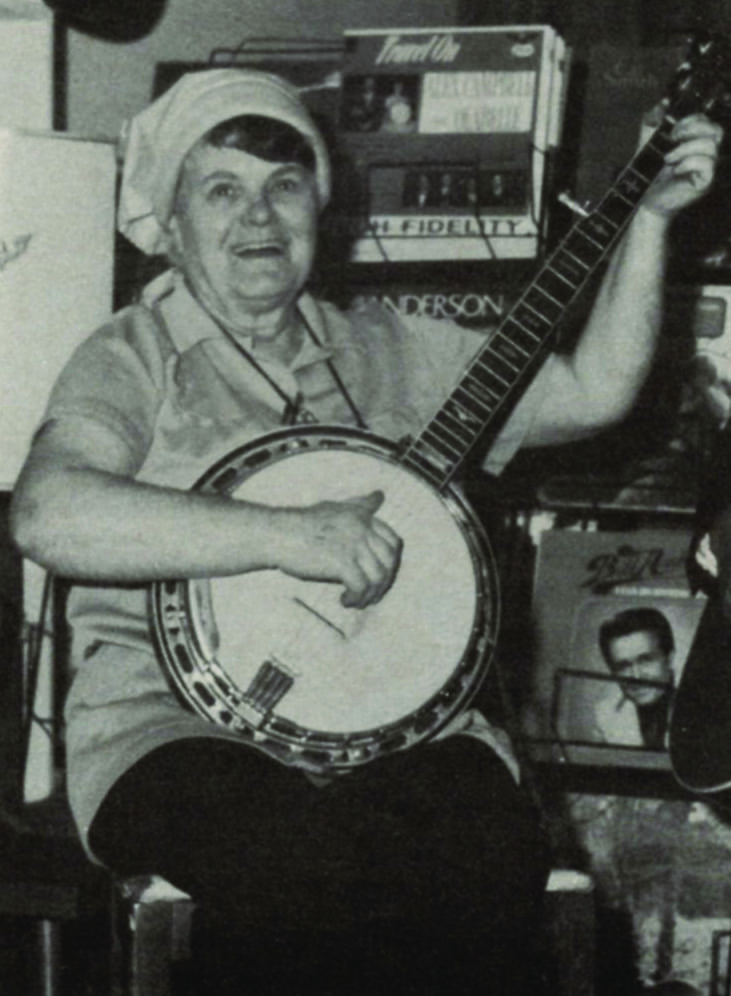
Another influential performer who comfortably straddled the chasm between bluegrass and old-time was Ola Belle Reed. Performing with Alex Campbell, as part of the house bands at New River Ranch and Sunset Park, as well as with a standard bluegrass configuration, her voice and her songs drew on a mountain tradition that defied easy categorization. Grounded in the late lamented northern country music parks at which she honed her stage skills, she was able to tap into the soulfulness of country soul and bringing the spirit and power of each song to her listeners.
Bill Clifton was another musician who blurred boundaries. While he was the organizer of one of the earliest bluegrass festivals (in Luray in 1961), he also championed the autoharp and was lionized by that instrument’s community by way of his incorporating it and the music of the Carter Family into his performances and recordings.
While bluegrass is indeed often defined by its instrumentation, Clifton is a classic example of how the introduction of an “exotic” instrument doesn’t automatically cause disbarment and exile from bluegrass. Sally Ann Forrester’s accordion might be an awkward anomaly in the gene testing of musical history, but it was real and so was their bluegrass, even at an experimental stage. The Osborne Brothers’ drums were necessary for them to compete in the country music package shows at which they worked hard to make a living, and their musicianship was no less peerless because of it. In more recent times, Florida banjoist Mark Johnson was able to hybridize his own fusion of clawhammer banjo technique and, with the more than able assistance of the Rice Brothers and Emory Lester, maintain the integrity of his unique clawgrass style.
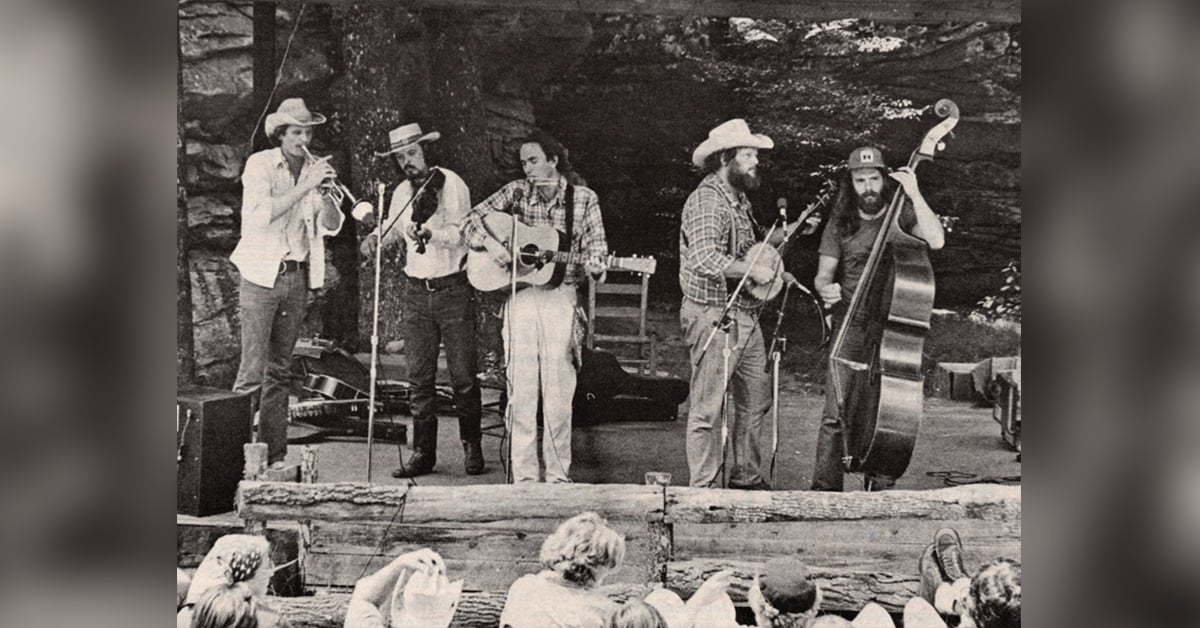
The New Lost City Ramblers and Highwoods Stringband were among the groups that transcended the world of old-time music and had the opportunity to be ambassadors for the music to general audiences. What the New Lost City Ramblers did for college audiences and musicologists in the 1960s, the Highwoods Stringband carried on in the 1970s. For all their furious energy and relentless touring, it may have ultimately been the combination of their unaffected informal appearance and their tapping into a connection with a long-submerged musical subculture that fueled their biggest impact. Banjoist Mac Benford described the group’s reception at a southern music festival in an Alice Gerrard article in the magazine Old-Time Herald by saying, “Our music obviously took them back to times and places in their own pasts, and they were good about expressing their gratitude. It was their conviction that we were keeping something they valued alive that convinced us we were an authentic part of the tradition.”
Other such bands, with varying mixes of old-time tradition and wild eclecticism, include the Red Clay Ramblers, the Freight Hoppers, Uncle Earl, Foghorn Stringband, and the Carolina Chocolate Drops, among others. Seemingly every few years, a new group emerges from the pack and becomes the focus of critical and popular attention. It’s an encouraging sign that there is a receptive demographic that is open and unbiased towards an entertaining and talented band whose fundamental focal point is still old-time music.
Repertoire can be a telling testing ground in the characteristics that both unite and separate bluegrass and old-time music. If you listen to a tune like “Salt River,” and hear how Bill Keith and Bill Monroe dammed the flow and channeled it into “Salt Creek,” what was gained was the drive and melodic complexity, while what was lost was the rambling wildness. Many fiddle and banjo tunes remain a comfortable dual citizenship between the styles and have learned to tailor their accents accordingly. And remember that Earl Scruggs was playing an older style of “Train 45” when he unlocked the technique that helped make bluegrass what it is today.
As for songs, one could simply delve into the deep repertoire of the Carter Family in order to see how much of their material has become infused with bluegrass DNA. Start with “Can (Will) the Circle Be Unbroken,” move on to “Gold Watch and Chain,” “Bury Me Beneath the (Weeping) Willow,” “John Hardy (Was a Desperate Little Man).” Both Flatt and Scruggs and the Stanley Brothers recorded entire albums dedicated to the songs of the Carter Family, but their influence certainly did not stop there.
Traditional songs are malleable, as they are survivors, hit selections on Charles Darwin’s jukebox. A song like “Rough and Rocky” has gone through changes that make it almost unrecognizable to anyone other than a musicologist. In our times, it’s likely that the process of preserving a song on a recording is one of the most vital factors that sustains and disseminates a song in what we would think of as a solid form. But even if the Blue Sky Boys’ version served as a template for the song most of us know, it can still be dressed up in new stylistic clothing and sung by a fingerpicking folksinger, a Celtic band, and, of course, everyone from Emmylou to Lester ‘n Earl, and serve as a link to its timeless source.
Since instrumental line-up has become one of the key identifiers of a bluegrass line-up, there is often a bit of an identity crisis when the duo format is presented. Just like the Monroe Brothers are not considered to be bluegrass while the Bluegrass Boys are not old-time, great tandems such as Ricky Skaggs and Tony Rice or Hazel Dickens and Alice Gerrard evoke some of the early traditional country sounds of pairings like the Blue Sky Boys and the Delmore Brothers. Although the ease of categorization often depends on whether the dual front line is supported by a full backing band, the spare beauty of two voices and two instruments generally brings the focus back onto the rustic beauty of the old songs and supple harmonies.
One aspect that can reflect the divergence between the two styles is one that wouldn’t occur to most bluegrass fans. I’m talking about dance. No, not the rollicking freestylers who block your view from your lawn chairs at a festival. The varieties of folk dance linked to most kinds of music have largely faded from bluegrass itself. Those of us fortunate enough to have seen Bill Monroe perform remember his buck dancing, and probably there are more than a few bluegrass bands that have found themselves playing for clogging troupes. But the tunes in bluegrass have generally separated themselves from their dance origins. (After all, when was the last time you heard “Clinch Mountain Backstep” played and seen the banjoist fall off the rear of the stage?) The sinuous, sometimes “crooked” nature of many old-time tunes lend themselves more to dancing and haven’t left those physical connections quite as far behind. The world of contradancing, while it tends to have caused older dance tunes to have become somewhat homogenized by their need to be “square” (as in 32 measures in two pairs of 8), many old-time bands have found second careers on the contra circuit with a repertoire of tunes that move and bounce in just the right places. While there are some bluegrass tunes, such as “Gold Rush” and “Dixie Hoedown,” that have the right stuff to serve that function, it’s still an area in which old-time music holds an edge.
So, like many things in the music business these days, does it all come down to marketing? Audience share? Demographics? Roots musicians may all be competing for the same small slice of pie.
What is bluegrass anyway (keep your answers to yourselves, please, and don’t copy from the student at the next desk)? Or old-time music, for that matter? The contemporary jamgrass bands and listeners are creating their own fusion of styles, and while inexperienced listeners (like many of us were ourselves once) think of it as bluegrass and/or old-time, the players happily draw on both ingredients to stew in their distinctive new musical gumbo.
There are encouraging signs that there will be more cooperation than competition between old-time and bluegrass in the foreseeable future. IBMA, with its Big Tent approach, has continued to make room for old-time bands in its event showcases. The 2020 IBMA Momentum Award for Band of the Year went to Canada’s Slocan Ramblers, whose banjoist, Frank Evans, can shift seamlessly from clawhammer to Scruggs style.
Musicians have always followed the music, no matter where it takes them and no matter where it springs from. The headwaters that feed both bluegrass and old-time are too rich and complex to be filtered by strict stylistic constrictions. Bluegrass will not lose its power, integrity, or identity by acknowledging the distinctive elements and shared ancestral sources of old-time music, and vice versa. Just as Ralph Stanley did by slipping in an old-time musical vignette in his shows, so will former Clinch Mountain Boy Ricky Skaggs allude to the tradition in features with his banjoist Russ Carson, who has a deep background in both forms.
It will do nothing but broaden the audience and freshen the vivacity of the music if the borders between these musical species are opened wider. In these divisive times, focusing on the shared qualities of deeply rooted musical integrity should make both styles stronger.