Notes & Queries – September 2023
Queries
Q: Can you tell me who the pickers and singers were on the 1950s recordings of the Country Pardners? Jerry Steinberg, Salem, Virginia.
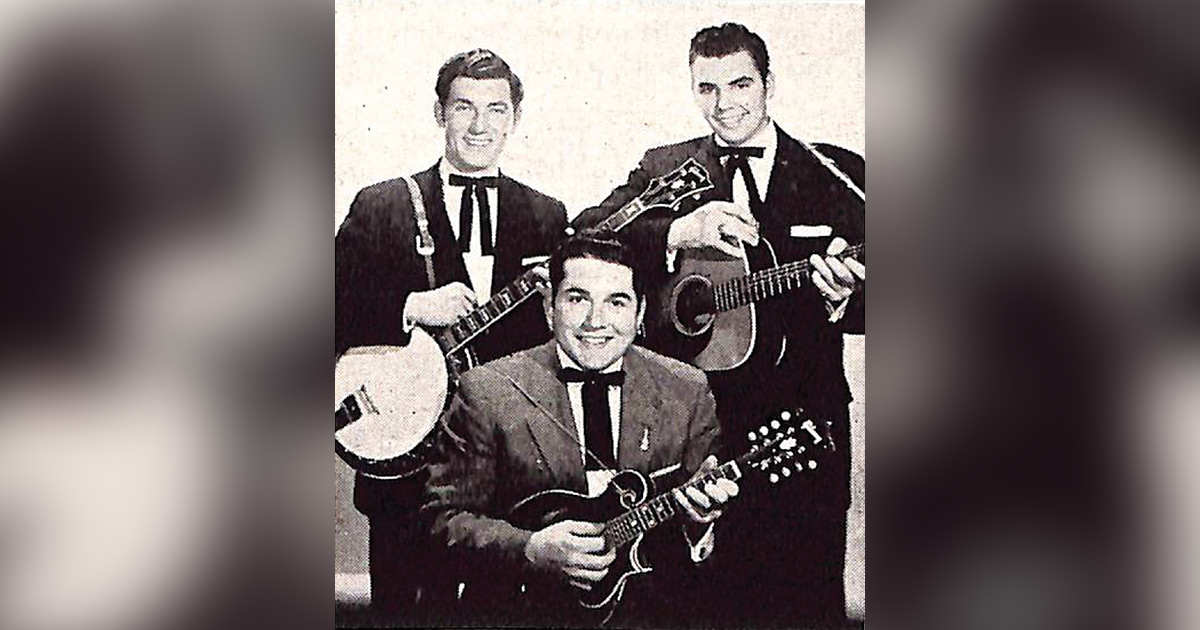
A: The Country Pardners was a short-lived group that came together in 1955 and disbanded two years later. Bill Price, a mandolin player/tenor singer from North Carolina was the founder and leader of the group. He had recently finished a stint with Jimmy Martin and landed a job at the Jimmie Skinner Music Center in Cincinnati. The mail order store was one of the largest, if not THE largest outlets for country music recordings in the mid-1950s. It was here that Price met others to form the core band. These included guitarist/lead singer Carlos Brock and banjo picker/baritone singer Bobby Simpson.
The music center’s manager, Lou Epstein, used his Nashville connections to secure a recording contract with RCA Victor for the new group. The recent break-up of Jimmy Martin and Sonny and Bobby Osborne and their exit from RCA left an opening at the label for a bluegrass band and the Country Pardners hit at the right time. The December 24, 1955, edition of Billboard magazine made note of the band’s good fortunes: “A new group, the Country Pardners, also working under the Epstein banner, have just signed to record for RCA Victor. Group comprises Bill Price, Bobby Simpson and Carlos Brock, who are featured regularly over WNOP, Newport, KY.” The once-a-week Saturday show emanated from the Jimmie Skinner Music Center.
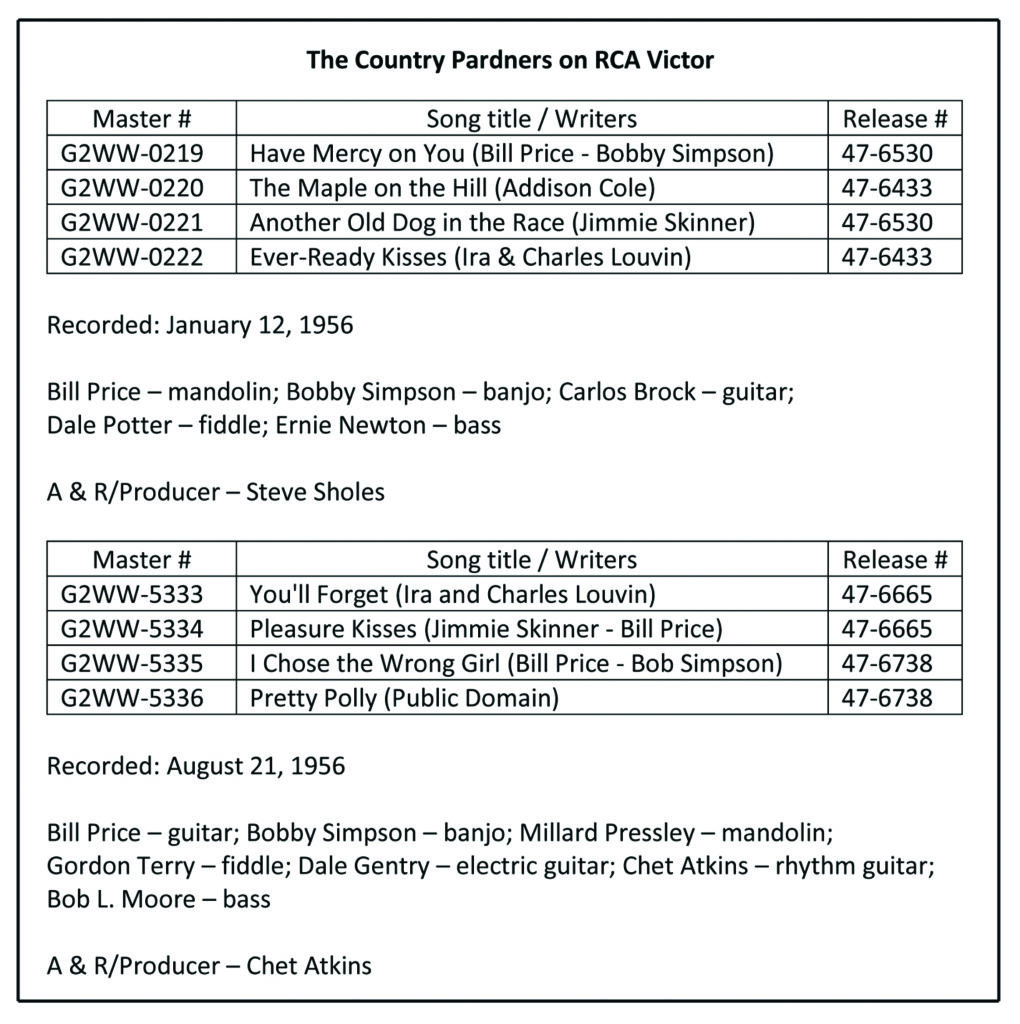
The following month, January 1956, the Country Pardners met in Nashville to record four songs. They were joined by two of Nashville’s best studio sidemen, fiddler Dale Potter and bass player Ernie Newton. The session was supervised by veteran RCA producer Steve Sholes. Of the four songs, one was a collaboration between Bill Price and Bobby Simpson, “Have Mercy on You.” Steve Sholes suggested that the group record “Maple on the Hill,” a song that was first published in 1880 by African-American wordsmith Gussie L. Davis. Curiously, the Country Pardners release gave composer credits to Addison Cole, which may have been a pseudonym used by Steve Sholes. “Another Old Dog in the Race” was written by Jimmie Skinner and may have been recorded as a thank-you for his help in promoting the group. The last song recorded was a previously unpublished Louvin Brothers song called “Ever-Ready Kisses.”
The songs appeared on two 45-rpm discs: 47-6433 contained “The Maple on the Hill” and “Ever-Ready Kisses.” Both Billboard and Cash Box magazines gave favorable reviews and praised the group for its “bright, wholehearted warbling” and their “terrific first showing, vocally and instrumentally.” 47-6530 included “Have Mercy on You” and “Another Old Dog in the Race.” Billboard liked the disc’s “real back country sound and excellent pickin’ and fiddlin’.”
In an April 2000 article in Bluegrass Unlimited, Carlos Brock noted that “R.C.A. really promoted us. We were sent to Indianapolis for a TV show then to Chicago to play on Pee Wee King’s huge Saturday night show to promote the numbers we had just recorded.” Further exposure for the group came in July 1956 when they were part of an eight-day tour through North Carolina and Virginia with a package that included WCKY radio personality Marty Roberts and Betty Foley (daughter of Red Foley).
By the time of the Country Pardner’s second, and final, session for RCA, on August 21, 1956, Carlos Brock had been drafted. In May 2008, mandolin player Millard Pressley told “Notes & Queries” author Walt Saunders that “I recorded with the Country Pardners on the RCA Victor label. Bobby Simpson and Bill Price were friends of mine. They needed a mandolin player and asked me if I could play on the session. It was in Nashville, with Simpson on banjo, Price on guitar, Gordon Terry playing fiddle, me on mandolin, and there was a boy playing electric guitar named Dale Gentry. He played like Chet Atkins. In fact, Chet Atkins ran the session.” Also on the session was Nashville A-Team member Bob Moore on bass.
As before, their session netted four songs, the first of which, “You’ll Forget,” was another unpublished Louvin Brothers composition. Bill Price shared credits with Jimmie Skinner on “Pleasure Kisses” and with Bob Simpson on “I Chose the Wrong Girl.” Closing out the session was the traditional “Pretty Polly.” When released, the label copy on all four songs indicated that Bill Price was the vocalist; the harmony singers were not indicated.
With Chet Atkins in charge of this session, the decision was made to bring in an electric guitar. This was inspired by the electric guitar work of Paul Yandell with the Louvin Brothers. Interesting enough, Yandell’s playing mimicked Atkins own work on earlier MGM and Capitol sessions by the Louvin Brothers. Dale Gentry’s electric lead guitar work was used sparingly on this session.
Again, Billboard and Cash Box had plenty of good things to say about the Country Pardners’ new releases. “Tremendous instrumental work on a real exciting platter. Could stir up a heap of noise,” “the Country Pardners dish up a first quality, ‘back-country’ quick beat,” and “‘pure country’ vocal and instrumental flavoring that the trio, spotlighting Price, once again, waxes in convincing fashion.”
The year’s worth of releases worked to the group’s advantage with their inclusion in a Cash Box poll that placed them as contenders for the Most Promising Vocal Combination. Sadly, the honor failed to generate enough momentum to keep the group going. The March 2, 1957, of Billboard reported that the “Country Pardners, Bill Price and Bobby Simpson, are label hunting, having recently been dropped from the RCA Victor fold.”
After the initial 45 rpm releases in 1956, the tracks languished in the vaults at RCA. In the 1970s RCA in Japan issued a lovely compilation that featured an A side with all six songs recorded by Jimmy Martin and the Osborne Brothers for RCA; the B side of the album featured six of the eight songs recorded by the Country Pardners. Here in the States, the only thing that remains commercially available is one track, “Another Old Dog in the Race,” which appears on Rounder’s Early Days of Bluegrass series.
Over Jordan
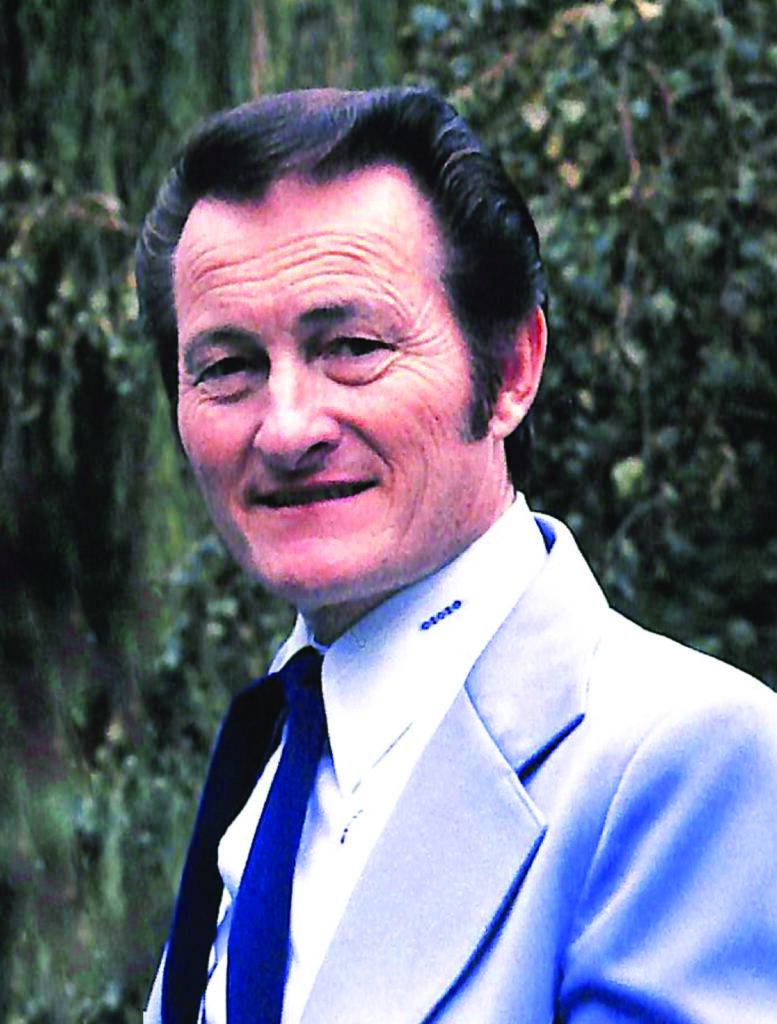
Jesse Lester McReynolds (July 9, 1929 – June 23, 2023) was among the last of the first generation of bluegrass music performers. He was an instantly recognizable vocalist, a creative and innovative instrumentalist, and a composer. With his late brother James Monroe “Jim” McReynolds (1927-2002) he logged fifty-five years as part of the longest running commercial brother duet team, Jim & Jesse and the Virginia Boys. At the time of his passing, Jesse was the oldest living member of the cast of the Grand Ole Opry.
A life with music seemed all but inevitable for Jesse. The McReynolds side of Jesse’s family had been in the musically-rich portions of southwestern Virginia since the early 1800s. His grandfather, Charlie, and an uncle, William, recorded two selections at the now-legendary 1927 Bristol sessions that launched the careers of the Carter Family and Jimmie Rodgers. Both of Jesse’s parents were musical as well. His coal-mining father played banjo while his mother played guitar, banjo, and harmonica and had a good grasp on singing harmony. As youths, Jesse played guitar while older brother Jim played mandolin.
Jesse’s career got under way in 1946, performing occasionally over radio station WNVA in Norton, Virginia. He was offered, but declined, a spot with the Stanley Brothers as their first fiddle player. Instead, he signed on with Roy Sykes and the Blue Ridge Mountain Boys – he was seventeen years old!
Upon Jim’s return from post-World War II military service, the two began appearing as the McReynolds Brothers. They experienced many ups and downs in the process of trying to establish themselves as popular entertainers. At times, they fronted their own group and at others they worked in the employ of other bandleaders. Over a five-year period they hopscotched around to a dozen different radio stations including WNVA in Norton, Virginia; WCHS in Charleston, West Virginia; WFHG in Bristol, Tennessee; WBBO (with Wade Mainer) in Forest City, North Carolina; WGAC (with banjoist Hoke Jenkins and developing legend Curly Seckler) in Augusta, Georgia; KXEL in Waterloo, Iowa; WMT in Cedar Rapids, Iowa; KFBI in Cedar Rapids, Iowa; WPFB in Middletown, Ohio; WWNC in Asheville, North Carolina; and WVLK in Versailles, Kentucky.
It was while working with Hoke Jenkins, ostensibly Jesse’s first in-person exposure to three-finger style banjo picking, that he began developing his unique cross-picking style of mandolin playing. It first appeared on a series of regionally distributed gospel recordings that they made in 1951 as the Virginia Trio, which also included banjoist Larry Roll. The style was shown to better advantage a year later when the group was signed to Capitol Records. Producer Ken Nelson suggested billing the group as Jim & Jesse and the Virginia Boys, a name that stuck for the balance of their career. The Capitol recordings showcased the band in a full bluegrass format for the first time, complete with 5-string banjo, mandolin, fiddle, guitar, and bass. Among the songs from the sessions was a definitive rendering of a new Louvin Brothers song, “Are You Missing Me.”
Jim & Jesse landed at one of the most popular radio stations in the area, WCYB in Bristol, Virginia. They were just getting established when Jesse was drafted and sent to Korea. Upon his discharge, he and Jim reunited and did another string of station hops that included WDVA in Danville, Virginia; WBBB in Burlington, North Carolina; WNOX in Knoxville, Tennessee; and WWVA in Wheeling, West Virginia. It was after this last stop that the group headed south to Live Oak, Florida, to be headliners on the popular Suwannee River Jamboree; their stay lasted for three years, from 1955 to 1957. During this time, Jesse picked up extra work as a disc jockey at radio WNER.
In 1958, two sessions that Jim & Jesse recorded for Starday Records yielded fourteen tracks. In addition to highlighting a crack band that included fiddler Vassar Clements and banjoist Bobby Thompson, the sessions introduced two of Jesse’s first instrumental compositions: “Dixie Hoedown” and “Border Ride.” The same period also saw the group expanding their exposure on television. With sponsorship by Ford, and later by Martha White, the group appeared on a number of stations including WCTV in Tallahassee, WSAV in Savannah, WTVY in Dothan, and WEAR in Pensacola.
In 1960, Jim & Jesse signed with Columbia/Epic Records. They remained with the label for nearly a decade. Early releases, that featured the stellar banjo work of Allen Shelton deft fiddling by Jim Buchanan and Jim Brock, included classic LPs such as Bluegrass Special, Bluegrass Classics, and a gospel outing called The Old Country Church.
Jim & Jesse made guest appearances on the Grand Ole Opry as early as 1961 but it wasn’t until 1964 that they – along with the Osborne Brothers – became full-time cast members. The middle and late 1960s were heady years for the McReynolds boys. In 1965, they broke new ground by recording a tribute album to rhythm and blues/rock ‘n’ roll icon Chuck Berry called Berry Pickin’ in the Country. They also released a light-hearted collection called Y’all Come – Bluegrass Humor with Jim & Jesse. And, in a departure from their bluegrass sound, the duo launched a syndicated television program that placed the group in a modern country setting, complete with electric and steel guitar.
With the explosion of bluegrass festivals in the 1970s, Jim & Jesse returned to the bluegrass format that defined the balance of their career. They were headliners at such events and even sponsored their own festival for several years.
Desiring to have greater autonomy in charting their own career path, the duo formed the Double J and Old Dominion imprints for the release of their recordings. One of the highlights from this era was the duo’s cover of John Prine’s “Paradise.” Eventually, they signed with several bluegrass-friendly labels including CMH, Rounder, and Pinecastle. The CMH years were witness to the release of The Jim & Jesse Story, a deluxe two-album set that featured excellent remakes of past career highlights, and the creation of a super group called The Masters. Its members included Jesse McReynolds, Eddie Adcock, Josh Graves, and Kenny Baker.
The Jim & Jesse duo came to an end on New Year’s Eve in 2002 with the passing of Jim McReynolds. Jesse continued on for another twenty years, leading the Virginia Boys, making new recordings, and eventually gaining status as the Opry’s oldest living member. A career highlight came in 2010 with the release of Jesse McReynolds & Friends: Songs of the Grateful Dead. Among his last recorded work was a guest appearance on the High Fidelity album Banjo Player’s Blues. For the occasion, the group resurrected a Jim & Jesse classic that was originally recorded for Capitol Records in the early 1950s, “Tears of Regret.” (Note: A more comprehensive appreciation of the life of Jesse McReynolds will appear in the December issue of Bluegrass Unlimited.)
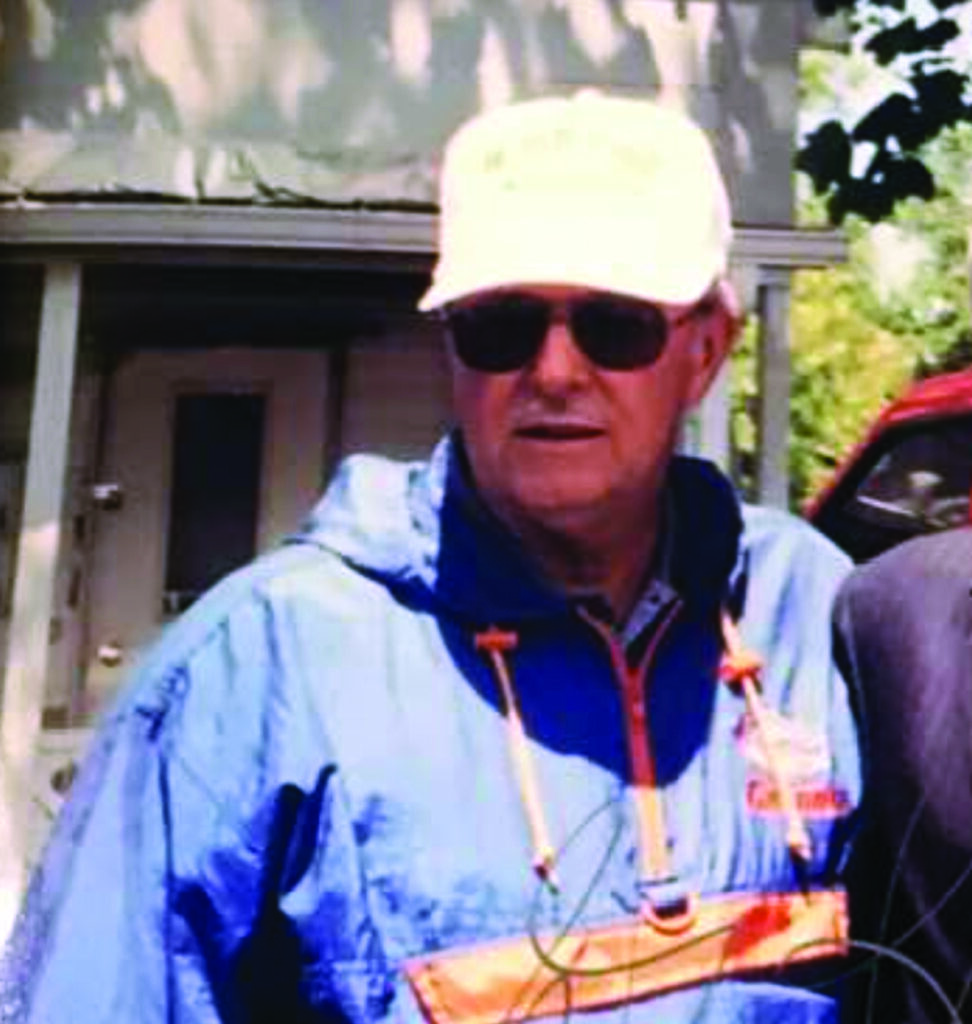
Carter Lee Stanley (September 29, 1947 – June 23, 2023) Aside from being the oldest son of bluegrass legend Carter Stanley, Carter Lee Stanley had no real musical claim to fame. He was not a performer, although he did play a few tunes on a guitar around the house. Out of high school, he served a stretch in the Air Force and then logged over thirty years at a Proctor and Gamble papermill. In his off time, he enjoyed golf and attending bluegrass festivals. He was an avid supporter of Ralph Stanley’s Hills of Home festival and could usually be found there under the shade of a tree, conversing with a series of well-wishes who shared his love for the music.
Perhaps more than anything, he was a conduit to the past. He lived the days that were the dawn of bluegrass music, and he was witness to the sacrifices that families make in the process of earning a living in the arts.
Much of Carter Lee’s early life was spent on Smith Ridge in southwestern Virginia, the same section of land where his father grew to adulthood. Around 1950, the elder Carter Stanley, with the help of friends, built a home for his growing family. It was situated across the road from his childhood home where his mother, Lucy Stanley, still lived. Carter Stanley’s new home contained no plumbing and water for cooking or bathing needed to be fetched from a well behind Lucy’s house.
For Carter Lee, it was a very isolated environment. His father was often gone, being one of the Stanley Brothers. At times, Carter Lee might only see his father once or twice a month. The task of childrearing fell to his mother, Mary, who, to her credit, raised five children to adulthood.
Carter Lee, and his younger brother Bill, attended the same one room school house – Big Oak School – that Carter and Ralph Stanley attended. It was a two-mile walk to school each day. It had an outdoor toilet and was heated in the wintertime with a potbellied stove. Classes were divided into groups by grade, one through six. The school’s lone teacher gave one hour of attention to each group each day.
Back at home, mid-day meals were prepared by Mary Stanley and evening meals were put together by grandmother Lucy. Just about everything food-wise came from Lucy’s garden. If she didn’t grow it, you didn’t eat it.
In 1957, Carter Stanley moved his family to Bristol, Virginia. It was here the Stanley Brothers appeared daily on radio station WCYB. For Carter Lee, living in Bristol and attending the Robert E. Lee school opened up a whole new world. There were new playmates, games, Nehi grape sodas, and oatmeal cakes. Sometimes he would get to visit the noontime WCYB programs, where his father would set up a chair for him to watch the proceedings.
The stay in Bristol was short-lived. In February 1959, Carter Stanley again moved his family, this time to Live Oak, Florida. In addition to headlining the Suwannee River Jamboree, the Stanley Brothers were sponsored on television by the Jim Walter Corporation, makers of shell homes. The sponsorship afforded the family a sense of financial security, and somewhat of a homelife. Carter Lee felt that these were the happiest years of his father’s career.
Eventually, the sponsorship ended and it put the Stanley Brothers back on the road, performing endless strings of one-night stands. Carter Lee made frequent trips on his bike to the Western Union facility in downtown Live Oak. It was to there that Carter Stanley wired money back home to keep his family solvent while he was on the road.
Carter Lee graduated from high school in Live Oak in June of 1966. A short time later, his father went with him to a recruitment center in Valdosta, Georgia. From there, it was off to basic training in San Antonio, Texas. On the evening of Carter Stanley’s last time to ever perform on stage – October 21, 1966, at the Red River Valley School in Hazel Green, Kentucky – he took out a picture of Carter Lee and showed it to other band members who were gathered backstage. Noting the youngster’s recent enlistment, Carter quipped, “Well I hope he does good. I pulled my hitch. I hope he does as good as I did.”
Passing away a scant six weeks later, Carter Stanley never had the opportunity to witness his son’s successes, in the military and in the private sector. He would have been proud that Carter Lee was a devoted family and that he served his community well. As a part of a family with a rich musical and public heritage, Carter Lee was a dedicated keeper of the flame.