
Notes & Queries – September 2022
Queries
Q: We’re having a little controversy in our bluegrass community regarding the definition of the title of the fiddle tune “June Appal.” Is it simply a misspelled reference to certain apples that will bloom early or is it a reference, somewhat in abbreviation, to the word Appalachia? Or is it something else? Hope you can help! Joe Fili, via email
A: The overwhelming number of recordings of this tune list it as “June Apple,” as opposed to “June Appal.”
A visit to the Bluegrass Discography website shows 58 entries for “June Apple” and only 1 for “June Appal.” And, a scan of the first 15 years of Bluegrass Unlimited shows zero references to the fiddle tune “June Appal,” but does have numerous references to “June Apple.”
While the tune has a relatively long history in the Mt Airy, North Carolina / Galax, Virginia region, it didn’t make its debut on record until 1967 (unlike tunes like “Fire on the Mountain” and “Blackberry Blossom” that were recorded in the 1920s and ‘30s), when it appeared on an album by the Camp Creek Boys. That, and other early recordings by Doc Watson and the trio of Fred Cockerham, Tommy Jarrell, and Oscar Jenkins, all spelled it as “June Apple.” When old-time banjoist Wade Ward made a field recording of the tune for Alan Lomax in 1959, he called it “just an old hillbilly tune” that somebody named “June Apple.”
I suspect that the alternate spelling (“June Appal”) resulted from the record label that was founded in the early 1970s, June Appal Records (an offshoot of Appalshop in Whitesburg, Kentucky); both names that reflect their Appalachian roots.
Outdoor Plumbing Company Remembered
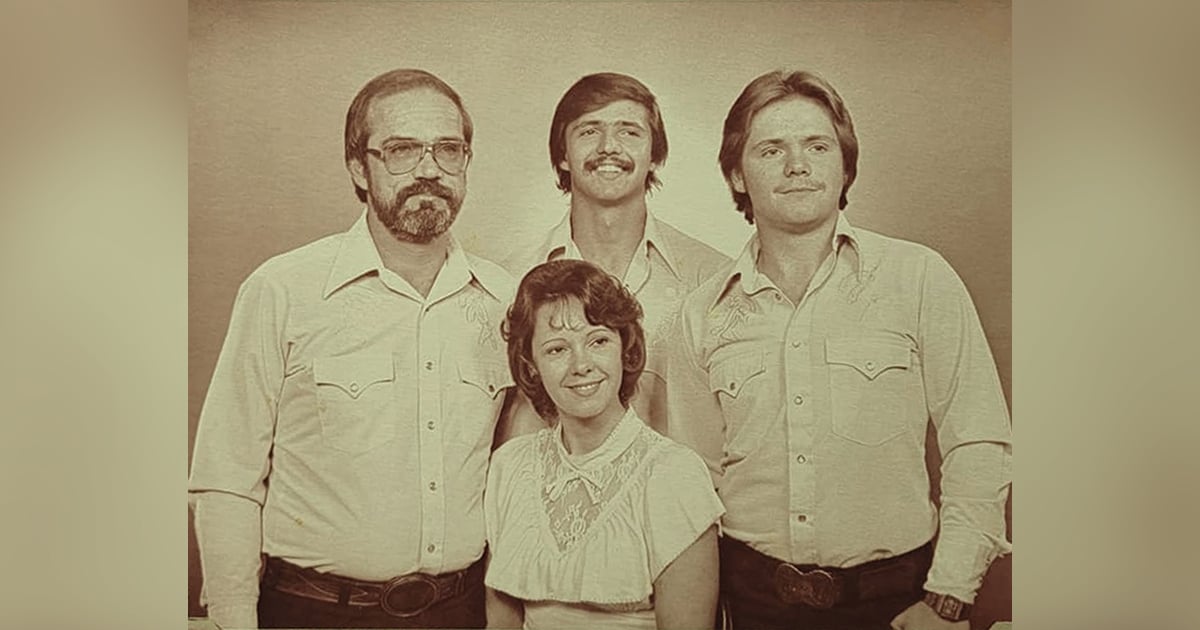
We heard recently from J. K. Spence of Huntington, West Virginia. He was a member of the Outdoor Plumbing Company, a Kentucky/West Virginia bluegrass band that was most active during the 1970s and ‘80s. Mr. Spence informed us that the two principles of the group, Jim and Ada McCown, had both passed away within the last two years and asked that Bluegrass Unlimited readers be made aware of this.
The driving force behind the Outdoor Plumbing Company was Jimmy Ray McCown (October 18, 1941 – October 7, 2020), a native of Pike County, Kentucky. He learned old-time banjo playing and fiddling from his grandfather, Boyd Smith. When Jimmy married Ada Jean Scott (October 8, 1945 – September 18, 2021) in May 1961, he counted his occupation as “musician.” A three or four year stretch in the Air Force in the middle 1960s added pilot and airplane mechanic to his resume.
Somewhere along the line, Jimmy taught Ada to play guitar and in 1967, shortly after his discharge from the military, the couple began making music together. It was during this same period that Jimmy began refining his approach to playing three-finger style banjo.
The earliest incarnations of the Outdoor Plumbing Company came together in the early 1970s when the band included Jim on banjo, Ada on guitar, Jerry Williamson on dobro and vocals, Marshall Scott on lead guitar, George Williamson on mandolin, and Jim May on bass. They were described as being one of the “younger bands playing more traditional tunes in a style that borders between folksy and bluegrass.”
Starting in the middle 1970s and continuing until the end of the 1980s, the Outdoor Plumbing Company maintained a busy schedule working summer bluegrass festivals. In addition to events in their native Kentucky, the group also ventured to Oklahoma, Florida, Virginia, Maryland, Ohio, and elsewhere. Giving the group somewhat of a competitive edge, Jim was also an accomplished audio technician and frequently ran sound at various festivals.
In 1975, the group performed at Ralph Stanley’s festival. A double-disk live album of the festival was released soon afterwards and included one track by the Outdoor Plumbing Company: “John Dig a Hole.” Due to its inclusion in the Live! At McClure, Virginia album, it turned out to be the most widely-distributed song by the group and led to a two-album contract for the band with Rebel Records. Bluegrass Unlimited reviewer Jim Griffith called the group’s debut album “a solid, professional, well-thought out album of new and old bluegrass material” and noted that “Ada McCown’s singing is especially nice on ‘This World’s No Place To Live’.”
Following the departure of Jerry Williamson in early the 1980s, the Outdoor Plumbing Company morphed into a family band. Sons Danny and Anderson (“Andy”) were featured on mandolin and bass respectively. The foursome recorded two albums together: the gospel Mountain Preacher and Kentucky’s Mountain People Are Comin’ Home. An instrumental album, showcasing Jim’s six-string banjo work, was also intended as part of the mix.
By the time J. K. Spence joined in 1984, playing mandolin, the group had started to slow down and the focus shifted more to the old-time music of Jim McCown’s roots. Eventually, it got to the point where it was just Jim and Ada going out to make select concerts. Jim also used his spare time to hone his talents on both the fiddle and banjo, and to also explore creative innovations within old-time traditions. He developed a style of picking that allowed him to play fiddle tunes, note-for-note, in a clawhammer style on the banjo. Pickers such as Bobby Thompson, Bill Keith, and Carroll Best were some of the earliest people to do this on the banjo in a three-finger style, but Jim was among the first to do this in the clawhammer style.
Throughout the early 2000s, Jim and Ada appeared at workshops and teach-ins where they presented examples of old-time and traditional music. They often infused healthy doses of humor into the proceedings. One of the annual events that Jim played a part in helping to create was the Cowan Creek Mountain Music School (located in Letcher County, Kentucky), a week-long teach-in that has been instrumental in teaching students to play the old styles of music.
Jim passed away from a heart attack in 2020 while working on renovating an old cabin. Ada died in 2021 from complications of covid-19. Andy McCown passed away one day prior his mother’s death. Danny works as a CPA in Virginia.
Over Jordan
Dewey Lee Farmer (August 6, 1942 – July 12, 2022) was an impressive Monroe-style mandolin player who lent his talents to a number of bluegrass bands from his native North Carolina during a career that spanned over sixty years.
Born Dewey Lee Williams in Seneca, South Carolina, his father was killed during World War II. When his mother remarried in 1948, Dewey assumed his step-father’s name: Farmer.
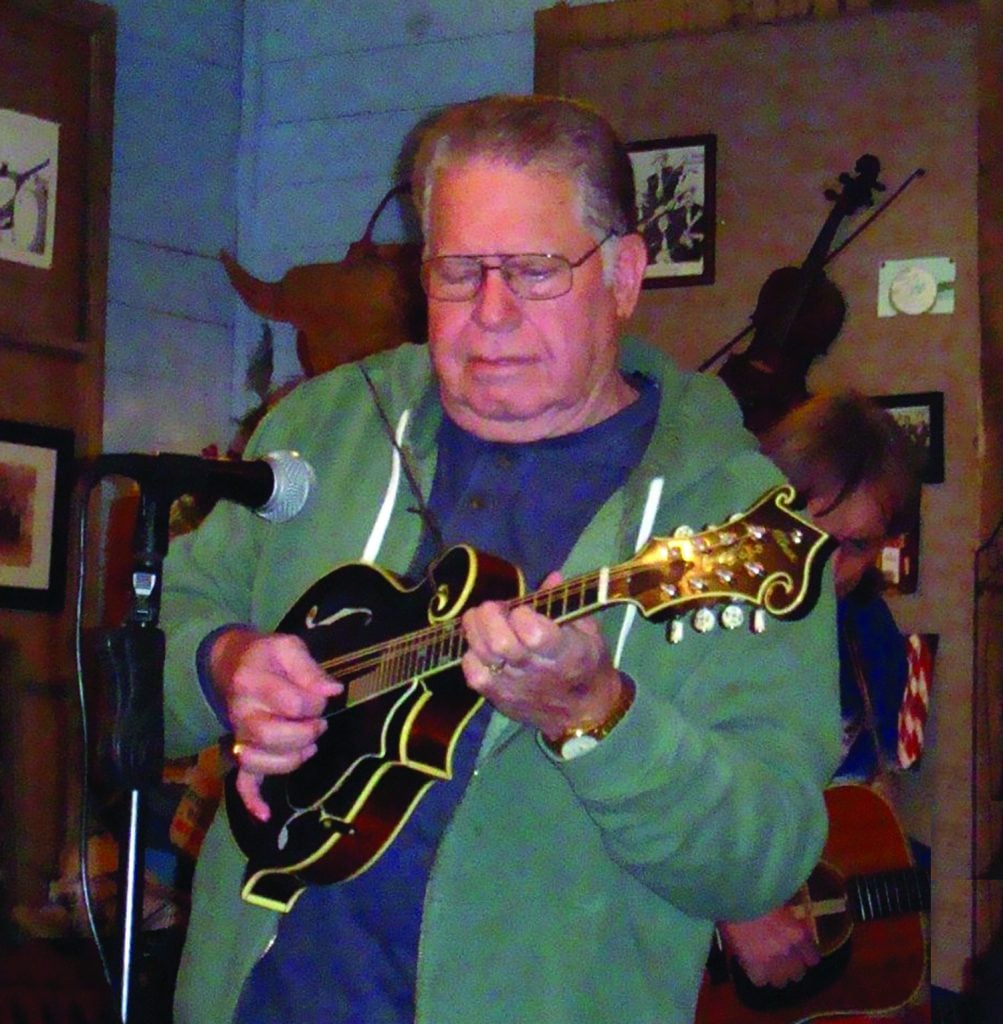
Surrounded by numerous uncles and neighbors who played music, Dewey was exposed to music at an early age. Live performances by groups such as Snuffy Jenkins and the Hired Hands helped to cement Dewey’s love for music.
Although known today mainly for his mandolin playing, Dewey started out on the guitar. Around age 14, his father purchased a new Gibson J-50 guitar. As he continued to improve on the instrument, he moved next to a Martin D-21 guitar.
In 1957, Dewey and a banjo-playing friend ventured to the Union Grove fiddlers’ convention. There they met other musicans and formed a band that competed at other conventions.
It was the following year that Dewey began to get serious with his mandolin playing. He went through several different instruments, including a Gibson A-50, an A-5, and an F-5. He was fortunate enough to receive a few pointers from Bill Monroe.
Dewey’s first work in a working band came in 1960 when signed on with L. W. Lambert and the Blue River Boys; he played mandolin with the group and sang lead and baritone. In 1962, the group placed second at the North Carolina championship competition.
By the middle 1960s, Dewey assembled his own group, the Bluegrass Pardners. At the 1964 North Carolina championship, the group won first place in the band competition as well as in the banjo and fiddle categories. The group took the top band prize again the following year.
The late 1960s found Dewey performing on an on-again, off-again basis with A. L. Wood’s Smokey Ridge Boys. He also played briefly with a group called the Dixie Mountain Boys, and also reconstituted his Bluegrass Pardners.
One of Dewey’s most high-profile positions came in 1968 when he joined Carl Story’s Rambling Mountaineers; Dewey assisted in the making of Carl’s album Daddy Sang Bass and also had the opportunity to perform on the Grand Ole Opry and at the legendary Ernest Tubb Record Shop.
After a year with Carl Story, Dewey began what is probably his most celebrated musical collaboration when he joined A. L. Wood’s Smokey Ridge Boys. After taking top honors at Carlton Haney’s String Music Championship that was held on Labor Day weekend at Camp Springs, the group came to the attention of Rebel Records owner Dick Freeland. Two well-received albums – Sing a Bluegrass Song and Bluegrass Today – were released over the next several years. A bonus to working with the Smokey Ridge Boys was the opportunity to back-up other musicians at festivals, such as Mac Wiseman, Clyde Moody, Howdy Forrester, Chubby Wise, Jim Eanes, and the duo of Snuffy Jenkins and Pappy Sherrill.
A. L. Wood’s group disbanded in 1974, following the passing of Odell Wood. Over the next quarter century, Dewey worked in several different groups: Blue Denim, the Legendaires (1976-1979), Hoyt Herbert and the Strings of Five (with which he recorded a solo project in 1982), Rosewood (which disbanded in 1986), the Foggy Mountain Grass, and Dewey Farmer & Powder Creek. In the 1990s, he appeared as a guest on two notable recordings: Butch Robins Grounded, Centered, Focused and Larry Perkins & Friends A Touch of the Past.
Throughout much of the early 2000s, Dewey worked in a group headed by Salem, Virginia, bass player Jerry Steinberg. The group, the Dixie Blue Grass Boys, made one recording in 2010. Dewey played mandolin and served as recording engineer. Jerry noted that Dewey was “very proud” of finished product.
A series of health issues, starting in 2013, impaired Dewey’s ability to pick and sing as he had previously. A bout with Bell’s Palsy left him unable to sing. In 2018, the ability to see well at night necessitated that he give up his position with the Dixie Blue Grass Boys. Lastly, a fall in November 2021 resulted in a broken wrist and shoulder.
Jerry Steinberg reported that he “knew Dewey from the late sixties and picked with him at fiddler’s conventions and maybe some blue grass festivals. Bill Monroe always called him up stage to do a mandolin tune and sometimes they twined. He leaves a legacy of being one of the top mandolin players.”
James Calvin Reams (January 10, 1956 – June 17, 2022) was a Kentucky-born picker and singer who led his own group, the Barnstormers, for close to thirty years. Along the way, he produced nearly a dozen compact disc and DVD projects, launched his own bluegrass and old-time music jamboree (smack in the middle of Brooklyn), oversaw the creation of two video documentaries, was a 2016 graduate of Leadership Bluegrass, and planted the seed for the launch of the recent Arnold Shultz Fund.
Born in the central Kentucky town of London, James was raised in a home that celebrated music. His father played guitar in a local band and jam sessions were a frequent occurrence at the Reams home. At some point, the family pulled up stakes and moved northward to Freedom, Wisconsin. It was a temporary stop along the way in James’ journey.

In 1982, at age twenty-six, James landed in New York City where his day job was as a special education teacher. It would be another decade before his bluegrass passion came to the forefront. In 1994, he formed the Barnstormers and released his first recording, Kentucky Songbird. The disc, a solo outing with guest artists, was a well-received calling card that introduced his pleasing baritone vocals and distinctive flat-picking guitar work. Four years later, he launched the Park Slope Bluegrass and Old-Time Jamboree, an annual event that featured workshops, jamming, and concerts that became the “focal point of bluegrass and old-time music” in Brooklyn. The one-day festival was nominated for the IBMA’s Event of the Year award in 2014.
James’ accomplice and soulmate in his bluegrass activities was Tina Aridas. She helped broker his affiliation with Copper Creek Records in 2000 and assisted in the post-studio production of his CD releases and subsequent promotion. James and Tina wrote songs together, a number of which appeared on James’ CDs. She also served as tour manager on road trips. The duo put their travels to good use by conducting a series of video interviews that were eventually edited and released as Making History With Pioneers of Bluegrass: Tales of the Early Days in Their Own Words. Other recorded highlights include two CDs that paired James with banjo legend Walter Hensley: Barons of Bluegrass and Wild Card.
The Barnstormers enjoyed a vibrant following in the northeast and worked a number of festivals and venues there, including the trendy Greenwich Village night spot The Bottom Line and the Lincoln Center Roots of American Music Festival.
Following the untimely passing of Tina in 2011, James moved to Phoenix to help care for his elderly mother. He became a driving force in helping to sprout bluegrass in the desert southwest. He served a three-year term as president of the Arizona Bluegrass Association and also formed a partnership called R & R Productions to bring touring bluegrass bands to the area.
Two of James’ most recent projects were Like a Flowing River: A Bluegrass Passage, a 72-minute documentary about his life in music, and Like a Flowing River & Soundtrack Album, a two-disc set that sampled music from his lengthy career and also highlighted music found in the documentary.
William Thomas “Bil” VornDick (March 9, 1950 – July 5, 2022) was an award-winning Nashville-based recording engineer and producer who had a special ear and love for bluegrass music. His list of over six hundred engineering and producing projects featured a diverse list of bluegrass, folk, and country legends that garnered at least forty-six Grammy nominations and nine wins.

A native of Northern Virginia, he relocated to Nashville in the late 1970s. Throughout the middle and late 1980s, albums recorded by Bil started coming to the attention of voters for the Grammy awards. Releases by Jerry Douglas (Under the Wire, Changing Channels, and Plant Early), Bela Fleck (Drive), Peter Rowan and the Nashville Bluegrass Band (New Moon Rising), and Alison Krauss (Two Highways) all placed as Grammy finalists. It was in 1990 that Bil’s projects began to take top honors, starting with Alison Krauss’ I’ve Got That Old Feeling (which he produced and recorded) and Doc Watson’s On Praying Ground.
For the next thirty-plus years, Bil remained one of the most sought-after “go to” engineer/producers in Nashville. In addition to a plethora of solo and band projects, Bil also worked on a number of multi-artists, multi-disc projects. Ralph Stanley alone accounted for three such projects: Saturday Night/Sunday Morning, Clinch Mountain Country, and Clinch Mountain Sweethearts.
Bil gave more to the music community than just his expertise in a control room. He was a founding member of the International Bluegrass Music Association. At World of Bluegrass and Leadership Bluegrass events, Bil lent his expertise to seminars and workshops. At Belmont Collete, he designed and taught advanced recording classes and served on the institution’s advisory board. He also spearheaded the development of the Sound Health Insurance cooperative to make health insurance available to IBMA (and similar organizations) members.
Perhaps more than anything, Bil was about relationships with those whose music he valued the most. Those relationships were a two-way street. Below, resonator guitar master Jerry Douglas shares some of his feelings about his forty-eight-year friendship with Bil VornDick.