

Notes & Queries – October 2022
Queries
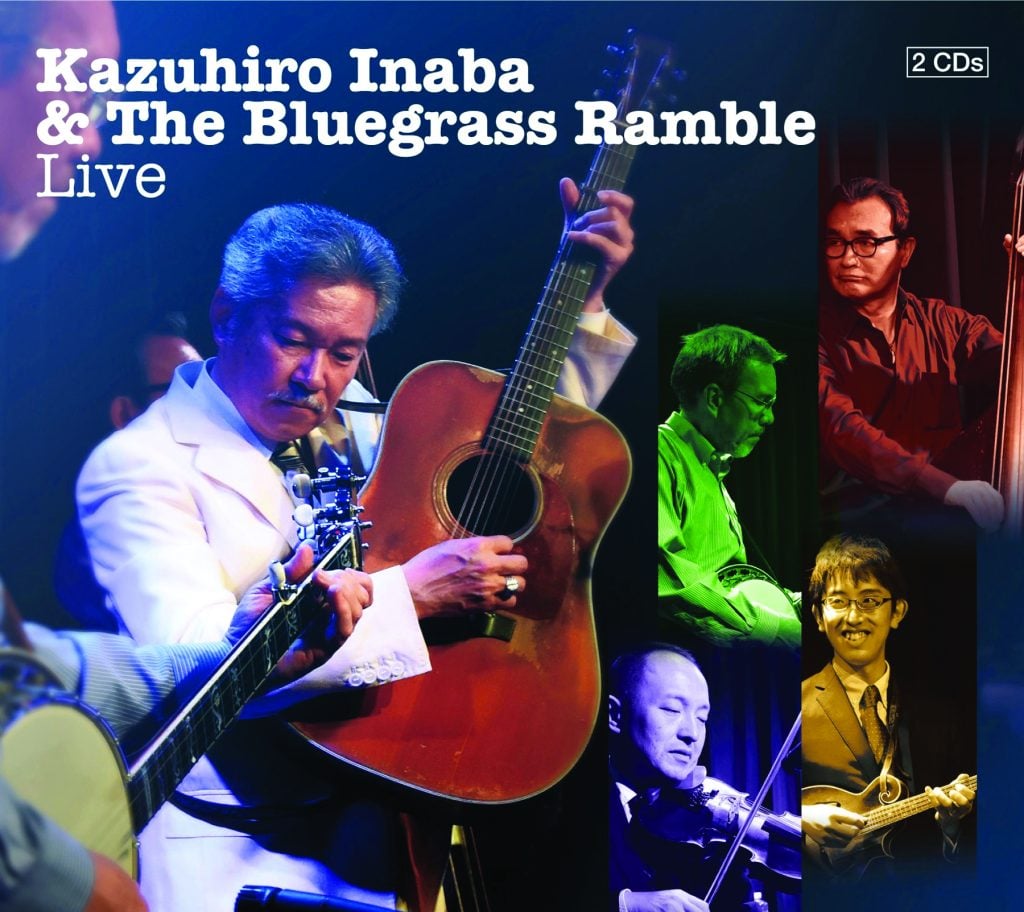
Q: I’m producing a new CD album of my band, The Bluegrass Ramble, here in Japan. The new album will be a live 2-CD set with 36 songs and will celebrate the Bluegrass Ramble’s 200th show in October 2022. We are now in the process of designing the package. I am having trouble finding the songwriter’s names for the following song and tune: “When My Time Comes To Go” and “Listen To The Mocking Bird.” I appreciate your help! Cheers. Kazuhiro Inaba, via email.
A: “When My Time Comes to Go” is credited to Molly O’Day, who recorded it for Columbia Records on June 20, 1950. It was released the following November as one side of the 78-rpm disc Co 20745. Molly passed away in 1987. In 1992, Bear Family Records issued a 2-CD set of Molly’s complete recordings for Columbia. In the accompanying booklet, Molly’s husband and musical partner, Lynn Davis, recalled simply that “That was one of Molly’s songs . . . one she played banjo on, too.” Over the years, it has been recorded by a number groups including both Danny and Bob Paisley, IIIrd Tyme Out, Wilma Lee and Stoney Cooper, Larry Sparks, Alex Campbell and Ola Belle Reed, and the Lost & Found, to name few.
“Listen to The Mocking Bird” was copyrighted and first published in 1855. The cover to the sheet music told that the melody was by Richard Milburn and that the piece was “Written and arranged by Alice Hawthorne.” Here, “written” refers to the words of the song only, and not the tune. The song was jointly published by the duo of “Messrs. Winner & Shuster.” A newspaper brief from 1856 for “New Music” told that:
We are indebted to the Publishers, Messrs. Winner & Shuster, 110 North Eighth street, Philadelphia, for the following elegant pieces of new Music, all composed by the accomplished “Alice Hawthorne,” who is the authoress of some of the sweetest songs and ditties of the day . . . “Listen to the Mocking Bird”—a sentimental Ethiopan [sic] Ballad that will be a great favorite . . .
In truth, Alice Hawthorne was a pseudonym for co-publisher Septimus “Sep” Winner (1827 – 1902); “Hawthorne” was his mother’s maiden name. The designation of “Mocking Bird” as an Ethiopian ballad likely stemmed from the fact that Richard Milburn was an African-American “street whistler-guitarist”; his “payment” for the tune was twenty copies of the sheet music. When Winner later sold the song to another publisher for the whopping sum of five dollars (roughly $175 in today’s currency), Milburn’s contribution to the piece was subsequently dropped. Both Milburn and Winner profited rather poorly from their labors as the sheet music was reported to have eventually sold approximately twenty million copies. Winner’s most popular song (published under his pseudonym) continues to be the hymn “Whispering Hope.”
Although written as a song that bemoaned the loss of the singer’s beloved, the jaunty melody of “Mocking Bird” endeared it to several generations of southern fiddlers. As a show piece, many fiddlers use their instruments to replicate various bird songs throughout the tune.
Over Jordan
Eberhard Finke The European Bluegrass Scene is mourning the death of Eberhard Finke, revered publisher of the German Magazine Bluegrass Bühne.

Eberhard was born in Strasbourg, France, in 1943. Soon after the war his family moved to Konstanz, Southwest Germany, where Eberhard spent his formative years. He studied Latin and Greek at the Universities of Heidelberg and Tübingen, where he also met the love of his life, Monika. The two married in 1970, started a family and worked as school teachers in Ulm, Germany, until their retirement in 2008.
Eberhard had many passions, but undoubtedly the biggest one was his love for bluegrass music. In 1981 he launched the magazine Bluegrass Bühne (Bluegrass Stage). It featured news, album reviews and touring dates of European Bluegrass artists, but also informed readers about the latest and greatest in the American Bluegrass scene. At that time, Bluegrass Music was a rare find in Europe. However, small cells of Bluegrass startups did exist, such as in Munich, Stuttgart, Vienna, and Lehr. Eberhard’s magazine provided that crucial communication platform and the connecting tissue for these Bluegrass enthusiasts. Arguably, there would have not been a thriving Bluegrass community throughout Europe for the remainder of the millennium without the Bluegrass Bühne.
In addition, Eberhard and his wife Monika graciously opened their home to touring bands from the United States throughout the last four decades, greatly reducing the musician’s lodging expenses. Their guest book reads like the who’s who in bluegrass music and they forged deep relationships with countless Bluegrass Musicians around the world.
Eberhard hardly ever missed a Bluegrass concert near his home in Southern Germany. He traveled all over Europe and the United States to be right there, where he loved to be – in the audience with a note pad in hand – for another story in the next edition of the Bluegrass Bühne.
Anyone who had the honor to meet Eberhard Finke will remember him as a kind, loving, soft-spoken, curious, and humble human being with a treasure trove of knowledge.
He passed away on the morning of July 28th, after a long struggle with Parkinson’s disease. His is survived by his wife Monika and his children Daniel and Annette, his grandchildren Heiko, Hannah, and Karl.
Rest In Peace, dear Eberhard!
(Contributed by Mark Stoffel. Written in Asheville, North Carolina, July 31st, 2022, with the help of Peter Wroblewski and Monika Finke.)
Clyde Maness, 80, bassist and proprietor of Maness Pottery & Music Barn in Carthage, North Carolina, passed away on July 31. The most recent recipient of the Alan Perdue Memorial Bluegrass Music Award opened his home, and later his pottery shop, on Tuesday nights starting in 1974 for a covered dish meal and jamming. The midweek music continued for the next 48 years. Maness orchestrated several expansions to his building to afford more room for pickers, including a music hall in the backroom.
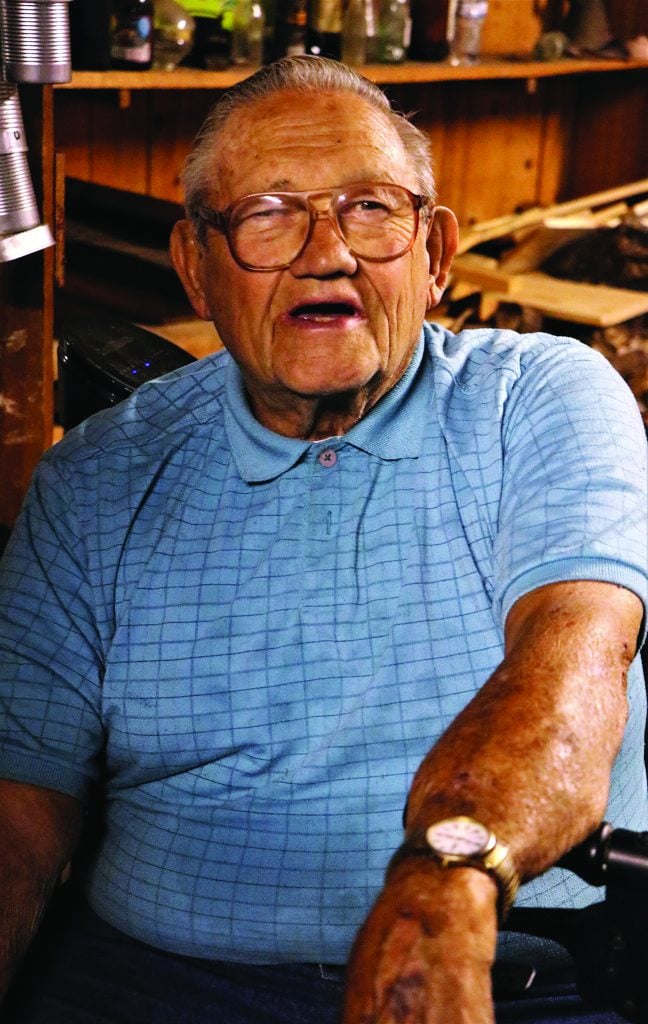
“Another legend is gone,” shared Janice Perdue, Alan’s mother, who presented Maness with the award on March 8 for his contribution to bluegrass music.
A storyteller, Maness would drop names, relay events, and share photos from his musical escapades.
Nathan Aldridge, fiddler with Russell Moore & IIIrd Tyme Out, declared, “Clyde embellished things. I liked listening to his Grand Ole Opry stories that he would tell.”
Maness often told newcomers about his inspiration for starting his weekly jam. “I was at the Grand Ole Opry and I told Roy Acuff that I was going to build a music barn. He said, ‘if you build it, they will come’ and he was right. There wasn’t church on Tuesday night so it seemed like a good time.”
He not only opened his pottery shop for music, Maness fed the masses, cooking 12-14 pounds of pintos and 20 pounds of potato salad each week. There was never an admission fee, just a donation basket by the door.
Many professional musicians got their start at Clyde’s midweek jams.
Kevin Richardson, former guitarist with Merle Monroe and Larry Stephenson Band, shared, “I have known Clyde all my life. He has always been a friend and a supporter of bluegrass and music in general. He would do anything to help you and I loved his support to the younger musicians. He will be missed by all of us.”
Sixteen-year-old powerhouse picker, Jake Goforth, stated, “I always enjoyed going to Clyde’s. We’d stay and pick for hours and he’d be there until the last person would leave. Gonna miss him and his great soul.”
“I am especially grateful to him for allowing myself, along with my friends to get on stage at a very young age when we really weren’t good enough to be there! That’s something I will always remember. Tuesday nights just won’t be the same,” stressed banjoist Trent Callicutt who recently made several appearances on the Grand Ole Opry.
Rising songstress, Caroline Owens of Denton, agreed. “I’ve had a very heavy heart since hearing of his passing. He was a local legend to many, but a friend to all. I can’t recall a single time that I walked through the doors of his pottery barn that I didn’t feel welcomed. He had a heart of gold and a passion for bluegrass. I am certainly going to miss him. His absence leaves a void that none could ever fill.”
Memorials may be made to Maness Music Barn, ℅ Edna Maness, 10995 NC Hwy 24/27, Carthage, North Carolina 28327. RIP, Clyde Maness. (Contributed by Sandy Hatley)
Leslie Matheson Sandy (August 8, 1928 – July 28, 2022) was a fixture of several top-name bluegrass bands during the 1950s, namely Bill Monroe and His Blue Grass Boys and Jim & Jesse. He recorded with both groups and also logged time with several regional bands. He remained active musically until well into his eighties and practiced regularly.
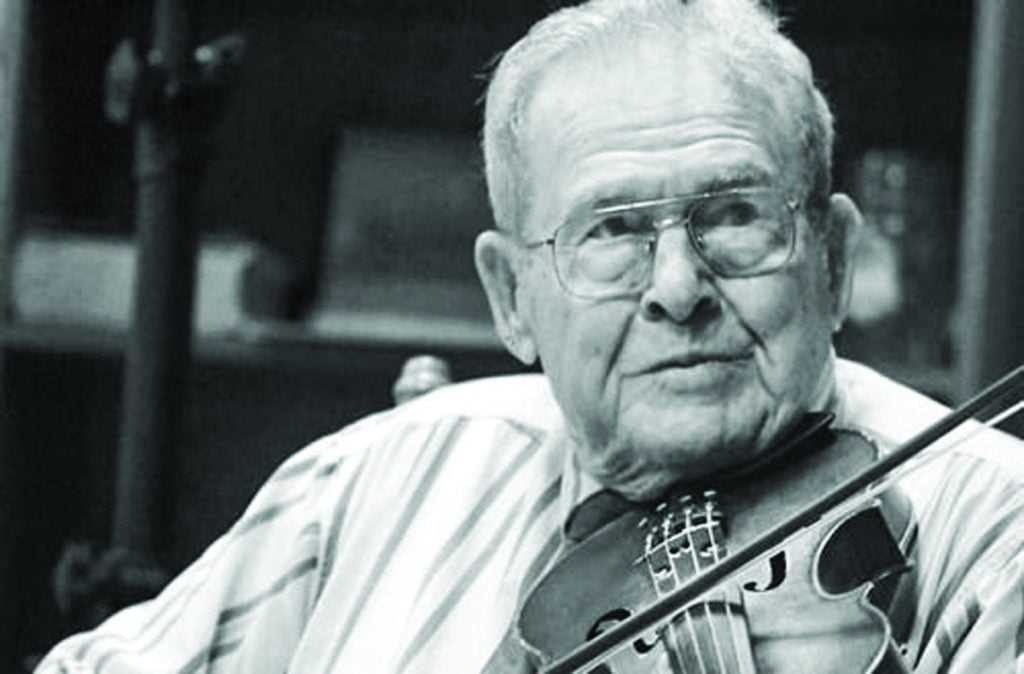
Born into a family of sharecroppers with a meager existence, among the Sandys’ few prize possessions were a harmonica and a radio. By age six, young Leslie was blowing out tunes on his father’s mouth harp. On the radio, he was able to hear such now-legendary entertainers as Snuffy Jenkins and Pappy Sherrill, J. E. and Wade Mainer, and the Monroe Brothers.
In 1948, Leslie rambled around, looking for musical opportunities. He wound up in Florida in a band that also included fiddler Vassar Clements. The two became friends and soon Clements began imparting his knowledge of the fiddle to Leslie. Upon learning of an opening in a venue in Key West, he contacted his older brother Coolidge and the two held forth at Sloppy Joe’s for slightly over a year. Key West local Ernest Hemmingway was a frequent addition to the duo’s audience.
Leslie’s first job in a bluegrass band came in the fall of 1949 when he went to work for Hoke Jenkins and the Smokey Mountaineers; the group was using Augusta, Georgia, as its headquarters. Working in the band were Jim and Jesse McReynolds.
Next, it was on to Raleigh, North Carolina, in 1950 to hook up with Homer Briarhopper. The following year, Leslie was offered a spot with a country band from Florence, South Carolina, that went by the name of Slim Mims and the Dream Ranch Boys. Leslie played guitar and fiddle and also sang lead. When the group opened for a Bill Monroe show near Florence, Leslie filled in for the evening as the Blue Grass Boys’ bass player. At evening’s end, Monroe offered him a job which he accepted on the spot. Leslie spent most of 1953 and 1954 with Monroe, playing bass and also taking on the comic persona of Uncle Puny.
By the end of 1954, Leslie found Jim & Jesse broadcasting over WDVA in Danville, Virginia. He joined the group in time to play bass on their last session for Capitol Records. The January 1955 session, on which Leslie played bass, yielded four songs: “I’ll Wear the Banner,” “My Garden of Love,” “I’ll See You Tonight in My Dreams,” and “Tears of Regret.”
Leslie never seemed to stay in one place very long. He left Jim & Jesse shortly after the session and organized the Carolina Jamboree television show in Wilmington, North Carolina. The program highlighted the talents of the Sandy Brothers, and others. After several years, the program was cancelled and Leslie found himself back with Bill Monroe, this time playing guitar and singing lead. He participated in two recording sessions, which added eight songs to Monroe’s first studio album, Knee Deep in Bluegrass. There was also a short stint with Jimmy Martin that included appearances on the Louisiana Hayride.
Throughout most of the 1960s, Leslie performed with his brothers (as the Sandy Brothers). When rock ‘n’ roll gave stiff competition to the group’s work, Leslie called it quits. He remained musically inactive for most of the next quarter century. It was only after a minor stroke in 1993, which necessitated retirement from full-time work, that he revisited the fiddle. He appeared with several regional bands and also took part in local productions of the play Smoke on the Mountain.
Richard “Dick” Smith (October 4, 1943 – July 28, 2022) was a multi-instrumentalist and vocalist who toured with some of the top names in bluegrass as part of a career that spanned over sixty-five years. Washington, DC, area musician and friend Ira Gitlin noted that Dick “exemplified ‘The three T’s’: timing, tone, and taste.” He also had an encyclopedic mind when it came to all-things-Gibson banjos and Martin guitars and more than knew his away around the delicate tasks of banjo set-up.
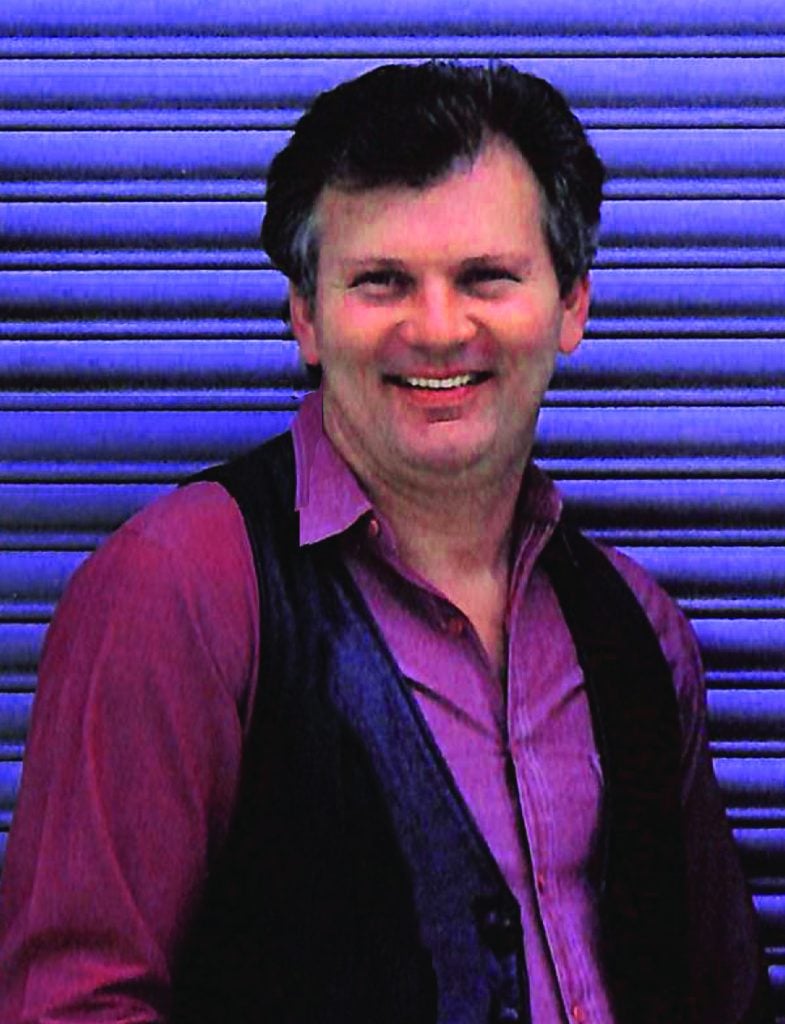
Life for Dick Smith began on October 4, 1943, in Syracuse, New York. At some point, he made his way to Chautauqua County, New York, and nearby Sugar Grove, Pennsylvania. Learning how to play music came early in his childhood. He started out on guitar at age eight, on mandolin at age twelve, and on banjo at age sixteen.
Dick embarked on a career as a professional musician at age twelve when he teamed up with his brother Bill to play mandolin at dances. Billed as the Smith Brothers, the group played together for almost seventeen years. They mainly worked in New York and Ohio. In 1962, with Jeff Wisor and Gene Johnson in the group, the band won several regional music competitions. As fulfilling as the music was, wage-paying day jobs were needed to help pay the bills and Dick worked as a machinist and also as a tire specialist.
When the Smith Brothers disbanded in the early 1970s, Dick relocated to the Northern Virginia suburbs of Washington, D. C. He found work with Jack Fincham and the Dixie Grass as well as with Country Store, an up-and-coming band in the D. C. area with Jimmy Gaudreau, Chris Stifel, and others. Dick appeared on the group’s 1974 Rebel album that was self-titled Country Store.
Country Store disbanded in 1975 and Dick soon teamed up Jeff Wisor and Gene Johnson to form a progressive bluegrass band called Night Sun. The group was managed by Bil VornDick, who recently passed away in July 2022 (see August 2022 Notes & Queries). Night Sun disbanded after a year and a half, leaving Dick available for freelance work. He subbed some with the Goins Brothers and also found time to appear on an album by New York-based Voices of Bluegrass.
In 1977, Dick received a call from Del McCoury to help out with a series of dates; he wound up staying with McCoury’s Dixie Pals for four years. He appeared on Del’s 1981 album Take Me to the Mountains and also participated in Del’s tour of Japan which resulted in a live album.
Dick’s most high-profile job came at the end of 1981 when he received a call to join the Country Gentlemen. He told Blueprint magazine in 1981 that by joining the Country Gentlemen, “I’ll probably make a better living, at it. Make more money per hour. It’ll be more financially rewarding than the last 10 years have been.” The band included founder Charlie Waller, mandolin player Jimmy Gaudreau, and bass player Bill Yates. During his five-year tenure, Dick recorded one album with the group: Good as Gold.
Throughout the 1990s, Dick logged time with Lynn Morris, playing mandolin; with a group headed by bass player Jerry McCoury; and was a partner with Canadian guitarist Mike O’Reilly. Dick’s stint with the latter, which lasted a decade or so, yielded four CDs and included several overseas tours. From 1998 to 2014, Dick performed on banjo and mandolin with Bob Perilla’s Big Hillbilly Bluegrass show, playing a variety of shows in the Washington, DC area. Some of Dick’s most recent work was with Jerry McCoury.
Esmond Arnold Terry (June 22, 1933 – July 17, 2022) was best-known for the percussive sock rhythm guitar work that was a hallmark of Jim Eanes’ best recordings of the late 1950s. He also performed as a part of several regional bands from the Martinsville, Virginia, area and at times fronted his own band. There was also a brief stint with Bill Monroe. As a disc jockey, and later as a radio station owner, he presented bluegrass music to residents of central southside Virginia. Some of Arnold’s first musical work was with Jim Eanes, who organized his Shenandoah Valley Boys in the early part of 1951. After Terry saw service in the military during the Korean War, a newspaper advertisement for an April 3, 1953, show at the Carolina Theatre in Burlington, North Carolina, told that part of the day’s festivities would include a performance by Arnold Terry and Benny Jarrell and The Flint Hill Boys. Others in the group included Pee Wee and Hubert Davis and mandolin player Bill Bledsoe. The group had a program on WBBB in Burlington and also appeared on WPAQ in Mount Airy as part of the station’s Saturday Merry-Go-Round program.

In December 1955, Arnold headed west to California as a member of Bill Monroe’s Blue Grass Boys. On Christmas Eve, the group performed on the Town Hall Party television program. A young Clarence White saw the performance and took note of Arnold’s guitar work, especially his G- and D-runs.
Less than a year after working with Monroe, Arnold was back with Jim Eanes, working at dances and concerts in the area around Martinsville. From 1956 until 1962, he helped Eanes to record near forty songs and tunes for the Starday and Blue Ridge labels. He played bass and sock rhythm guitar and added harmony vocals. Among the most memorable titles are “Your Old Standby,” “Bending the Strings,” “Lady of Spain,” and “I Wouldn’t Change You if I Could.”
While still working and recording with Eanes, Arnold picked up work as a disc jockey. When radio station WHEO in Stuart, Virginia, signed on the air on October 12, 1959, he was one of the first two announcers. In January 1961, he switched to WODY in Bassett, Virginia, where he started out as a salesman. In 1963 he was promoted to general manager. In a bid to be serviced by record companies with songs for airplay, Arnold announced that “We guarantee that all records sent our way will be programmed and played.” In 1968, he purchased a twenty percent interest in the station and was promoted to vice president. Two years later, he acquired the remaining interest in the station and assumed the titles of president and general manager.
Coupled with his radio work, Arnold provided music for local dances. However, this came to an end by 1967. It was about this time that he became a minister of the gospel, an endeavor that he undertook for the next fifty-six years. His hometown obituary noted that “he found no greater joy than leading someone to Christ.”