
Notes & Queries – November 2025
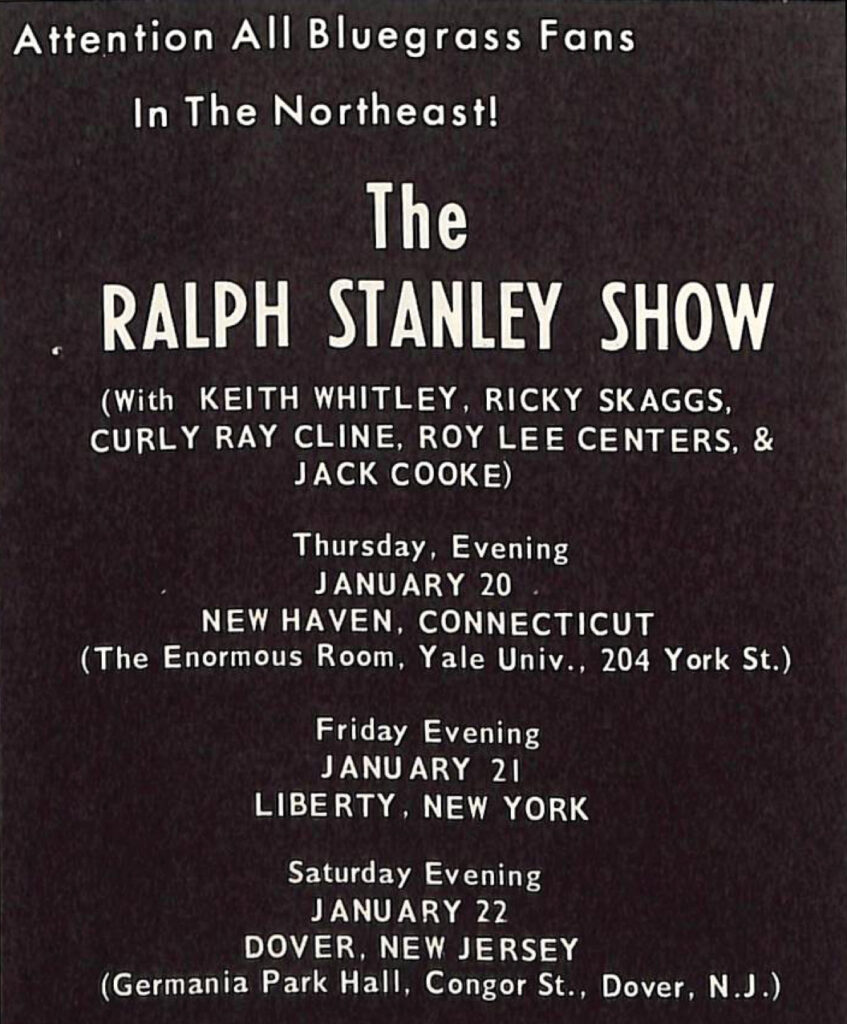
Q: The very first time I ever saw Dr. Ralph Stanley, it was late ‘60s to early ‘70s at a German club in Dover, New Jersey: Germania Park. There is NO info on this in ANY history. I would like to know what the date was if anyone has it. I did talk to Ralph briefly at the show. He was my hero then and now! Our local country radio show, Hometown Frolic (WAAT 970 on the AM dial) with Don “Larkin Barkin,” was off the air in 1960 or so. This was the era when country went to the crap we have today. So, to see Ralph was a miracle for us. Roger Freiday, via email.
A: The January 1972 edition of Bluegrass Unlimited contains an advertisement for a Ralph Stanley show at Germania Park Hall on January 22. The performance was part of a four-day tour through the Northeast, with shows in New Haven, Connecticut (January 20), Liberty, New York (January 21), and New York City (January 23). The group, considered one of Ralph’s best, included Roy Lee Centers on guitar and lead vocals, Curly Ray Cline on fiddle, Jack Cooke on bass, and the duo of Keith Whitley and Ricky Skaggs.
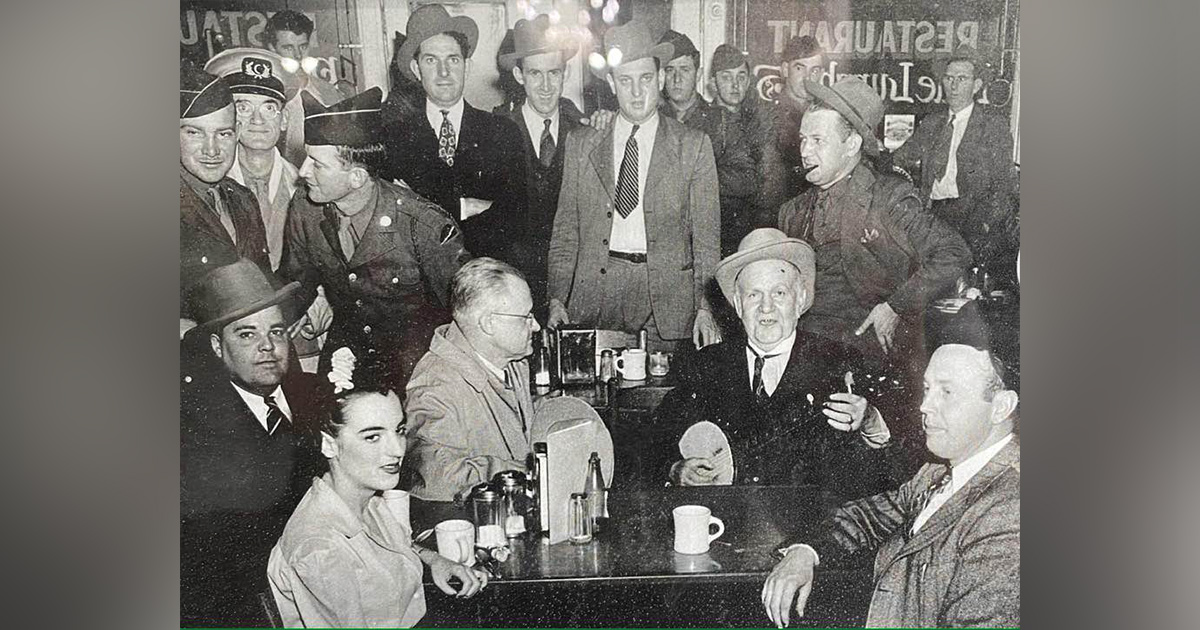
Bill Monroe and His Blue Grass Boys in 1944
The year 1944 marked a pivotal moment in the evolution of music performed by Bill Monroe and his Blue Grass Boys. A photograph from this era, recently shared by Dick Spottswood – a co-founder and longtime contributing editor of Bluegrass Unlimited magazine, offers a rare glimpse into the lineup of Monroe’s band during World War II.
The Photograph: A Snapshot of 1944
The photograph, taken between February and November 1944, captures Bill Monroe and his Blue Grass Boys alongside other notable figures from the Grand Ole Opry. The setting appears to be a restaurant or bar, possibly in Nashville, near the Grand Ole Opry. The presence of George D. Hay, the founder of the Opry, and Uncle Dave Macon, a Tennessee banjo player and popular Opry entertainer, suggests the photo may have been taken after an Opry performance or during a related event. The window in the background, marked with the word “restaurant,” hints at a casual gathering of musicians, though no newspaper advertisements from the time confirm a formal package show featuring this lineup.
The grouping in the photograph is an interesting mix of talent and instrumentation. Bill Monroe (lower right), the leader and mandolin player, had already been a member of the Grand Ole Opry since 1939 and was touring extensively under its umbrella. Wilene “Sally Ann” Forrester (lower left), an accordion player, temporarily joined the band to fill in for her husband, fiddler Howdy Forrester, who was serving in the military. Sally Ann’s presence brought a unique sound to the group, as the accordion was not a typical instrument in Monroe’s later bluegrass ensembles. Seated behind her is Chubby Wise, a swing fiddler from Florida whose contributions to the band added a lively and dynamic element to their performances. Curly Bradshaw (standing, left of center) played the harmonica, an instrument rarely featured in Monroe’s band, making his inclusion particularly noteworthy. Next to Bradshaw is Dave Akeman, better known as String Bean, a banjo player from Kentucky known for his two-finger style of playing, which predated the three-finger technique later popularized by Earl Scruggs. Rounding out the group is Clyde Moody, a guitarist and lead singer from North Carolina, who would later enjoy a successful solo career in the late 1940s and early 1950s.
Uncle Dave Macon, with banjo in hand, was seated at a table with Monroe; directly behind him is believed to be his son, Doris Macon, who often accompanied him in performances. George D. Hay, known as the “solemn old judge,” is also seated at the table with Monroe. Hay, the founder of the Grand Ole Opry in 1925, played a significant role in managing the show and serving as its master of ceremonies. The inclusion of these figures adds historical depth to the image, suggesting a connection to the Opry’s legacy and its role in promoting Monroe’s music.
The timeframe of the photograph is narrowed to February–November 1944, based on the membership of Curly Bradshaw (the band’s most recent recruit), who joined in February, and Clyde Moody, who left in November.
The Repertoire of 1944
Bill Monroe’s music in 1944 was a blend of old-time, swing, and early bluegrass influences. While the classic bluegrass sound had not yet fully emerged, the repertoire performed by Monroe and his band laid the groundwork for the genre’s development.
Some of the songs performed by this band in 1944 were from Monroe’s earlier recordings with the Blue Grass Boys in 1940–’41. These included “Doghouse Blues,” “In the Pines,” a duet with Clyde Moody, “Mule Skinner Blues,” which was described as Monroe’s most popular number, and “Orange Blossom Special.”
Clyde Moody’s role as lead singer allowed for several duets with Monroe, including “Columbus Stockade Blues,” “Sitting on Top of the World,” “Swing Low Sweet Chariot,” and “Where the Old Red River Flows.” These duets highlighted the vocal harmony that would later become a hallmark of bluegrass music. Moody’s smooth voice complemented Monroe’s high tenor, creating a rich and engaging sound.
Chubby Wise, the swing fiddler, contributed instrumental numbers such as “Arkansas Traveler,” “Bully of the Town,” “Cackling Hen,” “Soldier’s Joy,” “Wagoner,” and “Black-Eyed Susan.” These tunes reflected the influence of old-time music on Monroe’s evolving style. Wise’s fiddling added a lively and rhythmic element to the band’s performances.
String Bean’s two-finger banjo style was featured in songs like “Roll On Buddy, Roll On,” “Train 45,” and “Pretty Polly.” While his technique differed from the three-finger style soon-to-be popularized by Earl Scruggs, it added a unique flavor to the band’s sound.
The repertoire also included solos by Monroe on “Goodbye Old Pal” and “Footprints in the Snow” (originally introduced as “I Traced Her Footprints”), as well as the Jimmie Rodgers favorites “Blue Yodel No. 7” and “California Blues.” “Wandering Boy,” previously recorded by the Carter Family, was another notable selection. Curly Bradshaw’s harmonica was featured on “Mommy Blues,” adding a distinctive touch to the band’s sound. Other songs, such as “Milk Cow Blues” and “Ninety-Nine Blues,” remain mysteries in terms of their performers and arrangements, but they further illustrate the diversity of Monroe’s repertoire during this period.
The Transition to Classic Bluegrass
While the 1944 lineup and repertoire were diverse, they lacked the defining elements of classic bluegrass. This transformation occurred in 1945, when Monroe’s band included Lester Flatt (guitar), Earl Scruggs (banjo), Chubby Wise (fiddle), and Howard Watts (bass). This combination of instruments and styles established the blueprint for bluegrass music. The 1944 band, however, played a crucial role in Monroe’s musical evolution. By experimenting with non-bluegrass instruments like the accordion and harmonica, as well as String Bean’s old-time banjo style, Monroe demonstrated his willingness to adapt and innovate.
The Legacy of the Photograph
This photograph serves as a historical artifact, capturing a moment of transition in Monroe’s career. It highlights the contributions of lesser-known musicians like Sally Ann Forrester and Curly Bradshaw, whose roles were temporary but significant. It also underscores the importance of the Grand Ole Opry as a platform for Monroe and his contemporaries. While no known recordings exist of this particular lineup, a February 1945 session for Columbia – with Chubby Wise, String Bean, and Sally Ann – offers a pretty good approximation of the 1944 sound.
Conclusion
The 1944 photograph of Bill Monroe and his Blue Grass Boys offers a fascinating glimpse into a formative period in Monroe’s career. The lineup, featuring a mix of traditional and unconventional instruments, and the repertoire, blending old-time, swing, and early bluegrass influences, illustrate the dynamic nature of Monroe’s music during this era.
True and Trembling motorman
The song “True and Trembling Motorman,” also known by various titles such as “Reckless Motorman,” “The Dying Mine Brakeman,” and others, has a complex and fascinating history that intertwines folklore, mining culture, and early country music. From 1920s recordings by forgotten singers such as Aulton Ray, popularization in the 1930s by the Carter Family, and early bluegrass renderings in the 1940s by the Stanley Brothers, to folk adaptations in the 1960s by the New Lost City Ramblers and, most recently, with another reentry to bluegrass in 2018 by Peter Rowan, the song has enjoyed a long and twisted journey. Its origins, authorship, and evolution remain subjects of debate and intrigue, as the song has been adapted and performed by numerous artists over decades.
Origins and Authorship
The song’s origin is often attributed to Orville Jerry Jenks, a coal miner from McDowell County, West Virginia, who claimed to have written it in 1915 after witnessing a tragic mining accident. Jenks described the incident in vivid detail: a young brakeman fell under a trip of coal cars, and two cars passed over him before the procession could be stopped. Jenks stated, “The accident made a terrible impression on me. The idea for the ballad came to me as I was lifting the boy’s body from the bloody mess.” He composed the song over the course of a week, pairing his lyrics with a tune he devised. Jenks later performed the song under the title “The Dying Mine Brakeman,” and his version was recorded by folklorist George Korson in 1940.
However, the song’s history becomes murky when considering earlier recordings and versions. Aulton “Shine” Ray, a singer from Lancaster, Kentucky, made the first commercial recording of the song in 1927, featuring 11 verses. This predates Jenks’ 1940 claim of authorship, raising questions about whether Jenks was the original composer or whether he adapted existing material. Folk songs often evolve through oral tradition, with different performers adding or modifying verses, making definitive authorship difficult to establish.
Variations and Recordings
The song has appeared in multiple versions, each with slight differences in lyrics, structure, and tone. Jenks’ 1940 rendition contained only 7 verses, while Ray’s 1927 recording included 11. This discrepancy raises the question: if Jenks was the original author, why does his version contain only 7 verses instead of the 11 found in Ray’s recording? It is possible that Jenks’ version was a condensed adaptation or that additional verses were added by other performers over time.
The Stanley Brothers’ version, featured in their 1949 songbook (Folio Number Two Picture and Song Favorites) and performed in a 1951 radio broadcast, aligns closely with Jenks’ version but includes an additional 8th verse. This verse does not appear in any other known versions, leading to speculation that Carter Stanley may have written it. The Stanley Brothers’ adaptation demonstrates how folk songs often evolve as they are passed from one artist to another.
Other notable recordings include those by Cliff Carlisle, Bradley Kincaid, and the Carter Family. The Carter Family recorded the song under the title “Reckless Motorman” in 1938, and their text references mining trains, suggesting a connection to Jenks’ mining-themed version. However, their version does not appear to be directly copied from earlier recordings. Both Sara and Maybelle Carter stated that they learned the song from oral sources.
Cultural Significance
The song’s widespread diffusion among miners and musicians highlights its cultural resonance. George Korson, who documented Jenks’ version, noted that the ballad was a favorite among mountaineer bituminous miners in Virginia and West Virginia. Korson recorded multiple variants in 1940, concluding that the song was deeply embedded in mining communities.
Jenks himself became a prominent figure in union organizing, using his musical talent to rally miners during labor movements. Korson described Jenks as an “unofficial bard and minstrel of the union’s sub-district in Welch, West Virginia,” noting that his presence at union meetings drew large crowds. Jenks’ ballads, including “The Dying Mine Brakeman,” served as both entertainment and a means of conveying the struggles and dangers faced by miners. With his guitar in hand, Jenks traveled all over McDowell County and other nearby points, often proclaiming the union message in song.
Folklore and Adaptation
The song’s evolution reflects the fluid nature of folk music. As noted by Norm Cohen in Long Steel Rail: The Railroad in American Folksong, folk composers often feel justified in claiming authorship if they have fashioned a song out of fragments of older material. This may explain the multiple claims of authorship surrounding “True and Trembling Motorman.” Cohen also observed that the song’s mining-themed version may have derived from or influenced railroad-themed versions, such as “The True and Trembling Brakeman.”
The Carter Family’s version, collected in southwestern Virginia, and other variants recorded by folklorists like Alan Lomax and Herbert Halpert further illustrate the song’s adaptability. Its themes of tragedy, family, and mortality resonate universally, allowing it to be appropriated and reinterpreted by different communities.
Unanswered Questions
Several questions remain unresolved:
1. Authorship: While Jenks (in 1940) claimed to have written the song in 1915, early recordings like Aulton Ray’s 1927 version suggest that the song may have predated Jenks’ composition. It is possible that Jenks adapted existing material or that his version inspired subsequent adaptations.
2. Verse Discrepancies: The differences in the number of verses between Jenks’ version (7 verses) and Ray’s recording (11 verses) raise questions about the song’s evolution. Did Jenks omit verses, or were they added later by other performers?
3. Stanley Brothers’ 8th Verse: The origin of the additional verse in the Stanley Brothers’ version remains unclear. If Carter Stanley wrote it, this would exemplify how folk songs are continually reshaped by artists.
4. Transmission: How did the Stanley Brothers learn the song? Jenks did not commercially record it or publish sheet music, suggesting that oral tradition or regional performances played a role. One possibility could be the fact that for several months in a row in 1941, the most requested song in the repertoire of West Virginia radio performer Lee Moore was “True and Trembling Motorman.”
Conclusion
“True and Trembling Motorman” is a testament to the enduring power of folk music to capture human experiences and adapt to different contexts. Its history reflects the interplay between individual creativity, oral tradition, and cultural memory. While definitive answers to some questions may never be found, the song’s legacy as a poignant narrative of mining life and tragedy remains intact.
Over Jordan
Kathryn Ann “Kathy” Barwick (March 27, 1954 – August 20, 2025) enjoyed a journey through the world of bluegrass that serves as a testament to her talent, versatility, and dedication to her craft. Born and raised in Sacramento, California, Kathy’s musical excursion began during her college years at California State University, Sacramento, where she first picked up the banjo. Inspired by her rapid folk guitar playing, she took lessons from Allen Hendricks and quickly became proficient, eventually teaching banjo herself. This marked the beginning of a lifelong passion for bluegrass.

In the late 1970s and early 1980s, Kathy played with several bands, including the Bar Belles, the Good Ol’ Persons, and Horsing Around. Her mastery of multiple instruments—banjo, dobro, and guitar—made her a sought-after musician. She joined the Fog City Ramblers, a mixed-gender band that performed weekly at Paul’s Saloon in San Francisco and toured the Northwest and Canada. It was during this time that Kathy honed her skills and developed her signature style, blending traditional bluegrass with her own improvisational flair.
In 1989, Kathy co-founded the All Girl Boys, a groundbreaking all-female bluegrass band based in the San Francisco Bay Area. Alongside Mary Gibbons, Chris Lewis, Debby Cotter, and Bethany Raine, Kathy helped redefine the role of women in bluegrass. The band’s traditional yet innovative sound, tight harmonies, and exceptional instrumental skills quickly earned them recognition. They showcased at the International Bluegrass Music Association (IBMA) in 1991 and released their only album, Heart’s Desire, in 1994. Kathy’s contributions to the band included her warm dobro tones, lead guitar instrumentals, and low harmony vocals. She also served as the band’s principal emcee, bringing her charisma to their performances.
Throughout the 1990s, Kathy continued to make her mark on the bluegrass scene. She married Jon Hartley Fox in 1996 and remained active in music, playing dobro on Carolyn Cirimele’s album Lookin’ for Ida Rose. Her work extended beyond the All Girl Boys, as she collaborated with other artists and bands, including Mountain Laurel, where she showcased her resonator guitar skills.
Kathy’s influence extended into the 2000s. She participated in music camps, such as the Bluegrass for Beginners Music Camp in 2002, where she shared her knowledge with aspiring musicians. In 2005, she began an 11-year stretch as an instructional columnist for Flatpicking Guitar Magazine; a collection of her writings was later released as a book. In 2009, she contributed as a guest artist on Marty Cohen and the Sidekicks’ album As Yet Untold, playing banjo and dobro. Her dedication to teaching and mentoring continued, as she was listed as an instructor at the California Coast Music Camp in 2018.
Kathy Barwick’s legacy in bluegrass was defined by her passion, innovation, and trailblazing efforts for women in the genre. As a performer, mentor, and member of the All Girl Boys, she championed the equal footing of men and women in bluegrass, inspiring musicians like Sally Van Meter and earning enduring respect from her peers. Her contributions proved that women belong not just in the background but at the forefront of the bluegrass world.
Mike Seeger, with help from Tracy Schwarz, did a nice version of ‘The Reckless Motorman’ on his ‘Tipple, Loom and Rail’ album from 1965 on Folkways. Curiously, they sang only 6 verses.