
Notes & Queries – November 2021
Queries:
Q: There is a gospel tune the Gillis Brothers recorded which, as far as I can tell, has not been recorded elsewhere: “I Always Call Your Name.” I and my bluegrass friends LOVE the tune, but we are seriously struggling with understanding the lyrics in the second verse. We are missing the second and fourth lines. Can anyone out there help? Joseph Fili, via email.
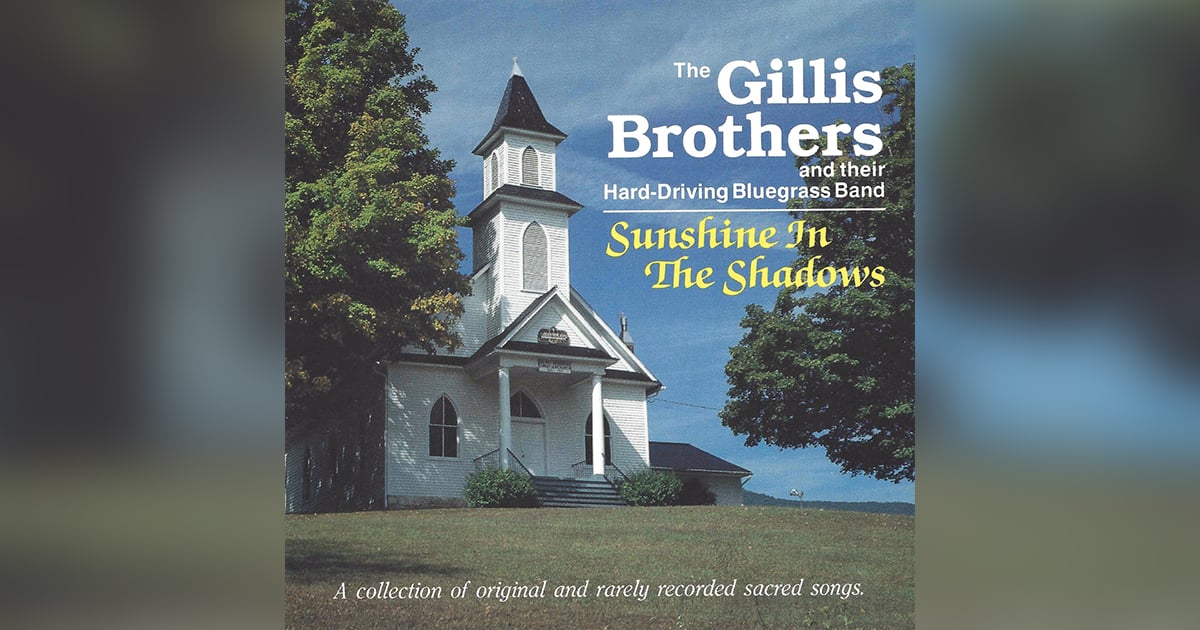
A: The song was recorded by the Gillis Brothers and their Hard-Driving Bluegrass Band on a 1993 CD called Sunshine in the Shadows (Hay Holler, HHH-CD-303). In the accompanying CD booklet, credit for the song is given to Harry C. Sisk, Jr. We reached out to Junior Sisk for clarification on the lyrics. He supplied a copy of the lyrics (as printed below) and informed us that “Dad wrote that [Harry Carpenter Sisk, Sr.]. We saw the Gillis Brothers at a festival and Dad gave them some songs to look over. They picked this one.”
I Always Call Your Name
“In the church house Sunday morning
I prayed and saw my savior there
He bade me come and to listen
On my knees I said a prayer
Chorus:
Lord, I never knew the right way
Many the time your name in vain
When my life was down and troubled
Then I seem to call your name
I want to walk the righteous pathway
And those mountains I will climb
In your footsteps I will follow
To my home on Mount Zion”
Repeat chorus
© Harry Carpenter Sisk, Sr., used by permission.
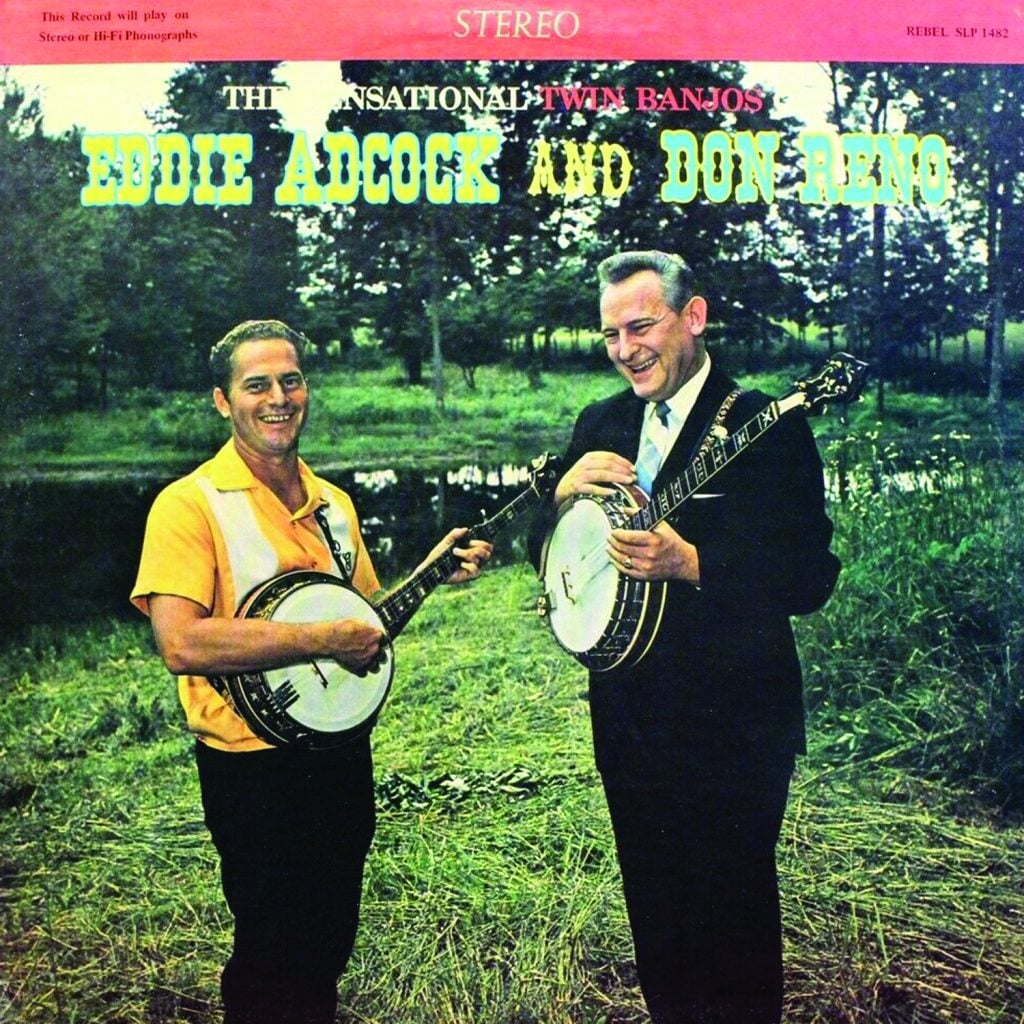
Q: What can you tell me about the Sensational Twin Banjos album cover that featured Eddie Adcock and Don Reno? Any idea when and where the photo was taken? Thanks. Lewis Story, Luray, Virginia.
A: Larry Stephenson informed us that “that photo was taken at American Legion Park in Culpeper, Virginia. It was right behind the stage with the small lake in the background. I remember being there right behind the photographer. I was probably 11 or 12, just a kid hanging around the stage and happened to see the photo being taken. The park was about an hour from where I grew up in King George, Virginia. My Dad and I went there many times in the late ‘60s thru the ‘70s.”
The album was recorded in January 1968 and was reviewed in the February 1969 pages of Bluegrass Unlimited. This suggests that the album cover photo was made sometime in the summer of 1968. The June 1968 issue of Bluegrass Unlimited contained an advertisement for the Second Annual Bluegrass Festival at American Legion Park in Culpeper. Listed among the talent appearing at the one-day festival (which took place on June 16, 1968) were the duo of Don Reno & Bill Harrell and the Country Gentlemen (which included Eddie Adcock). Credits on the back of the album indicate that the photographer was Edwin G. Huffman; he was quite active at bluegrass events in the Washington, DC, area in the late 1960s and early ‘70s. Although they weren’t credited on the album, supporting musicians included Charlie Waller on guitar, Ronnie Reno on mandolin, and George Shuffler on bass. Reviewer Richard K. Spottswood opined that “the talents of Messrs. Adcock & Reno make it an excellent banjo set.”
Notes:
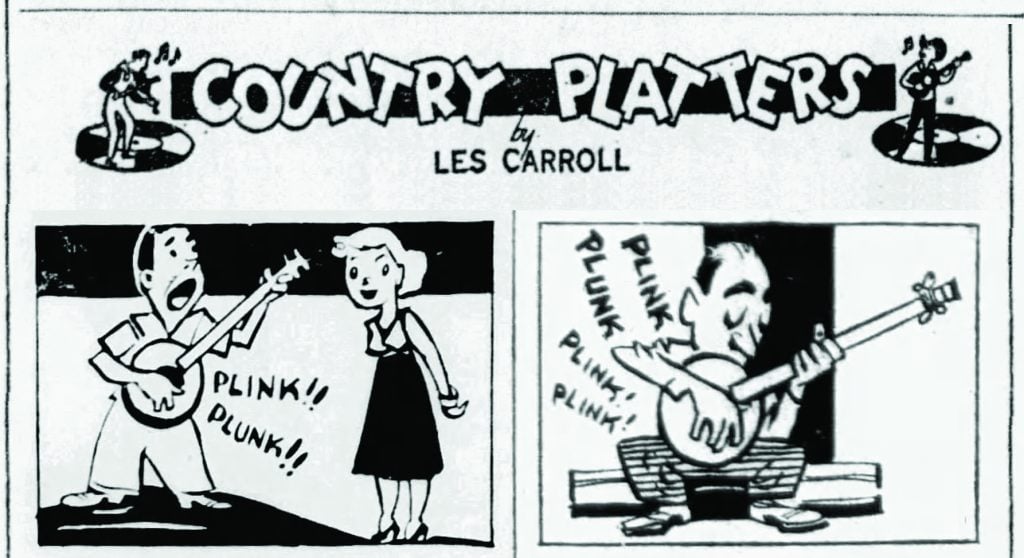
Speaking of record reviews, one of the earliest ways that fans of bluegrass music found out about new record releases was through a syndicated newspaper column called “Country Platters.” It was a monthly feature that ran from 1954 until the early part of 1961. While there were publications such as Country & Western Jamboree that contained record reviews, these required magazine subscriptions and were geared to the already-converted. “Country Platters” appeared in newspapers and shared new release information with the masses.
The column was written (and often times illustrated) by a cartoonist named Lester Edward “Les” Carroll (June 19, 1912 – October 28, 1998). A native of Lancaster, Pennsylvania, he developed an interest in drawing as a child and copied pictures of funnies from the newspaper. After graduation from high school, he enrolled in a correspondence course in art called The Landon Course. While working in the office of an auto parts manufacturer for nearly a decade, Les freelanced on the side. In 1943, he secured a job with the Newspaper Enterprise Association and launched a long-running (1943 – 1960) comic strip about a rural farm family called “The Tillers.”
It was while working on “The Tillers” that Les debuted “Country Platters”; the first column ran in January 1954. It began at a time when there was not a distinct division between mainstream country music and what came to be known as bluegrass. Consequently, artists such as Reno & Smiley, Mac Wiseman, the Stanley Brothers, and Carl Story were reviewed along with the Carl Smiths, Ernest Tubbs, and Hank Snows of the day.
Each column averaged about 375 words and contained information on roughly thirty different releases. As such, many of the reviews were rather brief. A few examples pertaining to bluegrass are: “With banjo numbers popular now, the country artists have their share of good releases. [Arthur] Smith & [Don] Reno give a fine example of tenor and five-string banjo playing in ‘Feudin’ Banjos’ (MGM). Jim Eanes’ ‘Cotton Pickers’ Stomp’ features excellent five-string banjo playing (Decca)” – July 1955. “‘Ruby, Are You Mad?’ is a honey by the Osborne Brothers and Red Allen, with fancy 5-string banjo picking (MGM)” – September 1956. “Jimmy Martin features old-time singing and playing, with some fancy five-string banjo plucking, in ‘Hit Parade of Love’ and ‘You’ll Be a Lost Ball’ (both Decca)” – December 1956. “For those who prefer the old-time country style of pickin’ and singin’ there are several fine new releases in this field. The Stanley Brothers do ‘I’d Rather Be Forgotten’ in the ballad vein (Mercury) and Don Reno and Red Smiley have a very peppy number in ‘Howdy, Neighbor, Howdy’ (Dot)” – April 1958.
Carroll’s first use of the term bluegrass came in a November 1958 review: “If you like the old-time bluegrass type of number it is hard to beat the Stanley Brothers’ ‘Gonna Paint the Town’ and ‘That Happy Night’ (Starday) and Jimmy Martin’s ‘I’ll Never Take No for An Answer’ and ‘Rock Hearts’–with five-string banjo pickin’–on Decca. And Bill Monroe’s ‘Panhandle Country’ features good, old-time fiddlin’; his ‘Scotland’ is really something to hear . . . a fine instrumental pairing on Decca.”
“Country Platters” ran for the last time in March 1961. It was probably no coincidence that Les started a new cartoon strip the very next month: “Life With the Rimples” (April 1961 – April 1975). Judging from Carroll’s many references to five-string banjo picking in his reviews, it should have been obvious that he was a fan. A 1976 newspaper article by Terrance Roskin called “Share Fun, Work Writing Cartoon” confirmed that suspicion. Roskin wrote that “Les Carroll works with the silence and riveted concentration of an artisan laboring at fine detail. His quiet mien belies the pick ‘n’ grin bluegrass banjoist who is another part of Les Carroll.” More recently, bluegrass has another cartoonist among its ranks, fiddler Jim Scancarelli has been the custodian of the long-running “Gasoline Alley” for the last thirty-five years.
Over Jordan
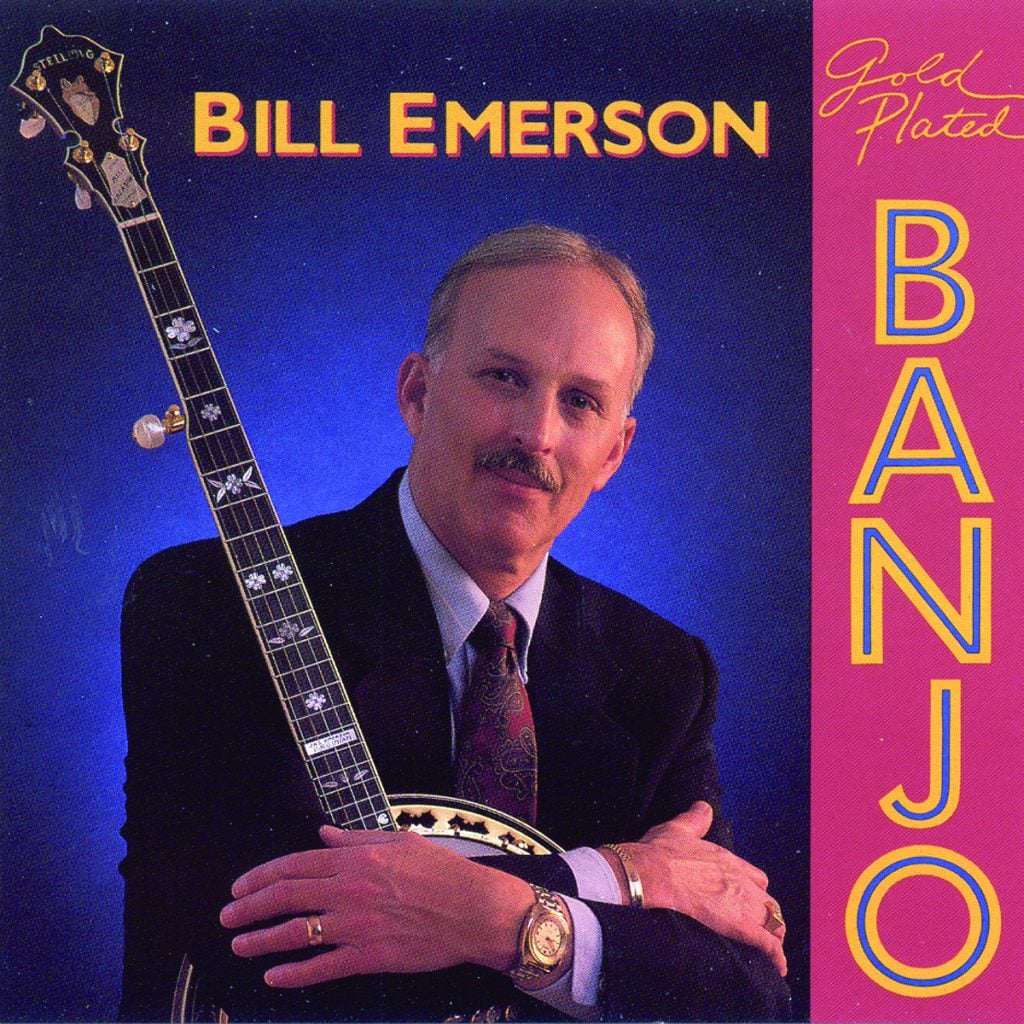
As a banjo player, William Hundley “Bill” Emerson, Jr., (January 22, 1938 – August 21, 2021) was the epitome of taste, tone, and timing. His career spanned six decades, from the middle 1950s to well into the 2000s. He was a key player in a number of groups including the Buzz Busby, the Country Gentlemen, Red Allen, Jimmy Martin, as a partner with Cliff Waldron, the US Navy band Country Current, and with his own Sweet Dixie group.
As a teenager growing up in the Maryland suburbs of Washington, DC, he heard the sounds of Bill Monroe, Flatt & Scruggs, and Mac Wiseman on local radio. The banjo work on these recordings and live radio broadcasts started Bill on his journey as a banjo player.One of Bill’s first professional jobs was with Buzz Busby and the Bayou Boys. He recorded several songs with Busby including “Me and the Juke Box,” “Lost,” “Going Home,” and “Lonesome Wind.” When Busby was involved in a serious automobile accident in mid-1957, Bill honored a July 4th booking for Buzz by recruiting a throw-together band. The group included guitarist Charlie Waller, mandolin player John Duffey, and bass player Larry Lahey to. The foursome clicked and remained together as the Country Gentlemen.
Bill remained with the Country Gentlemen for about a year and helped to record a dozen songs and tunes for the Dixie and Starday labels. He also participated in a radio show that aired five days a week on WARL in Arlington, Virginia.
Throughout the remainder of the 1950s, Bill found employment with a host of name bands including Mac Wiseman, Bill Clifton, and the Stoneman Family. He also made recordings with Harry and Jeannie West and Bill Harrell. He ended the decade by taking top place honors on banjo at the National Champion Country Music Contest in Warrenton, Virginia.
In 1961, Bill joined Jimmy Martin’s Sunny Mountain Boys for a two-year hitch. He credited the bandleader with improving his banjo skills within a band setting. Highlights of Bill’s time with Martin included performances on the Grand Ole Opry, the Louisiana Hayride, an extended stay at the Golden Nugget in Las Vegas, several USO tours, and the Wheeling Jamboree where Jimmy was a cast member. Bill also participated in the recording of Martin’s gospel album This World is Not My Home.
After leaving Jimmy Martin, Bill hooked up with Red Allen and the Yates Brothers. He contributed some fine banjo work to Allen’s recordings during this period, including a masterful rendition of “Little Birdie” and an album that also included Frank Wakefield called The Solid Bluegrass Sound of the Kentuckians. Bill also recorded two albums under his own name that were released as 99 cent budget releases.
Bill rejoined Jimmy Martin in the summer of 1965 for a year-long stay. He recorded some of his best-known tunes, including “Theme Time” and “Sweet Dixie.” Afterwards, he made a return to the Yates Brothers and assisted with the recording of Del McCoury’s first studio album. It was also through the Yates Brothers that Bill met his future partner, Cliff Waldron.
Emerson and Waldron joined forces and performed together during the late 1960s; they recorded three albums for Rebel Records. With songs like “If I Were a Carpenter,” “Proud Mary,” and “Fox on the Run, they were among the earliest groups to adapt folk and popular songs to bluegrass.
Bill returned to the Country Gentlemen in 1969. Band members included Charlie Waller, Bill Yates, and Jimmy Gaudreau (who was soon replaced by Doyle Lawson). The addition of Bill to this group made for one of the most memorable versions of the Country Gentlemen. Bill recorded five albums while with the band: One Wide River, Sound Off, The Award Winning, Live in Japan, and a Vanguard album called The Country Gentlemen. Two of the group’s most enduring song were recorded while Bill was a member: “Fox on the Run” and “The Legend of the Rebel Soldier.”
At the height of his tenure with the Country Gentlemen, Bill enlisted in the Navy. It turned out to be a twenty-year stay during which time he headed up the Navy’s country band, Country Current. It afforded Bill the opportunity to serve his country and to secure a retirement pension. During the latter part of his hitch, he recorded two solo albums for Rebel: Home of the Red Fox and Gold Plated Banjo. He also appeared as a guest on recordings by other artists.
Following retirement from the Navy, Bill continued to play and record. In 2007, he organized his own Sweet Dixie band and released recordings for Rebel and Rural Rhythm. As recently as 2015, he received an IBMA nomination for Banjo Player of the Year.
In a lifetime dedicated to music, Bill’s banjo work appears on some 400 individual songs and tunes. He was inducted into the Virginia Country Music Hall of Fame in 1984, received an IBMA Distinguished Achievement award in 2016, and was inducted into the IBMA Hall of Fame in 2019.
Although Thomas “Tom T.” Hall (May 25, 1936 – August 20, 2021) made his mark as a highly successful country music songwriter and performer, he was very much a friend to bluegrass. His first professional work as a musician was in early and middle 1950s in a bluegrass band called The Kentucky Travelers. The group’s work included both radio and personal appearances. A later stint as a disc jockey at a station in Morehead, Kentucky, preceded his joining the Army in 1957. After a four-year hitch, he landed at Roanoke College in Virginia where he studied journalism. While there, he also wrote ad copy for a Salem, Virginia, radio station.
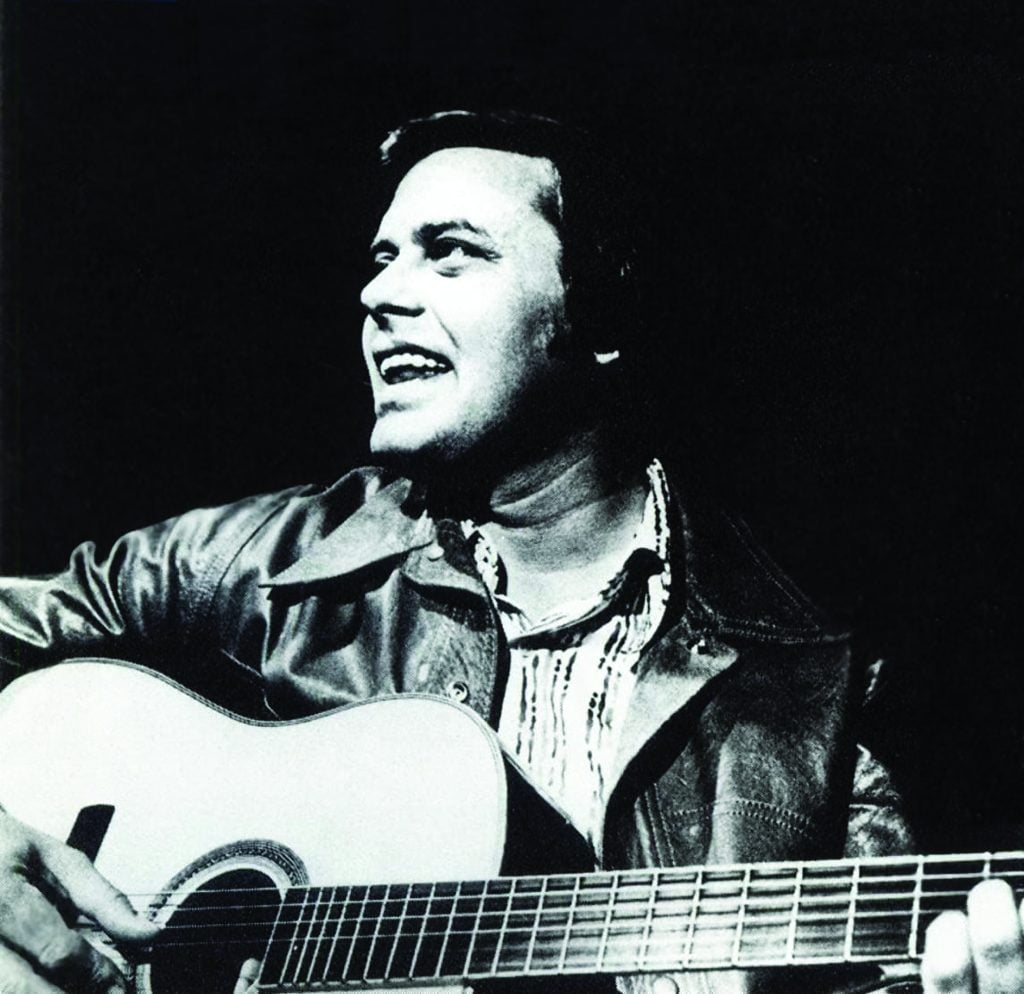
In time, Tom T. wrote over 900 songs. His journey as a songwriter began at age nine, when he penned his first song. He turned to songwriting professionally in 1964 when he took a position with Newkeys Music in Nashville. Among his early work was a 1965 #1 hit for Johnny Wright called “Hello Vietnam” and a 1966 single release by Lester Flatt and Earl Scruggs called “It Was Only the Wind.” After the debut of the 1967 film Bonnie and Clyde, Tom T. contributed six songs to a Flatt and Scruggs album that was inspired by the movie. One of his best-known songs, “Harper Valley P.T.A.,” was recorded by Jeannie C. Riley in 1968 and enjoyed crossover appeal on pop radio.
Tom T. added recording artist to his resume when he signed with Mercury Records in 1967. His first single release, “I Washed My Face in the Morning Dew,” hit the Billboard Top 30 chart and has since been recorded by a dozen and a half bluegrass bands including Jim & Jesse and the Stonemans. He scored his first #1 hit in 1969 with “A Week in a Country Jail.”
The Grand Ole Opry came calling in 1971 and Tom T. was awarded membership in the prestigious cast. The early and middle part of the decade was busy and productive. It included another of his signature hits, “The Year Clayton Delaney Died”; a Grammy award for the liner notes he for the album Tom T. Hall’s Greatest Hits; and the release of a children’s album that contained a song that he later characterized as his biggest money-maker ever, “I Love.”
For bluegrass fans, Tom T.’s 1976 album The Magnificent Music Machine is one of his greatest gifts to the genre. One of the few-and-far-between major label releases of bluegrass in the 1970s, the Mercury album featured a cream-of-the-crop list of pickers and singers including Bill Monroe, Jimmy Martin, Kenny Baker, Bobby Thompson, Donna Stoneman, J. D. Crowe, Johnny Gimble, and more. David Freeman, a tried-and-true stickler for “real bluegrass,” gave the album a highlight review in his County Sales newsletter. He noted that “This is a good one, and an album that just might open up a lot of doors for real bluegrass in various places . . . it’s obvious here that he has put considerable work and thought into this LP.” The disc balanced six new bluegrass-friendly Hall originals with a handful of well-known bluegrass standards.
In 1982, Tom T. paired up with Earl Scruggs for a bluegrass-friendly outing called The Storyteller and the Banjo Man. Several songs from the album did quite well, including “There Ain’t No Country Music on This Jukebox” and “The Engineers Don’t Wave From the Trains Anymore.” A decade later, Tom T. appeared on Ralph Stanley’s Saturday Night/Sunday Morning double disc set with one of his own co-compositions, “The Water Lily.”
Although Tom T. retired from commercial country music in the 1990s, he spent the early 2000s assisting his wife Dixie with the launch of Blue Circle Records and the Good Home Grown Music publishing concern. Most of the projects were recorded at the couple’s studio which was located on their Fox Hollow estate and included songs that were written by the couple. A unique gift to artists who recorded there, the Hall’s charged no fee for the use of their facility and asked only that the recording engineer be compensated.
Tom T. and Dixie received a Distinguished Achievement award from the International Bluegrass Music Association in 2004 and in 2018 were inducted into the organizations Hall of Fame. Other honors included a 2002 induction to the Kentucky Music Hall of Fame, a 2008 induction to the Country Music Hall of Fame, and a 2019 induction to the Songwriters Hall of Fame.
Norma Ann Chapman Morris (June 21,1939 – August 20, 2021) was a Nashville-based publicist who was known primarily for her promotion work for groups such as Exile, Vince Gill, The Time Jumpers, Pete Huttlinger, Nefesh Mountain, Steve Wariner, and others. Her connection to bluegrass lay in her representation of Ralph Stanley, which started with the 1998 release of the star-studded Clinch Mountain Country 2-CD set.

Chris Skinker, the Rebel Records production assistant for the recording of Clinch Mountain Country, told of the meeting when Norma bid to work on promotion for the release: “When Norma sat down at the meeting, she told us right off the bat that she’d recently read John Wright’s book on Ralph and had familiarized herself with Ralph’s career. She and Ralph definitely had a rapport in their working relationship
. . . [she] really got the music. Watching Norma work from a distance, I can only add that she was the consummate professional who cared about her clients.” Mark Freeman of Rebel reported that Norma “played an integral part in re-introducing Ralph and his music to not only mainstream media but, perhaps more importantly, to the music industry power players in both Nashville and LA.”
Norma’s involvement with Ralph didn’t end with Clinch Mountain Country. She was backstage at the Grand Ole Opry, watching from the wings as Ralph received his 2000 induction to the respected country music institution. She was there for other highlights, too, including the 2002 Down From the Mountain tour and the presentation of Ralph’s 2014 honorary doctorate degree from Yale. A friend to the end, she journeyed to the Stanley homeplace for Ralph’s final farewell in 2016. Norma once told Mark Freeman that “the lasting friendship she forged with Ralph was the highlight of her professional career.”
A native of Apple Grove, Ohio, a tiny hamlet on the Ohio river between Point Pleasant and Parkersburg, West Virginia, Norma married Ed Morris at age twenty in 1960. The couple had four children together. Her early professional life included work as a college textbook editor and author, as a photographer, and as a stage performer in musicals. She and Ed collaborated on the 1978 book Free and Low-Cost Publicity for Your Musical Act.
Described as a “veteran country music publicist,” the early 1990s found Norma as the general manager of The Press Office, a Nashville-based publicity firm; in 1994 she was promoted to senior publicist. It was in this capacity that she began her work with Ralph Stanley a few years later.
Although she and Ed were married for sixty-one years, they lived apart for thirty-five of those years. Ed characterized their time apart as one of the reasons for their successful marriage. When Norma was diagnosed with Alzheimer’s and Parkinsons diseases in 2015, he moved back in to be her caregiver. As a former writer/editor for Billboard magazine, he posted tender reflections of Norma’s decline; these Facebook posts were collected and formed the nucleus of the 2021 book Stardust: An Alzheimer’s Love Story.
A subscriber of many decades, I have corresponded with Walt Saunders using
the old address. Today I submitted a question to Gary using [email protected]. This failed 3 times. Am I supposed to put my question here? Or have you any idea what went wrong. I checked the address several times, the one from the Dec issue.
Please reply and set me straight. Dec was a great issue and I have a query for Gary the ultimate authority on all things Stanley.
Thanks
Dick Richards