

Notes & Queries – November
NOTES
In the August 2020 “Notes & Queries,” we fielded a query about the jam-session favorite and popular bluegrass number, “Love Please Come Home,” and its writer Leon Jackson. Leon, with his partner Johnny Bryant, fronted a band called the White Oak Mountain Boys. The group made at least eight recordings for the King label in July 1956. We just heard from one of one of Leon’s relatives:
“Leon Jackson was born on a small farm five miles north of the Buttahatchie River and eight miles east of Hamilton, Alabama. Bryant was from Anniston, Alabama, I think. Uncle Leon still has three sisters and two brothers living in Hamilton.”
– Wayne Holcombe | Irish Hills, Brooklyn, Michigan
(Leon Jackson & Johnny Bryant recorded the following titles for King Records in 1956: “Buttahatchee; So Goes My Heart; White Oak Mountain Breakdown; Love Please Come Home; Go Find Another Man; This Heart’s Been Broken Before; Rocky Roads; Buttahatchee”—2nd version. Thanks to Leon’s nephew, Wayne Holcombe, we now have a CD with all of the group’s recordings.)
“In the August 2020 column, there’s the mention of the Dry Branch Fire Squad’s version of the song ‘Golden Ring,’ made famous by George Jones and Tammy Wynette. I have it by Carl Sauceman and the Green Valley Boys on Rich-R-Tone vinyl 8104, Tribute To The King (Bill Monroe). The band is: Carl Sauceman (rhythm guitar), Fred Richardson (banjo), Joe Stuart (fiddle, bass fiddle), Benny Martin (fiddle), Josh Graves (Dobro). Vocals are by: Carl Sauceman (lead), Fred Richardson (baritone), Monroe Fields (tenor), Joe Stuart (bass).”
– Tony Fuld | Loganville, Ga.
QUERIES
Q: What can you tell me about a song, “The Old Account Was Settled Long Ago”? Who wrote it, and who recorded it? My grandmother used to sing it years ago, but she didn’t know who wrote it. She learned it as a girl. JC, S.C.
A: The song was written by F.M. Graham, and appeared in an old hymnbook published by Graham titled Songs For Jesus. It dates to at least 1908. My colleague Gary Reid provided the information. He has a collection of vintage hymnbooks and paperback gospel songbooks and told me, “Of the 300 books that I have indexed, ‘An Old Account Was Settled Long Ago’ appears in about 45 or them, so it seems to be a fairly popular selection.
“The Blue Sky Boys recorded the song in 1936, calling it ‘An Old Account Was Settled,’ and it has generally been known in old-time country and bluegrass by this title since that time. Another early group, Welling & McGhee, also recorded the song in the 1930s. In more recent times, such groups as the Carlisle Family (ca. 1960s), the Hee Haw Gospel Quartet (ca. 1970s), Doc Watson & Clint Howard (ca. 1970s), Wade Mainer (1972) and Jim & Jesse (1979), have recorded versions.”
Q: Do you have any idea where I could find a songbook or sheet music with the hymn “Cabin In The Valley Of The Pines”? LB, Fla.
A: That’s one of the many outstanding songs written by Albert E. Brumley, who was among the most prolific writers of hymns and heart songs in the business. “Cabin In The Valley Of The Pines” was copyrighted in 1940 by Stamps-Baxter Music. You can find it in the songbook, The Best Of Albert E Brumley, which should be available from Brumley Music, P.O. Box 27, Powell, MO 65730.
Q: Where did the Country Gentlemen get the song “Two Little Boys”? I have it by them on a box set, Early Rebel Recordings, 1962-1971, [1998]. Is this a Civil War song? RT, Md.
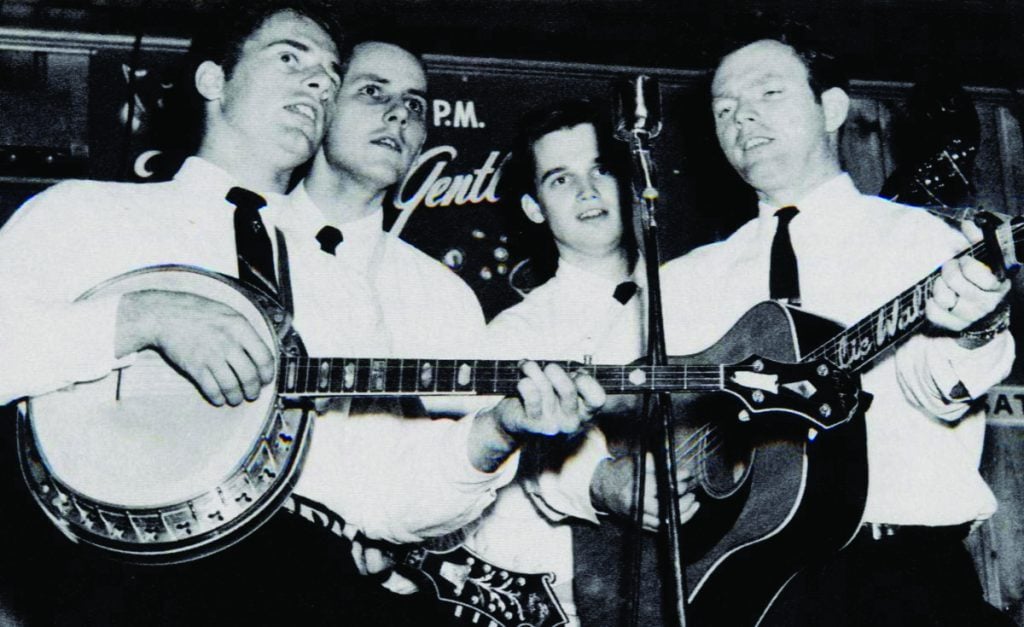
A: This writer always assumed it to be an American Civil War song, but this is not the case. The Country Gentlemen learned “Two Little Boys” from country singers Mickey and Roger, the Woodward Brothers, who at one time owned the Shamrock Tavern at 3295 M St., N.W. in the Georgetown section of Washington, DC., (where the Gents appeared for many years). The Woodward Brothers recorded “Two Little Boys” ca. 1955 for the Universal-Sheraton label. It’s unclear where the Woodwards learned the song—the Dixon Brothers recorded it in 1937, but the lyrics to their version are different.
Contributing editor and resident musicologist Dick Spottswood tells us that “Two Little Boys” was a Tin Pan Alley piece written by American tunesmiths Edward Madden (words) and Theodore F. Morse (music) in 1903. Byron G. Harlan and Frank Stanley put it on an Edison cylinder (#5480) the same year.
It was a popular music hall number around the turn of the 20th century, especially as performed by Scottish singer Harry Lauder. It relates the story of two boys who grow up to fight in a war. The event described supposedly refers to an incident in the Boer War,* in March or April, 1900.
[*The Boer War, between Great Britain and the Boers (Afrikaners, descendants of the original Dutch settlers in South Africa) in Transvaal and the Orange Free State, occurred between 1899 and 1902.]
John Denver and Kenny Rogers (as lead singer of The First Edition) were among artists who performed/recorded the song. The Country Gentlemen’s version apparently was the first in bluegrass.
Q: I am now in my late 70s (79) and have been listening to bluegrass music since the mid-1950s with gaps like when I got married, etc. I recently moved and during that operation I came across a number of American 45 rpm record singles and EPs on Starday, etc., which I ordered from the Jimmie Skinner Music Center in Cincinnati, Ohio. There were a few artists on a label which I did not recognize…Blue Grass Special, Cincinnati. These were 6 track EPs with Reno and Smiley, Jimmy Martin and Bob Osborne, Grandpa Jones, Wade Mainer and J.E. Mainer’s Mountaineers, as well as Rusty York. Have you a history on this label? AL, United Kingdom.
A: The record label Blue Grass Special was based in Cincinnati at the Jimmie Skinner Music Center. Other related labels included Kentucky, Gateway, Big 4, all of which were country music or bluegrass related. Skinner lent his name to the organization but had little else to do with the running of the business; Lou Epstein was the moving force behind the operation, which was one of the largest mail-order firms of the time. This writer was a regular customer during the 1950s, ordering many 78 rpm bluegrass records from them, and even an early Stanley Brothers song book.
Q: My question is about Martin guitars. What does the “D” stand for—as in D-28? Which number guitar is the larger, D-28 or D-45? IW, Mich.
A: The “D” stands for “Dreadnought.” When the C.F. Martin Company introduced their new line of large body guitars in 1931, they decided to break with the number tradition in use up to that time.
In World War I, the largest class of battleship was the dreadnought, named for the HMS Dreadnought, a British warship built in 1916. The Martin Company named their largest body guitar line after the battleship and used the letter “D” to designate the model.
Dreadnought guitars are all the same size. The number following the “D” indicates the type of wood and ornamentation. Among bluegrass musicians, the most popular models have been the D-18 and the D-28. D-45 is the top of the Dreadnought line, and pre-World War II models are very valuable.
For a history of the Martin Dreadnought line of guitars, as well as the Martin company, I recommend Martin Guitars: A History, by Richard Johnston and The Martin Book: A Complete History of Martin Guitars, by Walter Carter.
Q: I really love the Seldom Scene’s recording of “Last Train From Poor Valley.” Do you know who wrote that song? I’ve heard it by someone else, but don’t recall now who it was. My main question is—what is a coal tipple? DC, NY.
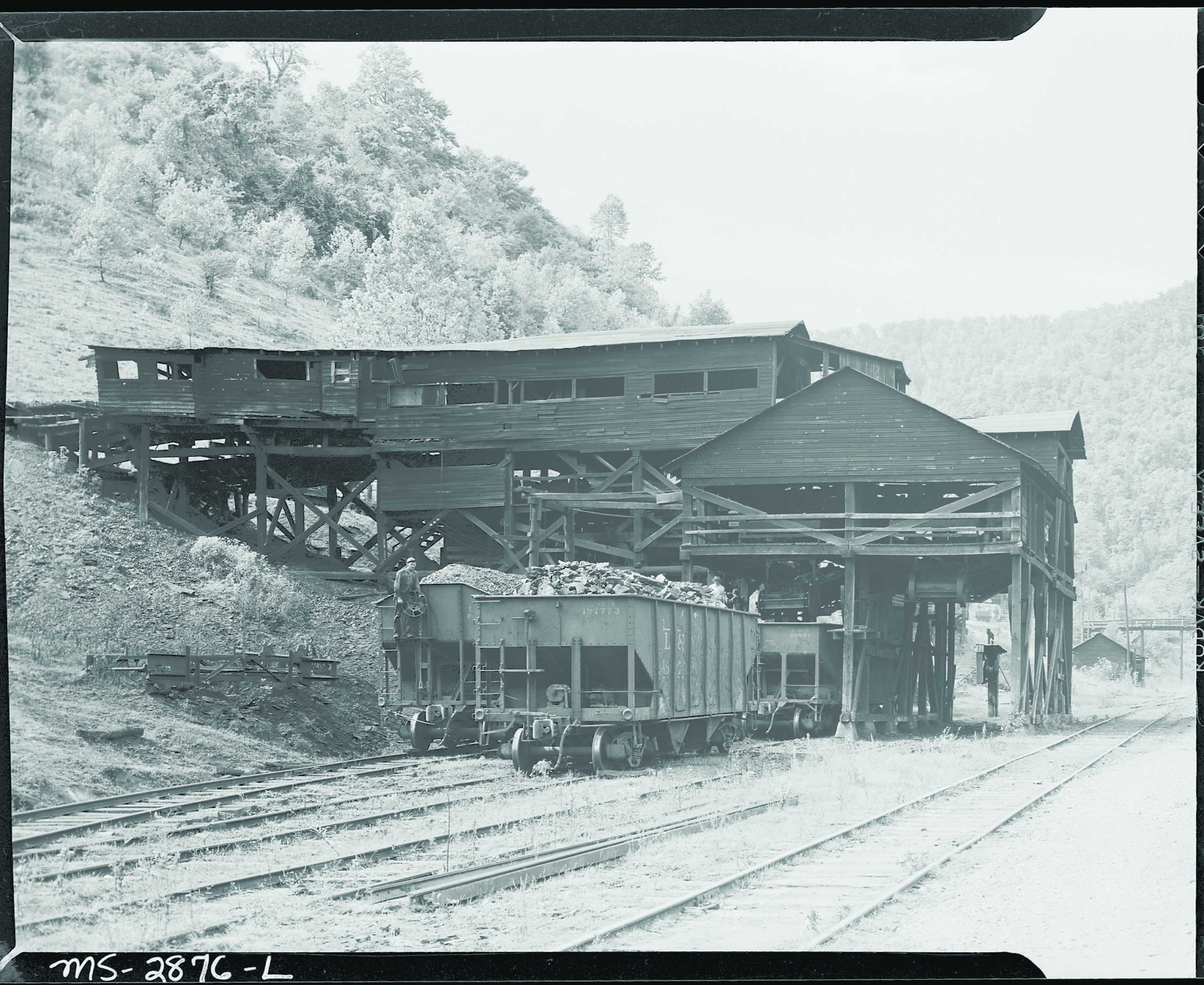
A: A coal tipple is a structure once found at coal mines, used to load the extracted coal for transport, typically in railroad hopper cars but sometimes coal trucks. No two were exactly alike, since the tipple had to conform to the topography at the mine entrance. At one time, tipples were a common sight; this writer saw a number of them years ago in the coal fields of southwestern Virginia (especially Dickenson, Wise and Buchanan Counties). They also were found in West Virginia, Kentucky, Pennsylvania, or anywhere coal was being mined. Today, a coal mine usually has a coal preparation plant which washes coal, before loading it for transport.
The song “Last Train From Poor Valley” was written by Norman Blake. I first heard it by the Seldom Scene in their 1973 Rebel album Act Two, and it’s always been one of my favorite numbers by them. In recent years, I’ve heard fine versions by composer Norman Blake, the Tim O’Brien Band, Nothin’ Fancy and Chesapeake.
Q: Do you happen to know where I could find Don Reno’s recording of “Limehouse Blues”? CM, Ga.
A: Don’s recording of “Limehouse Blues” is found on the 4-CD box set, Don Reno & Red Smiley And The Tennessee Cut-Ups, King 7001.
Q: Who plays the fantastic lead guitar work on Gene Autry’s “Dixie Cannonball”? Been wondering about this for years, but didn’t know who to ask until now. SJ, N.C.
A: The lead guitar work is by one of the greatest guitarists in the history of country music, Merle Travis.
Q: I read somewhere a long time ago (maybe in this magazine) that after Stringbean [David Akeman] left Bill Monroe’s Blue Grass Boys, that there was a tenor banjo player who took his place. This was supposedly before Earl Scruggs joined the band. Can you explain this? SR, Va.
A: The tenor banjo picker’s name was Jim Andrews, and apparently he did work briefly for Bill Monroe. In James Rooney’s 1971 book, Bossmen: Bill Monroe & Muddy Waters, Earl Scruggs recalled how he came to work with Monroe. In 1945, he (Earl) was working out of Knoxville, Tenn., with Lost John Miller, and they would drive over to Nashville to do a Saturday morning program on WSM. Earl recalled that Monroe’s band at the time consisted of Lester Flatt, Birch Monroe, Jim Andrews on tenor banjo and comedy, and Jim Shumate.
In his 1984 book, Bluegrass Breakdown, The Making Of The Old Southern Sound, Robert Cantwell describes Jim Andrews as a jazz-oriented musician and “probably the most forgotten man in country music.” Sometime after Akeman left Monroe (ca. September, 1945) to work with Lew Childre, Jim Shumate arranged for Earl to audition for the Blue Grass Boys. Earl was hired in December, 1945, so Andrews’ stay with Monroe would have been brief.
Q: Do you know of the cowboy song “When The Work’s All Done This Fall”? It was my dad’s favorite song, and he used to sing it. It’s pretty long, but I was wondering if anybody has done it bluegrass? SC, Texas.
A: Your query struck a nerve. “When The Work’s All Done This Fall” is the first song this writer ever sang in public. It was in 1943, as I stood in front of my third-grade class at the Annandale (Va.) Elementary School and with quavering voice rendered the number a cappella. I was into cowboys in a big way back then and that was my favorite song. To this day, it’s my favorite western song, and I still sing it now and then.
Cowboy poet Dominick J. O’Malley (1867-1943), using the name D.J. White, composed the song over 125 years ago. It was published as a poem in the October 5, 1893 issue if the Miles City, Mont., Stock Grower’s Journal under the title “After The Round Up,” sung to the tune of “After The Ball.” Apparently, the song was based on a true incident which O’Malley recalled from his 20-year career as a Montana horse wrangler. Supposedly the cowboy who met his untimely fate was Charlie Rutledge, killed while working as a cowhand on the XIT Ranch. To give the song more dramatic effect, O’Malley described the incident as occurring during a “wild stampede” in a thunderstorm.
Real-life cowboy Carl T. Sprague recorded the song in 1925 for RCA Victor. Thanks to Sprague’s recording, “When The Work’s All Done This Fall” was very popular from the late 1920s well into the ’40s (when this writer learned it), and was performed by a host of cowboy and country singers, e.g. Fiddlin’ John Carson, Bradley Kincaid, Pie Plant Pete, Wilf Carter, Ernest Stoneman, The Sons Of The Pioneers, Elton Britt and Tex Ritter, to name a few. The song has been recorded under the above title, as well as “The Dixie Cowboy,” and “A Jolly Group Of Cowboys.”
Mac Wiseman was the first bluegrass artist to record the song. Later, Jim Greer and the Mac-O-Chee Valley Folks, Doc and Merle Watson, Skip Gorman and Wayne Erbsen released versions.