Notes & Queries – May 2022
Queries
Q: Can you tell me who wrote and recorded “You Live in a World All Your Own”? I know that Bill Monroe recorded it but I assume it was a country song first. Thanks. Jerry Steinberg, Salem, Virginia.
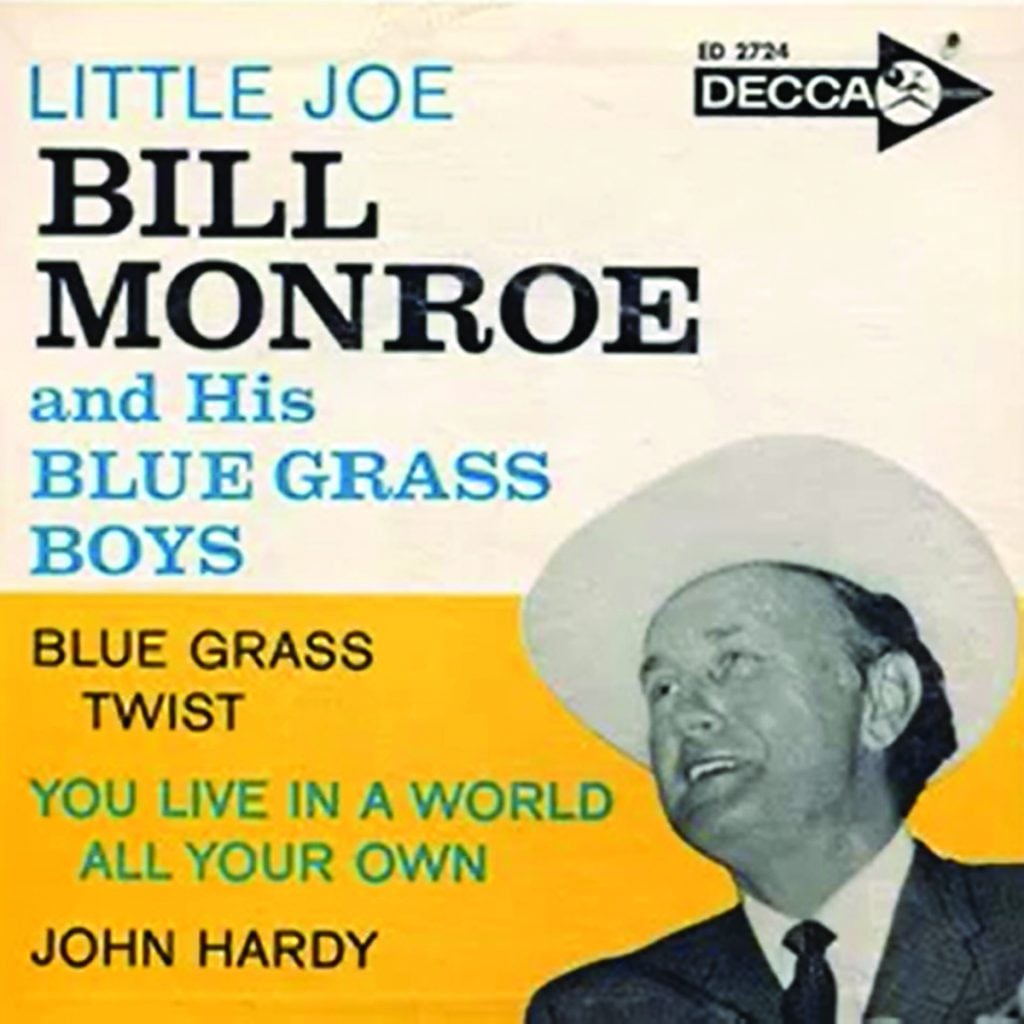
A: Bill Monroe recorded the song on November 30, 1960, and released it on the 1961 album Mr. Blue Grass. Composer credits on the record show that the song was “arranged and adapted” by Bill Monroe. As you suggested, the song does have a much older history. It was first recorded in July 1945 by country singer Cowboy Copas at his very first recording session. His King Records release (a 78-rpm disc with the catalog number 511) listed Lloyd Copas as the composer. The lyrics between the Monroe and Copas versions are virtually identical. But, it appears that neither Monroe or Copas were the actual writers of the song. In the book The Music of Bill Monroe by Neil V. Rosenberg and Charles K. Wolfe, the authors state that “according to Monroe, ‘You Live in a World All Your Own’ was based on an earlier song by the Knoxville tunesmith Arthur Q. Smith from whom Monroe had also bought ‘How Will I Explain about You?’.” Smith, whose real name was James A. Pritchard and who has been discussed at length in earlier editions of “Notes and Queries,” was a prolific songwriter who had a penchant for selling his works, as opposed to retaining ownership and collecting royalties. In this instance, it appears that he sold the same song twice; once to Cowboy Copas and again to Bill Monroe.
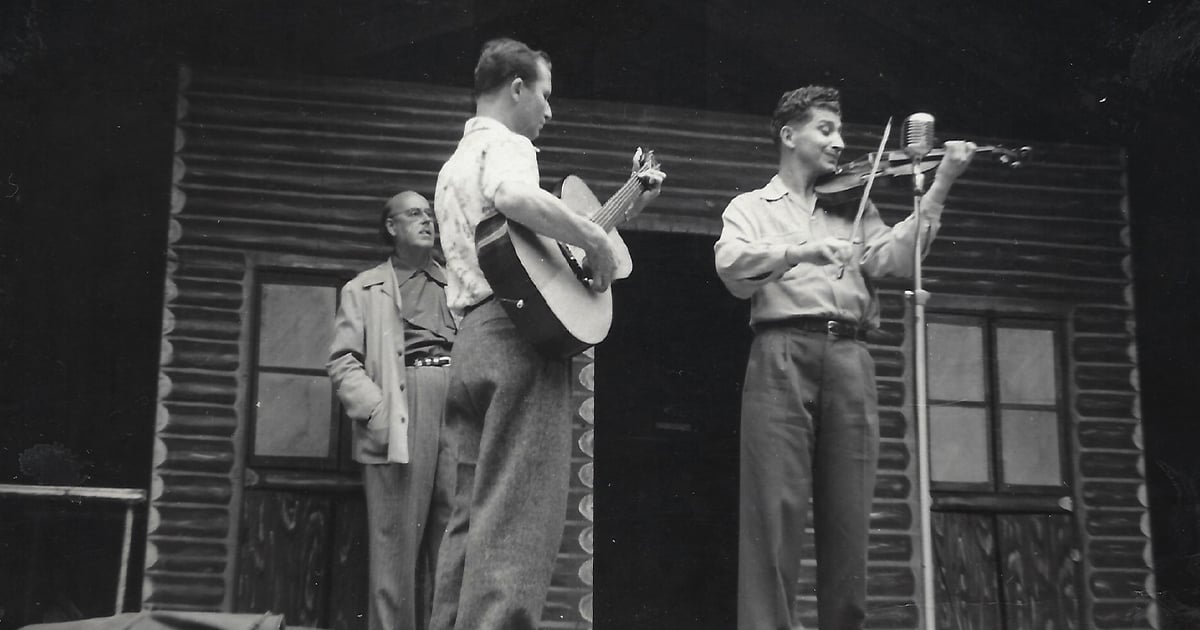
Q: I recently acquired the attached photo from a seller in New Port Richie, Florida. The back of the photo is dated September 11, 1949. Any idea who the musicians are or where the photo was taken? Thanks. John Schwab, via email
A: We believe this photo was taken at a fiddler’s contest at Buck Lake Ranch in Angola, Indiana. On stage, from left to right, are park owner Harry Smythe, guitarist Connie Smith, and fiddler Francis Geels.
The date on the back of the photo coincides with the date for a fiddler’s contest listed in an advertisement in the September 9, 1949, edition of The South Bend Tribune (South Bend, Indiana). The advertisement for Buck Lake Ranch promised a full day’s worth of entertainment on September 11. On the bill were Red Blanchard, a WLS star who was tagged as “radio’s funniest man in person” and who was “back again by popular demand.” An added attraction was the inclusion of Slim Bryant and his Wildcats, “NBC Radio & Record Stars.” Getting the festivities underway at 11:00 A. M. was the Tri-State Old-Time Fiddler’s Contest which promised the winner an “all-expense trip to national contest at Kentucky State Fair.” After examining the photo, Chicago folklorist Paul Tyler confirmed the location as Buck Lake Ranch and suggested Francis Geels as the fiddler and Connie Smith as the guitarist.
Francis John Geels (March 1, 1925 – April 11, 2011) was, according Tyler, a “well known Indiana fiddler.” His work on the fiddle dates back to circa 1937 when he played in a family band with his sister Helen and other siblings. His professional work included stints with Ernest Tubb and Pee Wee King. At the time this photo was taken, Geels and Smith were both active in a group called the Indiana Redbirds. Smith was a “national guitar champion” in 1946 and 1947.
Buck Lake Ranch was a new establishment at the time of the fiddler’s contest. The park was the invention of Harry Keith Smythe (May 24, 1898 – May 20, 1992) and his wife, Eleanor. He was a native of Illinois near Chicago who made his way to Fort Wayne, Indiana, where he managed the Hoosier Hop, a live jamboree program that was broadcast over WOWO in the middle 1940s.
When the lease expired for the building where the Hoosier Hop was held, the Smythes began looking for land on which to construct Buck Lake Ranch. They settled on Angola, Indiana, a small town about 42 miles north of Fort Wayne. Significantly, there were with a seventy-five radius about thirty towns with populations ranging from 5,000 to 150,000 people.
The park contained eighty acres of land which provided parking for 3,000 cars, a 4,000-seat outdoor amphitheater complete with a rustic looking stage (as seen in the photo) made from logs, a twenty-acre lake, two hundred picnic tables, and rides for children. Music shows, including occasional fiddle competitions, took place on Sundays, starting on the week before Decoration Day and ending in mid-September. The eighteen-week season also included wrestling matches on Saturday evenings. Over the years, the park hosted a number of mainstream bluegrass entertainers including Lester Flatt & Earl Scruggs and Bill Monroe.
Q: I used to have a copy of an album by members of the Red Clay Ramblers called Meeting in the Air. I’d like to get another copy. Do you know if it’s still available? DD, Vinton, Virginia.
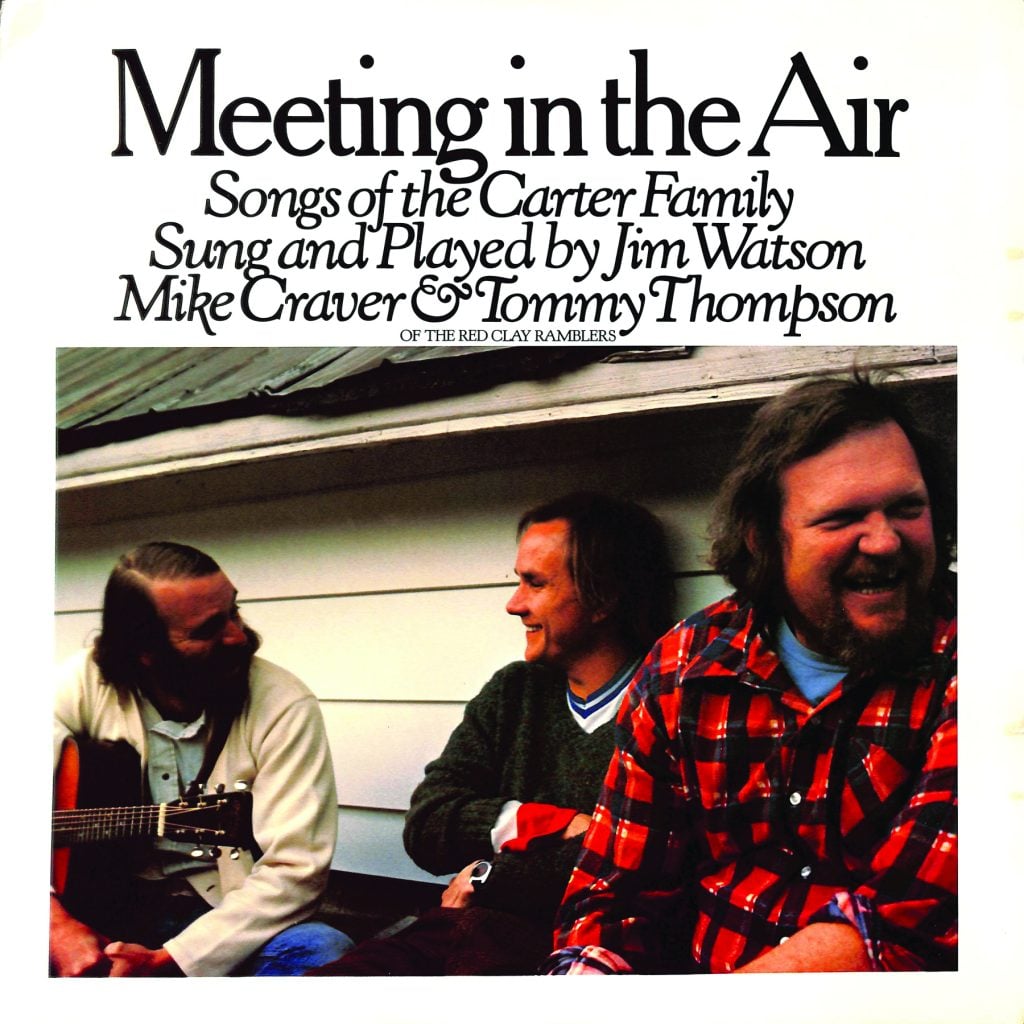
A: The album, an excellent tribute to the Carter Family, first saw the light of day in 1980 on the Flying Fish label. It featured three-fifths of the members of the Red Clay Ramblers: Jim Watson, Mike Craver, and Tommy Thompson. It was probably no coincidence that the album was recorded shortly after the passing of the last remaining members of the original Carter Family; Maybelle Carter died in October 1978 and Sara followed in January 1979. A handful of Carter tributes preceded Meeting in the Air. Two of the most influential ones landed on the market in 1961: Songs of the Famous Carter Family by Lester Flatt and Earl Scruggs and Carter Family Memorial Album by Bill Clifton. Joe and Janette Carter, children of A. P. and Sara Carter, released Carter Family Favorites in 1966. Lastly, The Carter Family’s Greatest Hits, by Wilma Lee & Stoney Cooper, appeared in 1977.
In reviewing Meeting in the Air for the September 1981 issue of Bluegrass Unlimited, reviewer George B. McCeney tagged the Red Clay Ramblers, the band to which Watson, Craver, and Thompson belonged, as “one of the most dynamic and creative old-time string bands currently recording. They are careful listeners and extremely faithful to the original [Carter Family] recording arrangements.” Given that the album featured old-time, as opposed to bluegrass, arrangements, McCeney’s comments were tucked away in the abbreviated “Additional Releases” section.
The original album is long out of print but happily Jim Watson and Mike Craver released it on compact disc in the early 2000s. It is currently available on Craver’s website: mikecraver.com/meeting.html.
The Girl in the Blue Velvet Band
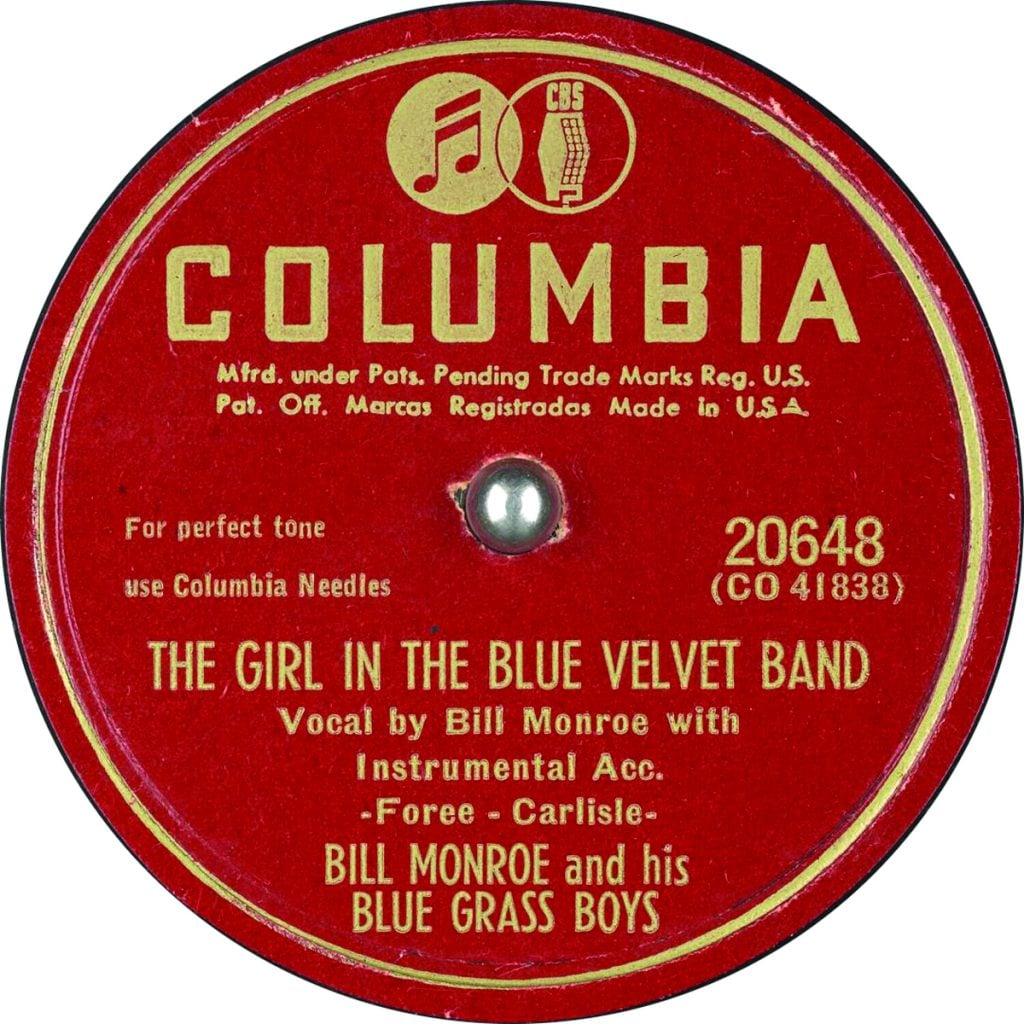
At Bill Monroe’s final recording session for the Columbia label, held on October 22, 1949, he recorded a song that has since been covered by dozens of artists, “The Girl in the Blue Velvet Band.” The list reads like a Who’s Who of bluegrass and country music and ranges from Hylo Brown, Mac Wiseman, Doc & Merle Watson, and Jerry Douglas & Peter Rowan to the Del McCoury Band, Charlie Moore, Delia Bell & Bill Grant, Louisiana Honeydrippers (Jim Smoak), and the Boys From Indiana. While Monroe recorded the song in 1949, he had been performing it off on since the mid-1940s; one fan documented Bill’s performance of it on the Grand Ole Opry on December 9, 1944.
Monroe’s Columbia release, catalog number 20648, appeared on the market on December 12, 1949, and gave songwriting credits to Cliff Carlisle and Mel Foree. Carlisle was a popular country music performer during the 1930s and, at times, recorded with his brother Bill as the Carlisle Brothers. Carlisle’s disc (recorded on August 28, 1934, and released in December 1935) listed himself and a person with the last name of Calaway as the writers of the song. Curiously, it wasn’t until December 2, 1939, that Carlisle, with Mel Foree, copyrighted the song.
Copyrights notwithstanding, “The Girl in the Blue Velvet Band” is actually a much older song. There is some connection to an English/Irish ballad called “The Black Velvet Band” which dates back to the early 1800s. One writer, however, tagged “The Girl in the Blue Velvet Band” and a “total re-write,” as opposed to a variant.
In the United States, the song first started out as a poem, with twenty-six stanzas, sometime in the early 1900s. The earliest reference to it in print was in a 1911 advice column called “Cynthia Grey’s Letters.” In it, a reader wrote: “Can you give me the name of the author who wrote the poem called ‘The Girl With the Blue Velvet Band?’.” Several years later, verses from the poem took on a melody and were sung in the trenches of France during World War I. In 1925, the poem was advertised as part of a collection of “Comic Recitations,” “all complete in one book, only 50 c.” Later still, in 1927, a newspaper article in the Akron Beacon Journal told that the poem had earlier appeared in magazines of the “Captain Billy’s Whiz Bang” variety, a “bawdy humor” magazine. Perhaps the poem’s widest circulation came the same year when it was printed in a book by Sigmund Spaeth called Weep Some More, My Lady.
Neil Rosenberg and Charles Wolfe wrote in The Music of Bill Monroe that “The Girl in the Blue Velvet Band” had been “a huge hit in 1934 when Cliff Carlisle recorded it for the American Record Corporation. The grim, melodramatic story concerns a boy from San Francisco who meets a strange girl whose hair is tied in a blue velvet band. As they walk arm in arm, she slips a ‘diamond worth ten grand’ into his pocket and frames him for robbery. He is sent to San Quentin for ten years. The song was already widely known in folk traditions, with considerable variation, when Monroe recorded it.”
Over Jordan
William Dermott Colleran (aka Mac Martin) (April 26, 1925 – February 28, 2022) was, by choice, a part-time performing bluegrass musician whose craft and length of service rivaled that of even the most seasoned touring professionals. Launching his career in 1949 as a part of a group known as the Pike County Boys, he logged sixty-six years of picking and singing before retiring in 2015. Most of those years were spent as the leader of his own Dixie Travelers. One-time band member and author of the book Bluegrass, Bob Artis noted more than thirty years ago that “Mac is unique in that he is one of the bluegrass old-liners, an original. That he is from Pittsburgh, that really makes him unique. I don’t think anybody performing has the background, the knowledge of old-time music that he does. I don’t think anyone playing has that old-time sound that he has, the early ‘50s Flatt and Scruggs sound from the golden age of straight bluegrass.”
Mac’s interest in music pre-dated the evolution of bluegrass. As the child of Irish immigrants, he grew up in a house with phonograph records of Irish music. He told the Pittsburgh Post-Gazette in 2001 that “the Irish reels and jigs attracted me to what later became bluegrass, although I didn’t realize it at the time.” During his middle teens, Mac acquired a guitar with the hope of playing songs he heard on radio stations such as WSM and WWVA. He sought out an instructor but quit after two lessons because the teacher wasn’t familiar with the country music of the day. Not to be deterred, Mac set about learning to play by ear by carefully listening to records.
Following naval service in the South Pacific during World War II, Mac returned to the United States in time to hear and appreciate Bill Monroe’s classic band of the middle and late 1940s, that which included Lester Flatt, Earl Scruggs, and Chubby Wise. A few years later, it was the Flatt & Scruggs band that served as an inspiration for Mac’s methodology in performing bluegrass. Disc jockey Peter Thompson, who got to know Mac well in the early 2000s, noted that he had a “pretty specific format, based on Lester Flatt’s approach, which included Lester-like intros and the classic mix of solo, duet, and trio songs; full band and fiddle-banjo instrumentals; Monroe/Stanley/Flatt & Scruggs and more obscure sources; gospel songs and jokes/stories.”
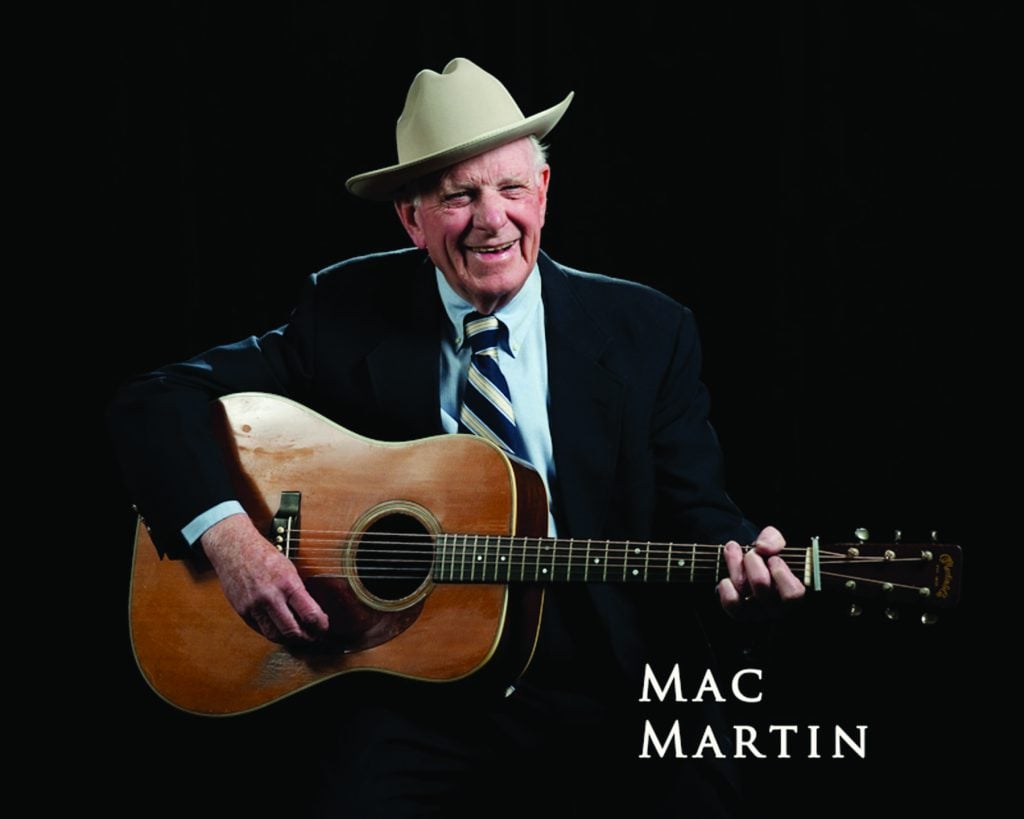
Bill Colleran took on the name of Mac Martin when his early group, the Pike County Boys, also contained two other Bills. To alleviate some of the confusion, he adopted the stage name that stuck with him long after the demise of the Pike County Boys. It was also with the Pike County Boys that Mac, known today for his guitar and mandolin work, played five-string banjo. He modestly told the Pittsburgh Tribune-Review in 2003 that “I wasn’t that good then. But at least I gave that particular sound of the five-string banjo to the group.”
Mac’s Dixie Travelers came together in the middle 1950s. The core group, fiddler Mike Carson and banjo picker Billy Bryant, stayed together for nearly fifty years and ended with Bryant’s passing in 1994. Carson appeared on the Travelers last studio album together, 2005’s Venango. Other long-time members include bassist Norm Azinger and Mac’s son Bobby on guitar and lead vocals.
As a dedicated family man with a wife and five children, it was always Mac’s decision to perform locally. Starting in the late 1950s and continuing for the next twenty years, the Dixie Travelers performed weekly at Pittsburgh’s Walsh’s Lounge. From there, it was off to Gustine’s, and eventually to the Moose lodge in nearby Elizabeth, Pennsylvania. The group also appeared at festivals in western Pennsylvania, eastern Ohio, and West Virginia.
Mac was never overly recorded but over the course of a half century, he released nearly a dozen and a half albums and CDs. Most were for small, independent labels who appreciated the artistry of himself and his band and all were excellent representations of original formula bluegrass. Leading off, from 1962, was an album for the Pennsylvania-based Gateway label called Folk and Bluegrass Favorites. From 1968 to 1971, Mac released four albums for Rural Rhythm. The middle and late 1970s saw a pair of albums on the County and Revonah labels: Dixie Bound and Travelin’ On.
Typical of the reviews for Mac’s albums are comments concerning his Dixie Bound release. “The first thing immediately apparent on the County album is the very fine lead voice of Mac Martin . . . Also quite apparent is the excellent choice of material. Mac Martin is living proof that traditionally oriented bands don’t have to record the same old shopworn songs over and over. Country music of the thirties and forties produced countless numbers adaptable to bluegrass. Mac knows hundreds of them and incorporated many of the best of these into his repertoire . . . The performances are impeccable as usual. No frills or showoff stuff – just good solid bluegrass all the way.”
John Michael “Buckwheat” Green (June 20, 1953 – March 17, 2022) was a talented West Virginia guitar and bass player, singer, and songwriter. To most of his friends and fans, John was known as Buck, or Buckwheat. The name came from one of the characters of the Our Gang (Little Rascals) short films that were shown on television in the 1950s and ‘60s.
Hailing from the hamlet of Hurricane, not far from the border with Kentucky, Buck was exposed to music at an early age when pickers would gather to play music with his father in the family’s kitchen. He made his singing debut at age five when he sang “Jesus Loves Me” for his church. He was so well received that he received a standing ovation and a request for an encore. When asked what he wanted to sing next, Buck asked if the pianist knew “You Ain’t Nothin’ But a Hound Dog”!
Television had a profound impact on Buck. One of his favorite programs when growing up was the Flatt & Scruggs Show. He was a faithful viewer and later got to the see the duo in action when they presented a program at the local high school in Hurricane.
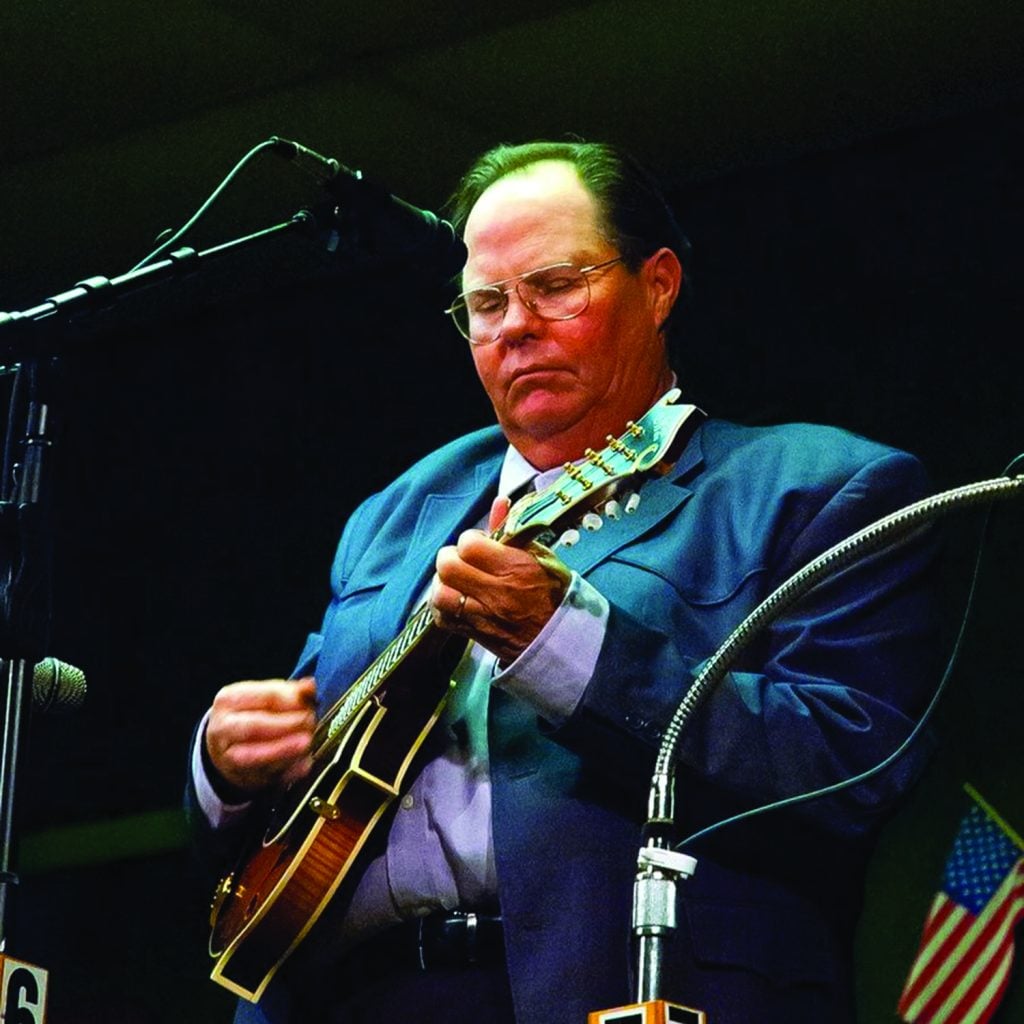
Some of Buck’s first professional music work was in the middle 1970s when he performed with the West Virginia Gentlemen. He played guitar and sang on the group’s 1975 album Sing the Gospel. He also served as the group’s point-person for bookings.
Buck’s talents as a songwriter started to show when he joined the Laurel Mountain Boys in late 1970s. The band was headed by noted West Virginia mandolin player Don Sowards. The group’s 1979 album Long Black Beauty featured Buck playing guitar and singing lead. He also contributed two of his own songs “Living Free and Easy” and “Dangerous Dan” and co-wrote “All That Jazz” with Don Sowards.
Later that same year, Buck teamed up with Tommy Cordel to form the High Time Pickin’ Band. The lead track on their High Time Pickin’ album featured Buck’s song “Touring Railroad Band.”
Buck’s biggest claim to fame came in the 1980s when he was an early member of the Lonesome River Band. Other members included Tim Austin, Dale Perry, and Dan Tyminski. By the time of the group’s debut album for the Rebel label, the self-titled Lonesome River Band, Buck was gone but one of his songs was included: “The Old Man in the Shanty.” It proved to be one of Buck’s most popular songs and was covered by a half dozen groups including the Chapmans and Special Blend.
Some of Buck’s more recent work came in 2011 when he accepted a position with the Gabeharts, a popular West Virginia group headed by Jim and Valerie Gabehart. Buck appeared on the group’s 2013 CD entitled I Was Raised in a Railroad Town. As on other recordings that he appeared on, Buck contributed several songs to this one including “Shoulder to Cry On,” “My World Wouldn’t Be So Cold and Blue,” and he co-wrote with Jim Gabehart on “He’s the Only One Who Cares.”
The same era was witness to Buck’s emergence as a correspondent for BluegrassToday. His career plans were put on hold in the early part of 2014 when he suffered a heart attack and underwent quadruple bypass surgery.
A Kickstarter campaign was launched to help defray the costs of his funeral and burial.