Notes & Queries – May
NOTES
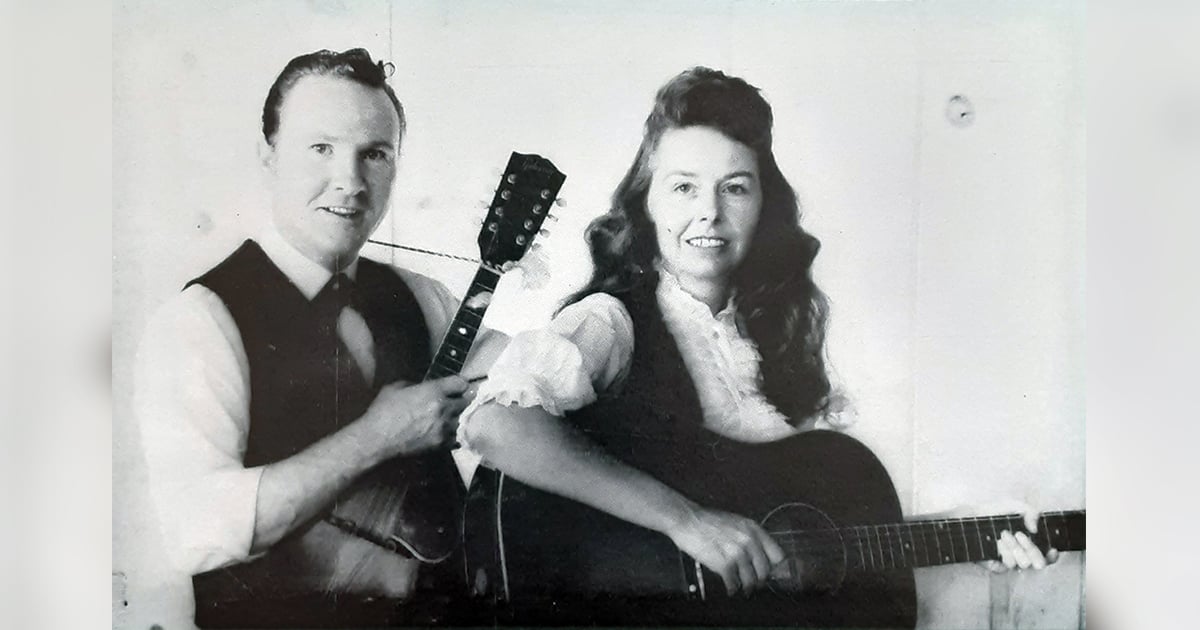
“I was pleasantly surprised to see that you mentioned and pictured Lacey Jenkins Daugherty, writer of ‘Beautiful Lost River Valley’ in the March 2021 issue of Bluegrass Unlimited. Let me add to the story. I used to own a Christmas tree farm in Hardy County, West Virginia. Friends there knew I was a bluegrass player, and told me I should meet their neighbor, Mrs. Daugherty, who writes songs. I went to her home to meet her. She gave me a book of her poetry and sang that beautiful song she wrote about the valley where she lives. She said it was her hope to get someone to put that song on a record. I contacted Pete Kuykendall to try to make that happen. I suggested that the best people to make that recording would be Ray and Ina Patterson, who sing pretty ballads in sweet harmony, like the Blue Sky Boys. So, Pete and I got Ray and Ina to record two of Mrs. Daugherty’s songs to release them on a 45. In Pete’s studio, I added a bass instrument to their recording, but told Pete to mix it low enough that you can’t distinguish it, maybe just make Ina’s guitar sound a little fatter. It was very satisfying to learn that Ken Irwin and the Whitstein Brothers liked it enough to record it again.”
Tom Gray, Kensington, Maryland

January’s “Notes and Queries” featured an overview of fiddler Jack Youngblood, which elicited several comments and questions from Vermont banjo picker Dan Linder. “Very interesting to learn that when he [Youngblood] left Monroe he headed down to Louisiana and hooked up with a band including Lum York, eventually bringing Jim Smoak into the group. That must have been the Louisiana Honeydrippers. They recorded at least two albums, which I treasure. One of the album photos shows Lum York with a huge bow tie and a big wink; obviously he filled the role of bass-playing funny man. The first album was all bluegrass; the second was half bluegrass and half old-time, with clawhammer banjo. I believe Jim Smoak sang lead for the most part. Was Jack Youngblood fiddling on both of those LPs? What other info can you provide on the Louisiana Honeydrippers?”
We reached out to Honeydripper Jim Smoak for some answers. He told us that “Jack Youngblood left Bill Monroe and went to work at WAFB radio and television [in Baton Rouge, Louisiana] in the employ of Bruce Broussard, a south Louisiana radio and TV personality. Jack called me saying they had a job for me also. We were on radio five days a week and TV one hour per week. [The group featured] guitar, banjo, steel guitar, bass fiddle, two girl vocalists, and a guitar/vocalist. This lasted about four months.
“Don Reno was leaving Arthur Smith in Charlotte, North Carolina, and Arthur called my Dad at Round O, South Carolina, to find out where I was. Arthur called and offered me the job in January of 1955. I stayed with him until mid-October 1955 when I got my draft notice. After two years in the Army, I went with Hylo Brown, from January 1958 until January 1960.
“The Louisiana Honeydrippers came about in 1961 when I signed a contract with Folk Lyric records of Baton Rouge, Louisiana, to make an album; we did two altogether. I put all the musicians together: Bucky Woods – fiddle, Dewey Edwards – fiddle, J. C. Meyers – mandolin, V. J. Meyers – guitar, and Lum York – bass. If Jack Youngblood had been around then, I certainly would have used him.”
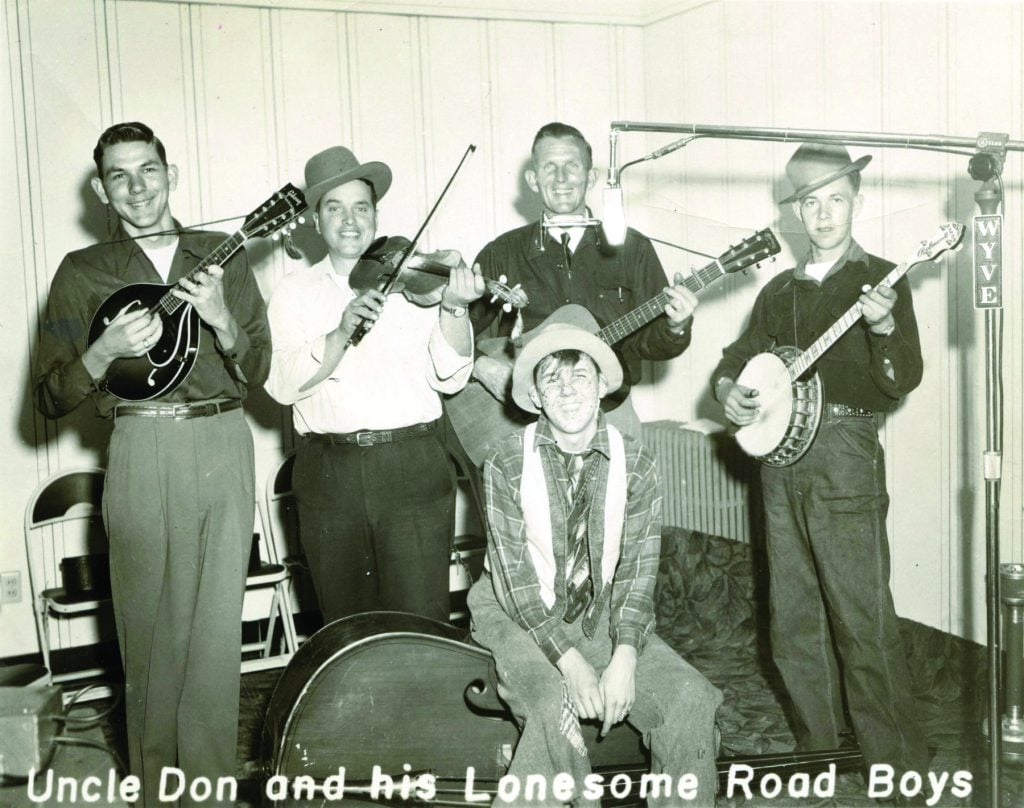
Ken Landreth from Fries, Virginia, sent a photo of a group billed as Uncle Don and his Lonesome Road Boys. Ken correctly identified the mandolin player as Jim Williams (who recorded with Mac Wiseman and the Stanley Brothers in the early 1950s) and the bass player as Paul Williams (a member of the Lonesome Pine Fiddlers, Jimmy Martin’s Sunny Mountain Boys, and later led his own successful gospel group the Victory Trio). Paul guessed his age as “about 15,” which would place this photo as having been taken in about 1950. Paul’s nickname while working with the Lonesome Road Boys was Stringbean. The guitarist in the photo is band leader Donald Hurley “Uncle Don” Dean, Sr. He was born on February 10, 1906, at Gunton Park in Wythe County, Virginia. According to Ronny Dean, Don’s son, his father lacked a formal education and could not read or write. But, he was a self-taught musician who played piano, trumpet, trombone, was a “great guitarist,” and “could throw a fit on a banjo.” His occupation in 1940 was listed as a truck driver but Uncle Don found time to lead several bands in the ‘40s and ‘50s including the Virginia Playboys and the Lonesome Road Boys. His various groups logged time on radio station WPUV in Pulaski, Virginia, and WYVE in Wytheville. Ronny characterized “Uncle Don” as a “good daddy [who] raised nine of us . . . got us all through school.” The fiddle and banjo players featured in the photo remain unidentified. Perhaps some of our readers can help in naming them.
QUERIES
Q: I recently came across a recording on YouTube by Bob Baker and the Pike County Boys called “Little Willie.” I enjoyed the soulful fiddling on this song. Unfortunately, YouTube didn’t list the names of the musicians. Any idea who is playing fiddle? SR, Fairfield, PA
A: This track was featured on an album that was recorded and produced by Mike Seeger called Mountain Music Bluegrass Style. The album was released in May of 1959 on the Folkways label and was reissued on CD by Smithsonian/Folkways in 1991. Mike Seeger’s notes to the album and CD collections state that the fiddler was Jimmie Grier and that he was “born [in] 1930 in Washington County, near Bristol, Tennessee. Claims a musical background: ‘My father beat me with a fiddle bow.’ Learned fiddle from his dad at about age 10. Joined the army in 1946 and played on army radio station and in USO until he left the army in 1955. Joined Bob Baker in 1957. Has had all types of occupations and is now specializing in sheet metal work.” He reportedly did some work with Earl Taylor in the Baltimore area around 1959/‘60. What happened to him after that remains a mystery. Queries to several long-time Baltimore bluegrassers came up empty. Perhaps some of our readers have some additional information about the elusive Jimmie Grier.
Q: I have a various artists album called Mountain Folk Song Concert Bluegrass Style that was issued on the Palace label. The front of the album boasts “The Sensational Stanley Brothers and The Great Carl Story.” However, the front cover photo features neither of these two groups. Shown on the album cover is an outdoor concert with a group that consists of fiddle, banjo, two guitars (one of which is played by a female), a piano, and steel guitar. Any idea when and where this photo was taken, and the identity of the band on stage? SS, Austin, TX

A: This album cover has stumped more than a few record buyers over the years. It was issued in 1963 and was comprised of songs and tunes that were leased from Starday Records. As has been discussed in previous N & Q columns, the identities of the artists were, for whatever reason, obscured. For example, the tune “Dixie Hoedown” is listed as being by Jimmy & Wayne Sanders when, in reality, it is actually by Jim & Jesse. As to the album cover, one of the first clues to its location is a canvass awning covering the stage that sports the letters “Silver Anniversary Concert Series.” A search of that phrase on a website of historical newspapers revealed that in 1961, Nashville’s Centennial Park was celebrating the twenty-fifth anniversary of a summer concert series that was sponsored by the Nashville Tennessean newspaper. A deeper dive into on-line newspapers suggested that the most likely album cover candidate from the season’s performers was none other than Grand Ole Opry performer Jumping Bill Carlisle; he was slated to perform for the concert series on June 25, 1961. Band members likely included female vocalist Bobbie Sills, banjo player Buck Trent, drummer Don Haggard, bass player Junior Huskey, fiddler Buddy Spicher, steel guitarist Bob Foster, and pianist Bill Pursell.
Q: “What can you tell me about the album Bluegrass Hootenanny by George Jones and Melba Montgomery? Who are the players and how did these recordings come about? Who selected the material, etc.? Thank you.” PP, Durham, NC
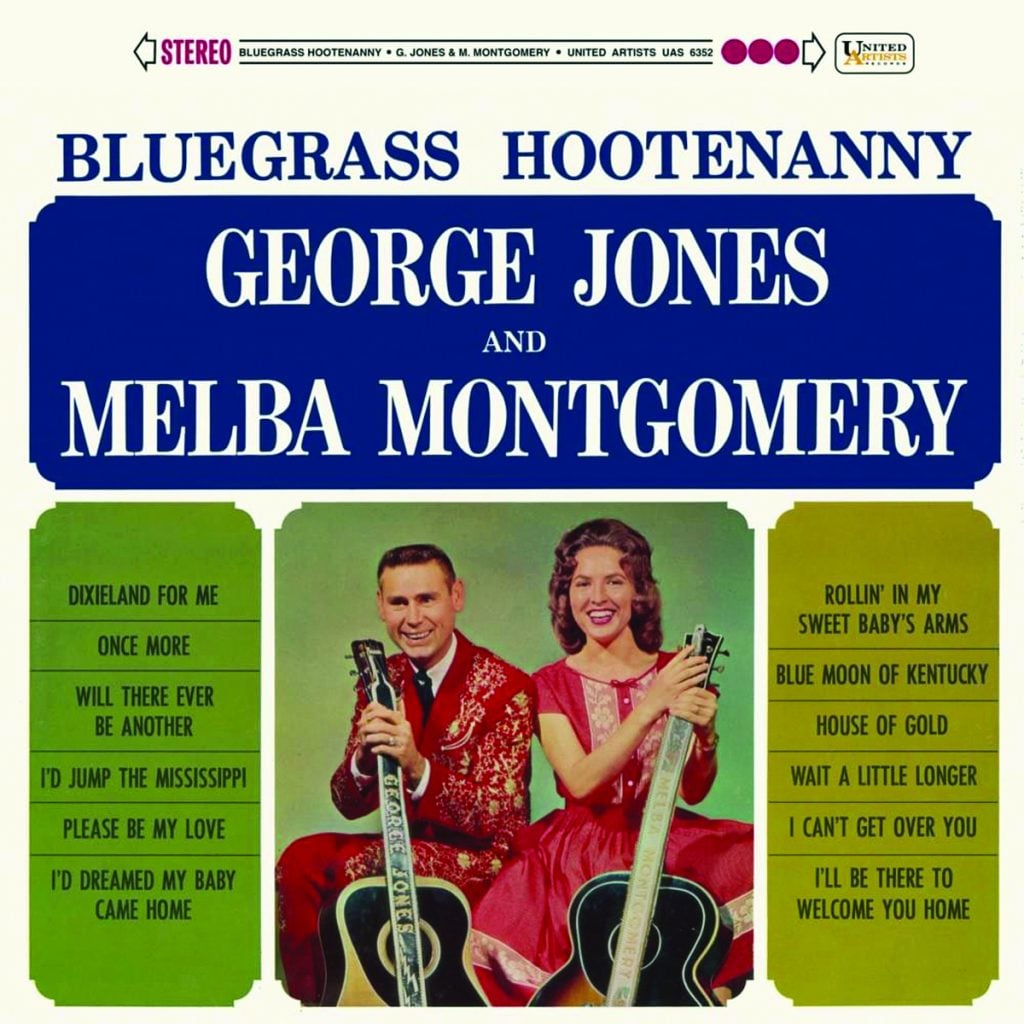
A: Bluegrass Hootenanny was recorded for the United Artists label over a two-day period on January 13 and 14, 1964. Pickers and singers on the album included George Jones – vocals, Melba Montgomery – vocals, Harold B. “Shot” Jackson – dobro, Curtis McPeake – banjo, Bob Moore – bass, Murrey M. “Buddy” Harman – drums, and Tommy Jackson – fiddle. The recording of a bluegrass album by a mainstream country artist was pretty much of a rarity in the middle 1960s, although there were a few exceptions. In 1962, Rose Maddox – with backing by Bill Monroe and the duo of Don Reno & Red Smiley – recorded Rose Maddox Sings Bluegrass. While she never recorded an album of bluegrass, crooner Patsy Cline recorded songs such as “Blue Moon of Kentucky” and “Love Letters in the Sand” (which was earlier a hit for Mac Wiseman). It wasn’t long after the release of Bluegrass Hootenanny that Porter Wagoner jumped on the bandwagon with The Bluegrass Story. Skeeter Davis closed out the 1960s with her album I Love Flatt and Scruggs. In 2013, John Lawless of BluegrassToday posted an informative overview of the Bluegrass Hootenanny album that included quotes from Melba Montgomery and Curtis McPeake. Among their remembrances were several revelations, including the fact that it was long-time Jones’ session producer Pappy Daily who had the specific idea (and title) for this album (even though Jones and Montgomery had talked previously about doing a bluegrass album). Daily left it to the singers to choose and arrange the songs that were recorded; Curtis McPeake brought one song to the session (“Dixieland For Me”) that Jones learned and sang on the spot!
Over Jordan
William Curtis McPeake (October 9, 1927 – February 20, 2021) rated for many years as a dean of Nashville 5-string banjo players. He grew up on a farm Scotts Hill, Tennessee, a small community that was located between Nashville and Memphis, Tennessee. He began developing an interest in music around age 6 or 7 and acquired his first guitar in 1936. During the 1940s, he played steel guitar with a group known as the Rhodes Brothers, who had a radio program on WTJS in Jackson, Tennessee.
It wasn’t until 1950 that Curtis concentrated on the banjo full-time. He organized a group called Curtis McPeake and the Rocky Valley Boys. They secured a program that aired six days a week on WDXL in Lexington, Tennessee.
Curtis met Earl Scruggs in the early 1950s. In 1955, when Scruggs was involved in a serious automobile accident, it was Curtis who was called upon by Lester Flatt to fill in. Curtis was the fill-in of choice over the next 15 years whenever Scruggs needed a temporary replacement.
In 1961, Curtis signed up for a two-year stint with Bill Monroe. A highlight of this time was an appearance at Carnegie Hall in November 1961. Curtis assisted in the recording of 18 songs that appeared on two albums: Mr. Blue Grass (1961) and Blue Grass Ramble (1962).

Roadwork for 1963 included time with Wilma Lee and Stoney Cooper. It was also a year for recording. ABC Paramount released an album called Bluegrass Hillbillies Pickin’ n’ Grinnin’ Featuring Curtis McPeake; the album was no doubt inspired by the recent success of The Beverly Hillbillies television program. Another major release was a project with fiddler Benny Williams that was billed as the Tennessee River Boys, Good Old Mountain Music.
Although he wasn’t credited on the album, Curtis was the banjo picker on the 1964 album by George Jones and Melba Montgomery called Bluegrass Hootenanny.
Starting in the middle 1960s, Curtis became a member of the Grand Ole Opry staff band, one of the few – if not only – musicians there whose primary role was as a banjo picker. The same era saw him as an in-demand session player.
Curtis’ longest stint with any band was from 1969 to 1987 when he worked as a member of Danny Davis and the Nashville Brass. This same period saw the release of several solo albums that were issued under Curtis’ name.
As a long-time player and instrument collector, Curtis was often sought out as an appraiser. He was a 50-year member of musicians’ union and the Masons. He was awarded a Distinguished Achievement Award by the IBMA in 2018.
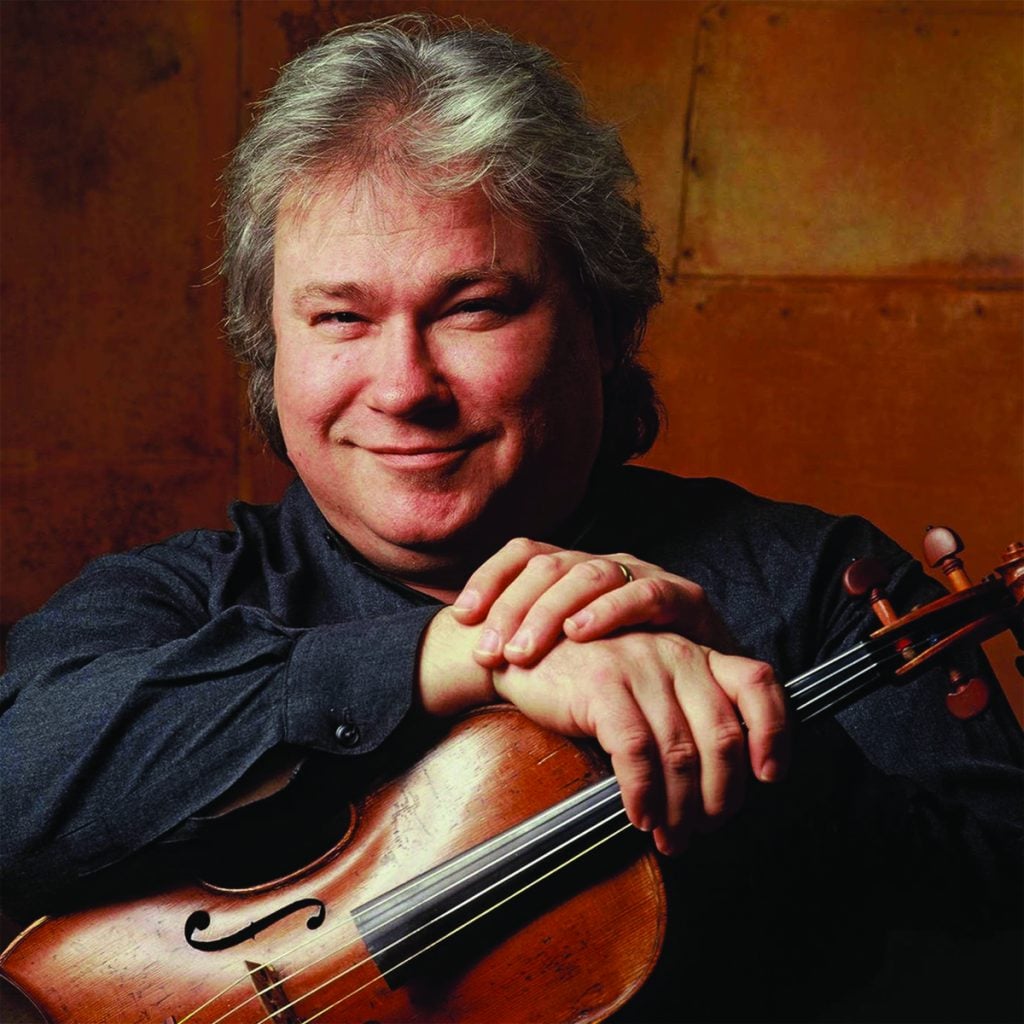
Peter Ostroushko (August 12, 1953 – February 24, 2021) was a world-class fiddler, guitarist, and mandolin player whose repertoire included – but was not limited to – bluegrass. As the son of Ukrainian immigrants growing up in Minneapolis, his interest in music began at age three when he discovered his father’s tater bug mandolin. His music career got underway in the middle 1970s when he made an uncredited contribution to a Bob Dylan recording. It was at the same time that he was asked to add his talents to the new roots-based variety radio show A Prairie Home Companion. Over a span of forty years, Peter appeared on over 250 episodes and, for a period of time, served as the program’s musical director. Working with a wide range of weekly guests on the show broadened and strengthened his musical sensibilities. Other media exposure included guest appearances on Austin City Limits, Mister Rogers’ Neighborhood and Late Night with David Letterman. Documentary filmmaker Ken Burns utilized Peter’s talents for the making of programs on Mark Twain and explorers Lewis and Clark. Still, Peter found time to tour with diverse entertainers such as Robin and Linda Williams, Norman Blake, and Chet Atkins. Over a 25-year period, starting in 1985, Peter released over fifteen recordings for the St. Paul-based Red House label. Fans of bluegrass and old-time music are probably most familiar with his outing with Norman Blake called Meeting on Southern Soil as well as The Mando Chronicles, a three-CD set that covered everything from bluegrass to classical and ethnic music from Brazil to Italy. Peter suffered a stroke in 2018 that left him with paralysis in his left arm and unable to play music. He devoted his energies to teaching music and hosting a podcast called My Life and Time as a Radio Musician.

Banjo player William Harvey “Bill” Runkle (January 7, 1939 – January 7, 2021) is best-known for his work as an early member of Del McCoury’s Dixie Pals, from 1970 to 1978. During that time, he appeared on four of McCoury’s albums including High on a Mountain (Rounder), the self-titled Del McCoury and Our Kind of Grass (both on Rebel), and Del McCoury & the Dixie Pals (Revonah). The Pennsylvania-born picker came by his music naturally; both his grandfather’s played fiddle and his mother and sisters all played piano. Bill’s parents appreciated country music and took him to see shows at area music venues such as Sunset Park. It was the radio in his father’s truck, which had better reception than the one in the house, that he used to listen to Bill Monroe on the Grand Ole Opry. Around the age of 8, Bill began playing guitar and it was a decade later, in 1959, that he took up the banjo. It wasn’t long before he was playing for square dances in a band known at the Country Four. This led to a six-year stint with Al Shade, an area radio personality. It was while working with Shade that Bill got a call from Del McCoury, needing a full-time banjo player. McCoury, who came from the same corner of Pennsylvania, hailed Bill as being “easily among the best” pickers to emerge from their section of the Keystone State. He appreciated Bill’s drive on the 5-string and his professional work ethic. Bill’s post-McCoury work included a year-long stay with Bob Paisley and the Southern Grass and a mid-1980s group comprised of former McCoury sidemen called Square Deal. Most recently, he led a group billed as Bill Runkle & Smith Hollow; their lone release on the Patuxent label was called Lonely Tonight. In addition to his banjo work, Bill hosted a bluegrass radio show for 25 years. Along the way, he found time to refurbish busses for touring musicians enjoyed restoring (and selling) old automobiles.