Notes & Queries – March 2023
Queries
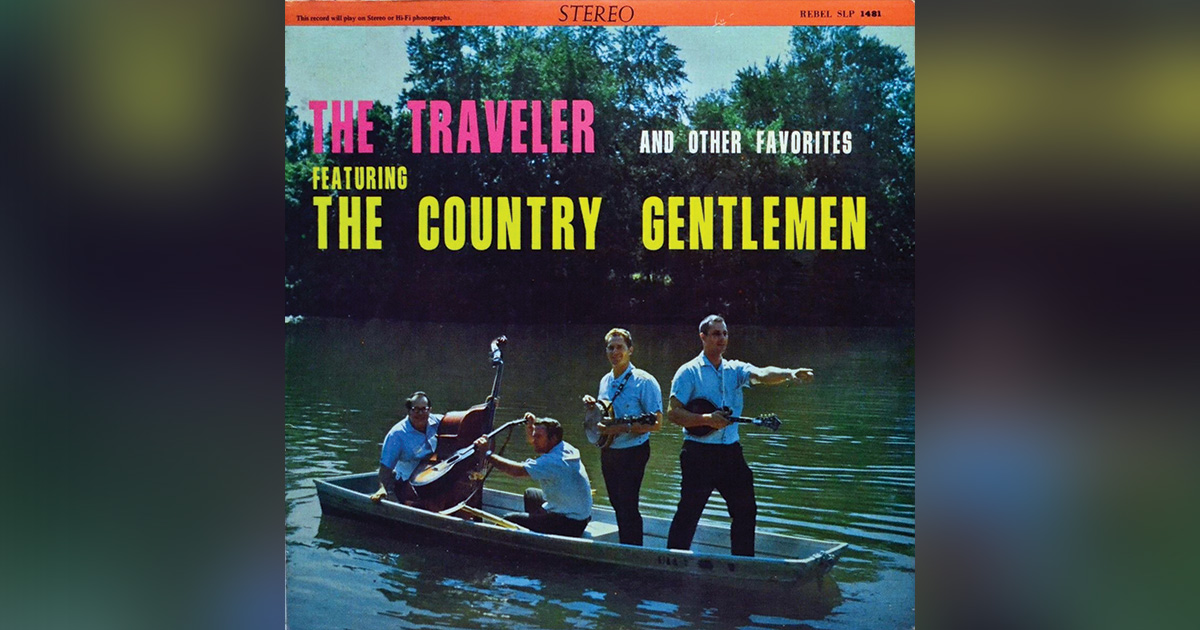
Q: I have a question about the photo of The Traveler album by the Country Gentlemen [Rebel SLP-1481, 1968]. According to my friends, the photo was taken in the Shenandoah River in 1968. I think this photo was modified later because it’s hard to believe that four big men with very expensive instruments would ride on a small unstable boat. Also, Eddie Adcock and John Duffey are standing firmly on a tiny boat. Please solve this mystery. Shigehiro Takeshita, via email
A: Your friends are mostly correct in that the album cover photo was taken in the Shenandoah River, but the year was 1967. While doing research for the booklet that would accompany a Country Gentlemen 4-CD set on Rebel (The Early Rebel Recordings, 1962-1971, issued 1998), I conducted an interview with John Duffey on June 4, 1995. During the interview, while discussing The Traveler album, I asked him “Where was the picture taken?” He replied, “That was down in Berryville [Virginia] in the river running behind Watermelon Park. The stage actually faced the Shenandoah River. There was a decent length of land [from] the audience area up to the river and there was a boat down there. One day we were looking for something goofy to take a picture of, so that’s how we did it. Ed Ferris was scared to death and finally we told Ed, ‘Sit still, you’re gonna tip this thing over’.” In a December 10, 1994, interview, Dick Freeland, who owned Rebel Records at the time The Traveler album was made, confirmed the location of the cover photo and added that the photographer was Ed Huffman. The photo was most likely taken when the Country Gentlemen were booked at Watermelon Park as part of the Third Annual Roanoke Bluegrass Festival that was promoted by Carlton Haney. They were billed as “special guests” on the Sunday afternoon, September 3, 1967, program. The album was released the following summer, ca. August 1968.
Q: I’ve been trying to confirm the guitar tuning that Charlie Monroe used on the Monroe Brothers’ 1936 recording of “What Would You Give in Exchange?” Unfortunately, I’ve been unable to find anything out via the internet. Is it true that Charlie used an open F tuning for this recording? Nathan L., via email
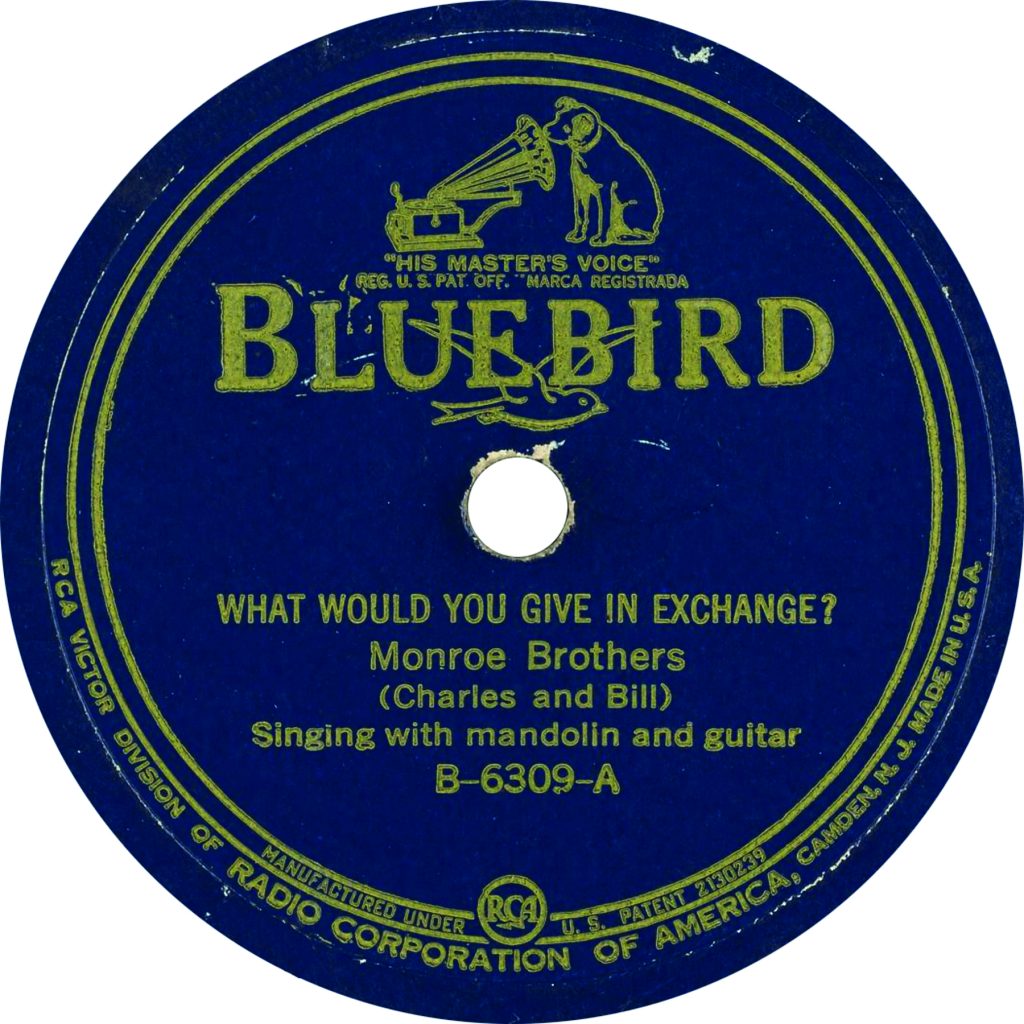
A: We ran this query past banjo/guitar ace Jeremy Stephens. His opinion is that Charlie Monroe’s guitar was tuned standard EADGBE and that he played in the key of F without a capo.
Something that you might find interesting is a 2009 publication, distributed by Hal Leonard, called The Country Guitar Style of Charlie Monroe. It’s a deep-dive into Charlie’s playing as heard on the Monroe Brothers’ recordings of the 1930s. One potential drawback: the examples are presented in standard musical notation, as opposed to tablature.
Q: After I finished the December 2022 issue featuring Earl Scruggs, I remembered my shelf of vinyl with nine Flatt & Scruggs albums plus one Earl Scruggs Revue. I got them out and noticed—I think for the first time—that all the album covers have artwork, not just photographs. I saw the names Tom Allen and Thomas B. Allen listed on the backs of some albums. I googled the artist and saw that he has sixty-two album covers to his credit, including seventeen for Flatt & Scruggs! Has anyone done any reporting on Tom Allen in relation to Flatt & Scruggs? How did he come to do so many of their album covers? Did he know Scruggs personally? Thank you. Paul Renner, via email.
A: Thomas Burt Allen (January 23, 1928 – November 8, 2004) was a Nashville native who made his mark as an illustrator. Trained in formal painting at the Art Instititue of Chicago in the early 1950s, he was tagged as a maverick who discarded romantic literal mannerisms in favor of painterly, abstract works.
By 1959, Allen relocated to New York. While there, he was commissioned to create a series of illustrations to accompany an article by Alan Lomax about folk music that was slated to appear in Esquire magazine. In a sidebar for the article, a brief paragraph told that “Painter Tom Allen . . . welcomed the chance to travel for Esquire to paint, in their own stomping grounds, some of the men who have made country music a part of the city scene.”
The Esquire article contained paintings of the Stanley Brothers performing under the cover of an angel band, a generic ensemble performing as part of a WWVA package show at Musselman’s Grove park in Pennsylvania, the Osborne Brothers on stage at the WWVA Wheeling Jamboree, a throng of music makers and listeners at New York’s Washington Square Park, and, perhaps most significantly, an image of Lester Flatt and Earl Scruggs that eventually found its way to the cover of the duo’s now-legendary Foggy Mountain Banjo album.
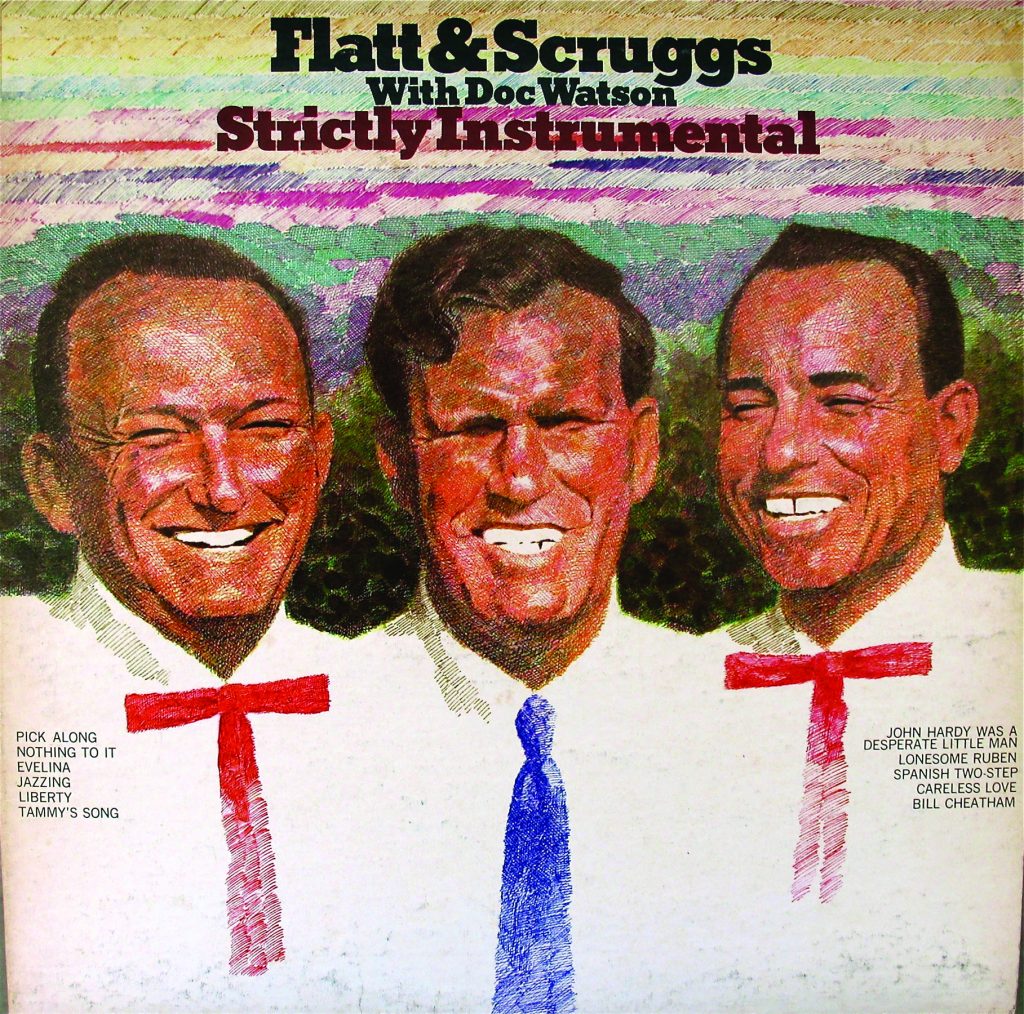
It was through the Esquire article that Allen was introduced to Flatt & Scruggs. Louise Scruggs, quoted in a remembrance of Allen by Natalia Mielczarek in The Tennessean, said that “I don’t have a habit of calling up strangers, but we wanted to meet Thomas Allen . . . We just got to be good friends. He always tried to put them in the best light he could.” From the same article, Earl Scruggs recalled that “back when I was recording for Columbia Records, we wanted something different for the covers than photographs. I think his art put prestige to the album covers. Tommy was just a great artist. We loved his work.” In all, Allen’s work appeared on eighteen releases by Flatt & Scruggs.
Prior to his work with Flatt and Scruggs, Allen illustrated several album covers for the Columbia, Philips, and Epic labels. Among the performers he illustrated were jazz musician Jimmy Rushing, Broadway actress and singer Lotte Lenya, composer Harold Arlen, and famed poet Carl Sandburg. Later triumphs included album covers for Little Jimmy Dickens, Mahalia Jackson, Aretha Franklin, Johnny Cash, Earl Scruggs, Pete Seeger, and even a few anthologies for Rounder Records. Allen’s work was also featured in major magazines such as Life and Sports Illustrated.
Although Allen enjoyed a robust career, he was “rediscovered” by the bluegrass and country music community in the late 1990s when Marty Stuart tracked down the illustrator. He subsequently engaged Allen for the purpose of illustrating the CD book for his 1999 release The Pilgrim. A few years later, Stuart spearheaded an exhibit of Allen’s work at the Country Music Hall of Fame in Nashville. A star-studded concert featuring Stuart, Earl Scruggs, and others, announced the opening of the display. Ironically, Allen was at work on graphics for another Marty Stuart recording at the time of his passing in 2004.
Bill Emerson Archives
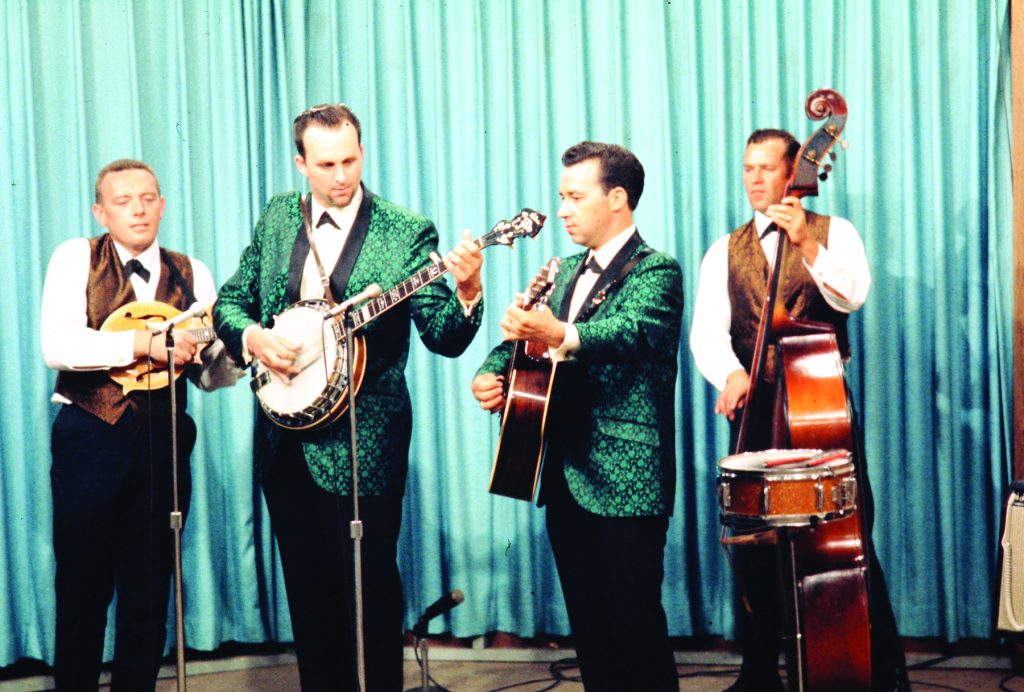
Since the recent passings of banjo legend Bill Emerson and his wife Lola, members of the Emerson family have been sifting through their parents’ memorabilia and unearthed a number of photographic treasures. Mike Emerson reached out recently to share several previously unissued photos that highlight Bill Emerson’s partnership with Cliff Waldron in the late 1960s.
In March 1968, Bill Emerson was in partnership with Wayne Yates in a group called the Kentucky Gentlemen. Other band members included Cliff Waldron on guitar and Earl Brown on bass. That group remained in place until June 1968. In July, the new group of Bill Emerson, Cliff Waldron and the Lee Highway Boys played some of their first show dates, with appearances at Maryland venues including Zebelean’s Lounge in Baltimore, the Red Fox Inn in Bethesda, the Bar B Q Pit in Gaithersburg.
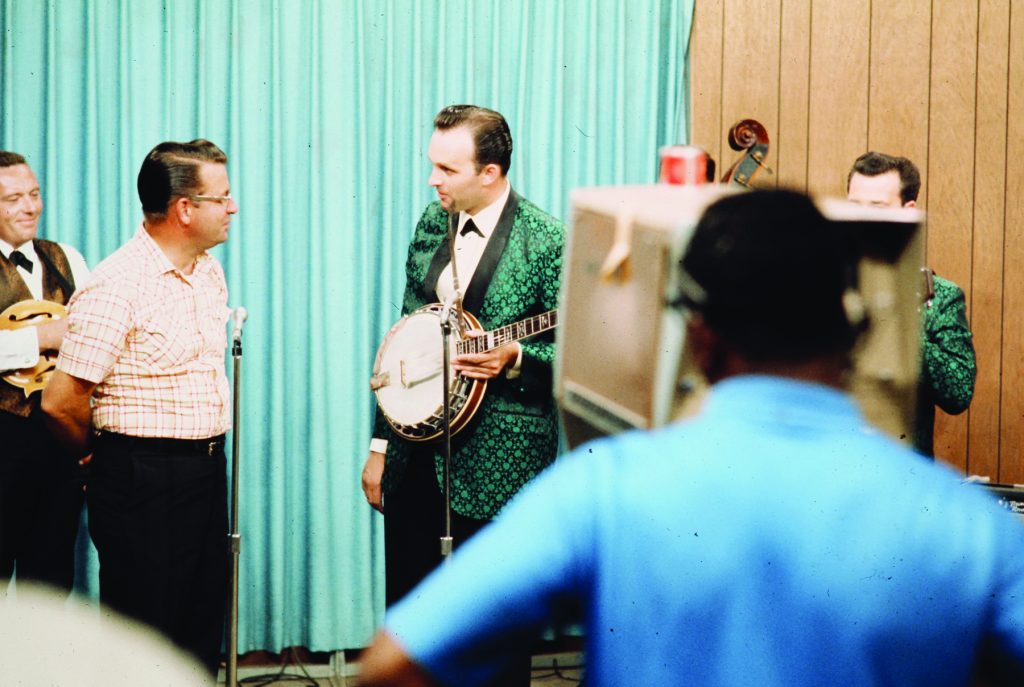
Two photos, both dated July 1968, show the new group in action in the studios of WMET, channel 24, in Baltimore. The studio was located in what used to be the Avalon Theatre, which was located at 4340 Park Heights Avenue in Baltimore. Emerson and Waldron ostensibly appeared on a program called Wally Horton’s Hayloft. Although Horton fronted a mainstream country band with electric guitar and steel (some of which can be found on a 45 rpm release on the Rebel label), he occasionally hosted area bluegrass groups as guests. A double bill on this particular date also included Delmar Delaney and the Windy Mountain Boys. Delaney took over the program a short time later and renamed it Delaney’s Hayloft; it aired for several years before signing off on October 29, 1970.
When I’m Gone
Although the performance dates have come and gone, it’s worth noting the world premiere of a play that recreated the night when Ralph Stanley discovered two future country music heavyweights: Keith Whitley and Ricky Skaggs. Written by Toronto-based playwright Michael Ross Albert, the production When I’m Gone made its debut at the Garden Theatre in Louisa, Kentucky. Ironically, the Stanley Brothers made a number of appearances at the theatre during the 1950s and ‘60s.
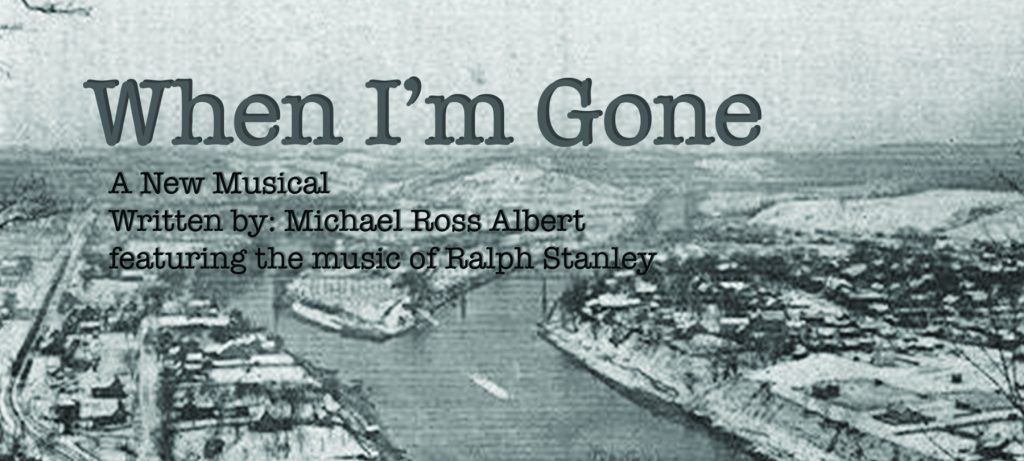
Tagged as “a new musical” and “featuring music by the Stanley Brothers,” promotional materials for the show told that “on the night Ralph Stanley and the Clinch Mountain Boys came to Fort Gay [West Virginia], the lives of two teenage musicians were changed forever. After arriving late to a New Year’s Eve gig at a local bar in 1969, Ralph Stanley hears fifteen-year-old Ricky Skaggs and Keith Whitley singing the songs he himself made famous with his deceased brother and singing partner, Carter. Ralph is so moved by their performance that he takes the two young musicians under his wing and on the road with him, jump-starting their professional music careers and setting them both on the path to world fame. The other people who came to the bar that New Year’s Eve may not have become celebrities, but that night had profound, life-changing consequences for everyone who saw Ralph Stanley play.”
The show’s musical director, Don Rigsby—who, in 2013, produced his own tribute CD to Ralph Stanley called Doctor’s Orders, noted that “up around here, Ricky and Keith meeting Ralph Stanley is legendary for all of us musicians . . . my greatest influences are those three people that are being portrayed in this play: Ricky, Keith, and Ralph Stanley.”
Albert reflected that “on top of hearing amazing music, played beautifully, there is a real celebration in this story. It’s a celebration of a time and place and I think at the end this is a really hopeful story about people growing, transforming, and really taking control of their lives.” He added that “learning about Ralph and Carter over the past year and half of working on the script has been very rewarding, and I appreciate learning even more about their history in the region. I’m hopeful that When I’m Gone will have a life in the future.” Be sure to check the Mountain Movers Theatre Company website for future updates mtnmoverstheatre.com.
Over Jordan
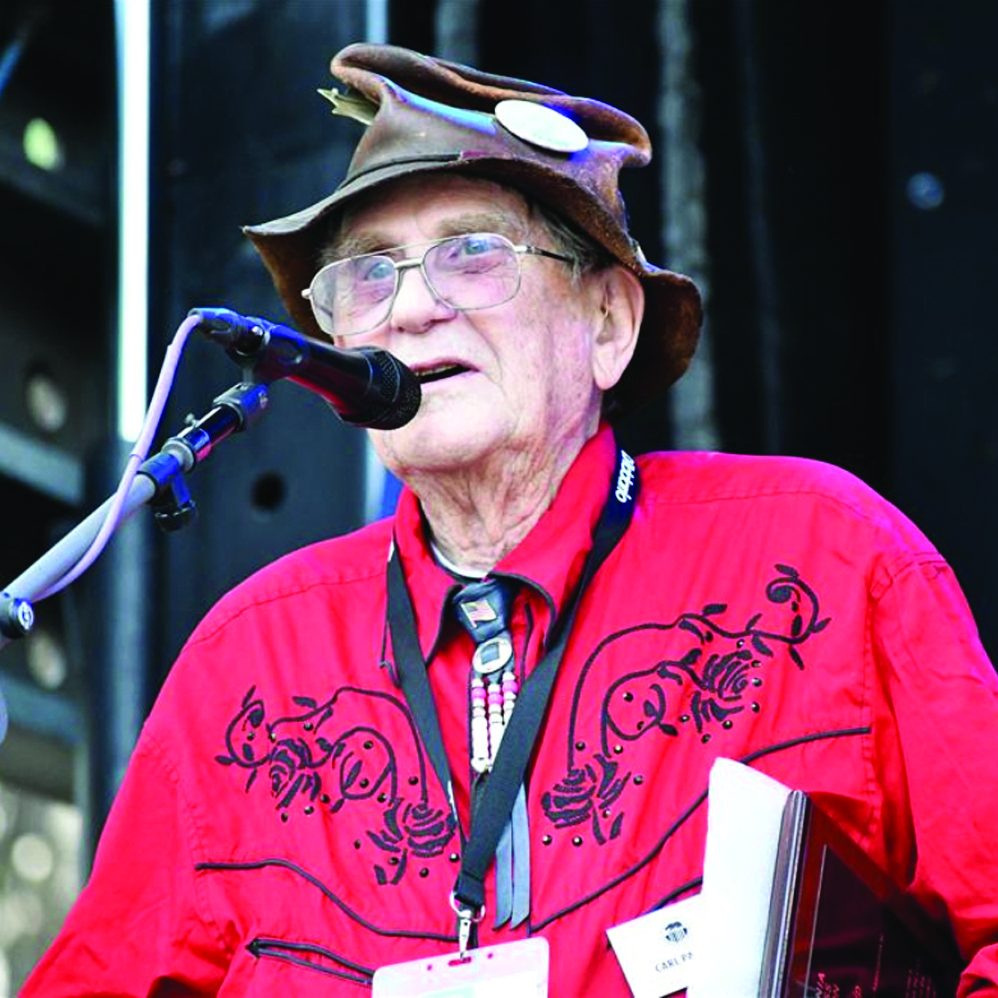
Carl Richard Pagter (February 13, 1934 – January 3, 2023) wore many hats (including his trademark crumpled leather picking hat!) in bluegrass and old-time music – band leader, organizer, recording artist, and facilitator, to name but a few. To many, he was known as Member #1 of the California Bluegrass Association, an organization of which he was a co-founder and which morphed into one of the largest, if not THE largest, regional bluegrass music associations. As a clawhammer banjo player, he fronted the bluegrass-friendly old-time band Country Ham – the group had over a dozen album releases to its credit. He brought his professional expertise as a lawyer to both the International Bluegrass Music Association and the International Bluegrass Music Museum by serving on the organizations’ boards of directors and/or trustees.
Pagter’s exposure to rural country music began in the mid-1940s when he heard occasional broadcasts of the Grand Ole Opry. But it wasn’t until 1957 that bluegrass, specifically, caught his ear. It was then that a fellow naval officer introduced him to Flatt and Scruggs and the sound of the five-string banjo. Discovery of other entertainers such as Mac Wiseman and Bill Monroe soon followed.
While still in the Navy, Pagter began performing in public as part of a twin ukulele duo. After transferring to Alameda, California, in 1960, he ordered a long-neck Vega banjo, a la Pete Seeger, and began performing as part of a banjo/guitar duo. After experimenting with three-finger style banjo, and finding the metal finger picks too cumbersome, Pagter concentrated on two-finger and frailing styles.
In 1970, while working as a lawyer for Kaiser Industries, Pagter was transferred to Washington, D. C., which enjoyed a thriving bluegrass music scene. He attended numerous festivals and fiddlers contests in the region and assembled a group called the Spout Run String Band.
Returning to California several years later, Pagter was keenly aware of the dearth of bluegrass festivals and events there, as well as a lack of means for bluegrassers to communicate with each other. Consequently, the California Bluegrass Association (CBA) was launched on December 1, 1974. The association currently boasts 2,600 members, produces the annual Father’s Day festival in Grass Valley (launched in 1976), and publishes the Bluegrass Breakdown newspaper (first published in 1975).
Despite living on the West Coast, Pagter maintained an East Coast connection. In the middle 1970s, the Spout Run band morphed into Country Ham. The group embarked on a series of well-received albums for Cincinnati-based Vetco Records and enjoyed an active personal appearance schedule. A highlight of the group was singing and instrumental work of Judie Cox. Carl and Judie’s chemistry was more than musical and they married in 1978.
With the advent of the International Bluegrass Music Association’s World of Bluegrass events, Pagter and the CBA organized one of the most successful after-hours showcase suites. The hospitality spot became one of the go-to places where talent gained valuable exposure to promoters, press, radio, and producers.
Pagter’s past experience as chair of the CBA and his involvement with IBMA events eventually led to his serving on the latter organization’s board of directors. He later served on the board of trustees of the International Bluegrass Music Museum and was a treasurer/board member of the Foundation for Bluegrass Music.
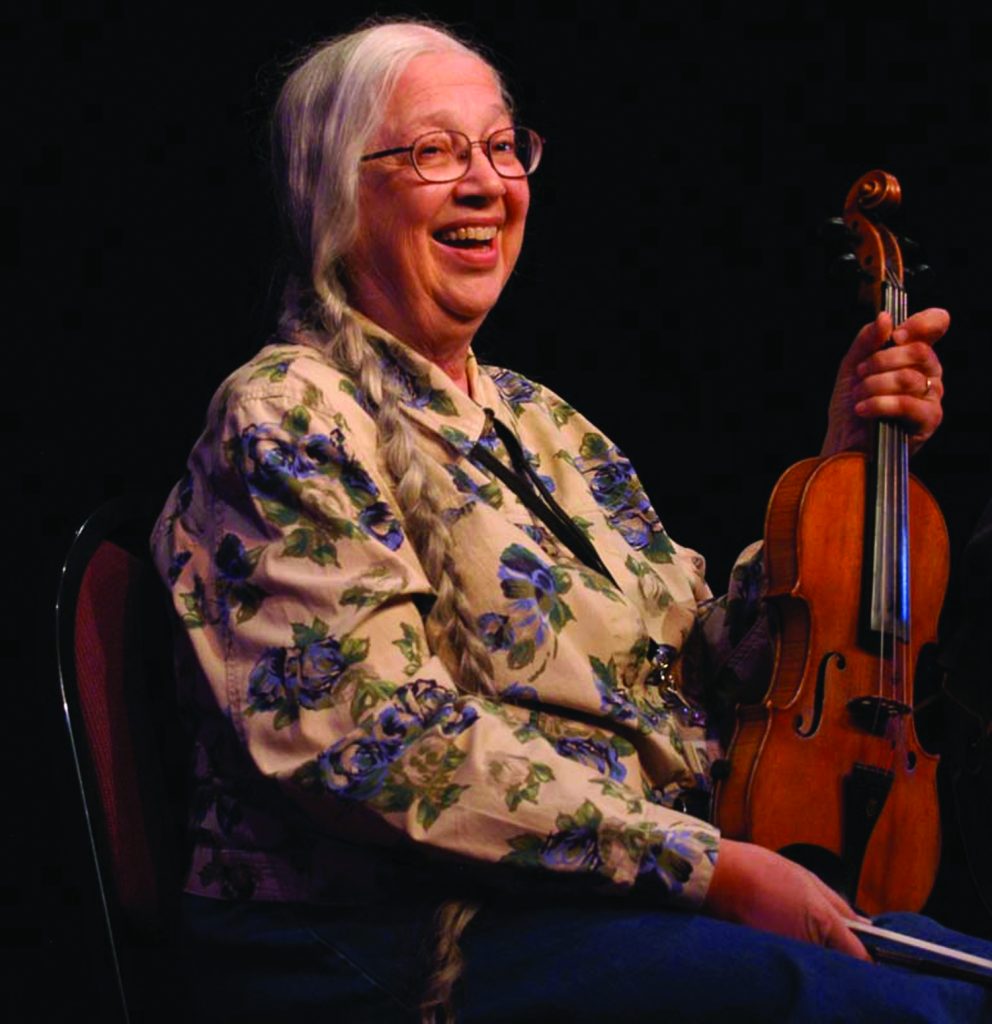
Vivian Tomlinson Williams (May 27, 1938 – January 6, 2023) was an award-winning fiddler from Seattle who had a passion for collecting and playing old fiddle tunes. With her husband, the late Phil Williams, she was active in several bluegrass bands and was a partner in a record label known as Voyager Records. Phil, a lawyer by trade, usually engineered the albums and Vivian served as producer/label manager.
A native of Tacoma, Washington, Vivian received early training as a classical musician. In the middle 1950s, she met future husband Phil when they were both attending Reed College in Portland, Oregon. A November 12, 1957, concert by Pete Seeger at nearby William and Clark College set the couple on a trajectory of old-time and (later) bluegrass music. Phil became obsessed with the 5-string banjo and Vivian, as she once quipped, took up the fiddle in self-defense.
Vivian and Phil married in 1959 and settled in the Seattle area. There, they began making music with a number of musicians who had relocated from North Carolina to work in the timber industry. The couple formed their own band in 1962: the Turkey Pluckers. The group recorded several 45-rpm singles for the regional Crossroads label and also backed up Vivian on a solo disc: “Lee Highway Ramble” b/w “Back Up and Push.” The couple also did recording and production work for the label.
The middle and late 1960s were busy years for Vivian and Phil. In 1964, they formed a new band: the Tall Timber Boys. In time, this morphed into the Tall Timber Gang and, eventually, just Tall Timber. Vivian also played in an all-female group called the White Pine Girls. From 1966 to 1968, Vivian held forth as the National Ladies Champion at competitions in Weiser, Idaho.
One year from Vivian’s past, 1967, stands out in particular. On May 6, she and Phil served as de facto Blue Grass Boys when Bill Monroe showed up in Seattle and was in need of musicians. Having a little bit of advance notice, Vivian rehearsed and learned tunes associated with the bluegrass patriarch. Monroe complimented her on one piece in particular, “Grey Eagle,” saying that “a lot of men fiddlers can’t beat her.” It was also in 1967 that Phil and Vivian launched Voyager Records, a label with a heavy emphasis on fiddle music of the Pacific Northwest. In time, the firm released over 80 albums and compact discs. Vivian was among the first of only a few women who were actively involved in the album production side of bluegrass and old-time music.
During the 1970s, Vivian taught fiddle to area students. She even collaborated with one student, Barbara Lamb, on a 1975 album called Twin Sisters; Lamb later co-founded the all-female group Ranch Romance. Vivian’s first solo album came in 1979: Fiddler. Later recordings included a group project with husband Phil and friends Shera and Harley Bray (the latter of Red Cravens and the Bray Brothers), a live album with Phil, and most recently an outing called Fiddling Down the Oregon Trail.
Long-time friend Barry Brower called Vivian a “true giant of Washington state folk music” and hailed her accomplishments as “a champion fiddler (50+ fiddle trophies), composer, documenter of Northwest folk music, mentor to countless aspiring fiddlers, and many other things too numerous to list. Most of all, she was an all-around extraordinary human being, humble and unassuming about her achievements.”