
Notes & Queries – March 2022
Queries
Q: Does anyone know how Margie Sullivan of the Sullivan Family is doing. I know Enoch passed away, but haven’t heard anything on Margie? Still think she is one of the best female bluegrass gospel singers ever. Thanks.
– John Bond, via email.
A: We were able to contact a family member who reported that Margie turned 89 on January 22. She has some mild issues with memory but is otherwise doing great. Her advice to readers of the magazine: Trust God.
Q: I am trying to find lyrics or a recording of a song that my dad used to have in 8-track format. It was by the Kings Countrymen. Part of the lyrics are: “I’m gonna lay down my pick, gonna lay down my shovel, when it’s camp meeting time for the Lord.” If I remember correctly there was some really good Scruggs-style three finger picking guitar on some or all of the breaks. I appreciate any help that you can give me, including information about the group.
– Wayne Craft, via email
A: The song you asked about appeared on the group’s 1974 album called Gospel Music Bluegrass Style. The album has been out of print for many years now but a YouTube search for “King’s Countrymen” brings up the entire album. The title of your song is “Camp Meeting Time” and was written by the group’s banjo player, Andy Purdy.
Veteran BU reviewer/columnist Walt Saunders wrote of the Gospel Music Bluegrass Style album that “I’ve always liked this group . . . what really got me listening was their driving instrumental arrangements and excellent choice of material. Put this together with singing that, if not exceptional, is at least well above average, and you have a combination hard to beat.” He cited the “excellent banjo work of Andy Purdy and solid lead guitar of brother Warren” as key components of the group’s sound.
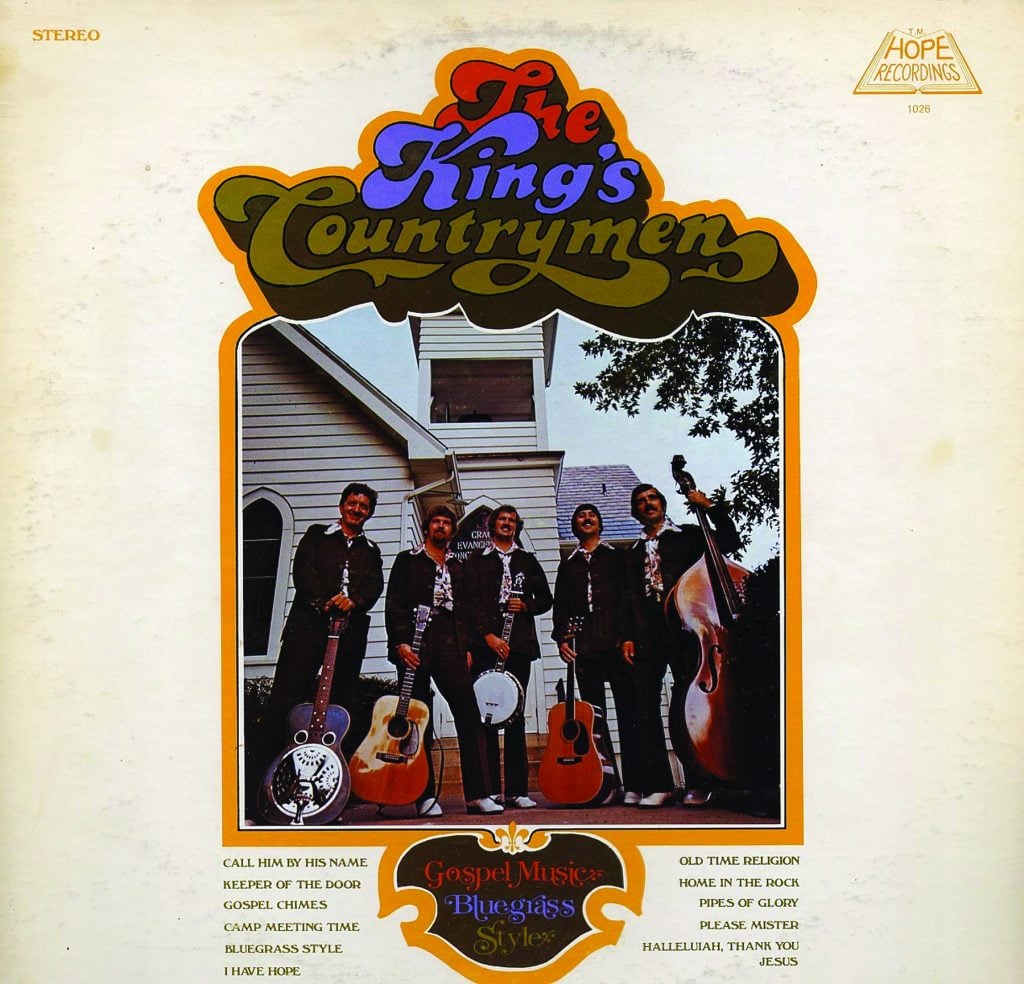
The King’s Countrymen came together shortly after meeting at an all-day homecoming at a church in Elmer, New Jersey. For a number of years, the group traveled as a quartet that consisted of John Bobbitt playing rhythm guitar and singing lead, Mally Jones singing and playing bass, and brothers Andy and Warren Purdy, playing banjo and lead guitar respectively. By the time of the group’s 1974 album, the personnel changed to include Ken Cox on guitar and vocals, Tracy Rice on bass and vocals, Dick Blattenberger on dobro, and the Purdy brothers.
The group was most active during the middle and late 1960s and into the 1970s. They brought bluegrass gospel performances to church services in the Pennsylvania/New Jersey area and also appeared at a number of bluegrass festivals. They were favorites at the Shindig in the Barn which was located near Lancaster, Pennsylvania. The group had six album releases to its credit: The Sweetest Songs We Know; Come One, Come All; Standing in the Need; A Better Way; Gospel Music Bluegrass Style; and Someone Up in Heaven.
Camp Meeting Time
I’m gonna lay down my pick, gonna lay down my shovel
When it’s camp meetin’ time for the Lord
Gonna get my sinful soul clean out of trouble
When it’s camp meetin’ time for the Lord
Chorus:
When it’s camp meetin’ time for the Lord
When it’s camp meetin’ time for the Lord
I’m gonna stand up and sing, shout hallelujah to the King
When it’s camp meetin’ time for the Lord
Let us cast aside all our earthly greed and sorrow
When it’s camp meetin’ time for the Lord
Let us turn our attention to the promise of tomorrow
When it’s camp meetin’ time for the Lord
© Andrew Purdy, used by permission.
Q: I found a bluegrass CD that has a song on it with no title and no artist. The verse to the song goes, “It was late one night when the snow was on the ground; A rage a man broke silence in the night; Married just a year, he took her life right here; And stabbed her with a long sharp Bowie knife.” Any thoughts about the Title and/or artist that recorded it?
– John Fox, via email
A: Alex Leach, host of The Bluegrass Special on WDVX in Knoxville, Tennessee, solved the mystery. He told us that “that’s Alvin Breeden and the Virginia Cutups with Charles Frazier singing lead. Recorded in 1999, I believe. Charles is a friend of mine and recorded some great music with Alvin thru the years. The name of song is ‘The Wind in the Pines’.” The song appeared on Alvin’s CD Yesterday, Fifty Years Ago.
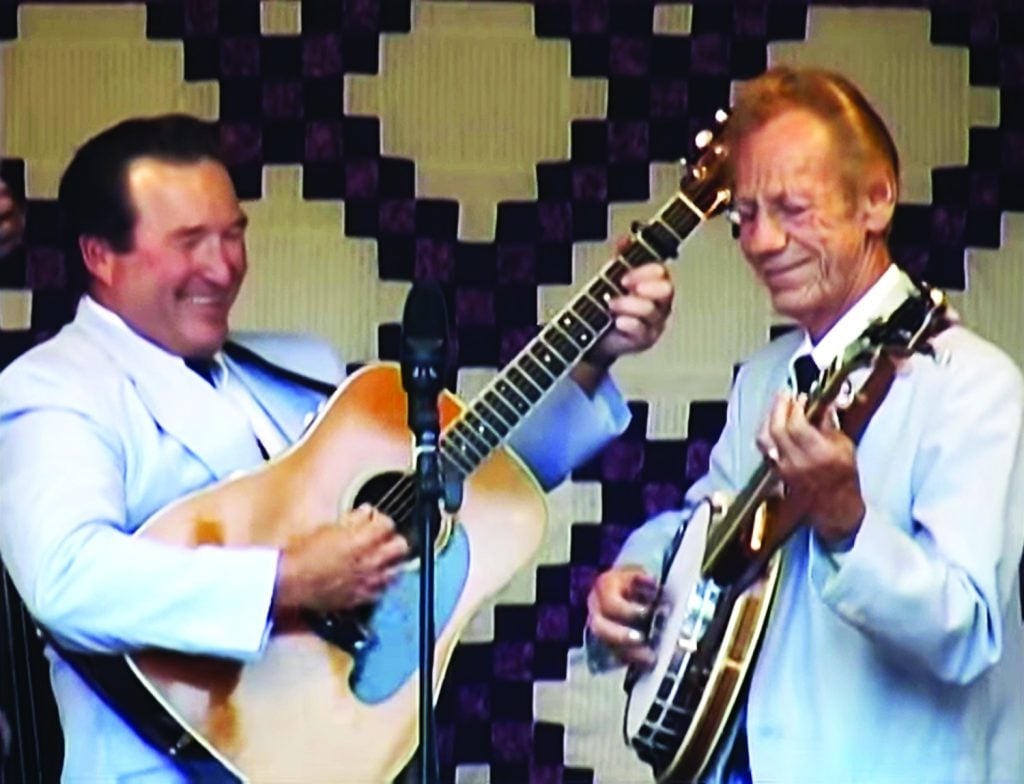
We reached out to Charles Frazier for some background information about the song. He told us that “my dad and my granddad, they were born and raised up on Skyline Drive, before the Skyline Drive was there, of course. We lived up in a holler at the foot of the mountains and lived on a big farm back when I was a little boy and I just remember seeing all that . . . and then the snow glistening in the night with the moon shining on it, I remember that very vividly. I just kind of used all of that putting that song together. Every time I sing it, it brings back memories of my childhood. Of course, the song is fiction, about killing a man’s wife. I remember as a little boy my daddy and my granddaddy used to talk about things back up in the mountains when people would do strange things and get away with them. That’s kind of where the song came from.”
Wind in the Pines
It was late one night when the snow was on the ground
A raging a man broke silence in the night
Married just a year, he took her life right here
And stabbed her with a long sharp Bowie knife
Chorus:
Oh I long to hear the whine of the wind up in the pines
As the moonlight glistens on the snow
Where a man killed his wife but he also lost his life
He’s gone where no one will ever know
I tracked him up and down the ridge above the town
I caught him as the snow was coming down
He pleaded for his life but I took it there that night
And buried him beneath the swinging pines
Well the judge sent me to trial I didn’t get but a little while
They charged me with the killing of that man
Well they all said I knew but they could not prove it true
They’ll never find him in the deep dark sound
© Charles Frazier, used by permission
Stanley Brothers Feedback
Photos from the December/Stanley Brothers issue of the magazine generated several queries from our readers. Page 14 featured an uncaptioned, on-stage picture of the group. It was taken at New River Ranch in Rising Sun, Maryland, on September 7, 1958. The group featured a guest fiddler that day, none other than long-time Bluegrass Unlimited editor Pete Kuykendall. It was Pete’s second day in a row to perform with the band, having appeared the night before at a firemen’s carnival in Vienna, Virginia. Pete’s appearance on stage at New River Ranch was apparently unplanned as a tape of the show captured a comment directed to him, in the audience, by Carter Stanley: “Pete, where’s your fiddle?” He then appeared on the remainder of the afternoon and evening performances at the park. The photo was taken by Pete’s then-future wife, Ann Lea Hill; the couple married on January 12, 1959.
The same photo prompted a message from mandolin master David Harvey who asked if the partially hidden mandolin player could possibly have been his father, Dorsey Harvey. Other photos that were taken on the same day revealed the mandolin player to be Bill Napier, and not Dorsey Harvey. But, the similarity lay in their F-5 mandolins, both of which had light, natural wood finishes (as opposed to the more common dark finishes on most other mandolins of the same period).
So, the musicians featured in the photo are, from left to right, Pete Kuykendall, Ralph Stanley, Al Elliott (dressed in comedic garb as Towser Murphy), Carter Stanley, and (partially-hidden) Bill Napier.
The other photo query concerned the image of Bill Monroe and Carter Stanley on page 46. A reader asked if the unidentified banjo player was Tony Ellis. Yes! Others in the photo are, from left to right, Bessie Lee Mauldin, fiddle player Billy Baker (partially hidden), Bill Monroe, guitarist Bobby Smith (partially hidden), Carter Stanley, and Tony Ellis. The occasion for the photo was the All Blue Grass Show that was staged by Bill Clifton at Oak Leaf Park in Luray, Virginia, on July 4, 1961. The event reunited Monroe with several past Blue Grass Boys, including Mac Wiseman and Carter Stanley. It was the first such event to recognize Monroe as the central figure in bluegrass music. As with the Stanley Brothers photo from page 14, this photo, too, was taken by Pete’s wife, Ann.
Over Jordan
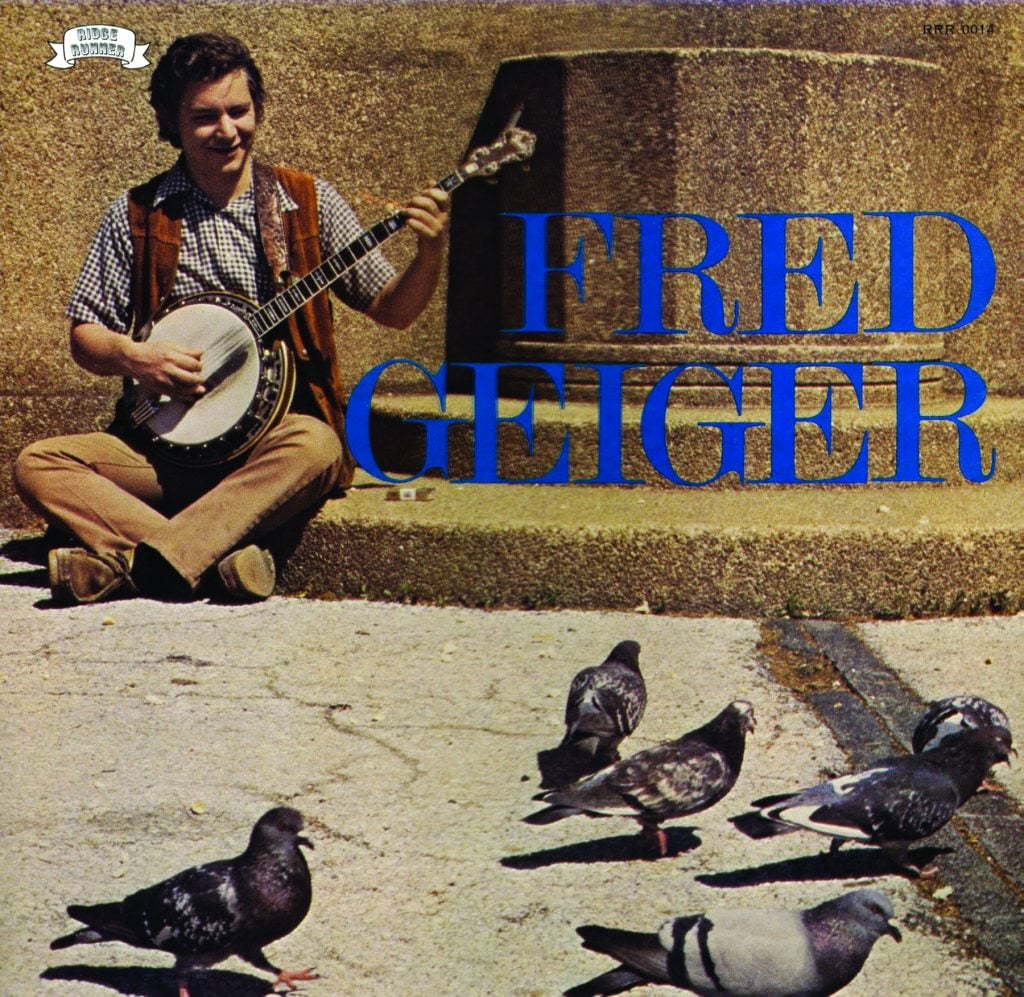
Frederick Casper “Fred” Geiger Jr. (September 4, 1940 – January 13, 2022) was a banjo stylist who oftentimes fused tunes from other genres with bluegrass. A native of Philadelphia, he developed an early interest in rural/roots music when he discovered the Sleepy Hollow Ranch Gang, a local singing cowboy outfit, on the radio. Later listenings to other stations such as Wheeling, West Virginia’s WWVA and Cincinnati’s WCKY sparked Fred’s interest in bluegrass.
Fred started out on guitar at age eighteen and progressed to banjo a few years later. During the early 1960s, he soaked up a lot of the rich bluegrass culture that was to be found in Baltimore. One of his first performance opportunities was as a member of Delmer Delaney and the Windy Mountain Boys.
Banjo Newsletter founder Hub Nitchie spoke of Fred’s early playing by noting that he had “always been impressed with the things he does on the banjo. Bill Keith has been a major influence on his style but there is enough of Fred’s own ideas in his playing to keep him from being called a carbon copy. He can also play straight hard-driving Scruggs’ style but his main forte is taking the banjo and treating it as an instrument without any limitations, and exploring tunes from other areas than Bluegrass.”
Fred relocated to the Washington, DC, area in 1969 to take a job with the Washington Star newspaper. He occasionally placed articles about bluegrass in with the news stories of the day. He also contributed articles to Bluegrass Unlimited as well as to Blueprint, a Washington-based bluegrass newspaper.
Fred’s longest-running writing assignment was his “Chorducopia” column in Banjo Newsletter. A regular feature since the earliest days of the magazine, it focused on the “practical application of music theory to the banjo, with Scruggs-style as a point of departure. The intermediate-to-advanced tabs explore material from the worlds of bluegrass, jazz and popular music.”
Most of Fred’s banjo activities centered around performing with local groups from the Washington area and teaching. An interesting departure was his appearance in a 1980s Washington staging of a western melodrama called Deadwood Dick. In 1977, he released a self-titled album on the Ridge Runner label that fused jazz styles with bluegrass. The early 1990s found him performing with the Gary Ferguson Band. The group’s 1992 release, Without You, included a Fred Geiger original called “Baltimore.” His most recent recording was a track on The Patuxent Banjo Project, “Blue Grass Stomp.”
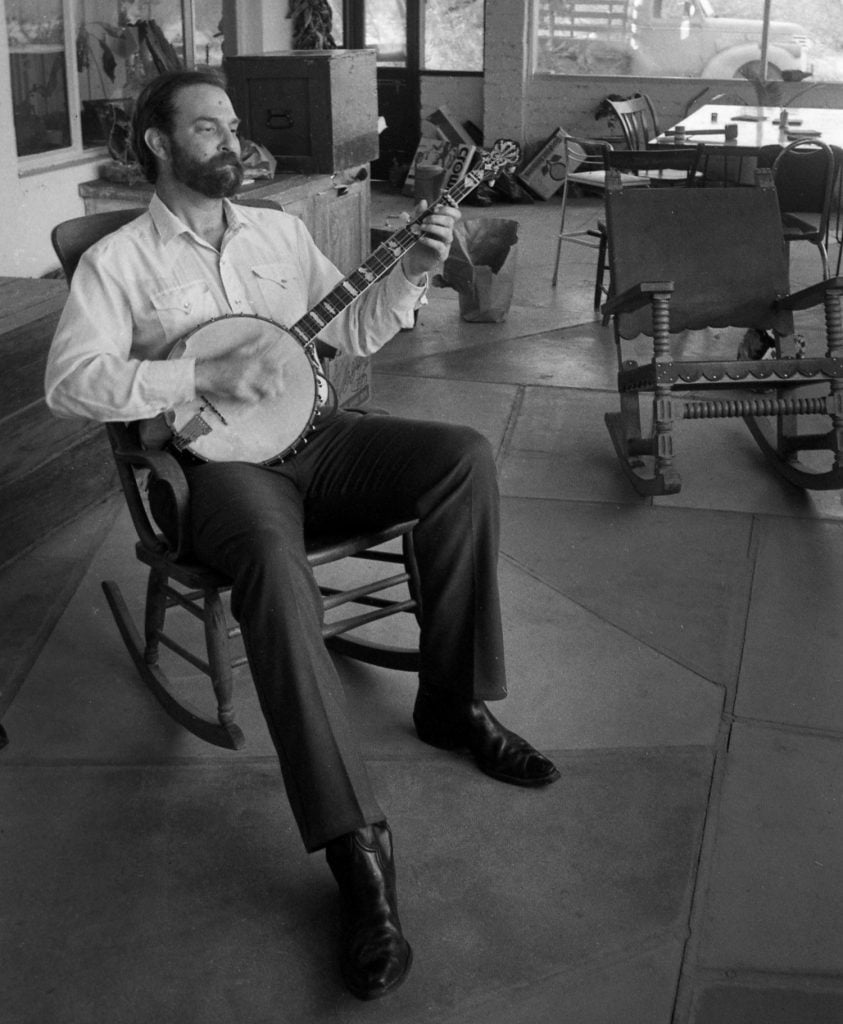
James Seavey “Big Jim” Griffith (July 30, 1935 – December 18, 2021) was a banjo-playing ambassador for bluegrass and old-time music in the Dessert Southwest for over fifty years. Standing at six feet, seven inches tall, he earned the nickname of Big Jim honestly. A native of Santa Barbara, California, he relocated to Tucson, Arizona, in 1955 for school. He picked up the guitar in 1956 and later the banjo in 1960.
It wasn’t until the 1970s that Griffith, a career anthropologist, began juggling (and including) music with work. In May 1974 he logged an appearance the Tucson’s Bluegrass & Old-Time Music festival. In 1975, he reviewed records for the Arizona Friends of Folklore, appeared in Arizona Public Theatre’s staging of the western musical Diamond Studs (which ran for ten weeks), and presented a lecture at the University of Arizona music school called “Bluegrass Music – What It Is and How It Got That Way.”
In 1976, Jim joined the staff of Bluegrass Unlimited magazine. Over a three-year period, he served as a record reviewer and submitted fifty-two critiques to the magazine. He also wrote a 1978 article called “What Unlimited? Confessions of a Record Reviewer.” In it, he outlined the challenges that reviewers experienced in the face of an ever-changing music. He offered a disclaimer, of sorts, by stating “If this article has shown a conservative bent, I’m not surprised – my musical tastes are in that direction.” Years later, he owned up to the fact that “the Stanley Brothers were my favorite bluegrass band, hands-down.”
During this same period of the middle 1970s, one of Jim’s musical collaborators was Leslie Keith, the often-hailed first fiddle player to work with the Stanley Brothers. Leslie had settled in the Tucson area and played on numerous occasions with Jim. Some time after Leslie’s passing in December 1977, I reached out to Jim to ask if Leslie had shared any stories of his Stanley Brothers days with him, and did he know Leslie very well. Jim wasn’t able to help with any Leslie Keith/Stanley Brothers stories but he answered the second half of my question by stating “I was two floors below him in the hospital when he passed away.”
It was also in the middle 1970s that Jim spearheaded a community event known as Tucson Meet Yourself, “an annual celebration of the living traditional arts of Southern Arizona’s and Northern Mexico’s diverse ethnic and folk communities.” The three-day free festival continues to this day. In 1979, Jim was appointed director of the University of Arizona Southwest Folklore Center; he held the position until his retirement in 1998.
Big Jim brought bluegrass to a region of the country far removed from the music’s heartlands. The Southwest Folklife Alliance observed that he “will be remembered with a banjo in hand and field notebook in his pocket, and for his deep respect for the cultures and communities who call the Southwest and U.S.-Mexico Borderlands home.”
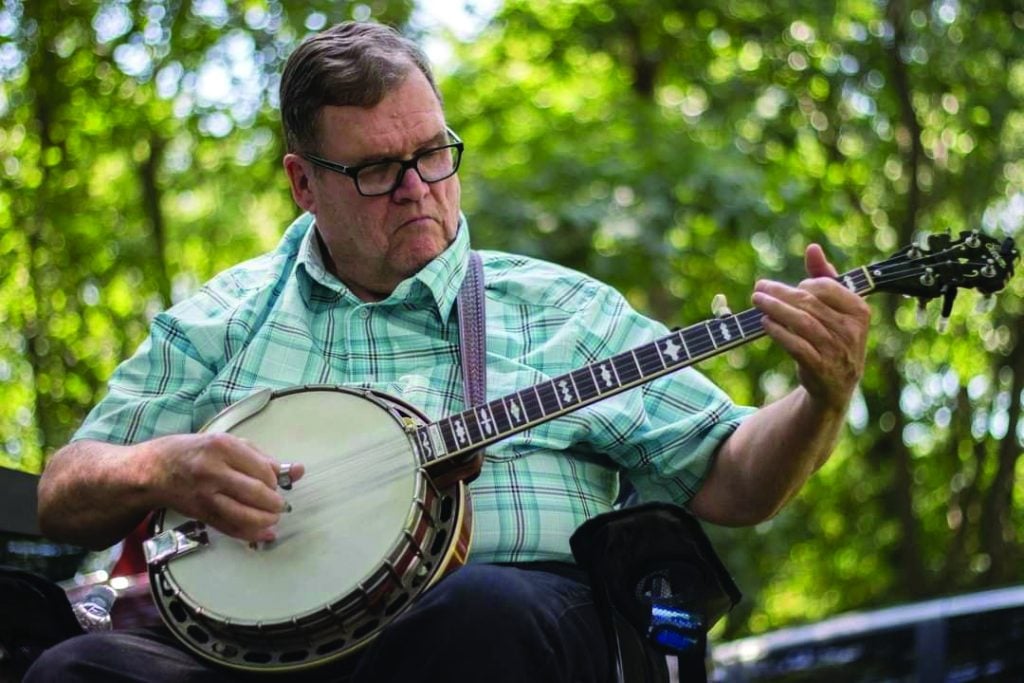
Thomas W. “Tommy” Neal (June 1948 – January 11, 2022) was a versatile Maryland-based banjo picker who logged over fifty years of performance experience. He was exposed to the music at early age by his father, who played mandolin, fiddle, and guitar and who also took him to country music parks such as New River Ranch; Sunset Park; Elicker’s Grove; American Legion Park in Culpeper, Virginia; and Lake Whippoorwill.
Tommy’s early musical efforts revolved around the electric guitar and pickers such as Merle Travis and Chet Atkins. A few years later, around 1966, he acquired his first banjo and set out to emulate Don Reno. It wasn’t long before others, such as Earl Scruggs, Alan Munde, and Bill Keith captured his attention.
Throughout his adult life, Tommy was a heavy equipment operator but he managed to balance work and music. His first recording experience was as a bass player on part of Del McCoury’s first album, Del McCoury Sings Bluegrass. In 1972, he plied his banjo talents to an album titled Pickin’ Around the Cookstove (with mandolin player Dick Staber and fiddler Tracy Schwarz). Tommy’s version of “John Hardy” later appeared on the 1992 disc, Son of Rounder Banjo.
During the summer of 1973, Tommy worked as a regular with Cliff Waldron and the New Shades of Grass. He appeared on one of the group’s albums, Bluegrass Time. Afterwards, he devoted his energies to working with several Baltimore-based groups including Grass on the Rocks and Country Grass. He also subbed occasionally for various members of Walter Hensley’s Duke of Bluegrass.
After spending three years in the middle 1990s with Jeff Pressley and South Central Bluegrass, Tommy embarked on his longest running venture, Bluestone. The group initially centered around Tommy, mandolin player Dick Laird, and guitarist/lead singer Carroll Swam. Later notables included dobro legend Russ Hooper and ace fiddler Jon Glik. It was while working with Bluestone that Tommy made his only solo recording, Banjoland.
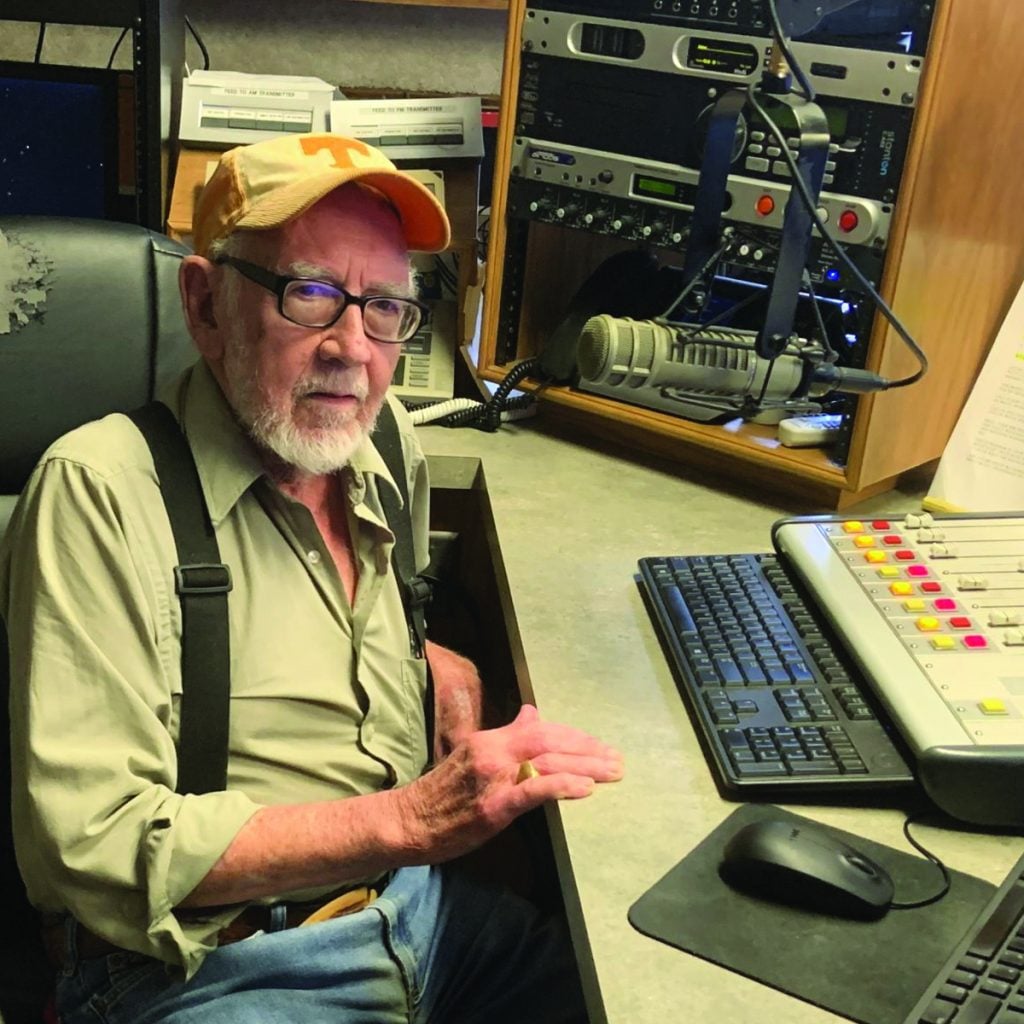
Carl Eugene Stump, age 86 of Kingston, Tennessee, passed away on Wednesday, December 22, 2021, in Oak Ridge, Tennessee. He was born in Lebanon, Virginia, on February 27, 1935. For 30 years, Carl was an engineer and on-air announcer for local radio stations WHBT in Harriman, Tennessee, and WECO in Wartburg, Tennessee.
When WECO first signed on the air in August 1970, Carl’s was the first voice to be broadcast over the airwaves. WECO general manager Ed Knight reported that “Carl did the morning shift for over thirty years and many of those years also hosted the Bluegrass Tour Unlimited Show on Sunday nights. He established the foundation for WECO’s success.”
Upon his retirement from WECO in 2020, Carl told the Morgan County News that “I’ve been a bluegrass person most of my life, and I’ve liked presenting it to the listening audience. I’ve tried to play what they wanted to hear . . . I thought there were a lot of people that liked bluegrass music and there wasn’t a lot of it on the radio.”
Early in his career, Carl played mandolin with Mac Wiseman. Later, he played in local bluegrass bands, including the Blue Valley Boys and nightly shows with the Smoky Mountain Travelers in Gatlinburg. He appeared on eight of the Traveler’s albums including Live!, Vacation in the Smokies, The Best Of, Live On Stage in Gatlinburg, Smoky Mt. Memories, You Are My Sunshine, Smoky Mountain Pickin’, and Blue Grass Grows in the Smokies. Carl was a member of South Harriman Baptist Church.
Ronald Kyle Wood (February 10, 1966 – December 19, 2021) was best known for his work with the 1990s band Crucial Smith. With that group, he played mandolin, sang, and wrote much of the group’s original material.
A native of Nashville, Tennessee, Kyle took up the guitar at age eleven. His father, who played guitar in a manner similar to Chet Atkins, showed him his first chords. He took up the mandolin in college and, with several other students, formed the band Crucial Smith. Starting around 1988 or 1989, the group played locally around Nashville and developed a hometown following.
While Crucial Smith maintained a regional standing for a number of years, Kyle experienced his first taste of life as a professional musician by touring with country star Eddie Rabbitt’s Hare Trigger Band.
Crucial Smith released its first CD in 1997. The self-titled disc was produced by former New Grass Revival guitar player Pat Flynn; Kyle met Pat when both were attending David Lipscomb College in Nashville. The new CD – with Kyle’s inventive mandolin playing and soaring tenor vocals – brought forth comparisons between Crucial Smith and New Grass Revival, especially in terms of energy and material.
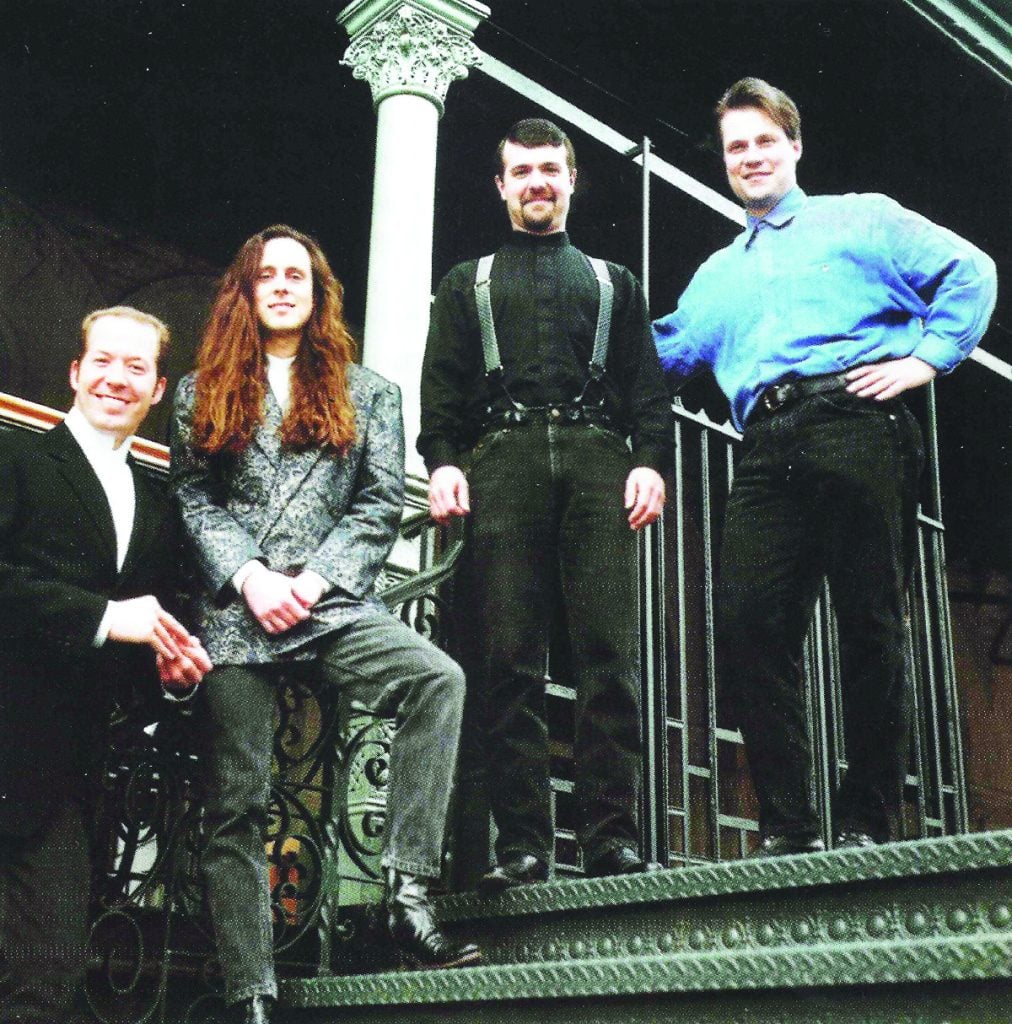
While there were similarities, Kyle stressed the group’s goal to be original. He told Bluegrass Now’s Nancy Cardwell that “all of us write. If you’re going to be original, then that’s the only thing you can do, write your own material and give it the kind of delivery that only your band can do.”
The goal of originality extended to stage presence, which often featured apparel that was designed and sewn by Kyle. Sporting loud colors and artistic designs and fabrics, he told Cardwell that his outfits were “. . . just sort of colorful, we’ll say that.” He added, “I always feel like you should look like you’re coming to play a show when you go somewhere.” His eclectic wardrobe earned him the title of Mr. Stage Presence from his bandmates.
Among Kyle’s more recent work was his tenure with Ray Cardwell and Tennessee Moon and with LaTresa and the Signal, a group described as “Kentucky bluegrass meets Southern soul.” He appeared on the LaTresa’s most recent recording, The Blood And The River.