
Notes & Queries – June 2022
More For the Good People
In response to a piece in the April 2022 issue concerning the location of a church on the cover of a Stanley Brothers album, Vermonter Dan Linder wrote: “I’ve had that Stanley Bros gospel album, For the Good People, forever, but it never occurred to me to wonder where the church photo came from. So, I was amazed to learn that you’d tracked it down to Peacham, Vermont! I know the church well. In my days as a piano tuner, I worked on a couple pianos in there from time to time, and over the past couple years the Peacham Acoustic Music Festival has used the church as one of its concert venues, so I’ve performed in there a few times as well. It’s a classic old New England church for sure – good detective work on your part!
“Here’s another challenge for you. Your photos of Dave Akeman and Clyde Moody, and of Big Mon himself, playing baseball reminded me of something I’ve always been curious about. I know that when Monroe was doing tent shows he often put together a team and took on local teams. But I’d love to know which Blue Grass Boys actually played, and what positions. As for Monroe himself, that photo of him pitching sort of surprised me. In view of his vision problems, I always figured he managed his team but didn’t play. What can you tell your readers about this?”
Bill Monroe began combining baseball with his tent shows starting in 1944. A circa 1944/’45 photo shows members of the Blue Grass Boys in baseball uniforms, including Howard Watts, Chubby Wise, Dave “Stringbean” Akeman, Clyde Moody, and Monroe. Both Moody and Akeman were athletic and rated as among the better players on the team. Akeman was described as being able to play any position, and was a good hitter and pitcher. Monroe noted that “he was a hard man to strike out.” Moody, too, was a good pitcher. Monroe, in spite of having poor eyesight earlier in life, also pitched. Watts, who acted as a catcher, noted that Monroe was a powerful pitcher.
Fiddler Jim Shumate was added to the roster for the 1945 season. He told that “I played shortstop and was a pretty good hitter too. I could lay the timber to that ball.” Shumate recalled that Sally Ann Forrester, who played accordion for Monroe at that time, sold tickets to the shows and Lester Flatt’s wife, Gladys, worked the concession stand.
For whatever reason, Monroe did not carry a team for the 1946 and ‘47 seasons. But, baseball was not out of the picture. Earl Scruggs related in Nicholas Dawidoff’s In the Country of Country that “Monroe carried two or three baseball gloves and a ball with us. We’d be in the ‘41 Chevrolet all night and all day and we couldn’t shift our legs, so we’d go out and play catch to loosen up our legs and have something to do until showtime.”
Monroe reactivated the team for the 1948 season, which ran from July through October. Don Reno told Bill Vernon in a 1973 edition of Muleskinner News that “Bill was a great baseball fan, and he organized his Blue Grass ball club while I was with him. We’d play semi-pro teams in the various towns. They were good teams, a lot of them. Of course, we had good players on our team, too. Jack[ie] Phelps was a good ball player and Bill hired G. W. Wilkerson, Grand Pappy George Wilkerson’s son [of the Opry group The Possum Hunters], and Mac[k] Carger, who had at one time played bass with The York Brothers, and who had played semi-pro ball in Arkansas. Bill organized The Shenandoah Valley Trio (Phelps, Carger, and Wilkerson) as an additional part of his traveling tent show, and also to complete his ball club. Bill also hired Mel & Stan, The Kentucky Twins, as a separate act for the tent show – they were good ballplayers. Everybody played. We would play a ball game and then a show. Phelps and Carger and G. W. Wilkerson, and Mel & Stan, were all excellent ballplayers. Myself and Joel Price and Benny Martin weren’t nearly that good, but we played fairly decently. I think we’d scare the other teams a lot of the time so that we’d beat them psychologically.” Don played “left field and third base” and, by his own admission, was “not very good.” He reported that Monroe “played first base, sometimes, and he’d switch around and play whatever position he took a notion to. He was a good hitter and a fine ballplayer.”
Monroe tagged Phelps as a first-rate shortstop and an excellent batter who was struck out only three times one season.
The ball team for 1949 featured fifteen players and included band members Benny Martin, Don Reno, Mac Wiseman, and bass player Bill Myrick. Monroe pitched some games during the season and catcher Myrick attested to the ball’s velocity. The Blue Grass team won 80 out of 130 games in 1949.
In 1974, Monroe told Kathy Stanton of Bluegrass Central magazine that at “one time in Nashville I had two ball clubs; one that worked in and out of Nashville, and one that traveled with me on the road. And they could really play ball—they was semi-pro, college kids—a lot of them could really play baseball. We had some good days back then. We’d play a ball park, put on a show–then we’d have the baseball game . . . Enjoyed it . . . back in them days you could play any town back in our country and have a crowd.”
The only known players for 1950 were Russell Petty, a recent high school graduate who was angling for the majors, and Bob Hornal; both were pitchers.
Monroe reportedly carried two teams for 1951 although the personnel for both teams is unknown. Carter Stanley performed with Monroe that summer but no mention has ever surfaced as to his participation as a ball player.
Monroe’s mixing of music and baseball appears to have ended after the 1952 season. Fiddler Charlie Cline is reported to have played ball that year, but his position is unknown.
Queries
Q: I remember hearing a bluegrass version of the song “Don’t Take Me Back to the Chain Gang” somewhere and would love to know who recorded it. Thanks. Shin Akimoto, via email.
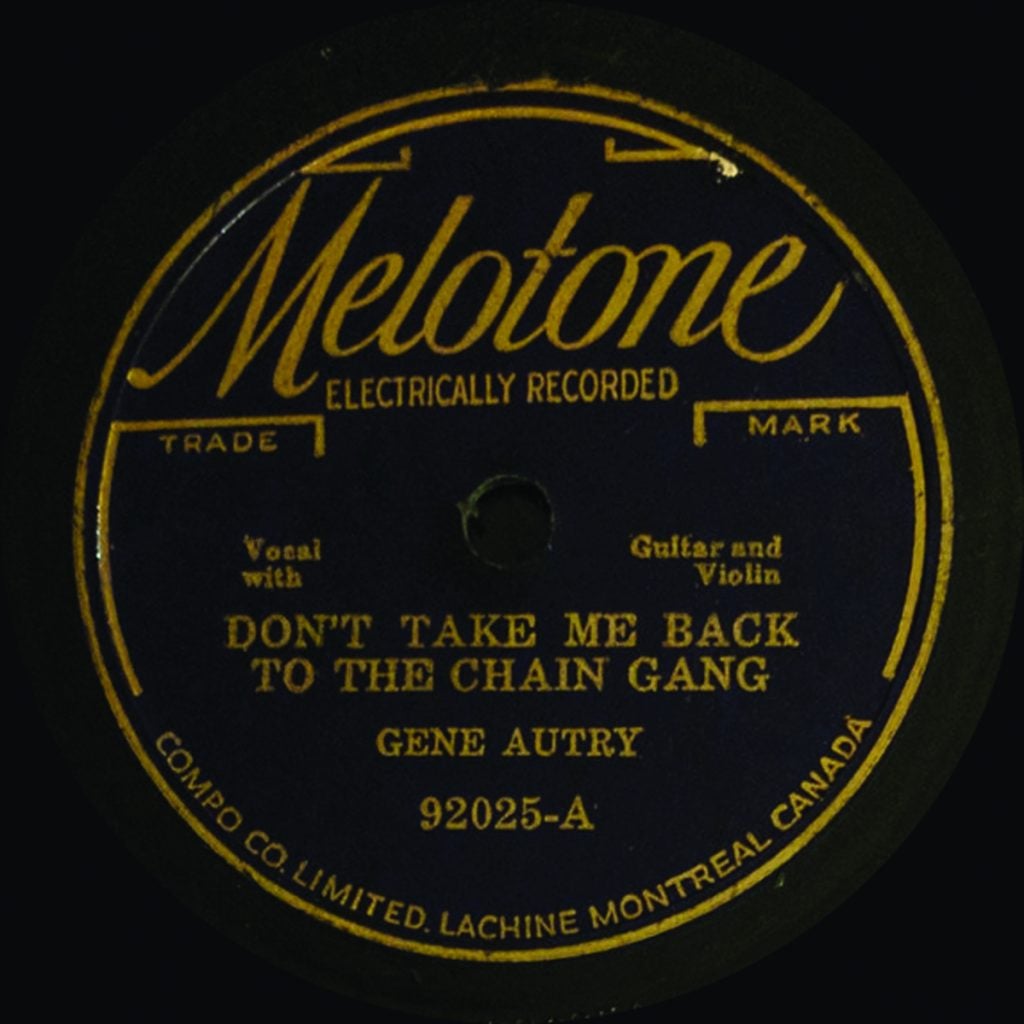
A: The song dates back to 1933 when it was written and recorded by cowboy film star Gene Autry. The first bluegrass recording appears to be a 1985 release by Harley Allen and Mike Lilly on an album for Folkways called Suzanne. In 1999, former Country Gentlemen member Jimmy Bowen used the song as the title track for the debut of his band, Santa Fe. Mandolin player Chris Davis, currently the guitarist and lead singer for The Grascals, included it in a 2011 self-titled solo project. The most recent recording of the song appears on a disc called Brian Christianson and Friends. Christianson is a Minnesota-born fiddler/luthier who, with his wife, runs The Fiddle House in Nashville. His recent work includes performing with The Mike Snider String Band, The Roland White Band, and The Russ Barenberg Trio.
Q: Have you ever seen Stoney Cooper actually play the fiddle? I saw Wilma Lee and Stoney (with the Clinch Mountain Clan) do a set or two at Sunset Park in West Grove, Pennsylvania, in the early ‘60s. I don’t recall hearing any fiddling. I’m pretty sure Stoney just held the fiddle and sang. I know he did play fiddle and I can tell on the old records when the fiddle is Stoney or someone else. In every video and most photos, he holds the fiddle but never plays a note. Any thoughts? Jody Stecher, via email
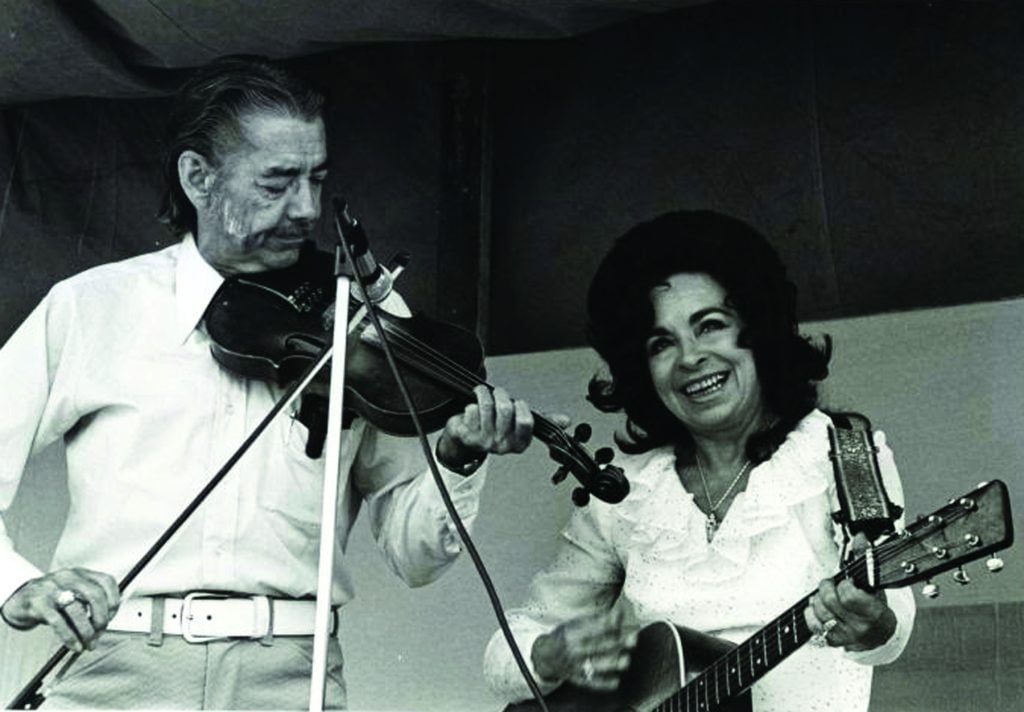
A: Stoney Cooper was definitely a more than competent fiddle player and it is somewhat odd that the half-dozen or so surviving video clips of Wilma Lee and Stoney – mostly from the early 1960s – show him cradling the fiddle, or appearing without it all together. Perhaps he was being modest when he told once that “I’m a half-way old-time fiddler, too, and some places we’ve been they sorta enjoy it.” The duo’s early recordings for the Rich-R-Tone label, available on a Wilma Lee & Stoney boxed set on Bear Family, attest to his skill. The author for the notes of the boxed set, Bruce A. McGuire, noted that Stoney “usually played with the other fiddlers but preferred to use others on a lot of recordings. Mostly Benny Martin, for obvious reasons.” Author/researcher Ivan Tribe opined that “I suspect Stoney deferred to more skillful fiddlers on sessions.” McGuire and Tribe both pointed to the instrumental “Canadian Reel” (hearable on YouTube) as a fine example of Stoney’s fiddling. Another possibility could be the times. Then-powers-that-be in Nashville were crafting a new (more saleable?) image for country music that downplayed the fiddle in favor of electric instruments and lush backing vocals by groups such as the Anita Kerr Singers and the Jordanaires. Instrumental breaks on available Wilma Lee and Stoney video clips all feature electric guitar, as opposed to the fiddle or other traditional instruments. However, the truth may never be known. When I queried Ivan Tribe about this subject, he noted that I “have a good talent for asking questions that haven’t come up when there were people who could answer them.”
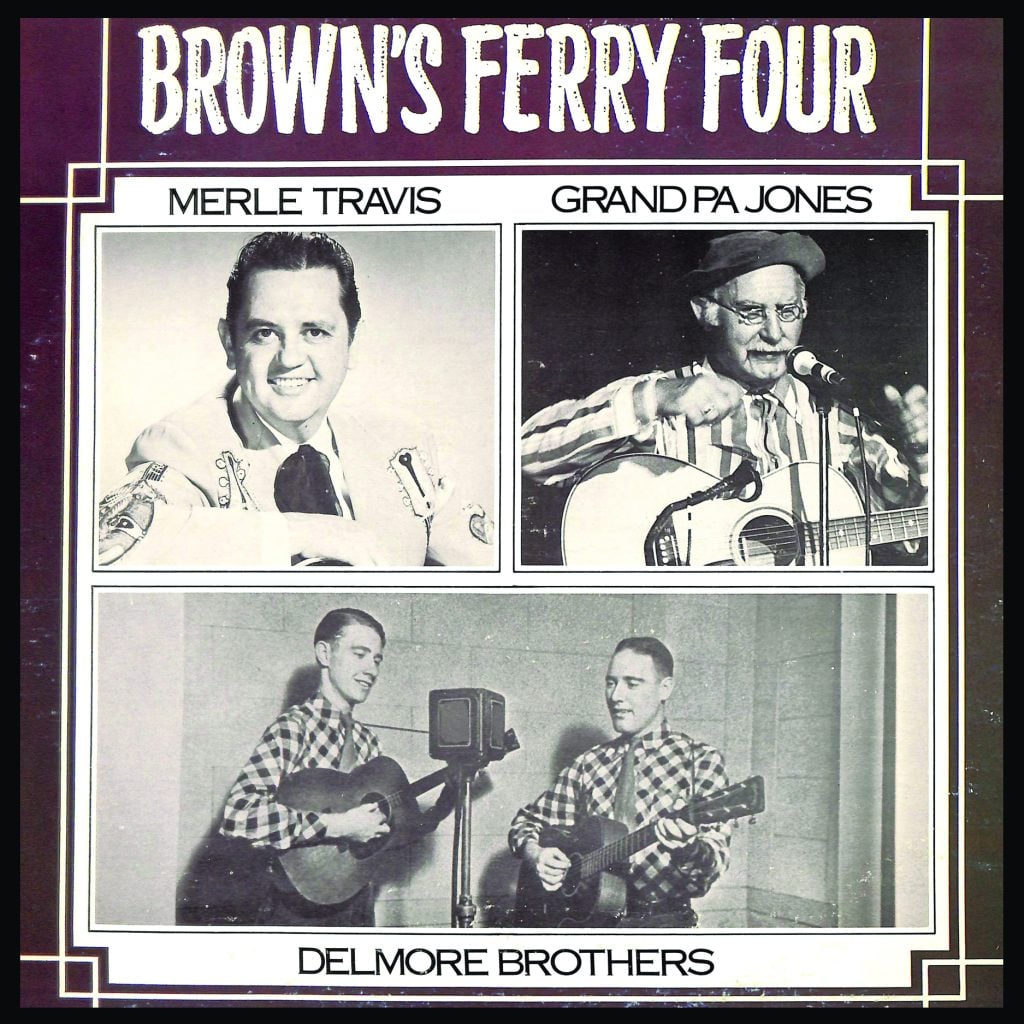
Q: Do you know who played mandolin on the Brown’s Ferry Four records on King in the late 1940s. All I can find is “unknown mandolin.” At the same time Ramona Jones, Ernest Ferguson, and Jethro Burns played on some Grandpa Jones records. Doesn’t sound like Jethro on the Brown’s. Fred Isenor, via email.
A: The Brown’s Ferry Four was a popular gospel quartet that recorded for King Records from 1945 through 1952. The original, and most popular, incarnation of the group consisted of the Delmore Brothers, Grandpa Jones, and guitar legend Merle Travis. The group got its start in 1943 when all of the members were performers on radio WLW in Cincinnati, Ohio. Their forte was offering spirited renditions of hymns that were drawn from popular shape note hymnals of the day. Also part of the mix was the group’s take on spirituals that were first recorded by African American quartets such as the Golden Gate Quartet.
Over a seven-year period, the Brown’s Ferry Four recorded forty-five songs for King Records (forty-four of which were released). The general format consisted of quartet singing with tasteful guitar leads.
Eventually, Merle Travis drifted out of the picture and others such as Red Foley, Clyde Moody, and Ulys “Red” Turner took his place. As other members came and went, changes to the original format began to take place. These were first noticeable on a 1951 session. A six-song session contained a selection called “There’s a Page in the Bible” that featured mandolin, presumably by Red Turner, and clawhammer banjo by Grandpa Jones.
One year later, a session from the spring of 1952 featured four songs – “The Arm of God,” “Bound For the Shore,” “Eternity Without Him,” and “Can’t You Har Him Calling” – all of which sported lead guitar and mandolin breaks. Unfortunately, personnel files for the session are lost to the ages and early research left the fourth member of the quartet as “unknown.” A best-guess for the session would be Red Turner.
Two more sessions, with four songs each, were recorded in August of 1952. The first outing contained only one song with mandolin, “The Uncloudy Day.” The same track was devoid of lead guitar (which in later sessions was usually played by Rabon Delmore); this suggests that the mandolin player on this song was Rabon Delmore. His bio on the Nashville Songwriters Hall of Fame said that he “also taught himself to play banjo, mandolin, fiddle, and tenor guitar.”
The second August session, which turned out to be the last of the group’s career, contained three tracks with mandolin: “When the Redeemed Are Gathering In,” “Praise God! He Loves Everybody,” and “What Shall I Do With Jesus.” Best-guess, again, would be for Red Turner.
Sadly, Rabon Delmore died from lung cancer four months after the session. Grandpa Jones left the King label and went to RCA. The one-two punch effectively put an end to the Brown’s Ferry Four. The format of the group served as a template for the popular Hee Haw Gospel Quartet – complete with Grandpa Jones – in the 1970s and ‘80s.
Over Jordan
Bobby Lee Atkins (May 22, 1933 – March 27, 2022) was a longtime fixture on the bluegrass and country music scene in North Carolina and Virginia. He was known primarily for his banjo work, as the bandleader of the group known as The Countrymen, and for several stints with Bill Monroe in the 1950s and early ‘60s.
Born in Shoals, Surry County, North Carolina, Atkins moved with his family to the Greensboro area when he was around the age of five. It was about the same time that his mother showed him his first chords on the guitar. While still in grammar school, he honed his talents by playing with one of his brothers and some friends. During recess, the pickers retreated to woods near the school where they fashioned a pretend microphone and imagined they were performing on the Grand Ole Opry.
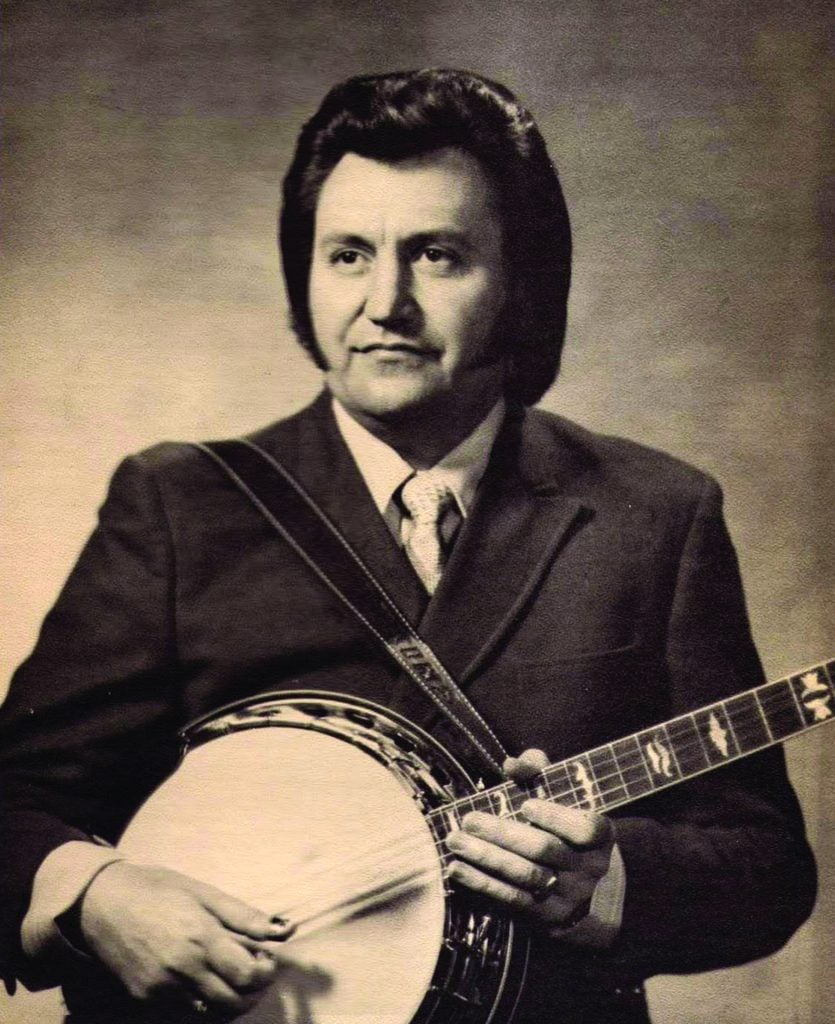
As a young teenager, Atkins began performing on area radio programs with two of his brothers. A few years later, at age sixteen, a performance by Tommy Magness and His Tennessee Buddies, with Don Reno on banjo, redirected the trajectory of Bobby’s musical career. Reno reportedly played “Foggy Mountain Breakdown” and it was only a short time later that Bobby traded a watch for a five-string banjo.
Two years later, at the Broadway Theatre in Reidsville, North Carolina, Atkins auditioned for, and was hired by, Bill Monroe. His first show as a Blue Grass Boy was in Alabama. Having never been away from home before, a homesick Atkins was unable to cope with life on the road and quickly made his way back to North Carolina. He later served two longer, and more successful, stints with Monroe.
Closer to home, Atkins found work with a number of groups including Jim Eanes and Charlie Monroe. He formed a partnership with Joe Stone and launched a group called the Dixie Mountaineers, which became the house band for the Old Dominion Barn Dance in Richmond, Virginia. With the exception of a brief timeout in 1961 when Atkins spent about eight months touring with Bill Monroe, he and Stone worked together for about fifteen years. Their group served as a proving ground for a number of up-and-coming bluegrass musicians, including guitar legend Tony Rice and banjo prodigy Jimmy Arnold.
In the mid-1970s, Atkins launched The Countrymen, a group that served him well for the remainder of his career. The outfit became a showcase for his children and other aspiring young pickers. Along the way, he recorded over fifteen albums and CDs for the Old Homestead and Thunderbolt labels; contributed his musical talents to two movies: Preacherman and Preacherman Meets the Widder; launched his own bluegrass festival in Madison, North Carolina; and gave banjo lessons.
Posting on BluegrassToday.com, banjo picker Lynwood Lunsford wrote that “Bobby Atkins was another of those great musicians that have flown under the radar and never received the recognition they really deserved . . . I always admired his singing and he opened my eyes to adapting all types of music to the banjo. If there was such a thing, ol’ Bobby deserves a star on the Bluegrass walkway of the stars.”
Roland White (April 23, 1938 – April 1, 2022) enjoyed a lengthy career in bluegrass music during which time he lent his talents to a Who’s Who list of entertainers including the Kentucky Colonels, Bill Monroe, Lester Flatt, Country Gazette, the Dreadful Snakes, the Nashville Bluegrass Band, and most recently, his own Roland White Band. A fixture of the Nashville music scene for half a century, he endeared himself to the bluegrass community there, and was held in high esteem both nationally and internationally.
Roland Joseph LeBlanc was born on April 23, 1938, in Madawaska, Maine. His family’s roots were a mix of Acadian, French, and Canadian ancestry. Once firmly established in America, the family adopted the English translation for Blanc, which is White.
As a youth, music abounded in the White household. Father Eric, Sr., played fiddle, guitar, tenor banjo, and harmonica while several uncles played piano and guitar. Roland started out learning to play guitar and soon added playing the mandolin to his list of talents. Younger brothers Eric, Jr., and Clarence tackled the tenor banjo and guitar, respectively, while sister Joanne picked up the bass. The young family band gleaned its repertoire mostly from then-current country music.
The White family moved to Burbank, California, in 1954. Roland, Clarence, and Eric acquired the stage name the Three Country Boys and in 1955 competed in a local talent contest. As first-place winners, the trio landed television appearances on local programs such as the County Barndance Jubilee, Town Hall Party, and Hometown Jubilee. That same year, Roland’s purchase of a recent Bill Monroe recording set him and his brothers on a decidedly bluegrass path.
The group shortened its name to the Country Boys and by 1959 had grown to include Arkansas banjoist Billy Ray Lathum and California Dobro player LeRoy Mack. They made their debut recording with a 45-rpm disc for the Sundown label: “I’m Head Over Heels in Love With You” and “Kentucky Hills.”
The Country Boys gained national recognition in 1961 when they appeared on two episodes of the Andy Griffith Show. The group landed the prestigious spots when a CBS Television representative caught one of their performances at the Los Angeles nightspot the Ash Grove. The first episode, called Mayberry on Record, aired on February 13, 1961. Additional exposure from the association with the Griffith show came in November 1961 when Capitol Records released an album called Songs, Themes and Laughs from the Andy Griffith Show; the Country Boys were featured on four of the songs on the album.
From the latter part of 1961 through the latter part of 1963, Roland served a two-year stretch in Army. While he was gone, the Country Boys were rechristened the Kentucky Colonels. He returned in time to participate in the making of the group’s landmark instrumental album, Appalachian Swing.
Throughout 1964 and 1965, the Kentucky Colonels branched out from their base in California to make appearances in the east at the Newport Folk Festival, Gerde’s Folk City in New York, Club 47 in Cambridge, Massachusetts, and at other folk venues. However, the work was not enough to sustain the group and in October 1965 they called it quits.
Starting in April 1967, Roland logged two years with Bill Monroe and the Blue Grass Boys, playing rhythm guitar and singing lead. He made three trips to the recording studio with Monroe which netted nine tracks including “The Gold Rush,” “Kentucky Mandolin,” and a Monroe-Peter Rowan collaboration called “The Walls of Time.”
When Lester Flatt and Earl Scruggs parted ways in February 1969, Roland joined Flatt’s new group, the Nashville Grass. Returning to the mandolin, Roland played on twenty-one recording sessions that produced a total of ninety-three songs and tunes. Albums that were released during Roland’s tenure with Flatt included Flatt Out, The One And Only Lester Flatt, Flatt on Victor, Kentucky Ridgerunner, Foggy Mountain Breakdown, and Country Boy. Also released were three albums by Lester Flatt and Mac Wiseman: Lester ‘n’ Mac, On the South Bound, and Over the Hills to the Poorhouse.
In January 1973, Roland and Clarence came together to form the New Kentucky Colonels. The group enjoyed a successful tour of Europe and appearances at several east coast bluegrass festivals. The reunion was cut short in July 1973 when Clarence was killed by a drunk driver.
One of Roland’s longest musical associations began shortly after Clarence’s passing when he signed on with Country Gazette. The trend-setting West Coast group included banjo picker Alan Munde, fiddler Byron Berline, and bass player Roger Bush. Sporting a fusion of bluegrass and country-rock, the band – with Roland – released eight well-received albums: Live, Out to Lunch, What a Way to Make a Living, All This and Money Too?, American and Clean, America’s Bluegrass Band, Bluegrass Tonight, and Strictly Instrumental. Also released was Roland’s first solo album, I Wasn’t Born to Rock ‘n’ Roll. Included in it were two songs from groups that he had worked in previously: “If I Should Wander Back Tonight” (Lester Flatt) and “Can’t You Hear Me Calling” (Bill Monroe).
While still with Country Gazette, Roland collaborated with super pickers Bela Fleck, Blaine Sprouse, Pat Enright, Mark Hembree, and Jerry Douglas to form a studio group called the Dreadful Snakes. They recorded one album together, Snakes Alive. Eventually, Enright and Hembree joined forces with banjo picker Alan O’Bryant and mandolin player Mike Compton to form the Nashville Bluegrass Band. When Compton left in 1989, Roland stepped in to take his place; he held the mandolin spot in the group for the next eleven years. He appeared on five albums with the band: The Boys Are Back in Town, Home of the Blues, Waitin’ for the Hard Times to Go, Unleashed, and American Beauty. With backing by several of his fellow Nashville Bluegrass Band mates and special guests, Roland recorded his second solo album, Trying To Get To You.
In 2000, Roland launched his own Roland White Band. At times, the group included his wife, Diane Bouska, on guitar, Richard Bailey on banjo, Brian Christianson on fiddle, and Jon Weisberger on bass. The band’s debut recording, Jelly On My Tofu, received a Grammy nomination for Best Bluegrass Album.
As a well-respected instrumentalist, Roland was sought out on numerous occasions to add his talents to recordings by other artists. Among the various persons and groups he subbed out to are Joe Greene, Muleskinner, Alan Munde, Butch Robins, Buck White, Bobby Hicks, Joe Carr, Doc Watson, David Grier, Stuart Duncan, Marty Stuart, Clint Black, Valerie Smith, and Ricky Skaggs.
Roland was never hesitant to share his knowledge in picking the mandolin. He frequently taught at a number of mandolin camps and workshops and, with Diane Bouska, he co-authored several instruction books including Roland White’s Approach to Bluegrass Mandolin, The Essential Clarence White Bluegrass Guitar Leads, Roland White’s Mandolin Christmas, and Roland White’s Christmas Chord Book.
Roland’s contributions to bluegrass were duly noted on several occasions. In 2010, the Society for the Preservation of Bluegrass Music (SPBGMA) added him to their Preservation Hall of Greats and the International Bluegrass Music Association presented him with a Distinguished Achievement Award in 2011 and later with induction into the organization’s Hall of Fame in 2017.