Notes & Queries – June
Queries
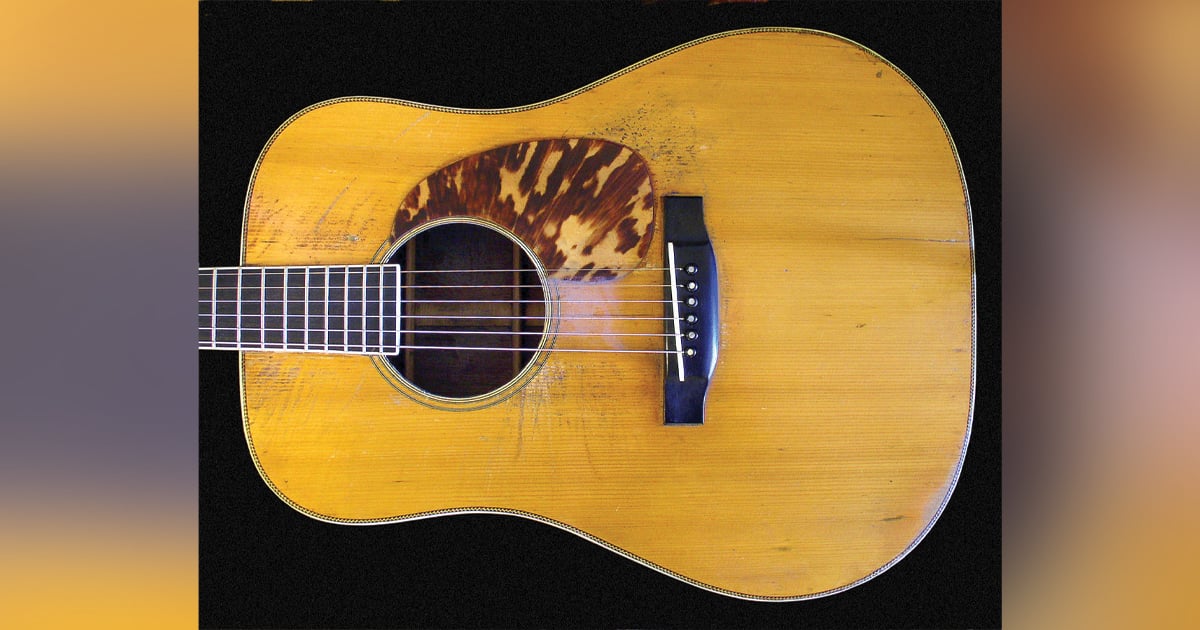
Q: Terry McManus from Maine asked: “With Tony Rice gone, what will become of #58957? Will it be retired, which would be sad, or will someone else pick it up? My (unasked for) opinion – Wyatt Rice, Josh Williams, or Mark O’Connor.”
A: #58957 refers to the serial number of Tony Rice’s 1935 Martin D-28 herringbone guitar that once belonged to Clarence White. In a Spring 2007 issue of the Fretboard Journal, Rice noted, “It’s a beautiful instrument. I never pick it up but that I don’t think that. It’s got to be the Holy Grail.” In the same article, author Art Dudley said that the guitar “sings with a voice that simply can’t be ignored.” While luthier Wayne Henderson once speculated that 95% of the instrument’s acclaim came simply from the artistry of Rice’s playing, it did inspire the naming of a retrospective CD on Rounder Records called 58957 Tony Rice: The Bluegrass Guitar Collection. For the fate of the guitar today, we reached out to Tim Stafford, longtime guitarist with Blue Highway and the co-author of Still Inside: The Tony Rice Story. He replied that, “I really don’t know at this point. I’ve talked to some principals involved and others who have connections to closer principals, but . . . No word as of yet.”

Q: I recently found an album on YouTube by Bill Lowe titled Kentucky Farewell on the Ramblin’ label. It is a very nice album with some good vocals that I presume to be by Bill; he sounds a little bit like Doc Watson. Is this the same Bill Lowe that played mandolin with the Stanley Brothers on the early Mercury sessions? Tom Knowles, via email
A: Kentucky Farewell is, indeed, a fine album. Issued in 1977, it contains a nice cross-section of bluegrass and old-time songs and tunes with solid accompaniment by some of southwest Ohio’s best roots-based musicians of the day. The recently released book Industrial Strength Bluegrass, edited by Fred Bartenstein and Curtis Ellison, goes into some detail about Bill Lowe and his album. Getting to the heart of the question, essayist Jon Hartley Fox states: “Not to be confused with the musician who worked with the Stanley Brothers, this Bill Lowe was born in 1930 in Pike County, Kentucky.” The Bill Lowe who worked with the Stanley Brothers was also born in 1930 but hailed from Smyth County, Virginia.
Q: I am searching for any music or information on Earl and Ed Webster. Also known as the Webster Brothers. Any help would greatly be appreciated. My momma grew up with these boys and they lost touch. She used to sing with them and she would love to have everything they recorded. I have found some of their music. But I’m searching for “Model A’s,” a song they recorded. Thank you so very much for your time. Mary Gibson, via email
A: The career(s) of the Webster Brothers was covered by Walt Saunders in the June 2006 “Notes and Queries” column. Following Earl Webster’s passing in 2018 at the age of 85, Richard F. Thompson posted a detailed remembrance on the BluegrassToday website.
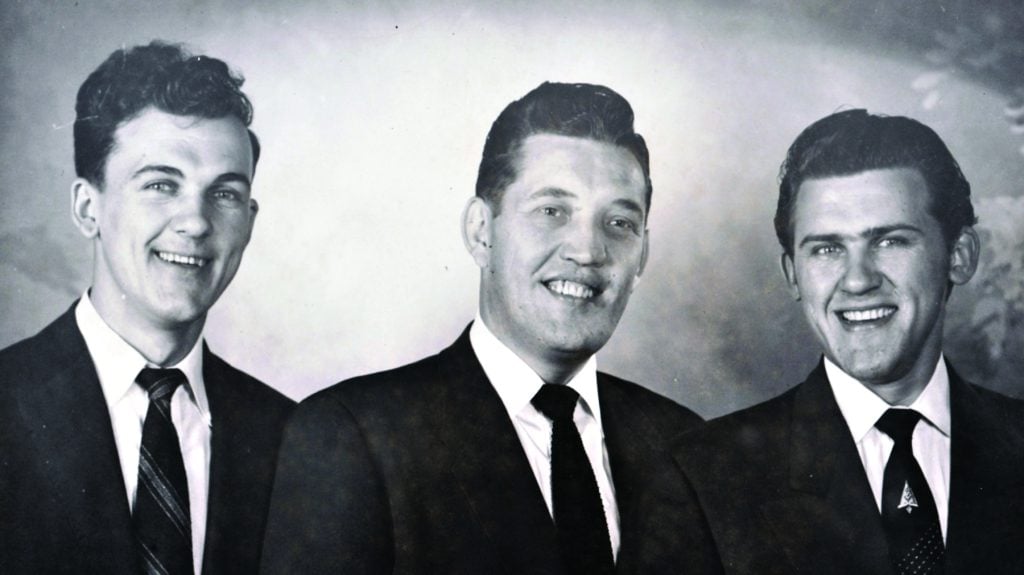
For those who missed these write-ups the first time around, James Austin “Audie” Webster and William Earl Webster were East Tennessee natives whose career spanned the early 1950s through the middle 1970s. Their earliest work was as a Webster Brothers quartet with siblings Ed and Horace. In 1951, Earl and Audie secured the sponsorship of grocery store magnate Cas Walker who put the duo on radio in Knoxville, Tennessee. It was while in Knoxville that the pair hooked up with singer Carl Butler. Recordings by the trio soon appeared on the prestigious Columbia label; among the best was their rendition of “Angel Band.” Earl and Audie also made several notable duet recordings, also for Columbia. They chose an early Louvin Brothers song called “Seven Year Blues.” The Websters obviously imitated the Louvin Brothers but were so convincing that many people thought that they actually out-Louvin’d the Louvin Brothers on this recording! For a period of time in the late 1950s, the Websters resurrected their quartet by partnering with another Knoxville-based brother duet, the Brewster Brothers.
Around 1960, after having “played out” the Knoxville area, the Webster Brothers relocated to Dothan, Alabama, and partnered with fiddle player Ralph Mayo. The group was sponsored by a shell home builder who bankrolled their television programs. It was while working in Alabama that Audie Webster moonlighted and sat in on a Stanley Brothers recording session for Starday Records that included their now-legendary recording of “Rank Stranger.”
After several years in lower Alabama and the panhandle of Florida, the Webster Brothers returned to Knoxville. Audie again found work in the recording studio when he helped to record several albums on the King label by Charlie Moore and Bill Napier. Earl and Audie recorded a baker’s dozen songs in the middle 1960s that slowly made their way out as a series of 45s, extended play discs, and eventually on an album that was issued in the United Kingdom. The Websters’ sister noted that the group never really broke-up, per se, but slowly faded away. Audie made his way to Atlanta and did roofing work. Earl made one final recording in 1974, a single with two songs: “Dusty Roads and Model A’s” and “Alabama.” Any hopes for a Webster Brothers reunion were cut short when Audie passed away in 1982 from pancreatic cancer; he was forty-seven years old. The only recordings by the duo that are commercially available today are on a CD credited to Carl Butler and the Webster Brothers I Wouldn’t Change You If I Could. Issued on the Bear Family label, it contains their classic Columbia recordings of the 1950s. A number of the 1960s recordings can be heard on YouTube.
Q: I used to hear the old gospel song “Something Got Hold of Me” many years ago. I was reminded of it recently when I purchased a CD by Paul Williams and the Victory Trio called Satisfied. There was no writer credit listed. Any idea who wrote it? Thanks. JR, Phoenix, AZ
A: “Something Got Hold of Me” has a history that dates back to at least 1932. The Altoona Mirror newspaper in Altoona, Pennsylvania, gave coverage to a church revival taking place at the Altoona Pentecostal tabernacle. The paper reported that on the evening of May 18, 1932, Evangelist Stanley C. Cooke preached on the subject of “Is Pentecost a New Religion?” and then presented the vocal number “Something Got Hold of Me.” Similar accounts appeared in various newspapers throughout the 1930s, including one noteworthy piece that was syndicated to papers from coast to coast. On the evening of July 22, 1937, at the Trinity Tabernacle church in Peoria, Illinois, a seven-year-old child was ordained into the ministry. Following the ordination, “the roly-poly youngster, who can speak five languages, climbed onto a chair in the pulpit and gave a sermon on ‘Hell, or God’s Penitentiary,’ then in a boyish voice he sang ‘Something Got Hold of Me.’” The song wasn’t printed in any mainstream hymnals of the day and how it was disseminated to the public at that time remains a mystery.
The earliest known recording of “Something Got Hold of Me” was made in January 1938 when Mary Elizabeth Barnicle, a contemporary of folklorist Alan Lomax, recorded Willie Bledsoe of Pineville, Kentucky. The recording was not made for commercial distribution and currently resides in the Library of Congress. The first commercial recording was made three years later when the original Carter Family cut a version at their very last session together, on October 14, 1941. The recording featured A. P. Carter, as opposed to Sara or Maybelle, singing the song as a solo, without any instrumental interludes. He sang five verses; each one of which was followed by the song’s chorus. Two months after the Carters’ recording (and long before it was released on record), the song was collected in Arkansas and later appeared in a 1949 book by Vance Randolph called Religious Songs and Other Items. He noted that it was “sung by Mr. and Mrs. Arlie Freeman, Natural Dam, Arkansas, December 14, 1941. The Freemans learned it by ear at Holy Roller meetings in the woods and have never seen a printed copy. They first heard it in 1937.”

The next commercial recording of “Something Got Hold of Me” was made in the middle of 1946 when the Bailes Brothers waxed a version for King Records. The King release (which didn’t appear on the market until 1949) was credited to Caplinger. According to Bailes Brothers chronicler Ivan Tribe, “either John or Walter [Bailes] or both told me it was Warren Caplinger’s song. That said, it doesn’t necessarily make it so. I have several Cap, Andy & Flip songbooks and it is not in any of them, nor did they ever record it as far as anyone knows.” Caplinger, like the Bailes Brothers, was from West Virginia and toured and recorded in the late 1920s with a group known as the Cumberland Mountain Entertainers. In the 1930s, Caplinger teamed up with Andy Patterson and William Austin Strickland to form the trio of Cap, Andy & Flip; Caplinger was Cap, Patterson was Andy, and Strickland was Flip. It was with Patterson that Caplinger assigned “Something Got Hold of Me” to Acuff-Rose music publishers, but not until 1951. Ivan Tribe continued that “if I recall correctly Caplinger was a Christian Scientist and that doesn’t sound like a Christian Scientist song (however they sound?). It has more of a Holiness or Pentecostal sound.Of course, Caplinger may have become a Christian Scientist later in life (he lived until 1956).” Caplinger was known to be performing “Something Got Hold of Me” while working at radio station WMMN in Fairmont, West Virginia, in the middle to late 1930s.
About the time of the Bailes Brothers release, other radio artists began performing the song, most notably West Virginia’s Molly O’Day and Grand Ole Opry star Hank Williams. With the publicity being generated from the Bailes recording and the Williams radio exposure, several gospel music publishers suddenly became interested in the song. Publisher R. E. Winsett from Dayton, Tennessee, published a version in the 1950 hymnal Radio Melodies. He listed the song as being from anonymous sources and claimed an arrangement (Arr. R. E. W.). The Stamps Quartet Music Company, with offices in Dallas, Texas, and Birmingham, Alabama, also copyrighted the song in their 1950 hymnal called Sacred Cross. The Stamps book listed the author as “unknown” and assigned an arrangement to “R. S. Reed” (Roscoe Simon Reed).
In the middle 1960s, several bluegrass artists began making use of the hymn. The first of these was the duo of Charlie Moore and Bill Napier, who recorded it for their 1964 Grand Ole Opry Hymnal album (later renamed Country Hymnal) on the King label. These were followed by recordings by Red Smiley and the Easter Brothers. Smiley’s was derivative of the Bailes version while the Easter Brothers appear to have learned their version from the Winsett book. With these, and recordings by mainstream artists such as the Wilburn Brothers, Stonewall Jackson, Porter Wagoner, and Jim & Jesse, “Something Got Hold of Me” is today a time-honored standard.
Over Jordan
James Allen Collins (August 7, 1931 – April 8, 2021) was a fixture of the East Tennessee bluegrass music scene for seventy years. He was born in Grainger County, Tennessee, about thirty miles northeast of Knoxville, and was later a U. S. Army veteran, an electrical contractor by trade, and a lifetime bluegrass musician. He enjoyed talking about the times when, as a teenager in the late 1940s, he used to ride his bike to see performances of Lester Flatt and Earl Scruggs when the duo was headquartered in Knoxville.
As a regular attendee of the WNOX Tennessee Barn Dance in Knoxville, Allen made the acquaintance of mandolin player Buster Turner and guitarist Don Gulley in 1957. He was soon picking regularly with the boys and the group eventually morphed into the Pinnacle Mountain Boys, of which Allen was an original member. A highlight for the group occurred in 1961 when they participated in a talent contest that was sponsored by Pet Milk. As one of several finalists, the group was invited to appear on the Friday night version of the Grand Ole Opry, on June 23, 1961. They were introduced on stage by Faron Young and veteran announcer T. Tommy Cutrer. In addition to Allen, Buster, and Don, other band members included fiddler Charlie Collins and banjo player Lorne Rogers.
Following the departure of several members from the Pinnacle Mountain Boys in 1966, the group drifted apart. Allen later formed a new group with his sons that was billed as The Collins Boys; they were frequently tagged as the “youngest bluegrass band in the southeast.” They recorded at least one album together, a 1978 release called Train 45.

In 2008, the almost-original Pinnacle Mountain Boys were reunited on stage at the Louie Bluie Music and Arts Festival in Caryville, Tennessee. With Buster Turner, Don Gulley, Charlie and Allen Collins, and banjo picker Larry McNeely, it was the group’s first time to perform together in over forty years. Several additional reunions followed in subsequent years, including a 2014 get-together that was aired over Knoxville’s WDVX. The station’s Alex Leach recalled that, in addition to some great music, the various band members shared stories of days gone by. In a friendship that he forged with Allen, Alex appreciated the fact that the elder musician was “always encouraging me.”
Bradley Hanson, the director of folklife at the Tennessee Arts Commission, cited Allen as “fit, sharp, opinionated, and encyclopedic in his knowledge of the music that he loved, obsessively.” Most recently, Allen was “serving in the house band [on Tuesday nights at the Bradbury Community Center] with a group of regular old timers he dubbed the Bluegrass Pilgrims.” He also loved to trade and sell instruments.
Jon Stephen Raemore (1947 – March 22, 2021) of Harrisburg, Pennsylvania, was a banjo player and a driving force behind the Seven Mountains Bluegrass Association. Born and raised Williamsport, Pennsylvania, he was an avid outdoorsman who spent more than thirty years working for the Pennsylvania Department of Environmental Protection.

Jon was a self-taught musician who played guitar, mandolin, banjo, and 12-string guitar. He started picking in the 1960s and – from the mid-1970s through the early 1980s – he performed with the Grass Express. He later played banjo and sang baritone for Old Time Way. He counted Earl Scruggs as a major influence. As a member of the Seven Mountains Bluegrass Association from 1983 until 2017, Jon served as president, as vice president, as a board member, and as a trustee; established committees to enhance membership and attendance; and set goals for the future of the organization. In his position as chair of the music committee (starting in 2005), he oversaw the selection of talent for the Seven Mountains bluegrass festival as well as for various Association events. Jon was also a regular attendee at IBMA World of Bluegrass events in Louisville. One recent remembrance noted that “for Jon, the ‘Grass’ is really ‘Greener’ on the other side. Stop by, he will be playing every night when you next see him.” Contributions in Jon’s memory can be made to the Seven Mountains Bluegrass Association c/o Jean Snyder, 827 New Valley Road, Marysville, PA 17053.
Philip Michael “Phil” Zimmerman (March 4, 1944 – April 16, 2021) was a multi-talented individual who brought
his skills to the fields of music, photography, and education. A native of Indiana who spent his formative years in Illinois and Nebraska, Phil was exposed to rural music at an early age. This came mainly through the radio with such programs as the WSM Farm Show and the WLS Barn Dance. Later, clear channel stations such as KXEL, WWVA, and WCKY, as well as singing cowboys like Gene Autry and Roy Rogers, added to his musical landscape.
It wasn’t until high school that one of Phil’s classmates got him started on banjo and guitar. The loan of a bluegrass album as well as attendance at shows featuring the likes of Peggy, Pete, and Mike Seeger; Doc Watson; and the New Lost City Ramblers further cemented Phil’s interest in and love for the music.

Following graduation from high school, Phil attended the University of Rochester where he majored in history and minored in photography. He was still in school when he made the fateful decision to attend the first multi-day bluegrass festival, which was held on Labor Day weekend (1965) at Cantrell’s Horse Farm in Fincastle, Virginia. He put his photographic skills to use by capturing numerous images of Bill Monroe, the Stanley Brothers, Doc Watson, and others throughout the three-day event. He also assisted festival co-manager Ralph Rinzler with recording the festivities. He also found time for some parking lot picking on his banjo.
From the time of the Fincastle festival until the early 1980s, Phil divided his time at festivals between photographing and picking. Over a fifteen-year period he amassed an amazing array of photos from festivals such as the Country Gentlemen festival in Webster, Massachusetts, in 1972; the Delaware Bluegrass and Old-Time Music Festival in Glasgow, Delaware (also in 1972); the Green Mountains Country Banjo Festival in Essex Junction, Vermont, in 1978; and numerous outings at the Berkshire Mountains Bluegrass Festival in Hillsdale, New York; to name a few.
The competition for Phil’s time at festivals – picking vs. taking pictures – came to a head in the early 1980s, and the picking side won. Over the years, he participated in a number of groups including Last Fair Deal, North by Northeast, Traver Hollow, Old-Time Heroes of Tradition (with legendary fiddler Stacy Phillips), American Flyer, and Bluegrass Union.
Phil put his years of entertainment savvy to good use when he served as President and Music Director of Guitar & Mandolin Camp North and Banjo Camp North; he also taught mandolin and banjo workshops at the Boston’s Joe Val Festival.
In 2008, Phil released a book of his festival photos called Bluegrass Time. The release of the book coincided with an exhibit of his photos at the International Bluegrass Music Museum in Owensboro, Kentucky. Most recently, Phil donated his archive of bluegrass photos to the Museum.