Notes & Queries – January 2025
Q – I have a question for you about Don Reno’s two cousins “Chuck” and “Jay” Haney. Are they still living? If not, any idea when they passed away? Apparently, there’s not much mentioned about them in bluegrass, at least not that I’m aware of . . . besides being on the early recordings of Reno & Smiley. Just wondered whatever happened to them. Wayne Hoffman, via email.
A – There were actually a number of Haneys who were associated with Don Reno over the years. In addition to Chuck and Jay, there were at least three others: Bill Haney, Walter Haney, and Jarvis Haney. Ronnie Reno noted recently that “the Haney’s were a family around Buffalo and Union [South Carolina] and most of them played music.”
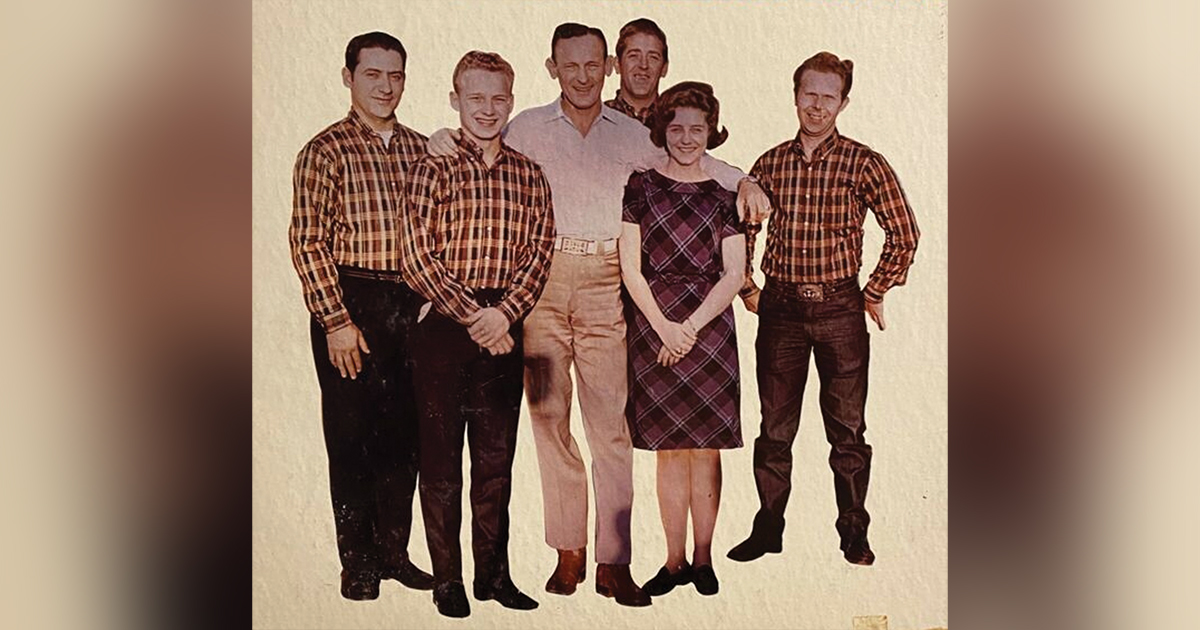
Charles Edward “Chuck” Haney (February 14, 1934 – October 19, 1998) probably logged more time with Reno than any of the other Haneys. In 1992, as I was working on compiling a 4-CD set of Reno & Smiley’s earliest recordings (still available, by the way), I had the opportunity to speak with Chuck. He related that “I wasn’t but about thirteen years old when I started with Don. He come by. I was in the gully singing. He said he looked over there in that gully and I was down there in a mud hole and he said [when] that big voice come out of there [it] sounded like a grown man. Don took me and taught me everything I know.
“I worked with Don before Red did. Don and Verlon [Reno, Don’s nephew] went with some group over here in Greenville and they worked for Bonnie Lou and Buster. Then they left and went to Roanoke, they left and went up there but I didn’t go.” One reason Chuck didn’t go with the group to Roanoke was the start of school.
Chuck continued that “[they] went to work with Tommy Magness, that’s where he met Red. Tommy already had a band, him and Red and Irving Sharp. Verlon got drownded and that’s when [Don] come and got me. His nerves got pretty bad and he wanted me to go up there, said he believed it would help him and I did. After they quit Tommy Magness in Roanoke, they came south and me and Don and Red and Jay Haney (on bass) and Gopher Addis (on fiddle), we all got another group and recorded for King Records.”
That session for King Records marked the official start of the Reno & Smiley team on record. The January 15, 1952, session yielded a whopping 16 songs and tunes. The session was evenly divided between hymns and secular songs. Among the more memorable selections were “The Lord’s Last Supper,” “A Pretty Wreath for Mother’s Grave,” “Maybe You Will Change Your Mind,” “Drifting With the Tide,” and the instrumentals “Tennessee Cut-Up Breakdown” and “Crazy Finger Blues.”
Describing his work on the session, Chuck noted that “I was real young then. I wasn’t but about 16 when we cut that. I was just beginning to play the mandolin. I wasn’t all that great but I could play a fairly good rhythm. I played guitar on some of it, too. On a lot of them we just used three instruments. We used the bass fiddle and the banjo and Red’s guitar. That’s all we used on a lot of them. ‘Using My Bible for a Roadmap’ was done that way, I think. But we had a time ‘cause we were just learning most of the [songs]. We sang quartets [in the car] all the way up there. We had a good quartet in them days, it was very good. It was one of the best Don ever had, I think.
“We worked at WBCU in Union, [South Carolina] small radio station, and we worked at WSPA. and sometime WRD in Spartanburg. [South Carolina]. But WSPA was a bigger station, it went out farther. We had an early morning television show there at one time. Red got mad one time and just walked out. We busted up and he went to Asheville. He worked with Cousin Wilbur some then and then Don went with Arthur [Smith].”
Chuck Haney resurfaced in Don Reno’s career shortly after the 1964 split between Reno and Smiley. He appeared on two albums that Reno recorded shortly after the breakup. The first was an album for Dot Records called Mr. Five String Banjo. The second was an album recorded for Arthur “Guitar Boogie” Smith’s Sardis label. It was called, simply, Don Reno & His Tennessee Cut-Ups. A brief bio on the back of the Sardis album told that Chuck was from Buffalo, South Carolina; played guitar; was married; and liked fishing and football.
William Jay Haney (July 15, 1912 – June 2, 1975) went by his middle name, Jay. Noting a family connection, Ronnie Reno related that “Jay Haney was kin to my Aunt Minnie Reno as she was a Haney before my Uncle Harley married her.” Don Reno pegged his first memory of hearing music to music 1931 when his older brother Harley managed and acted as master of ceremonies for a group billed as the Haywood Mountaineers; brothers Jay and Walter Haney played mandolin and guitar respectively. Around 1940, Reno was approached to join a group called the Tapp Brothers Band (they got top billing because they owned a car and the public address system!). Don recruited Jay Haney “who had become a good fiddler.” Later in the year, Reno, with Jay and Walter in tow, joined Tex Wells and His Smoky Mountain Rangers; the group performed over WISE radio in Asheville, North Carolina. Next, Zeke Morris took Reno, Jay, and Walter to WSPA in Spartanburg, South Carolina. World War II put Jay’s music career on hold. He reconnected with Don Reno in the fall of 1951 as part of the group that later debuted on King Records in January 1952. By the time of the first single release from the session (April 1952), the band had broken up.
William Jay “Bill” Haney (July 28, 1929 – October 30, 1990) was a native of Haywood County, North Carolina. He claimed to be a first cousin of Don Reno. “We learned to pick together up around Hyder Mountain . . . We called [it] hillbilly music back then,” prior to World War II. He got his first guitar in 1935 when an aunt purchased it for him. World War II interrupted his musical ambitions. He lied about his age and joined the military. He saw action, at age 17, at the Battle of the Bulge in 1944. Although Haney made a career with the military, serving for 23 years, he is reported to have played guitar for Bill Monroe, presumably while Don Reno was also a member of the band. After leaving Monroe, Reno formed a new band called Don Reno & the Tennessee Cut-Ups. Bill Haney was among the group’s charter members. This likely took place while Haney was on an 11-month sabbatical from the army. During Haney’s stint with Reno, in June 1949, he and Reno collaborated on writing a song called “Old Home Place”; Reno & Smiley later recorded the song for King at a November 1954 session. Haney’s last work with Reno was in April 1954 when he played mandolin on a 12-song session that included songs such as “Since I’ve Used My Bible for a Road Map,” “Tree of Life,” “Emotions,” “Tally Ho,” and the instrumentals “Limehouse Blues” and “Dixie Breakdown.” Ronnie Reno remembered Bill Haney as “a cousin that played with Dad’s band after he left Bill Monroe. Bill Haney played mandolin with Dad and was in the Army. He later grabbed all the musicians that joined at Fort Jackson including Butch Robins and Little Roy Lewis and many more to play in his army band.” Haney’s military career ended when he suffered a series of heart attacks and a stroke that left him legally blind. He found new purpose in 1977 when he, his son, and several others formed a group called the Zassoff Boys. The group performed bluegrass standards with a rock ‘n’ roll beat. Shunned by rank-and-file bluegrassers, the band developed a following outside of traditional festivals and venues.

In 1949, when Bill Haney was occasionally unavailable for Tennessee Cut-Ups personal appearances, his brother Jarvis Haney (February 27, 1926 – June 25, 2021) filled in for him. Avid Don Reno researcher Jeremy Stephens spoke with Jarvis in the early 2000s. Recalling their conversation, Jeremy noted that “his only music playing really was as a makeshift bass player with Don in the original Tennessee Cut-Ups. (When I spoke with him, he) had basically been out of the music since 1949!” Indeed, his 2021 obituary in the Asheville Citizen-Times gave no mention of his musical interests. But it did report on a life well-lived: “Jarvis proudly served his country in the United States Navy in World War II. After having served in the Navy he became an aviator and loved to fly. His aviation license is still in his wallet to this day. He retired from Champion International Paper Company in 1987 after 33 years of service. An avid deer hunter with his sons and grandsons, he also loved fishing and camping. In his younger years he was very adept at fixing most anything and was indeed handy. He always had a beautiful garden every summer and was very generous to most anyone with the bounty.”
Will You Miss Me When I’m Gone?
Over the years, I have collected about 120 unique live recordings by the Stanley Brothers (live concerts, radio shows, television audio, interviews, etc.). For the last several years (for my own information as much as anything) I’ve been working on drafting write-ups on each of these programs . . . when and where they were made, histories of the various venues where the shows were performed, histories of the songs and bios on the supporting musicians, promoters, masters of ceremonies, songwriters, and recorders. I started with the earliest known non-studio recordings of the group (radio shows from their Farm & Fun Time program in Bristol, Virginia, from late 1947 or early 1948) and have worked my way up to 1965 and the Stanley Brothers’ appearances at the first multi-day/weekend-long outdoor bluegrass festival, which was held that year on Labor Day weekend near Fincastle, Virginia.
The act of crafting these write-ups has been riddled with roadblocks and hurdles. Unraveling the histories of songs, sometimes written a hundred or more years ago, is oftentimes not an easy task. Which leads to my most recent work-in-progress, the men behind the writing of “Will You Miss Me When I’m Gone?”.
Most people know “Will You Miss Me?” as a staple of the Carter Family’s early repertoire, and that the Stanley Brothers, and later Ralph Stanley, turned in defining bluegrass renderings. For the last 50+ years, researchers writing about the music of the Carter Family have correctly attributed the song to a lyricist named Rev. George Beebe and a composer named H. E. McAfee. Their identity was obscured on the early Carter Family releases as A. P. Carter claimed credit (at the urging of their publisher, Ralph Peer) for nearly everything that the trio recorded. It was only later that it was learned that the song was under copyright protection and that, as Maybelle Carter quipped, “they [meaning the record label] had to pay for it.”
The song has enjoyed widespread popularity over the years. It was the title of a biography of the Carters by Mark Zwonitzer and Charles Hirshberg, the title of a play about the Carters by playwright Douglas Pote, and has been featured in countless Carter Family album and CD reissues. Yet it is interesting to note that the only two recordings of the song made during the golden era of old-time music, the 1920s and ‘30s, were both made by the Carters. The first, and arguably the best, was made at their fourth outing for Victor Records, on May 10, 1928. The second version was waxed seven years (almost to the day!) later on May 9, 1935. The latter version appeared on a variety of labels including Banner, Melotone, Oriole, Perfect, Romeo, Vocalion, Okeh, and Conqueror.
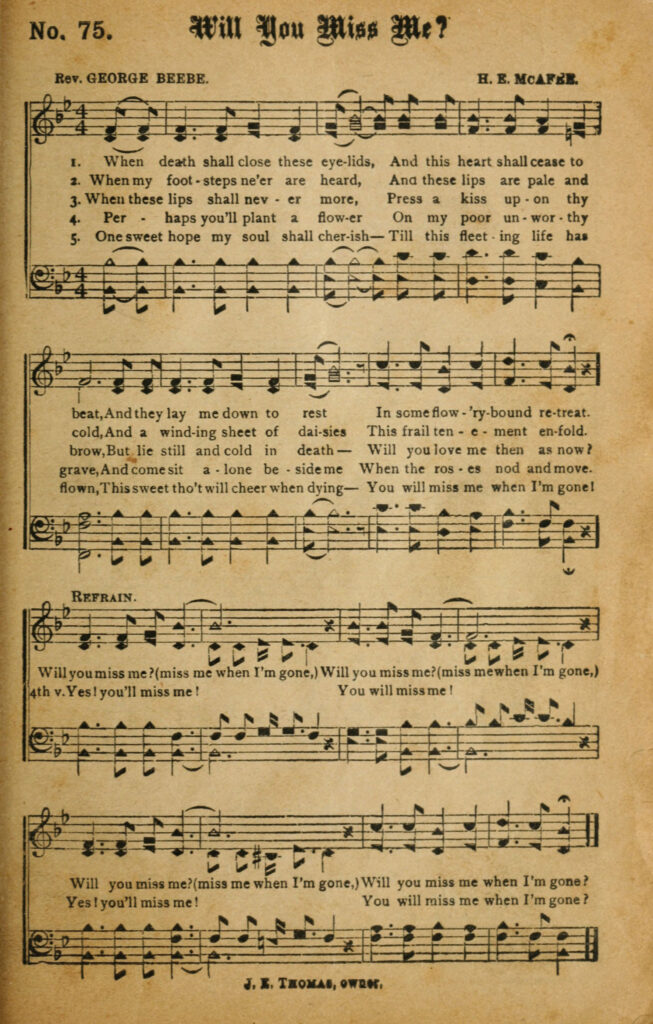
The Carter Family was well-known for their ability to “work up” songs. Sara Carter recalled that “that was in a songbook . . . we heard people sing that.” Fate must have been with the group in that they lucked onto a songbook that contained “Will You Miss Me?”. There are probably more, but as of today, there are only two known song books that the song appeared in prior to the Carters’ 1928 recording: Songs for the Singing, Normal and Literary Schools (published in 1900) and Our Hymns of Love, a Choice Collection of Gospel Songs (Published in 1909).
Which brings us to the song’s creators: Rev. George Beebe and H. E. McAfee.
George Arthur Beebe was born in Texas on August 11, 1869. Census records for the following year indicate that the Beebe family lived in Hill County, Texas, which is located about 60 miles due south of Dallas and Fort Worth. Beebe’s father, Riley, was a Civil War veteran who fought for the Confederacy as a member of the 15th Regiment, Texas Infantry. After the war he labored as a farmer. It is believed that the elder Beebe died at some point after 1880, leaving young George and other family members living at home with their mother. This continued to be the case until 1900 when, by this time, George was known to be a preacher.
It was at the same time that “Will You Miss Me?” was published for the first time, in Songs for the Singing, Normal and Literary Schools. Although the song appeared primarily in gospel song books, the piece could be better described as a sentimental heart song. Beebe was 30 years old, living at home with his mother, and single; he apparently never married. One has to wonder who this song was written to, or for? Before another ten years had passed, his mother had died and he was living as a boarder in a rooming house.
At some point in the 19-teens, Beebe moved to Los Angeles where he died on March 29, 1920 at age 50. A simple tagline on his Find-A-Grave page, perhaps from an obituary, said that Beebe had “worked as a preacher in Texas until a few years ago. Died of pernicious anemia and tuberculosis.” It was a sad ending to what sounded like a solitary existence. “Will You Miss Me?” appears to be his one and only published song.
What scant information about Beebe’s life is known raises more questions than it answers. Was his tuberculosis diagnosis the impetus for his writing of “Will You Miss Me?” Was his move to California an attempt to find a climate that was more amenable to his medical condition?
The life of Hugh Embury McAfee (July 8, 1859 – April 6, 1926) was, in many respects, a complete opposite from that of George Beebe. He was born in Mississippi and moved to Emmett, Texas, when he was 16 years old. The move coincided with McAfee’s conversion to Christianity. On May 21, 1882, he married the former Elizabeth Rice “Bettie” Groves; the couple had thirteen children together, eleven of which survived to adulthood.
McAfee was a farmer by trade. He worked an area that was part of the Texas black land plains, a region known for its dark, rich soil. He was also a music teacher and he occasionally wrote songs – either complete songs or sometimes just the music. He is known to have had published at least five songs: “Whiter Than Snow” (1898), “Will You Miss Me?” (1900), “A Few More Days on Earth to Wander” (1905), “The Crowning Day is Coming By and By” (1908), and “There’s a Beautiful Home, O’er the Dark” (1910). All of his children could sing and play music on a variety of instruments including the piano, violin, guitar, and mandolin.
Perhaps we’ll never know the true character of George Beebe, but the children of H. E. McAfee put forth a loving portrait of their father in his obituary: “The deceased was a Christian who practiced his religion. He set the right example always before his children. He was pure in his life, honest in his convictions and dealings with his fellow man, righteous in his ways. There was nothing he enjoyed more than reading the Bible and discussing its teaching with his children and his friends. He remarked before his death that he had no ill will against anyone, was concerned about the welfare of others, and a good friend to all. He was faithful in all his duties, a good Christian and a sweet singer. He praised his redeemer in a life of song. A writer of music, two of his own compositions, ‘Whiter Than Snow’ and ‘Will You Miss Me When I’m Gone,’ were sung at his funeral. The children are comforted by his upright life and high ideals as he set before them. A rich legacy which no doubt each will pattern after.”
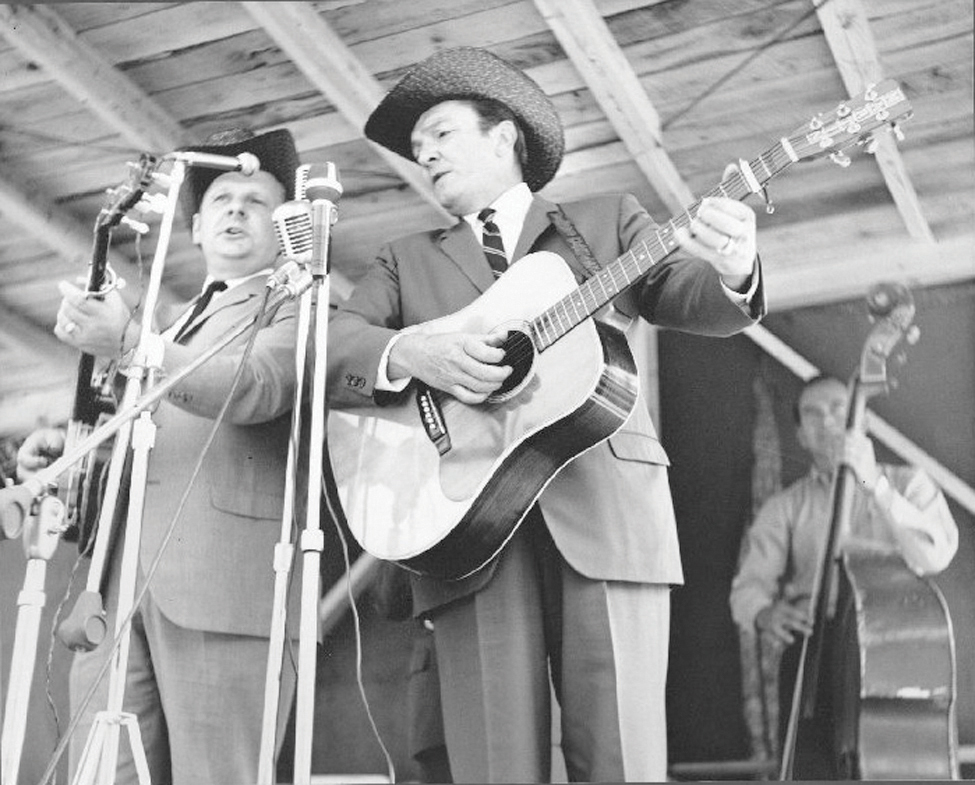
Fast-forward to December 1963 when the Stanley Brothers were in Baltimore, Maryland, for a week’s worth of work with disc jockey/promoter Ray Davis. At the end of the week (December 14), the Stanley Brothers performed at a Christmas party/open house for Ray’s sponsor, Johnny’s Used Cars. Later that evening, or in the wee hours of December 15, the Stanley Brothers, working under the pseudonym John’s Country Quartet, recorded a gospel album for Ray Davis’s Wango record label. The very last song recorded at the session was “Will You Miss Me?” The song was included on the session at the request of Carter Stanley, who suffered then from a bout of laryngitis. Consequently, Ralph Stanley sang lead on the song. His plaintive, emotion-laden vocals, coupled with the exquisite lead guitar work and bass vocal refrains by George Shuffler, made this track a masterpiece.
That 1963 recording of “Will You Miss Me?” has created a separate bit of mystery. Ralph Stanley sang only two verses, the first of which was:
Perhaps you planted flowers
On my cold unworthy grave
Come and sit along here beside me
Where the roses nod and fade
The second verse is a completely new one which did not appear in the original 1900 text, or in any subsequent versions by the Carter Family, or others:
On a cold, dark Sunday morning
In a country far away
A girl from old Kentucky
Lifted up her voice to say
Several recordings of “Will You Miss Me?” by other artists appeared not long after the Stanley release. Liner notes by Bob Artis to a 1971 release by Mac Martin tagged it as being “from the Carter Family.” When queried recently about the verse, Artis noted that “a lot of Mac’s songs were from the memory of having heard them live from the radio back in the day. Where he heard the ‘girl from old Kentucky’ verse is unknown to me.” A still later recording by Jody Stecher and Kate Brislin made use of the mystery verse. The notes to their recording state that it was the recording by the Stanley Brothers that influenced their rendition. Most recently, I reached out to Ralph Stanley II to ask if he knew the source of the verse. He replied, “No I really don’t. I know he always put that verse in when he [sang] lead [on] the song.”
In introducing the song at the Fincastle festival – the only known live recording of the song by the Stanley Brothers, Carter noted simply that “it’s an old Carter Family tune.” Carter Stanley’s rendition utilized verses from the Carter Family’s recordings and dispensed with Ralph’s mystery verse.