
Notes & Queries – January 2023
Queries
I have a 45 by the Page Valley Boys on Franc Records from Arlington, Virginia. The record is “Reubens Train” and “Old Blue.” Were they from Page County, Virginia, and who played in the group? I know Franc records was a folk label. Robert Embrey, via email.
A: The Page Valley Boys came together in the middle part of 1963 as a mostly folk group that was headquartered in Northern Virginia. The group took its name from Page Valley that was located in the Shenandoah Valley of Virginia. None of the members were from there, but they made frequent trips there to visit friends.
The band had a manger in the form of Frank Gist, who was also the owner of Franc Records. In the summer of 1964, the Page Valley Boys went into Edgewood Studios, located at 1627 K Street NW in Washington, DC, and recorded a 45-rpm single for release on Franc. Band members on the recording were Stafford Markham on guitar and lead vocals, Ed Warren on bass and tenor vocals, and John Cyr on banjo and baritone vocals. The July 25, 1964, edition of Billboard magazine featured a brief line-listing of the release under the heading of Folk Music: “PAGE VALLEY BOYS – Reuben’s Train (1:55) Old Blue (2:52). FRANC 4504.” Cash Box magazine hailed “Reuben’s Train” as a “high-spirited, infectious reading of the folk oldie” while tagging “Old Blue” as “another folk sturdie essayed.”
Shortly after the release of the record, guitarist/mandolin player Cliff Waldron from Jolo, West Virginia, joined the group. It was then the band transitioned from a folk group to a bluegrass one. Stafford Markham, who had been learning banjo from Johnny Whisnant, switched from guitar to five-string. The Washington Folk Strums newsletter told of the “joyful bluegrass of the Page Valley Boys” and of the “latest improved version” of the group.
The Page Valley Boys enjoyed steady work in the Northern Virginia/Washington, DC, area throughout the middle and late 1960s. About the time of Waldron’s joining the group, it morphed, at times, into a full five-piece band with guests such as Smiley Hobbs sitting in from time to time.
The personal appearance calendars in back issues of Bluegrass Unlimited reveal that the make-up of the group for most of 1967 consisted of Stafford Markham on banjo, Clifford (as he was billed in the magazine) Waldron on mandolin, Bob Brown on bass, and Don Lambert on guitar. They mainly played at Virginia clubs and restaurants such as the L & M Grill in Dumfries, the Elden Street Restaurant in Herndon, and the Fairlington Inn in Alexandria. One deviation was a benefit concert for banjo picker Don Stover. The end of the year was marked by the exit of Cliff Waldron, who left to form a partnership with Bill Emerson, and the addition of mandolin player Johnny Johnson and dobro picker Bruce Stark.
Notes
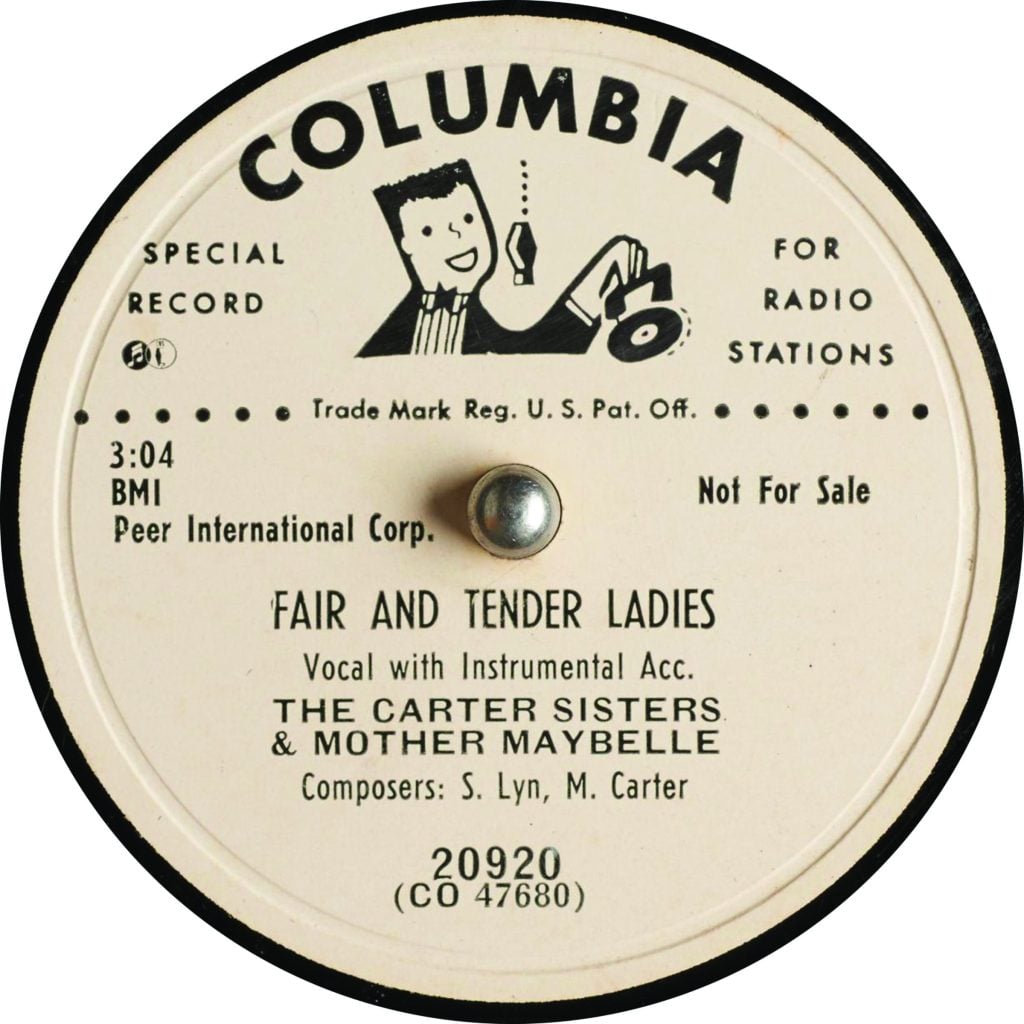
Every so often, a photo of the Stanley Brothers shows up on Facebook. And the inevitable questions follow: “Who is that on drums?” and “Who is that on electric bass?” The most recent posting of the photo came on December 1, 2022, when photographer/author Frank Godbey uploaded it. In doing so, he noted that “Carter Stanley left us 56 years ago today. But the music & the memories linger on. RIP.”
Frank and his late wife, Marty, took the photo of the group on May 29, 1966, when they appeared at Frontier Ranch, east of Columbus, Ohio.
But, to answer everyone’s burning questions, the two guest musicians in the photo were members of the Frontier Ranch house band, the Country Playboys; John Thornhill played electric bass while Gary Shirk sat in on drums. Though not pictured here, Frank Godbey offered additional information about the band: “The leader of the house band was ‘Cousin Roy’ Stingley, who was also a DJ on station WHOK down in the Hocking Hills southeast of Columbus. The ‘girl singer’ in the band was Connie Smith. Roy ultimately left for a bigger radio job in Chicago and Connie went to Nashville at the urging of Bill Anderson. Y’all know Connie’s history . . .” Completing the picture, at far right, is long-time Stanley sideman George Shuffler.
In the audience at the Frontier Ranch show was Norma Fannin, vice president of the Stanley Brothers Fan Club. She wrote of her experience that “I had the pleasure of seeing the Stanleys play a show May 29th at Frontier Ranch, just outside of Columbus. This was something special to me, as this is where I saw them for the first time, June 13, 1963. There was a wonderful crowd at this show, and to all you who joined the [fan] club that day, again, a great big thank you! When we saw the Stanley Brothers on May 29th, I made several colored pictures, one especially is good, is being reprinted for use in the next journal.”
Murphy Henry, Bluegrass Unlimited’s intrepid keeper of the “General Store” column, has been hard at work on her upcoming biography of country music legend Maybelle Carter. She recently ran into a roadblock while researching the song “Fair and Tender Ladies.” Murphy noted that “songwriter credits go to S. Lyn and M. Carter – which is surely Maybelle. ANY CLUE who S. Lyn might be? I’ve googled the name but come up with nothing. They were recording for Columbia, if that helps any.”
S. Lyn, or as more formally known, Shirly Lyn, was a pseudonym for songwriter/song plugger Troy Martin. In his liner notes to the 1987 Flatt & Scruggs gospel release called You Can Feel it in Your Soul (County CCS-111), Charles Wolfe wrote that Troy Martin was a “song plugger for Peer-Southern, [who] was an especially important source for finding good material.” Martin supplied songs to several bluegrass artists such as Jimmy Martin (“Before the Sun Goes Down”) and Carl Story (“Love Me Like You Used to Do” and “Someone to Lean On”), but it was for Flatt & Scruggs that Martin was most effective. Throughout the 1950s, he brought at least fifteen songs to the group: “Bubbling in My Soul,” “Building on Sand,” “Crying Alone,” “Don’t Let Your Deal Go Down,” “I’d Rather Be Alone,” “I’ll Go Stepping, Too,” “I Saw Mother With God Last Night,” “I Won’t Be Hanging Around,” “Is There Room For Me,” “Joy Bells,” “A Million Years in Glory,” “Mother Prays Loud in Her Sleep,” “Old Fashioned Preacher,” “On My Mind,” and “What’s Good For You.”
Martin’s name was affixed, in one way or another, to all of these songs. He often used pseudonyms such as Jerry Organ, Tom Lee, and George Sherry to hide his identity, perhaps to avoid any appearances of conflicts of interests by being both songwriter and publisher. There’s no real evidence that Martin actually contributed to the creation of any of these songs. It was not uncommon for some publishers and song pluggers to receive a partial credit/interest in a song as a “cost of doing business” to get their work recorded and promoted. In the end, it was probably to the writer’s advantage to do so. Earl Scruggs (quoted in Wolfe’s album notes) reflected with a chuckle, that “Troy worked harder for a song if he had a piece of it.”
Troy Lee Martin (May 16, 1911 – February 21, 1977) was a native of Danville, Virginia. Throughout the 1930s, his musical exploits were chronicled in his hometown newspaper. One of the most notable entries came from the May 27, 1933, edition of the Danville Bee, issued when Martin was just barely twenty-two years of age. “The cattle train wreck at Stacey has found its way to the permanent records of music. Fred Richards, Danville youth a member of the Blue Ridge Mountaineers playing organization composed the tune and Troy Martin wrote six versus. The ballad has been recorded in New York and is to be marketed.” Though not mentioned in the article, the song in question is “Wreck of the Number 52,” which was released by Cliff Carlisle in September 1933.
Before coming to Nashville in 1949 to work for Peer Southern as a song plugger, Martin, at times, fronted his own band and also worked as radio personality on WBIG in Greensboro, North Carolina. Coming from a radio background, Martin knew how to service the DJs. One jock, Mort Lloyd of KEXL, Waterloo, Iowa, wrote that he “likes the record service he gets from Troy Martin of Southern.”
In 1952, Martin built upon his expertise in publishing by going into partnership with talent booker Jim Denny and rising country music star Carl Smith. The trio launched one of the earliest publishing houses in Nashville, Driftwood Music. Later ventures included a stint with Gene Autry’s Golden West Melodies. Still later, in the 1960s, Martin served as executive vice president of publishing and recording concerns that were owned by Hank Snow.
Over Jordan
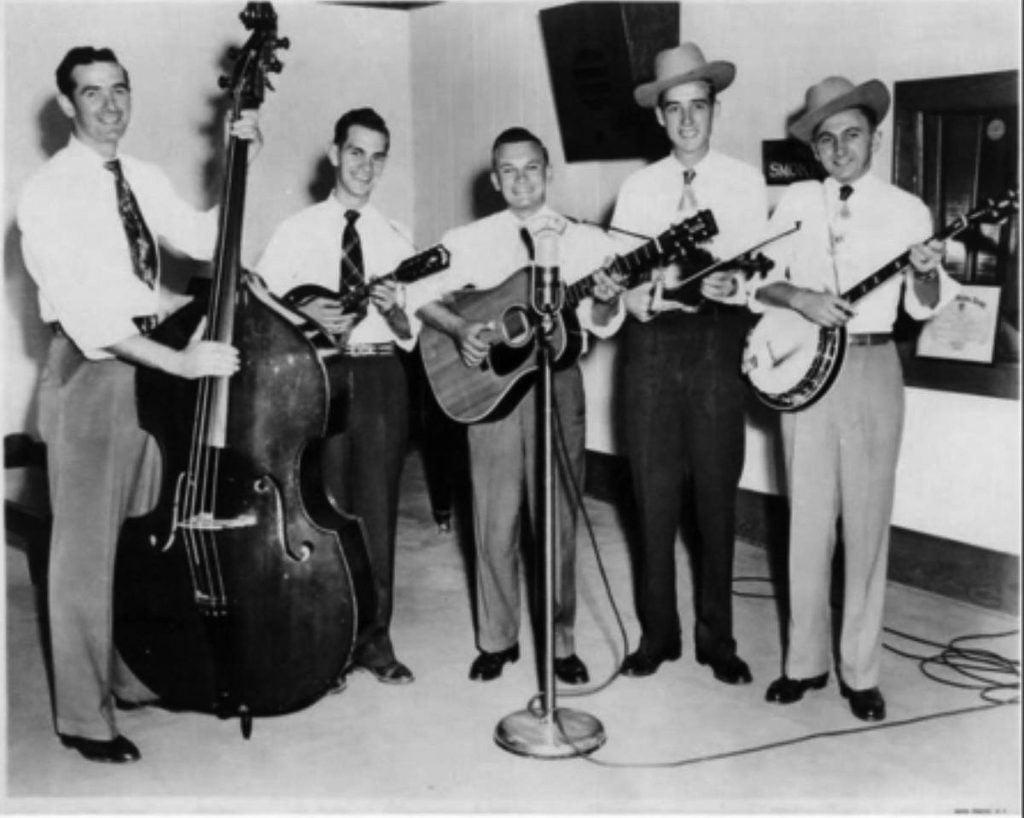
Troy Shirley Brammer (July 24, 1932 – December 11, 2022) was a multi-instrumentalist who was known primarily for his banjo playing. A native of Woolwine in Patrick County, Virginia, he is reported to have taught himself to play the banjo starting at age five. As a teenager in the late 1940s, he and his brother Joyce were members of a group called the Sodbusters. A short time later, the Brammers banded together with musicians Lloyd Burge and Marion Hall to form the Brammer Brothers and the Virginia Partners.
The new group often appeared as a special attraction for local performers Dee Stone and the Melody Hillbillies. It was though Stone that the Brammers released some of their earliest recordings. The April 5, 1951, edition of the Bassett and Henry County Journal newspaper announced that “the Mutual Recording Company of Henry, Va., which is managed by Dee Stone, has just released a new record. One side of the record is ‘Virginia Waltz,’ with vocal by Joyce Brammer and Lloyd Burge, and featuring the music of the Brammer Brothers and the Virginia Partners. The other side is ‘Tell Me Truly, Little Darling,’ also featuring the same vocalists, and the Brammer Brothers and the Virginia Partners. Dee tells us that these records can be bought at most all record bars and music stores.”
In July of 1951, the Brammer Brothers joined the cast of performers at radio station WPAQ in Mount Airy, North Carolina. The station gave them exposure to go out and perform show dates throughout the area. In addition to placing second in the band competition at the Galax Fiddlers Convention, the group logged appearances at such venues as the Floyd-Willis Drive-In, the Hillsville Drive-In, the Pine Tavern Movie Park in Woolwine, and the Dublin Theatre. Press for one of the outings boasted that the Brammers “are hitting the big time now on phonograph records and radio.”
As 1951 drew near to a close, Joyce Brammer was drafted and brought an end to the Brammer Brothers. A short time later, Troy and his bandmates (minus Joyce) found themselves in Cincinnati helping Wade Mainer on a November 19 session at King Records. Troy played banjo on several selections, and added fiddle and baritone vocals to “That Star Belongs to Me.” Other songs from the session included “Little Birdie,” “The Girl I Left in Sunny Tennessee,” “I’m Not Looking Backward,” “Standing Outside,” and “Dreaming of a Little Cabin.”
At least one other recording opportunity came to Troy during this same period. A session with Mac Wiseman was held at a radio station in Gallatin, Tennessee. Others on the session included fiddler Curly Ray Cline, mandolin player Jim Williams, and bass man Ezra Cline. Songs recorded included “Georgia Waltz,” “Love Letters In The Sand,” I’ll Still Write Your Name in the Sand,” and “Dreaming of a Little Cabin.” Unfortunately, Wiseman suffered from laryngitis that day and the session was scrapped, never to see the light of day; the songs were re-recorded at a later session with different musicians.
Following the Korean War, the band members of the Virginia Partners went in different directions, pursuing full-time jobs and family obligations. Troy and Joyce continued making music but on a more limited basis. This came to a halt in 1960 when Joyce died suddenly and unexpectedly. It wasn’t until the summer of 1966 that Troy reactivated the band. In competitions at the Union Grove Fiddlers Convention, the group took top honors in the “modern division.” Throughout the 1960s and into the early ‘70s, Troy and the Virginia Partners competed at area fiddlers conventions, oftentimes taking home first place trophies. In 1973, Troy recounted that he won 120 times in various categories at conventions over the years.
In 1973, Troy worked in a band called Jake and Fennie and the Hearts of Gold Band. It was during this period that Troy experienced most of his recording activity. On that band’s Golden Sounds of Bluegrass album, reviewer Dick Spottswood called out the “special interest [in] the presence of banjoist Brammer, who was one of the Brammer Brothers who made some significant recordings in the early fifties. His work is solid and inventive—a real asset to the group.” It was while with the same group that Troy recorded his only solo album, The American Sound. Columnist Walt Saunders noted Troy’s fondness for the music of Don Reno and complemented him for playing the tunes “differently enough to demonstrate his ability to think for himself, and not just merely mechanically copy, note for note, another’s work . . . a better than average collection of banjo pieces.”
Troy remained musically active for much of the next five decades, working in various band situations, competing at numerous fiddle contests, occasionally venturing into the recording studio, and serving as a mentor to younger generations. One of Troy’s most ardent protégés was Jeremy Stephens who, at age sixteen released his own solo banjo outing called Scarlet Banjo. That title track was written by Troy, as was another selection on the disc. And, he played guitar on most of the project. In his notes to his recording, Jeremy spoke for countless others when he expressed gratitude to “Troy Brammer for being my musical mentor – for that I will ever be thankful.”
Ronald “Ron” Petronko (May 21, 1943 – November 13, 2022) was a Montreal native who was best known as a photographer that was most active during the 1960s and ‘70s. He was one of a handful of people who captured on film the essence of the first multi-day bluegrass festival that was held in Fincastle, Virginia, on Labor Day weekend in 1965. He was also a banjo and guitar picker who played in the early 1970s Canadian band Coldwater Flat. Ron’s list of talents also included work as a luthier; he built guitars.
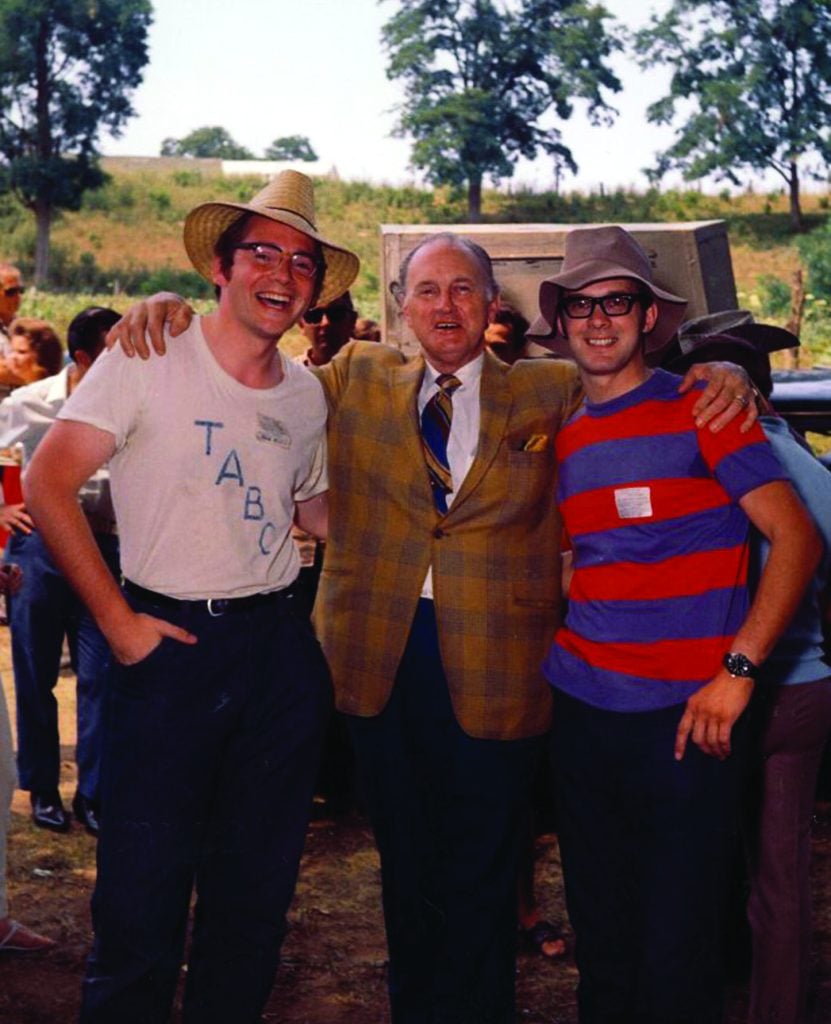
Ron came of age listening to classic country music by performers such as Hank Williams. However, in the middle 1950s, he heard the five-string banjo work of Earl Scruggs and became an instant convert. He was able to tune into other bluegrass styled groups by listening to WWVA from Wheeling, West Virginia. The station’s roster included impressive groups such as the Osborne Brothers & Red Allen and Jimmy Martin & the Sunny Mountain Boys. Some of Ron’s earliest bluegrass photography was of Jimmy Martin’s group when it traveled to Ottawa, Ontario, in 1960. He also snapped images of Flatt & Scruggs when they visited Montreal in 1963.
Ron was one of a handful of northern bluegrass aficionados that descended upon the first Fincastle festival. He captured now-historic images of Bill Monroe performing together with luminaries such as the Stanley Brothers, Mac Wiseman, Jimmy Martin, and Clyde Moody. There were also pairings of Doc and Merle Watson as well as Don Reno and Benny Martin; group photos of the New York City Ramblers (Jody Stecher, Sandy Rothman, David Grisman, Fred Weisz, and Winnie Winston), local favorites such as the King Brothers, and Monroe with his Blue Grass Boys (Gene Lowinger, Peter Rowan, Lamar Grier, and James Monroe); and solo shots of notables such as Red Smiley.
If he never snapped another photo, Ron’s coverage of the Fincastle festival would have earned him a respected place in bluegrass history. But he soldiered on with a return trip to Fincastle in 1966, and to many other events such as Berryville 1969, Bean Blossom 1971, the Green Mountain Banjo Festivals in Vermont, the Berkshire festivals, and many more.
Longtime friend Doug Hutchens recalled one memorable outing that provided many photo opportunities for Ron. In August 1971, Bill Monroe and the Blue Grass Boys (with Hutchens playing bass) spent a week in Montreal. Hutchens reported that “Ron had hung around with us all week in Montreal . . . when we left to come back to the states, he had talked to Bill about riding with us to Nashville. On Sunday afternoon [we] started south.” The band played a fair in Stoverstown, Pennsylvania, before heading to Tex Logan’s home in New Jersey. “We did Tex’s all-night BBQ where Ron took a good number of photos, then we left there to go to the Philly Folk Festival . . . there were monsoon rains the night before. When we got ready to leave [the festival] on Saturday night, the small one-lane black top we had to drive down had cars parked on both sides . . . Bill told Kenny [Baker] to get behind the wheel and Bill, Jack [Hicks], Joe [Stuart], Ron Petronko and myself got out to pick up one end of a car and slide it over, then go to the other end and do it again. We probably slid at least twenty-five or more cars either to the right or the left in order to be able to get the coach out that night.”
Over the years, Ron’s photos appeared in a variety of publications, including Bluegrass Unlimited, Muleskinner News, and Pickin’. He also contributed photos to the first book on bluegrass that was written by Bob Artis in 1975. More recently, his work was featured in a 2006 exhibit at the International Bluegrass Music Museum in Owensboro; was included in a 2006 film called The Rhythm of My Soul: Kentucky Roots Music; and was featured in the Ken Burns 2019 Country Music series. As an author, Ron contributed the article “Bill Clifton in England” and a Bill Clifton discography to a 1971 edition of Bluegrass Unlimited. Ron’s bluegrass photos are being donated to the International Bluegrass Music Museum.