Notes & Queries – April
Bluegrass has been beset with the recent passing of a number talented members of our community. In lieu of our regular “Notes and Queries” column, we use the space this month to honor their memories.
Wayne Wendell Daniel February 14, 1929 – February 16, 2021
Wayne Wendell Daniel was a prolific author who specialized in old-time, bluegrass, and early country music. From 1978 until 2002 he contributed 35 articles to Bluegrass Unlimited alone. Another 150 writings appeared in publications such as the Atlanta Journal Constitution, The Devil’s Box, JEMF, The Journal, The Journal of Country Music, Nostalgia Digest and Radio Guide, Old Time Country, Old Time Music, and Precious Memories. In music circles, he is perhaps best known for his 1990 book Pickin’ on Peachtree, a comprehensive history of country music in Atlanta.
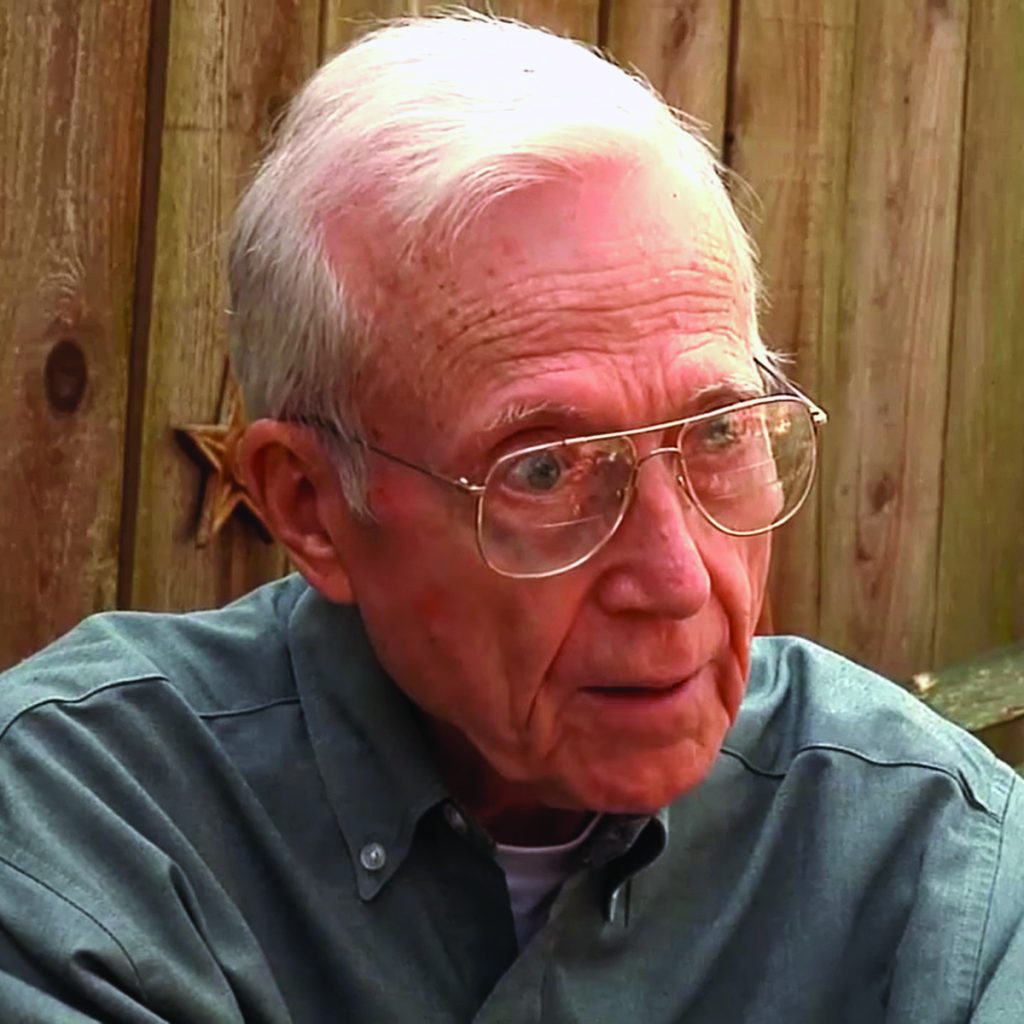
He was born in Tallapoosa, Georgia, a tiny community that is located near the Alabama border, about 60 miles due west of Atlanta. He attended the Pine Grove Elementary School (one of the last one-room school houses in the state of Georgia) before graduating from Tallapoosa High School in 1947. Further education continued at West Georgia College, the University of Georgia, the University of North Carolina, and the University of Oklahoma. The bulk of his professional life was spent at Georgia State University where he taught statistics. During his career, he authored five books on statistics as well as 27 articles.
But it is for his dedication to traditional music that has endeared him to long-time readers of this magazine. By his own admission, he was a life-long fan of country music. He started writing about it while still in high school; his first published article on the subject appeared in the January/February 1948 issue of National Hillbilly News magazine: “Cotton Carrier.” More recently, he confided to a friend that he “had the love of the music, but not the musical ability to play an instrument and perform. So, he chose to write about it instead.” It wasn’t until 1978 that his country music research – especially that surrounding the Atlanta area – took off in high gear.
Wayne’s first contribution to Bluegrass Unlimited was a 1980 article entitled “So You Want to Start a Bluegrass Festival.” He followed this up with pieces on Lewis Phillips “The Youngest Banjo Picker Around,” the Blue Sky Boys, Wilma Lee Cooper, Josh Graves, “The Gospel Roots of Bluegrass,” Chubby Wise, Jeff and Sheri Easter, and Blaine Sprouse, to name but a few.
While Pickin’ on Peachtree was Wayne’s only book devoted to country music, he made numerous contributions to other volumes such as the Encyclopedia of Country Music, the New Georgia Encyclopedia, the Encyclopedia of Appalachia, as well as one chapter, “Hayloft Patriotism: The National Barn Dance during World War II,” in the 2005 book Country Music Goes to War.
Although Wayne wasn’t a performer, he did rise to the occasion to make public presentations of papers about the music. He was a frequent speaker at the annual International Country Music Conference, Nashville, Tennessee. Other engagements included talks for the Folk Alliance, the Tennessee Folklore Society, and a gathering of IBMA members in Atlanta.
Aaron “Frosty” Foster
September 1992 – February 10, 2021

Aaron “Frosty” Foster was a rising name in bluegrass whose life was unexpectedly cut short at the youthful age of 28. A native of Wells Bridge, New York, he was exposed to bluegrass as a youth through the enthusiasm of his grandparents. He began playing guitar at age 10. After graduation from high school, he enrolled at East Tennessee State University in Johnson City, Tennessee, and it was only after he had been there a while that he changed majors and entered the bluegrass program. He was a two-year member of the school’s Bluegrass Pride band, which had several songs that appeared on the BluegrassToday airplay charts. Foster graduated in 2017 and recently returned to the school’s Appalachian Studies department as a public relations and marketing coordinator. He performed in several groups including the Amanda Cook Band and Boone and Foster, the latter having just landed their “Country Fool” single at #6 on the BluegrassToday charts.
Rudolf “Ruedi” “Hank” Dettwiler Gloor
February 5, 1945 – February 2, 2021
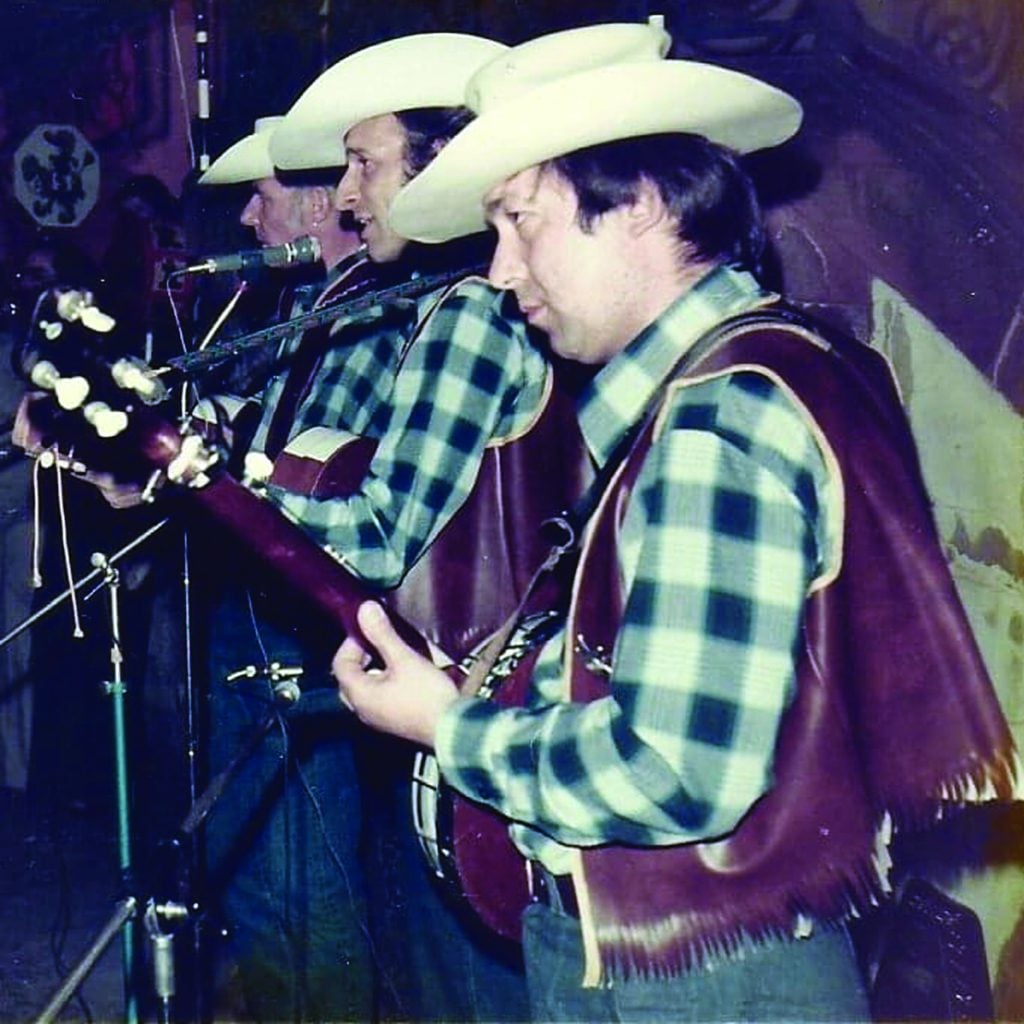
Rudolf “Ruedi” “Hank” Dettwiler Gloor had the distinction of being the first bluegrass style 5-string banjo picker in Switzerland, and perhaps in all of mainland Europe. He became interested in the instrument as a teenager and relied on sources from outside the country to fuel his passion. He procured a banjo by mail order from England and received a copy of Pete Seeger’s How to Play the 5-string Banjo from the United States. In 1962, he joined the already existing duo of Bill Bohn and Peter Gisin and the trio named their outfit The Country Pickers. In an effort to affect a more country music persona, Ruedi adopted the stage name of “Hank.” The group performed throughout the early and middle 1960s and then took some time off to tend to growing families. One highlight during this era was Ruedi’s opportunity to see the Stanley Brothers, the New Lost City Ramblers, Roscoe Holcomb, and Cousin Emmy in person when the Festival of American Folk and Country Music tour performed in Basel, Switzerland, on March 20, 1966. The Country Pickers re-formed in the 1970s and continued until 1996. The band grew from a trio to a quartet in 1983 when Ruedi’s son Paolo joined on bass and later switched to mandolin; a later addition of dobro further added to the group’s bluegrass sound. While with the Country Pickers, Ruedi helped with the recording of two albums: Happy Days in 1986 and East to West in 1990. Ruedi’s 30-year involvement with the group came to an end with his retirement from music in 1992. His instruments wound up in the possession of his son, Paolo, and he later remarried and assumed his wife’s surname of Gloor.
Clarence Edgar Hall
November 6, 1933 – February 4, 2021
Clarence Edgar Hall was an accomplished musician, singer, songwriter, instrument maker, and repairman from Stuart, Virginia. His knowledge of instruments prompted one picker to note that Clarence has “forgotten more than I’ll ever know about banjos.”
Clarence began learning to play the banjo in his teens, around 1950. He teamed up with his cousins, Cecil and Marshall Hall; Buddy Pendleton; and Henry Hill in a group known as the Mayo River Boys. Throughout the early and middle 1950s, the group was a mainstay at WPAQ radio in Mount Airy, North Carolina.
Following a stint in the Army, Clarence returned to Patrick County, Virginia, where he taught auto mechanics at the local high school; he remained on staff until his retirement. Throughout the 1960s and ‘70s, he played in several bands including the Southern Partners, where he played twin banjos with Troy Brammer. The group won ribbons at numerous fiddlers conventions and appeared on several albums that were recorded live at the Old Fiddlers Convention in Galax, Virginia.
Others groups included the Virginia Partners and the Dominion Bluegrass Boys. The Dominion group, which formed in 1971, recorded two albums, one for Grassound and another for Rebel. A highlight of the Dominion Bluegrass Boys was the opportunity to back up Charlie Monroe when he came out of retirement in 1973 and 1974.
Over the years, Clarence kept a hand in music by performing for dances and at various fiddlers conventions. As a repairman, he counted musicians as Gene Parker, Dewey Brown, and Don Parmley as satisfied customers.
Robert W. “Bob” Mitchell
April 11, 1937 – January 26, 2021
Robert W. “Bob” Mitchell was a lifelong fan of bluegrass who, in his later years, took to the printed page and the airwaves to share his love of the music with the masses. The Louisville native often told how in childhood he rode his bike downtown to the local radio station or to area businesses to hear bluegrass and country music.
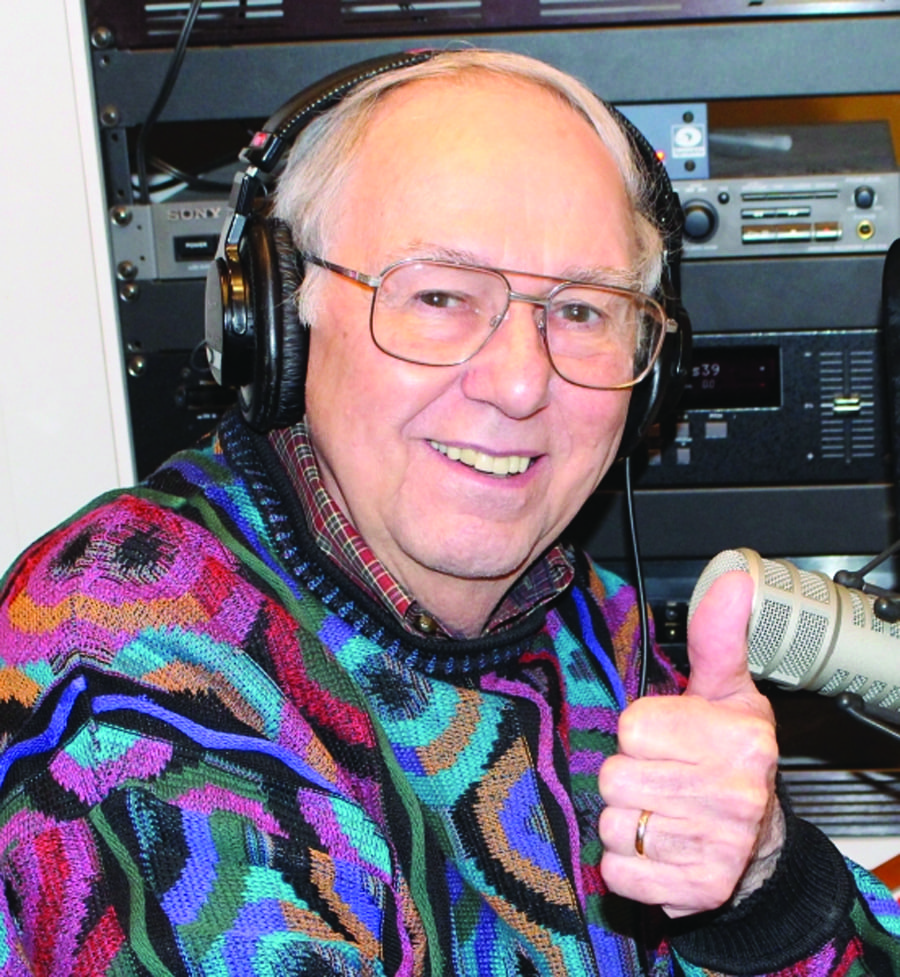
Bob’s professional life centered around social work, mental health, and public speaking and training. He spoke to over 350,000 people in 49 states and Canada and published three books. Music, in one manner or another, was always a part of his presentations.
In 1995, Bob utilized the services of Gary Brewer and the Kentucky Ramblers, with a youthful Ron Stewart on banjo and fiddle, to record an album of humorous songs called Some Days This Place is a Zoo. Striking a more serious tone, Bob began writing record reviews for Bluegrass Now, Bluegrass Music Profiles, and Louisville Music News.
At the urging of fellow Louisville bluegrass enthusiast Berk Bryant, Bob launched his radio career in 2008. In time, his Best of Bluegrass radio program was syndicated to the following outlets: WFPK, WKWC, WMAK, Crescent Hill Radio, The Bluegrass Mix, and The Bluegrass Jamboree. He was a four-time nominee by SPBGMA for their Best DJ of the Year award. AirPlay Direct chairman Robert Weingartz touted Bob as a “dedicated radio professional, and a very strong supporter of the bluegrass community as a whole. He has been a fantastic Industry Ambassador.”
Edwin Morton “Ed” Pearl
May 24, 1932 – February 7, 2021
Edwin Morton “Ed” Pearl is best known as the founder and driving force behind the Los Angeles-based Ash Grove coffee house. The venue ran from 1958 until 1973 and featured an eclectic mix of folk, blues, bluegrass, old-time music and more. The Ash Grove introduced legions of southern Californians to a bevy of unique sounds and styles and served as an incubator that allowed for the development of rising talent.
Pearl was the son of Jewish Russian emigrants who came to the United States in the early 1900s. He grew up hearing the sounds of Israeli and Yiddish songs as well as those of local country music entertainers that could be heard on the radio. While enrolled at UCLA in the middle 1950s, he discovered Harry Smith’s Anthology of American Folk Music and subsequently organized the Berkeley Folk Music Club. In January 1958 he organized the Folk Arts Society and six months later opened the Ash Grove.
The venue was named after a well-known Welsh folk song and had the stated purpose of becoming “the best possible showcase for presenting folk music as nearly authentic as possible.” It was a daunting task considering that the area already sported some 60 other coffee houses. But, the Ash Grove was more than just a performance hall. It also offered classes on guitar, banjo, and folk singing; staged monthly art exhibits; and frequently made its space available as a lecture hall.
In a Sing Out! article by John Cohen, Pearl reflected on the success of the Ash Grove. “I guess one of the main characteristics of the Ash Grove is its steadiness. We constantly put on good music and very rarely fail in this. As agencies go up and down, promoters gain and lose interest, the Ash Grove remains a constant cultural and social force.”
Indeed, among the “good music” to be featured at the Ash Grove were performances by The Country Boys (later re-christened The Kentucky Colonels) and The Dillards. Colonels co-founder Roland White reflected recently that “Ed was a good and generous man. He got us started in the folk music scene.”
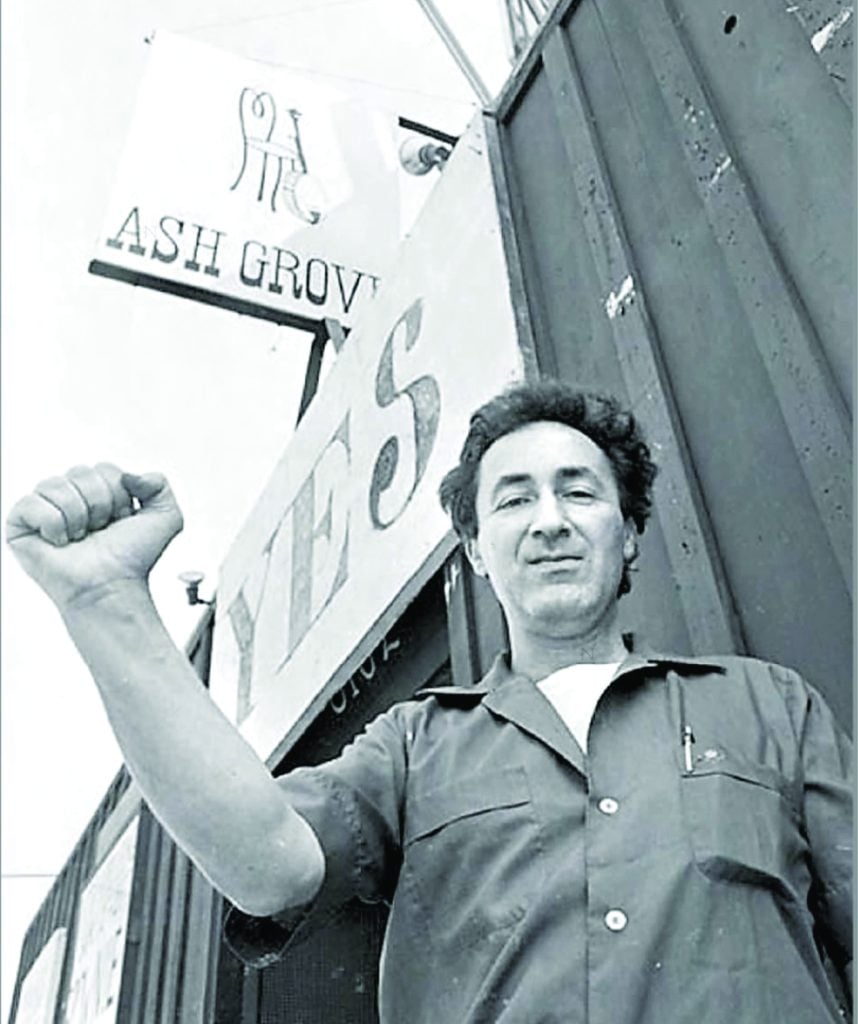
As the club developed a reputation for being “the” place to go hear traditional and roots music, it attracted the attention of media moguls in the Los Angeles/Hollywood area. It was at the Ash Grove that The Country Boys and The Dillards were discovered by talent scouts from the Andy Griffith Show. Additionally, record producer Jim Dickson signed The Dillards to a recording contract for Elektra Records.
The Ash Grove sported its share of distinguished guest artists as well. During a 1962 engagement, Lester Flatt and Earl Scruggs were recruited to perform the theme music for The Beverly Hillbillies. The Stanley Brothers landed a two-week stay that included visits by members of the cast from the Bonanza television program. Also in the audience was future guitar guru Ry Cooder; Herb Pedersen caught the Stanleys at a Pearl-organized concert in Berkeley. Budding bluegrass enthusiasts Eric Thompson and Cheney Otis hauled a reel-to-reel recorder to the club to tape seven 45-minute sets by the Stanleys. It was also in 1962 that old-time musician Clarence Ashley, with Doc Watson, appeared at the Ash Grove; Watson’s guitar work made an immediate and long-lasting impression on Country Boy Clarence White. Other notables throughout the early and middle 1960s included Mother Maybelle Carter, the New Lost City Ramblers, Johnny Cash, and Bill Monroe.
In addition to his work as a music presenter, Ed Pearl was very active in progressive politics and social justice issues. His activities were not without consequence and it was believed that several arson-suspected fires at the Ash Grove were set by those at odds with Ed’s liberal politics. The last such fire, in November 1973, resulted in the permanent closure of the club after a successful 15-year run.
For the next 20 years, Ed held a series of what he termed “unglamorous jobs” that included producing music and theater, organizing concerts for various causes, hosting a blues music show on KPFK radio, and dealing with “personal problems.”
In July 1996, the Ash Grove reopened as part of a pier renovation project in Santa Monica. The fanfare surrounding the new venture was short-lived. By September of the following year, the club owed a year’s worth of rent payments to the city and was forced to file for Chapter 11 bankruptcy.
Despite its ups and downs, it was the Ash Grove that seemed to define Ed Pearl’s life. In 2008, UCLA hosted a three-day 50th anniversary celebration of the Ash Grove. It was a mix of lectures, remembrances, and concerts by a host of pickers and singers that included Mike Seeger, Roland White, Ry Cooder, Ramblin’ Jack Elliott, Michelle Shocked, and others. Elliott’s daughter, Aiyana, with Ed’s cooperation and input, has been working on a documentary about Ed Pearl and the Ash Grove.
More recently, the advances of Alzheimer’s disease had confined Ed to an assisted living facility where, in late January, he contracted COVID-19.
Lee Sexton
(March 23, 1928 – February 10, 2021)
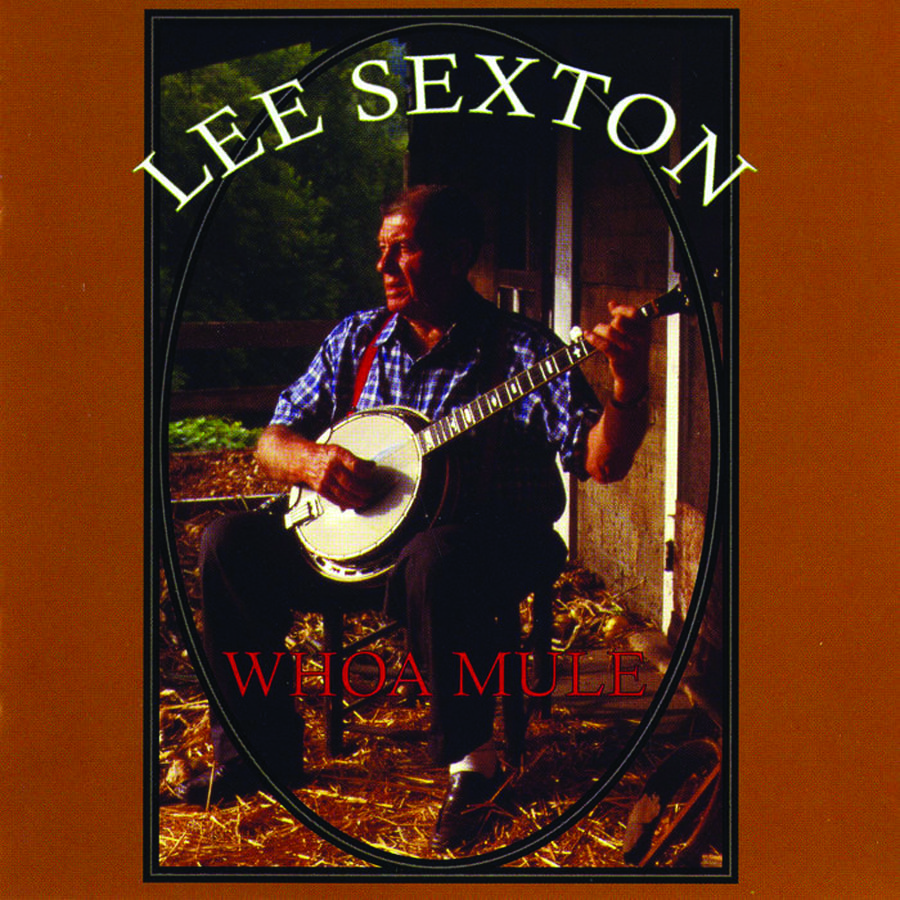
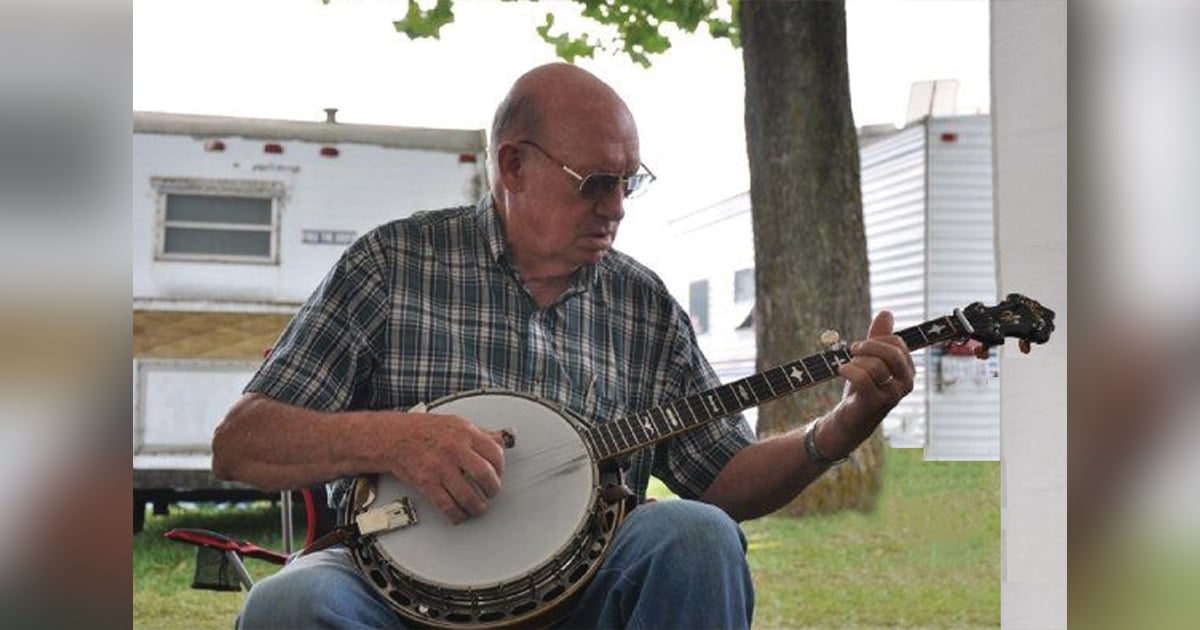
In reviewing the CD release of the Whoa Mule, Bluegrass Unlimited contributor Steve Goldfield hailed Lee Sexton as “one of the finest banjo players of our time.” He never really took his music to a national audience and was known as a well-kept regional treasure. But the world, at times, came to him. In the late 1950s, John Cohen recorded him for his Mountain Music of Kentucky album for Folkways. He touted Sexton as “one of the cleanest and fastest banjo frailers I ever met.” Years later, he was sought out for a brief music-making appearance in the film Coal Miner’s Daughter. But mainly, his music consisted of playing for dances (where he and Marion Sumner played fiddle and banjo tunes for 50 years), on the radio, and “at a local beer joint every weekend.”
Like his father and grandfather before him, Lee took up the banjo at an early age. He earned the money to buy his first banjo, around age 7, by clearing his grandfather’s corn field of stalks at the end of the growing season. His father’s music making came to an end when Lee was 10 years old; a stick of dynamite exploded prematurely and blew off both of the elder Sexton’s hands. The accident necessitated Lee’s having to enter the workforce at an early age; he worked the family’s farm for 25 cents a day. At age 16, he went to work driving ponies in a nearby truck mine.
Lee was adept at playing the banjo in a variety of styles including drop-thumb/clawhammer; two-finger, which he learned in part from his cousin Roscoe Holcomb; and three-finger/bluegrass. However, mining and farm-related accidents damaged his fingers and in later years left him with the ability to only play two-finger style.
Colleen Bain Trenwith
June 14, 1946 – January 24, 2021
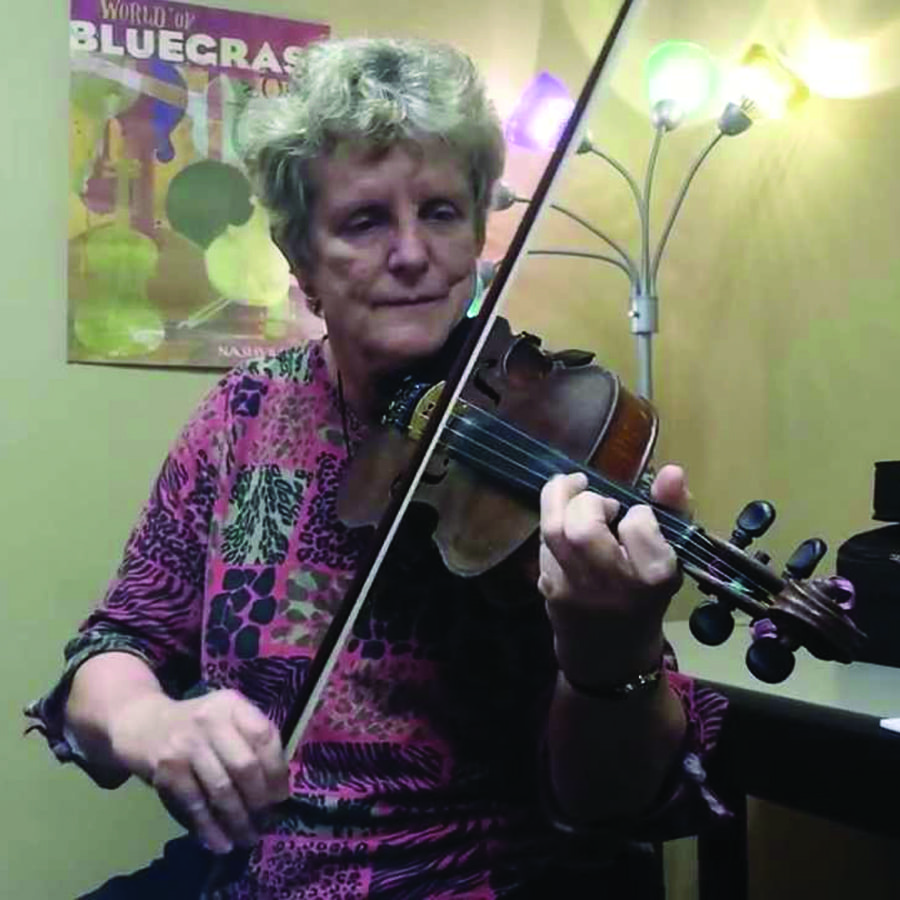
Colleen Bain Trenwith was a classically-trained-violinist-turned-fiddler who made her mark with the popular New Zealand group The Hamilton County Bluegrass Band. Her immersion to bluegrass came at age 20 when she met Paul Trenwith, a banjo player whose own passion for the music was inspired by The Beverly Hillbillies television program. The Hamilton County Bluegrass Band, with Colleen on fiddle, was formed in 1966 and soon became the house band on the nationally televised Country Touch program. The exposure led to numerous touring opportunities in New Zealand and Australia.
Colleen and Paul married in 1970. The following year, in a tour that was facilitated by Mike Seeger, the entire group made its first trip to the United States. They performed at Bill Monroe’s Bean Blossom festival as well as on the Grand Ole Opry. From 1974 to 1976, Colleen and Paul were tapped as the backing band for Australian country music star Slim Dusty.
Following the stint with Dusty, Colleen and Paul concentrated on raising a family and also fronted a bluegrass gospel group. Over the years, the Hamilton County Bluegrass Band released at least fifteen albums and CDs while Colleen and Paul released five of their own recordings.
More recently, in 2007, Colleen enrolled in the bluegrass program at East Tennessee State University. Two years later, she was invited to lecture as part of the program; it was a position she held until her retirement in May 2020. During her decade-long tenure at ETSU, she balanced life in States during the school year with summer visits to New Zealand. Her many students remember her fondly, not only for her exacting teaching skills but also for her cheery disposition and eagerness to always lend a hand.