New Growth on an Old Vine
Photos by Johnny Calcagno
There is no groove in American music quite as deep as the one laid down by a hard-driving old-time stringband in full roar. It doesn’t require trickeration or effects pedals or fancy lighting. It can’t be faked. The groove comes from the heart, and it comes from the soul.
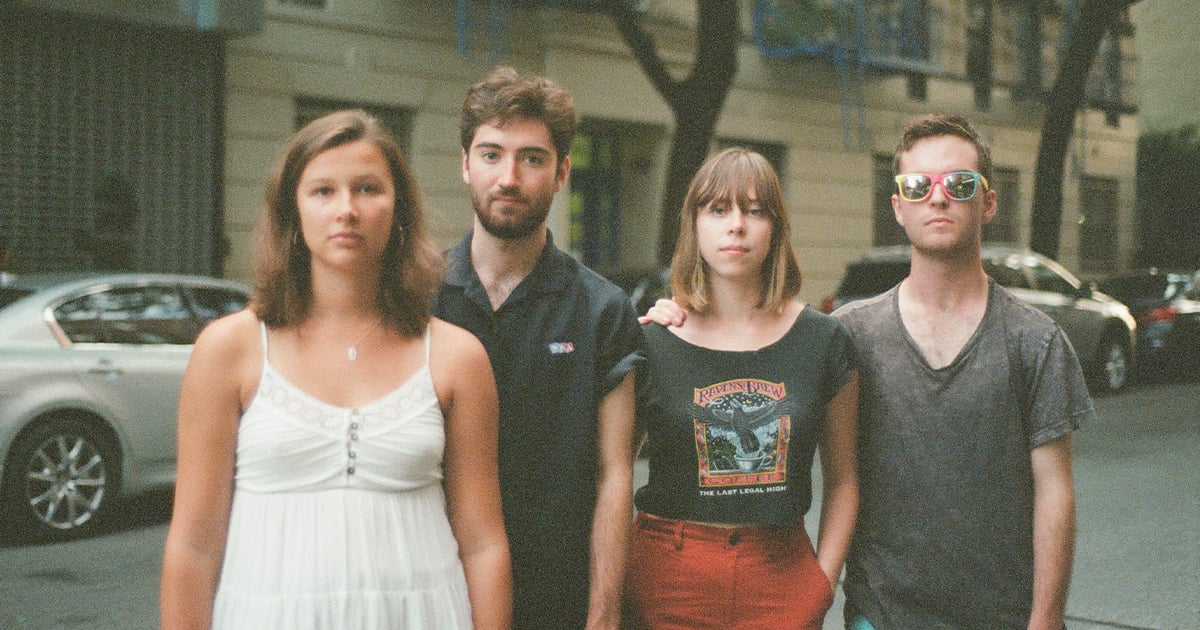
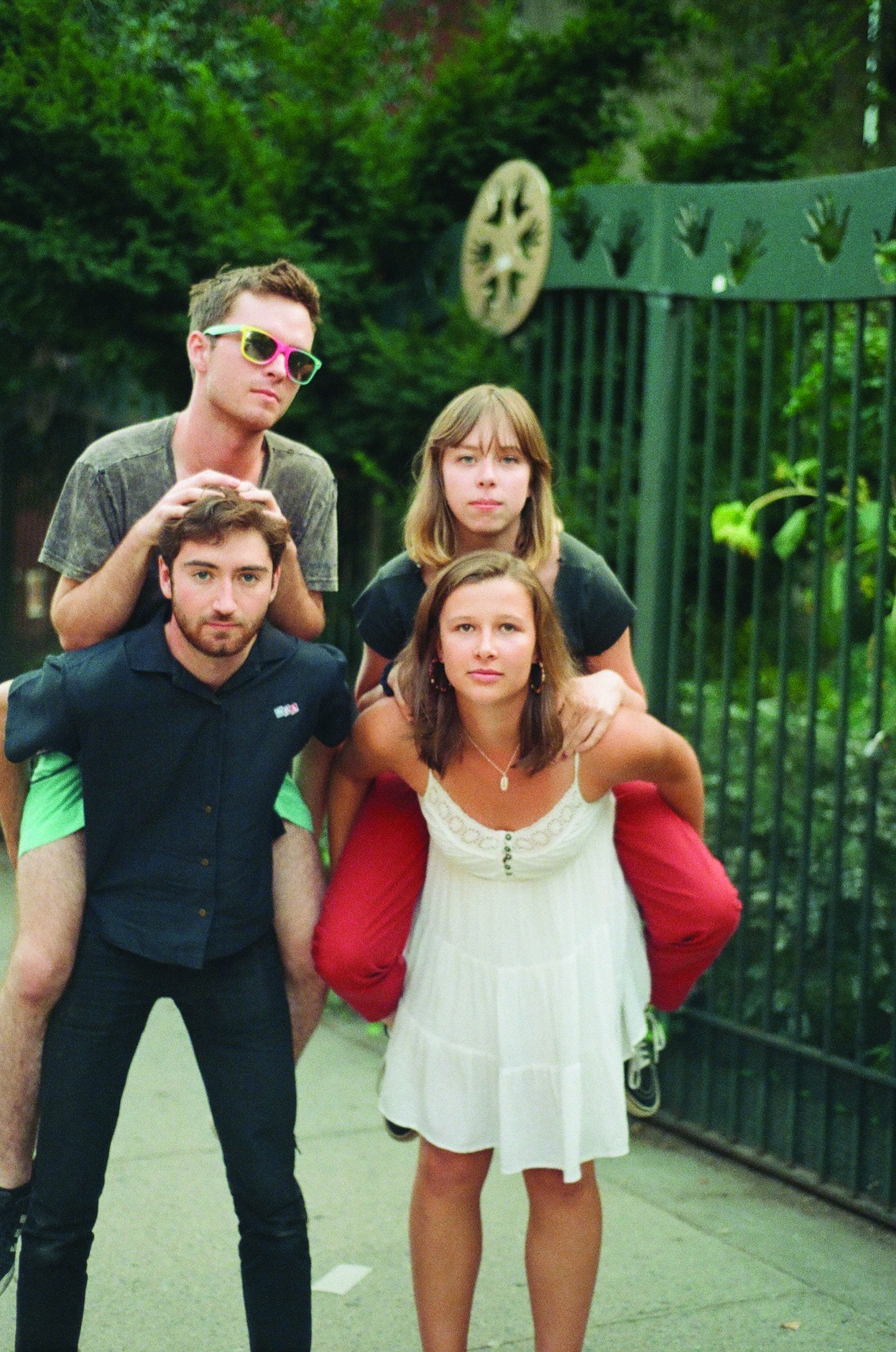
The Onlies, a young old-time stringband based in North Carolina, Tennessee and Kentucky, have plenty of heart and soul, but also boundless talent, imagination, charisma, fire and musical intelligence. The band is, in a word, groove-y. It’s not hard to imagine the Onlies filling a major role in the world of modern old-time music before much longer.
An unenlightened but oft-repeated knock on old-time music is that it all sounds the same—tune after tune after tune. The Onlies demolish that stereotype. With four lead singers and two multi-instrumentalists in the band, the Onlies present a wide variety of sounds spanning the old-time spectrum that appeal to more than just tune freaks. They draw strength from the traditions, but are most definitely not limited by them.
All born in 1998 in Seattle, the three original members of the Onlies—Sami Braman, Riley Calcagno and Leo Shannon—have been tight since they were four years old. Sami and Riley met at swimming class when they were two; Riley and Leo met a pre-school the next year; Sami and Leo met at a different pre-school the following year. They began playing music together when they were in elementary school and have now been together as a band for almost 17 years.
The band was originally called Beach 3, chosen because they needed a name for their first on-stage performance at the Northwest Folklife Festival in Seattle; they had previously busked at the festival. Now 10 years old, the trio began playing at weddings, parties, community events, and square and contra dances. A name change became imperative a couple of years later when they were informed of the existence of Sexy Beach 3, a pornographic video game. Since Sami, Riley and Leo were all only children, the trio began calling itself the Onlies, and the name stuck.
Sami Braman started playing fiddle at age six, learning both classical violin repertoire and fiddle tunes from a well-known fiddler Ruthie Dornfeld, “a big influence on my playing at a young age,” says Sami. She began playing with Riley and Leo at age eight. Their three families were friends and neighbors who were highly supportive of the kids’ endeavors and would camp together at annual pilgrimages to the Festival of American Fiddle Tunes (Port Townsend, WA).
“The first time I went to Alasdair Fraser’s Valley of the Moon camp in California, I went with my dad,” Sami remembers. “The next year, I brought Riley and Leo with me, and Riley’s dad, Johnny. So, there we were, the three of us and my dad and Riley’s dad. People probably thought they were a gay couple with triplets.”
Sami continued with her fiddle lessons, but didn’t participate in school music programs until high school. She attended Garfield, a large public school in Seattle with a renowned orchestral program, and played first violin in its orchestra for four years. Sami’s classical education developed further at Whitman College in Walla Walla, Washington, where she played first violin in its orchestra and took private lessons from her professors.
Riley Calcagno began taking violin lessons when he was four, studying both classical music and learning fiddle tunes by ear from his father, old-time musician Johnny Calcagno. His next instrument was the clarinet, which he started in fourth grade. Seriously into classical and chamber music as a boy, Riley attended those camps as well as the fiddle camps he attended with Sami and Leo. He played in school orchestras and chamber music groups throughout middle and high school, attending Garfield High, as did Sami and Leo.
Riley began writing songs in middle school, but feels he found his voice a few years later in college. He got more deeply into old-time music in high school after hearing a recording by a band called the Wandering Ramblers. “It immediately blew my mind,” he says. “The singing of Carol Elizabeth Jones and Jim Miller, the fiddle playing of Dirk Powell, the banjo playing of John Herrmann. It felt like the old-time music I’d been wanting to make. That was a big turning point in my life. I became super obsessed with that record.”
He picked up the banjo when he was 14, inspired by Lucas Hicks, Jason Romero and P.T. Grover, and learned to play both three-finger and clawhammer styles. His use of three-finger picking on certain tunes with the Onlies gives the band a unique, distinctive sound. “Clawhammer is amazing and really driving,” Riley says, “but there’s something about the simultaneous push and pull of the three-finger playing that really grabbed my ear. That’s what I was drawn to.” He also started playing guitar along in here, again taught by his father, who Riley cites as his earliest and most important musical influence.
Riley attended Oberlin College in Oberlin, Ohio, which includes both a liberal arts college and a renowned music conservatory. He enrolled in the college, and then auditioned for, and earned, a place in the conservatory. He spent almost three years in the conservatory, studying chamber music, jazz and world music, before returning to and graduating from the college. “The classical life was too hard-core for me,” he laughingly admits.
Leo Shannon started playing violin at age five and studied classical music for a few years. “I defected from classical music pretty early on,” he says. He was more interested in traditional Irish music and took lessons for several years from Irish fiddler Dale Russ. His father played banjo, so Leo had grown up hearing old-time music, but something about the music clicked into place for him when he was 14.
“I suddenly heard old-time music anew,” he says, “like it was the first time. It transformed my life. There was just a fire all of a sudden.” He had just seen Bruce Molsky at the Fiddle Tunes festival and hearing Molsky play and talk about how he had learned the music by digging deep into old recordings was quite inspiring for the young musician. He added guitar and banjo during this period.
Leo went to college at Warren Wilson College in Swannanoa, North Carolina, just outside Asheville. It was there he came interested in the music of Marcus Martin, a fiddler from Macon County, North Carolina, who was first recorded by Alan Lomax for the Library of Congress in the 1930s. Leo was fascinated by the ways in which the bulky, primitive equipment used for field recordings (in the days before tape recorders) colored, distorted and possibly changed the music that was recorded.
To that end, he found a jazz musician in New Orleans (Twerk Thomson) who had acquired some antique recording equipment and set out on his exploration of field recording techniques. Using one microphone and recording live in the studio, Leo cut five of Martin’s tunes into a 1930s Presto K8 lathe and cut directly onto 78-rpm lacquer discs. The fascinating project, Most High Thing, is available for streaming and download from Bandcamp.
Vivian Leva was born in Lexington, Virginia, in 1998 into a world of old-time, country and bluegrass music. Her parents, Carol Elizabeth Jones and James Leva, were performing and recording as an old-time duet then, and they hauled baby Vivian around the country with them to their gigs. The family also made regular trips to the old-time music conventions in Mt. Airy, North Carolina, and Clifftop, West Virginia. Vivian says she went to Clifftop “every single year of my life” until COVID closed it down.
She loved to sing and write songs, and picked up the guitar at age 10, primarily to back up her singing. Vivian continued to write songs throughout high school, mining both traditional and contemporary music for inspiration. She grew up listening to and learning from friends and musical associates of her parents, from the Wallin Family (Berzilla and Doug) and Tommy Jarrell to Hazel Dickens and Alice Gerrard.
Vivian’s first album, Time is Everything, was released by Free Dirt Records in 2018 when she was just 20 and a student at Wofford College in Spartanburg, South Carolina (she later transferred to and graduated from Lewis and Clark College in Portland, Oregon). The album’s 10 original songs “are very much country and old-time inspired,” she explains. “I was trying to just get my songs together and out there, and it was a lot of fun and a great experience. It really got the ball rolling for me.”
The critically acclaimed album earned rave reviews. Rolling Stone, in a 2018 article called “Ten New Country Artists You Need to Know” called Leva “a neo-traditionalist exploring the middle ground between Appalachian music and Americana.” No Depression said, “This is not a songwriter. This is an artist.”
“That summer after we graduated from high school,” says Sami, “we met Vivian. She was so good at playing old-time back-up guitar and singing. She knew so many great songs and she’d written so many good songs. Immediately, all three of us were locked in. We had never considered adding another band member, but this was like, ‘Oh, this makes our old-time music sound really good.’”
The would-be quartet worked that summer, billed as “the Onlies with Vivian Leva,” as something of a trial run. Everything went so well they decided to make it a permanent arrangement. Though not technically an “only” (she has a brother), Vivian became a full-fledged Onlie in 2017. Later that year, the band won first place at the Clifftop Appalachian Stringband Festival in West Virginia.
The Onlies, the only Onlies album that includes Vivian, was released in 2020. It’s a fine collection of songs and tunes that faithfully represents the band’s energetic stage show. In addition to an original tune by Sami, “Snowtown,” the album contains material from a wide-ranging cast of characters, including old-timers Kilby Snow, Gaither Carlton, Melvin Wine and the Stanley Brothers; iconic artists Hazel and Alice, Bob Dylan and Townes Van Zandt; Vivian’s parents Carol Elizabeth Jones and James Leva; and the Foghorn Stringband.
All of the Onlies contribute both lead and harmony vocals on the album. Vivian does the lion’s share of the lead work: “Going Across the Sea,” “The House Carpenter,” “A Few More Years,” “Still Looking for You,” “Lonesome Pine Special” and, in a duet with Leo, “Let Us Be Sweethearts.” Leo takes the lead on “Troubles” and “Look Up Look Down,” while Riley (“Diamond Joe”) and Sami (“My Dear Little Soldier Boy”) sing one each.
Vivian plays guitar on the album, Sami plays fiddle, Leo plays fiddle, guitar and banjo and Riley plays fiddle and banjo. They were joined in the studio by bass player Nokosee Fields, known for his work with the bands Western Centuries and Steam Machine. The record is produced by Caleb Klauder (Foghorn Stringband), who also adds mandolin on a couple of cuts.
Sami, Leo and Riley recorded two previous albums while they were still in high school. The first, Setting Out to Sea, was released in 2013. Long Before Light, the trio’s second CD, was produced by Tristan Clarridge and released in 2015. The playing on these albums is confident and assured, even exceptional given the ages of the three. What’s really impressive, though, is the sophistication and intricacy of the arrangements. (Both albums can be streamed on Bandcamp.)
The trio can also be heard on The Ruglifters, produced by Clarridge and released in 2018 by Yodel-Ay-Hee. The band included Sami, Riley, Leo, John Hermann (banjo), Meredith McIntosh (bass), Eric Robertson (mandolin) and Tristan Clarridge (cello). Vivian is on board for Clifftop 2019, recorded live at the West Virginia festival, which includes seven tunes by the Onlies with John Hermann, Meredith McIntosh and Eric Robertson.
The four Onlies, diplomas in tow, left college behind and set out for new frontiers. Sami moved in Nashville in 2021 and immediately connected with the local old-time scene. “A lot of the people I grew up going to camps with have moved to Nashville in the last few years. A lot of my fiddle heroes are here—like Darol Anger, Brittany Haas, Rayna Gellart and Rafe Stefanini. I love it here. I was really expecting it to be kind of a scary and intimidating music scene, but it’s actually been very inviting and welcoming.” She frequently plays with the Willie Watson Band, led by a founding member of Old Crow Medicine Show.
Riley and Vivian moved to Durham, North Carolina, that same year, partly to be closer to Vivian’s family and partly to be closer to the center of the modern old-time world. Outside of the Onlies, Vivian and Riley work as a duet and have toured widely throughout the U.S. as well as in Canada, Wales, Northern Ireland, England and France.
The duo’s first album, Vivian Leva & Riley Calcagno, was released in 2021 by Free Dirt Records. The songs are all original, some by Vivian, one by Riley, but mostly cowrites. The rootsy album made Folk Radio UK’s “Albums of the Year” list in 2021, and led to NPR Slingshot naming the duo one of its “2022 Artists to Watch.”
Leo now lives in Whitesburg, Kentucky, where he is Collections Manager of the archive at Appalshop, an organization that has been documenting the traditional arts and folkways of Appalachia since 1969. The archive is an irreplaceable cultural resource that contains countless sound recordings, oral histories, films, photographs, musical instruments, videotapes, ephemera and more. The archive was heavily damaged—much of it was underwater—during the devastating flooding that ravaged eastern Kentucky in July 2022. Restoration efforts are underway.
When asked to name favorite musicians, the four Onlies demur and seem more comfortable mentioning the many musicians and singers who have influenced them, most of them in old-fashioned face-to-face interactions. A few of the names are fairly well known; others will be known only to well-informed old-time and Irish musicians and fans. All have played some part in making the Onlies sound like they do.
That list includes such names as Texas Gladden, Jean Ritchie, Tara Nevins, the Foghorn Stringband, Dirk Powell, Pharis and Jason Romero, Lucas Hicks, Carol Elizabeth Jones and James Leva, Bruce Molsky, Richie Stearns, Ruthie Dornfeld, Alasdair Fraser, Paul Brown, John Herrmann, Meredith McIntosh, Brittany Haas, Natalie MacMaster, Tristan and Tashina Clarridge, Darol Anger, Tommy Jarrell, Clyde Davenport, Dykes Magic City Trio, P.T. Grover, the Skillet Lickers, Marcus Martin, the Canote Brothers, Mike Bryant, Fiddlin’ Doc Roberts, Lee Stripling, Dale Russ, Eamon O’Leary and Cleek Schrey.
Grammy-nominated multi-instrumentalist Bruce Molsky plays many different styles of music, but is perhaps best known as an old-time musician. He’s known the Onlies for years (and Vivian since she was a baby) and has high praise for the band. “Individually, all four of the Onlies are shining stars,” he says. “Together, what most impresses me about them is that they’ve grabbed this old music we all love by the reins and dragged it into the 21st century. They have a certain kind of polish, which I think is unique, that has to do with their various musical training and influences. They’re one of the groups that is offering a new voice for all that old music.
“There’s an aesthetic that goes along with how a lot of people perceive this music, and I think what makes them unique is that they’ve managed to transcend that into a style that’s smooth and polished and accessible. And also imaginative; their arrangements are really cool, and they strike me as musically fearless. They offer a window into where all this traditional music we love is going. It’s a nice window to look through.”
The band began recording its second album late in 2022, working with producer-engineer-musician Joel Savoy at his studio in Eunice, Louisiana, where he also produced the album by Vivian and Riley. All four Onlies express a desire to work more, but their divergent locations and busy schedules put a limit on how much the band can tour.
The Onlies have already played a number of important and prestigious festivals in their first five years together including California Bluegrass Association Father’s Day Festival, the Delaware Valley Bluegrass Festival, the Baltimore Old-Time Music Festival, Pickathon, Portland Old time Music Gathering and AmericanaFest in Nashville.
Certainly, the Onlies will continue doing camps and festivals during the summer and as much as possible the rest of the year. The relative scarcity of Onlies gigs makes each one more special, to the fans and especially to the band. These folks truly love playing together.
All four of the Onlies are deeply committed to education and passing the tradition along and have taught—singly or collectively—at camps and festivals across the country, including Festival of American Fiddle Tunes, Wintergrass Youth Academy, California Bluegrass Association Music Camp, Portland Fiddle Camps, Berkeley Old-Time Convention, Big Sur Fiddle Camp, Colorado Rockies Old-Time Festival, Portland Old-Time Gathering, Swannanoa Gathering, Nimble Fingers, and Centrum’s Voice Works.
“I think of the Onlies as a really special kind of ‘family band,’” says Sami. “I like to think of us as a family because we have maintained this connection over a lot of time and much distance and changes. It’s just easiest for me to play music with those three people. Hands down.
“We’re all very passionate about fostering a younger generation of old-time music, and carrying that music forward, and really respecting and learning the history of where this music came from. It’s a big honor to be a young person in this scene and to be respected as an old-time musician. We have this collective goal of playing really good old-time music and making it ‘cool’ in the setting of other genres, like bluegrass festivals or Celtic music festivals. We’d love to bring this music to new and younger ears.”