Musician and Teacher In The Shadow of Bluegrass
Mark Maggiolo is an accomplished musician who plays most of the bluegrass instruments at a professional level. He has played with touring bands and taught music to hundreds of students through the years, but is not a household name.
Mark was born in 1957 and spent his early childhood on a dairy farm in New Jersey. When he was 10 years old the family moved to a large beef farm in Hume, Virginia. No one in his family played a musical instrument but his older sisters enjoyed listening to the popular music of the day and often had it blaring at an uncomfortable volume. They were listening to Steppenwolf, Blood Sweat And Tears, The Beatles and other popular electric bands of the day. To Mark it seemed like noise and he just didn’t care for it at all.
Soon after moving to Virginia, he was riding in the car with his mother to an appointment and the radio was tuned to ‘Big K Radio,’ WKCW, in Warrenton, Virginia which was a hard-core country music station. Every fourth song they played was bluegrass and Mark had never heard anything like that before. He remembers, “I heard this amazing sound coming over the air waves. I was just enthralled and I asked my mom what is that? She said, ‘it’s a banjo,’ but it wasn’t like any banjo I had ever heard. I was used to the strumming sound of a banjo. The song started out with a banjo pinch (sort of like ‘ten-hut’). I enjoyed the most beautiful music I had ever heard. It was Earl Scruggs and the song was ‘Cripple Creek.’ After listening to the whole song I knew that I had found my calling.”
One of Mark’s sisters had a 5-string banjo which she never played and had relegated to a closet. It was an inexpensive Checkmate brand banjo which couldn’t be played above the 5th fret. Mark’s brother had a friend named Dick McCarty who played banjo and lived in nearby Delaplane, Virginia. He gave Mark a few lessons and showed him the basic roll patterns and how to play some tunes. Mark had music ability in his brain and was a quick learner and in no time at all learned to play some of the songs of the day which were mostly made up of three chords. Mark remembers that while he was in the early stages of learning he thought that the only three chords in existence were G, C, and D7th. Later he took lessons from other teachers and he made good progress very quickly. Several months of lessons from Wayne Fairfax, who was teaching at the Harmony Hut in Manassas, Virginia made Mark a pretty good picker. He also took a few lessons from James Bailey who was playing with the Country Gentlemen at the time.
When Wayne Fairfax stopped teaching at Harmony Hut the owner of the store said to Mark, “You’ve been taking lessons here longer than any of the other students and you have become a very good banjo player, so I believe you are ready to teach.” So, when the next student came into the store Mark gave him a lesson and at the end of the session he told Mark that he had learned a lot and wanted to come back for more. Mark was thrilled at this opportunity and all of a sudden he had a second career from farming with a good source of income. Soon an opportunity came to teach at another store in Manassas called Music City. The owner of the store was a wonderful man named Don Vance and Mark started teaching there as well as at Harmony Hut. While at Music City he was often visited by the legendary Smiley Hobbs who would show him banjo tunes he had learned from Earl Scruggs. Smiley often entertained everyone with stories of his times playing with the legends of bluegrass.
Soon after becoming proficient on the banjo Mark realized that in bluegrass and banjo music a guitar was needed for rhythm. He purchased a guitar for his brother, but first had to learn to play guitar himself so that he could teach his brother to play. Mark learned to play rhythm guitar with some help from school mate Gary Keel and Edward Ashby, who was the nephew of the legendary fiddler John Ashby.
By the time Mark became really good on banjo and guitar he was just old enough to drive. So, with this mobility he was able to expand his musical horizons. Mark remembers, “I met a very interesting man in Morrisville, Virginia named Ted Kreh who took me under his wing. He was sort of like a ‘Dutch Uncle’ to me and he played many instruments well and was also a wonderful singer. He showed me a lot of stuff on the mandolin, guitar and bass. He also helped me with my banjo playing and showed me how to fingerpick on the guitar. With his help I was becoming quite good on all the bluegrass instruments.”
After graduation from high school Mark went to Shenandoah University in Winchester, Virginia and studied in their Music Conservatory. It is interesting to note that one of Shenandoah University’s alumni is Mac Wiseman, when the school was located in Dayton, Virginia. Mark learned classical guitar, keyboard, music theory, and how to read and write musical notation. He left after only one year but the formal training he received helped him in his playing and teaching. After Shenandoah University, Mark went back to work on the farm and began playing several instruments including keyboard with area bands for dances and concerts. They played mostly country and western music and, on a few occasions, Mark played light rock music on electric bass and keyboard. The country dances were a means to make some money but he still had a love for Bluegrass and played and jammed with bands in his area. Mark would often sit in with the Virginia Travelers and he picked in jam sessions with the Freestate Ramblers. There was a weekly jam at Ronnie Poe’s garage on Thursdays in Amissville, Virginia. So, Mark had a lot of good input and learning opportunities from a lot of good musicians. There was a plethora of music flowing into his brain at the time.
During this period Mark spent a lot of time at festivals. He was a regular participant at the Galax Old Time Fiddlers Convention and Carlton Haney’s festivals in North Carolina. At the National Country Music Championship competition in Warrenton, Va he earned third place on the ‘old 5-string.’ At these festivals he met and became friends with many of the touring musicians and enjoyed the all night jam sessions that were common. Being a student of the music, he was interested in the different way songs were played. At the Camp Springs Labor Day Festival in North Carolina Mark carried his cassette recorder around the festival grounds and recorded ten versions of “Arkansas Traveler.” He was curious as to the different ways the song was played and these recordings helped him learn about improvisation and how to make a song interesting to the listener.
Mark made many lifetime friends at these festivals and there are very few musicians that the writer of this article contacted that don’t know Mark. They all speak highly of his musicianship and character.
In September, 1985 mark moved to Florida to work in the family-owned RV Park and Campground. He still had time to pursue his music and began playing at the many theme parks in Florida. He worked at Disney World, Boardwalk and Baseball, Cypress Gardens and Universal Studios. Sometimes he did a solo gig and other times he worked with a group of musicians. Mark remembers, “Sometimes we did some pretty goofy stuff. At Disney World I would often dress up as a Disney character like a bear. For Sea World I would go to hotel brunches and play my banjo and give a talk about the park.”
Mark met a number of prominent and good musicians in Florida. Aubumdale, Florida, located in the middle of the state, was a hot bed for country and bluegrass music. Jim Fee and ‘Big Timber Bluegrass’ were based in Tampa. Mark played some gigs with Wynn Osborne, Bobby Osborne’s son, and remembers that he was a wonderful banjo player and a pleasure to listen to and watch perform. The whole area of central Florida was a real happening place.
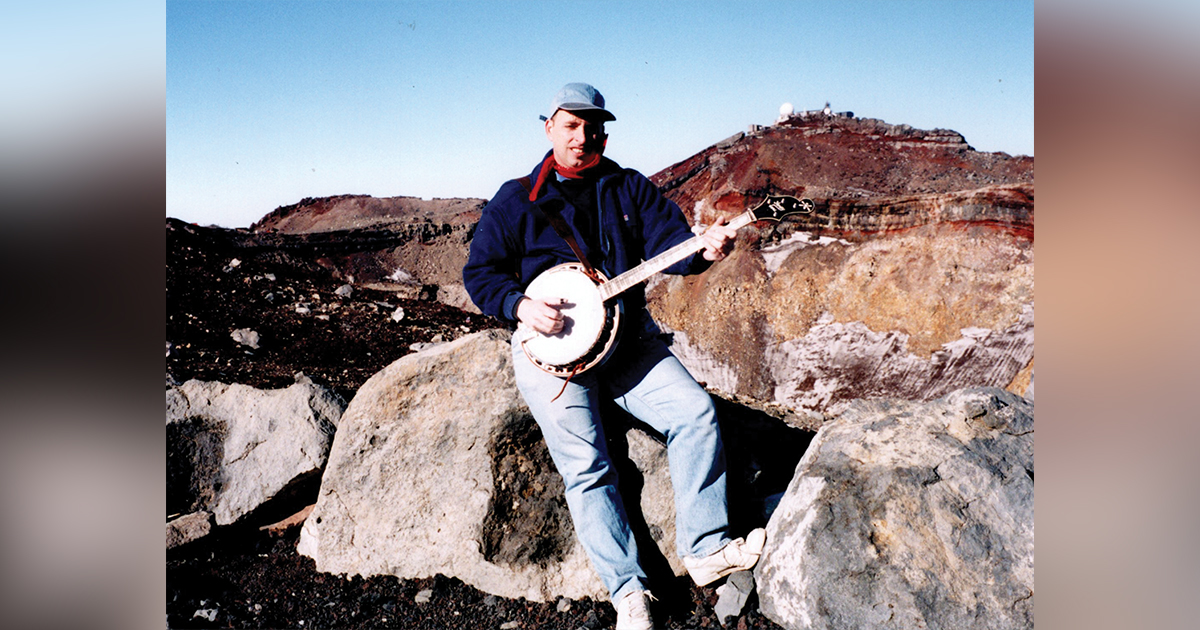
Mark stayed in Florida a little over one year and then put together a trio and picked up a gig with Disney to play in their theme park in Tokyo, Japan. It was quite a chore to put together the group because not too many people were willing to go overseas for seven months. First, he tried to get his high school friend Gary Keel to go. He wasn’t interested, but said his brother Larry might be. Larry was just 18 years old and jumped at the chance to go. He went to Tokyo with Mark and did a great job. Mark reflects, “When Larry came back to the US, we were sitting in a coffee shop and he told me that he wanted to play music for a living. And he did. He went on to play music full time and was very successful. If you do a Google YouTube search on Larry you will come up with hundreds of pages of his music.” Larry made a number of successful LP albums and CD projects and he worked for a while with a band called Natural Bridge. He also played with Sam Bush on a number of shows. Then he worked with his wife Jenny as The Larry Keel Experience. Larry’s father, Jim Keel, was a wonderful banjo player and had a big influence on Larry. Mark remembers that when he was learning banjo Jim taught him a lot about melodic banjo and timing.
It is interesting the way Disney selects talent for their world wide theme parks. The overseas gigs last for six or seven months and the bands work as independent contractors. Mark auditioned for the Japan gig in Orlando, Florida and remembers, “Disney had already auditioned several bands but didn’t like any of them so they were in a kind of desperate situation. So, I showed up with Larry Keel and a bass player from Dade City, Florida named Angela Hines. We called ourselves Southern Traditions. We played our set and they liked us.”
So the three of them got their passports and made the necessary preparations and went to Japan. Disney made them shave off their beards and clean up their act because they demanded wholesome looking young people for their parks. They played there for seven months doing six sets a day and had a very enjoyable time despite the hard work of playing for so many hours. After seven months their replacement band came in and they all went home.
Not long after returning to Virginia, Mark’s life took an unusual turn. He went back to Japan to take advantage of lucrative teaching opportunities. While he was in Japan working for Disney he had also taught English to Japanese students. This experience made him a good candidate for full time employment in Japanese public schools. After World War II, the US occupation and reconstruction of Japan had a requirement that students take at least six years of English to ensure that the youth were knowledgeable of the world around them and not be just focused on Japanese history and culture. The schools preferred native English speakers to ensure proper accent and pronunciation. So, Mark returned to Japan to teach English and stayed there for more than ten years. Mark learned a great deal about teaching methods which was of great benefit to him when he returned to the US and taught music. While in Japan, Mark immersed himself in the local culture and was able to hook up with a few Japanese bluegrass bands and play a few shows. There were more than 50 bluegrass bands in Tokyo at the time but the music scene in Japan was quite different than what we are used to in the US. The clubs were very small; sometimes as small as 100 square feet. Just barely enough room for the band and one or 2 tables. The bands were often not paid and even had to pay for their drinks and meals. They played for the love of the music!
The bands were very good but it was difficult for them to pronounce the English lyrics. They did their best to honor and emulate the bluegrass sound that they so loved. Mark spoke a little bit of Japanese and he would hear them say things like, “We have an American guest so we will no longer be singing in English.” They didn’t want to embarrass themselves with their accents. Mark felt honored that they were doing such a good job. Their playing was top notch and they had good instruments. Mark enjoyed the Japanese culture and played some shows with the Wayfaring Strangers and became an ‘honorary member’ of the band.
Mark returned to the US in 2000, settled at the old homestead in Hume, Virginia and began teaching bluegrass instruments at a music store in Culpeper, Virginia. The store lined up the students and Mark paid for use of the space. He was teaching six days a week and making a good living. When the store manager passed away, Mark began teaching at his own studios in Culpeper and Warrenton, Virginia. During this period Mark had more than 60 students. For more than 20 years everything was going just fine until the COVID Pandemic arrived and everything just stopped! When people started going out again many of his students were happy to return for lessons.
Before COVID hit, Mark would often set up jam sessions for his students to help them get comfortable playing with other musicians. This is a critical element in the learning process. When COVID hit the jam sessions stopped and never really started up again which was sad because Mark felt strongly that this is how musicians learn their craft and become good. Most of Mark’s students would take a lesson, go home and practice a bit, play with their phones and computers and come back the next week for another lesson. He found it difficult to convince his students to go to jam sessions and play music with other people. Mark asked a number of prominent musicians if they became good without participating with others and going to jam sessions. The answer was a resounding “No!”
After Mark returned from Japan in 2000 and began teaching he also played in several bands. He worked with M.D. Mallory who played guitar and was a wonderful vocalist. Most of their gigs were in Albermarle County, Virginia at private parties, high school concerts, and town events. M.D. was always able to get very good money for the gigs and he always carried good musicians. Mark played mandolin in the band but M.D. didn’t know that Mark could also play banjo. On one occasion when Billy Wheeler was not available Mark told M.D., “I can play banjo.” So Mark filled in for Billy on banjo and when Billy left the band Mark became the banjo man. Joe Meadows was on fiddle whenever M.D. could get him and Bobby Hicks played fiddle on a recording session and on several shows.
Mark joined Cliff Waldron and the New Shades of Grass in 2003. “I played banjo for 2 years and then switched to mandolin for the next 2 years,” he said. Mark played mandolin on one album titled New Directions with Wayne Lanham on fiddle and Terry Lanham on bass. Kevin Roop picked banjo and Mark Clifton played Dobro. Mark also did a number of recordings with various bands as a studio musician.
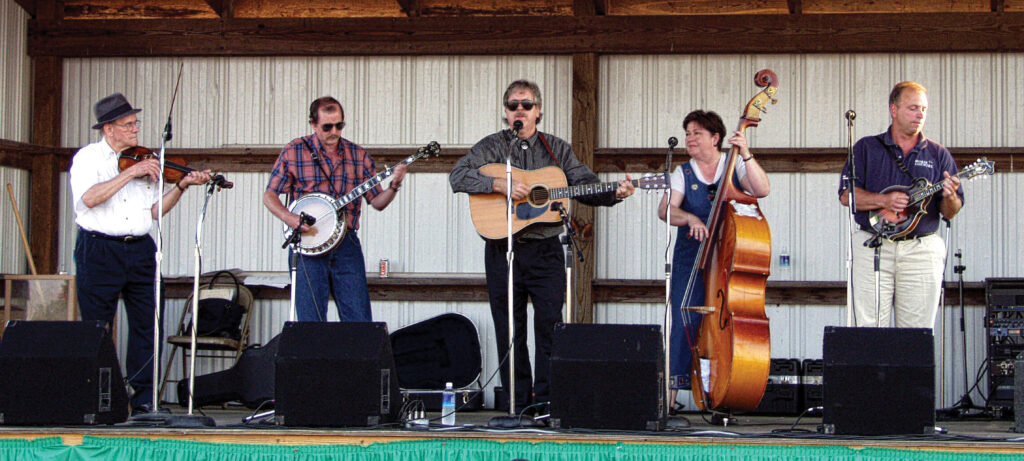
Mark is pretty much retired these days. He still has a few students and played in Gerald Crowell’s band, Flatt Broke. He picks occasionally with other area musicians and enjoy the local jams but prefers the sessions with only one of each instrument. His favorite gathering takes place weekly at Ray Hicks’ home in Winchester, Virginia where five great musicians always show up. Mark picks banjo, Red Henry is on mandolin, Ray Hicks slaps bass, Gerald Crowell plays guitar and Tom Knowles saws away on the on fiddle.
In closing, Mark reflects “I feel blessed that at my age my hands are still good and I can still pick at a professional level. Unfortunately, my hearing is shot so it is hard for me to listen to music. When I do listen, I like to hear fiddle and instrumental music because it is so difficult for me to hear and understand the lyrics. Reflecting on my days in Japan, I showed Larry Keel a few licks and he told me this early leaning is the basis for much of his music today. He is a wonderful guitar player and when Tony Rice heard him play he said, ‘Wow! Here’s someone playing that doesn’t sound like me.’ Certainly a nice compliment. That’s interesting, but I can’t say that I taught him. I showed him a few things but he developed on his own and created his own style of playing. Over the years I’ve had hundreds of students. I don’t know of anyone who went on to greatness but many of them stayed with me for seven or eight years. It has been an interesting and rewarding life. I look forward to picking as long as I can.”