
More Encounters with Bill Monroe
‘I know him, but he don’t know me’
Bill Monroe was properly regarded as the very model of a traditional American musician. However, he could also be full of surprises, whether poking fun or providing unexpected revelations about life and music.
Part One of this coverage included my experiences seeing, hearing and talking to Monroe from 1971 to 1987. This concluding piece deals with a busy period of his career, as well as his death and funeral in 1996.
It was great, being able to visit in person with the founder of bluegrass music, and even to run into him when out and about in my role as a music writer for Nashville’s daily newspaper, the Tennessean.
In April 1988, I had arranged to meet a friend of Grandpa Jones for breakfast at the Dickerson Road restaurant at Mason’s Motel, a favorite gathering spot for Monroe and others. Monroe was there working the room when we hailed him. “Mr. Monroe, do you know Thomas Goldsmith of the Tennessean?” my contact asked.
“I know him, but he don’t know me,” Monroe said, obscurely.
“Mr. Monroe, I know you every time I see you,” I said, caught by surprise. One step behind Monroe, it wasn’t until after the fact that I caught on. With Monroe, as with many celebrities, I typically re-introduced myself at each encounter if there was any chance they didn’t remember me. Monroe must have just decided I had offered my name to him one too many times.
Cutting Southern Flavor
But I guess I didn’t irritate Monroe too much. For coverage that ran May 14, 1988, in the Tennessean, and later in Bluegrass Unlimited, I was invited to attend his recording session with the Blue Grass Boys for Southern Flavor. The MCA release would win Monroe the first bluegrass Grammy Award.
Monroe and producer Emory Gordy allowed me to sit on the floor of a small recording space for a few takes as all the musicians played. They produced a balanced, magical, acoustic blend without using headphones, a sound I’ll always remember. All-time fiddler masters Buddy Spicher and Bobby Hicks joined the band for Monroe-composed tunes such as “Stone Coal.”
“I write for the music and for the sound,” Monroe said that day. “I write all the time when I’m on the road. I can write an instrumental in just a minute.” Hicks testified about what it takes to play bluegrass music. “People don’t realize it, but bluegrass is hard,” he said while rehearsing a demanding tune. “There’s nothing to hide behind, there’s no drums.”
With frequent bylines on Monroe stories, I must have come to be identified with the tall Kentuckian. The nonprofit Country Music Foundation engaged me to write a 1989 cover story for its well-regarded Journal of Country Music periodical. Gathered from previous reporting and new interviews, the article was aimed at telling Monroe’s story and describing his music with all its complexities.
“From a distance, the upright, three-piece-suited Monroe, 78, exudes tradition and conservatism,” the article began. “He’s the revered ‘Father of Bluegrass Music,’ the recipient of honorary degrees and plaques, of tributes to his place in musical history. But in life, as opposed to legend, Monroe’s contributions to music are far from over. The truth is, Bill Monroe has always been a restless sort of man.”
Keeping Up With A Busy Big Mon
Busy times kept coming for Monroe, as in spring 1989, when the Opry prepared to celebrate his 50th anniversary on the WSM radio show. In addition to the Grammy award for Southern Flavor, he had been named an honorary member of the highbrow Sonneck Music Society of America. Other luminaries who have received the honor include Leonard Slatkin, Virgil Thompson, Doc Watson, and Art Neville.
Also that year, Tony Conway at Monroe’s booking agency, Buddy Lee Attractions, had suggested that I visit Monroe’s Sumner County homestead for another Tennessean feature. I drove out to meet with him and to discuss his rural background and the way his music had come together. “I knew that these country farm people would love bluegrass music, when I was putting together numbers and playing them the way that I was going to be sure that it was played in bluegrass,” he said, a little mystically.
“I wanted that music played that way to where it could be what I wanted, and it would touch me, and I could hear that feeling coming right to your heart from the way it was played. I think it was in me to hear it right.”
Sitting outside his cabin as we talked, I gathered the courage to ask if he might play a number or two with me. I had a 1933 Martin D-18 in my car, and he got out his F-5 for some informal picking. I remember joining him in singing “I’ll Be All Smiles Tonight” and picking “Lonesome Moonlight Waltz,” without terrible failings or moments of glory.
A few nights later, at the Sonneck Society presentation, my wife mentioned to Monroe that he and I had picked together. He didn’t comment on my playing. “He’s got a good guitar,” Monroe said.
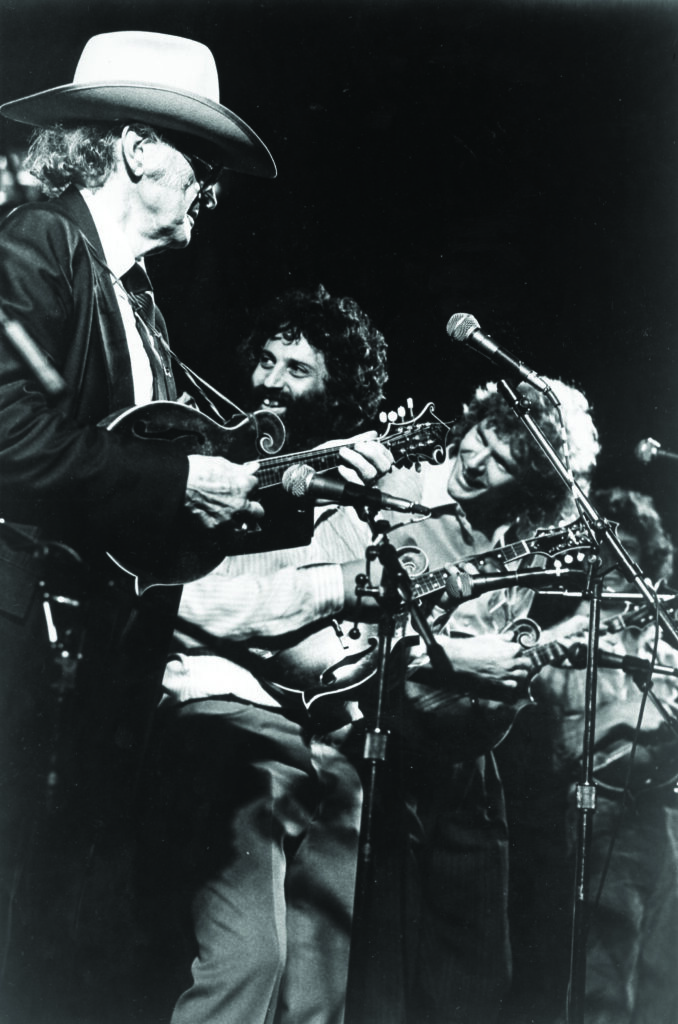
On June 13, 1989, I trekked out to the Grand Ole Opry because I’d learned that Rolling Stone had set up a photo shoot for a feature on musicians and their mentors. Former Byrds bassist Chris Hillman was paired with Monroe. It was thrilling to hear them play mandolins and sing “The Old Crossroads” together.
Talking with Monroe backstage after a team of RS professionals caught the photo, I got another taste of his sly humor. “What was that feller’s name?” he asked me. “Umm, that was Chris Hillman, you know, of the Byrds,” I answered, realizing after I spoke that Monroe knew perfectly well the identity of this famous practitioner of rock, country, and country-rock.
‘They Had A Job’
Monroe went on to talk forthrightly about his feelings about Lester Flatt and Earl Scruggs, two foundational figures of the music who worked in his Blue Grass Boys from 1945 through 1948. He conceded that the so-called “classic band of the era” had been a good one. “I gave Earl a chance to be in the Blue Grass Boys,” he said. “And it was good for Lester Flatt to come along.”
However, in Monroe’s telling, Flatt & Scruggs contributed little to the other elements that made up bluegrass music. “Bluegrass was already going when they got into the picture,” he said. “They didn’t have nothing to do with bluegrass music, getting it going the way it’s going. The fast time of the music and everything was already there. They just had a job.”
Many followers of this music would say, with justification, that Scruggs’s fiery banjo picking and Lester Flatt’s singing in 1945 completed the sound that Monroe began crafting after splitting with his brother in 1938. But it was illuminating to hear Monroe say, basically, that bluegrass had been his creation, although with contributions from many of the Blue Grass Boys. “All of them have played a part in the music,” he said. “Everybody that’s worked for me has played a part when they were working for me, when they were coming along with some good ideas. Some of the fiddle players, some of the banjo players, some of the guitar players had good ideas that they would come along with that I would use and put in the music.”
Singing, Dancing, Praising, Healing
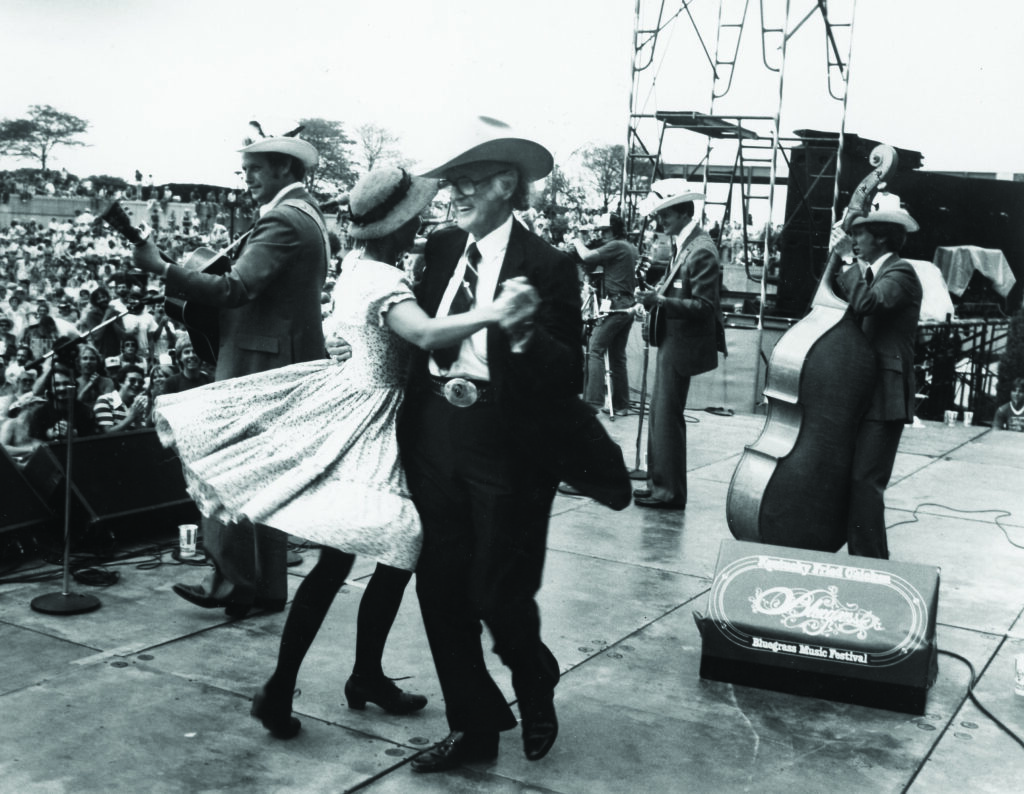
Monroe’s dancing continued to be a regular highlight of his shows and guest appearances, including an Emmylou Harris TNN special that was taped in May 1991 and aired in January ’92. Harris had been practicing her buck-dancing, and she and Monroe showed off their steps together for the Ryman auditorium crowd, as well as viewers of the show when it aired.
Spring of 1991 brought the release of Monroe’s final studio album, the gospel collection Cryin’ Holy Unto the Lord. I was enlisted to write liner notes for album, which featured another all-star approach, with appearances by Skaggs, Jim & Jesse, Ralph Stanley, and others. I wish I could say I had soulful conversations with Monroe that assignment, but the MCA bigs must have decided that wasn’t necessary.
As the hometown paper of country music, the Tennessean often found space and time for updates on Monroe and other stars. In August 1991, I wrote, “Two weeks and a day after undergoing heart surgery, Bill Monroe walked onto the Grand Ole Opry stage Saturday night.” He had been discharged five days earlier following Aug. 9 double-bypass surgery. His 80th birthday came on Sept. 13, 1991.
By the spring of 1992, I experienced a shift in roles by moving to the Tennessean hard-news side, eventually in the role of city editor, then assistant managing editor. In 1993, Monroe was named the Heritage Award Winner of Uncle Dave Macon Days in Murfreesboro, Tennessee, where pioneering Grand Ole Opry star Macon was recognized each year with a music-filled festival. Monroe performed energetically with his band as well as serving as marshal of the event’s old-time Motorless Parade.
He reiterated that the music he played and the musicians he played with were G-rated, so to speak. “My music is clean,” he told the town’s Daily News Journal. “And the people who work for me have to be that way, too. I don’t allow no filthy word and no drunks.” It was a slightly more specific echo of what he’d told me about his music years earlier.
Even though I wasn’t covering music for the newspaper, I still followed bluegrass, and my family went out to the Macon celebration for a Saturday excursion. I remember holding my son Nate, less than a year old, high above the crowd, so that he’d always know he had seen Bill Monroe play music.
A Starry Band of Bluegrass Angels
During Monroe’s later years, I felt lucky to attend an historic Ryman show that brought him together with musicians who, at some levels, matched the “classic” Blue Grass Boys of 1945-1948. The show included Monroe, Earl Scruggs, who debuted with Monroe’s band in December 1945, and Skaggs in the Lester Flatt role, along with great fiddler Benny Martin and heralded sideman Roy Huskey Jr. on bass.
Backstage, the venerable musicians appeared low-energy, even sleepy in the moments before the show. But Monroe and Scruggs set off musical fireworks the moment they hit the stage with, as I recall, “Blue Grass Breakdown.” Looking back, the chances to hear and even discuss the bluegrass music with its principal founders made me feel like a Constitutional scholar talking with Thomas Jefferson and John Adams. I took advantage of my journalist’s access a number of times, and wrote about their contributions, but to this day I still conjure up questions I should have asked.
William Smith Monroe was just days shy of his 85th birthday when he left this world on Sept. 9, 1996. I returned to writing about music for Sept. 12 front-page coverage of his funeral at the Ryman Auditorium. That was the same stage where he had debuted the “classic” Blue Grass Boys and enjoyed so many high points.
Before the service, I saw the notable folklorist-musician Mike Seeger, who said that the death of long-lived, energetic Bill Monroe reminded him of John Henry, the legendary Black hero who “died with a hammer in his hand.” As we’ve seen, Monroe kept playing music until late in his life. Seeger’s comparison also seemed apt given Monroe’s embrace of working people’s lives and of deep strains of African American music.
During the service, whoops came from band and audience as musicians tore lickety-split through Monroe’s classic instrumental “Rawhide.” I mentioned it as an uplifting moment in the story. Bluegrass star Skaggs, perhaps sensing that some might not get it, had introduced the tune. “If this seems inappropriate, we’re sorry – pray about it and you’ll get over it,” he said.
Marty Stuart, also in the band for the funeral, told me afterward that the upbeat tune and crowd reaction was something Monroe would have enjoyed. “It was getting way too serious; somebody needed to grin. He would have done it,” Stuart said.
Plenty of traditional gospel tunes unrolled throughout the service, of course. Favorites were sung by notable performers including Connie Smith, Emmylou Harris, and Ralph Stanley, who led a melancholy version of “Rank Stranger.” The list of mourners included former band members Earl Scruggs, Doug Green, Roland White, Jimmy Martin, and Vassar Clements. The Opry stars who came out in force included Grandpa Jones, Little Jimmy Dickens, clogger Ralph Sloan, Bill Anderson, Jean Shepard, Skeeter Davis, Jim McReynolds, and Bill Carlisle.
This was an open-casket service, and like hundreds of fellow mourners, I filed by for a last look at the Father of Bluegrass. He looked fine. A long line of quarters adorned the edges of the coffin, reminders of the 25-cent pieces that Monroe regularly gave to youngsters during decades of interaction with fans.
I was lucky indeed to be around Bill Monroe, from my young musician days to my years as a reporter and editor. Of course he was a matchless source on bluegrass music, but also offered lessons about life, and even about wellness. One day Monroe said he wanted to tell me something he’d never shared before.
“I can get ready to go on stage and really feel under the weather, way down,” he said. “I get out on stage and play to the people, and all that leaves – the good feeling that comes from the music clears it up.
“Just a little bit later, it’s all cleared away – that’s the most wonderful thing in my life.”

Did Bill have any favorite venues he liked to perform at? Always interesting to hear about those stories.