Modern Banjo Master
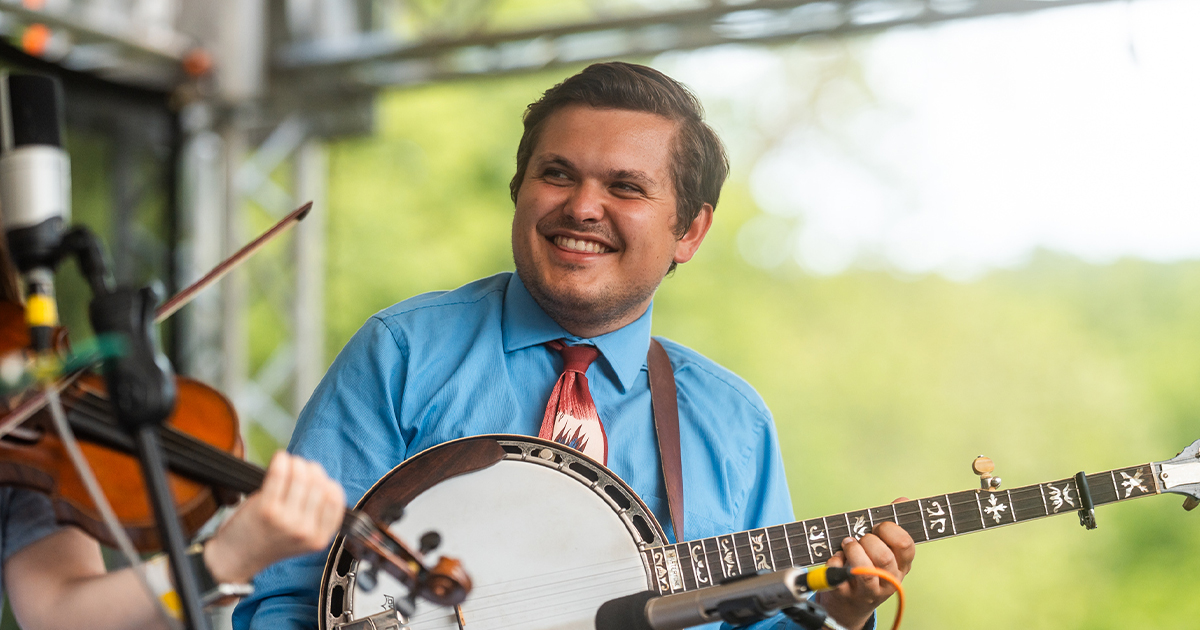
The best. Proclaiming someone as the best this or that is a highly subjective and contentious undertaking, almost certain to create heated debate. So, to hedge the bet a bit: if twenty-five-year-old Trevor Holder is not the best banjo player on the scene right now, he’s in the top two or three. And if he’s not the best—or at least most complete—banjo player of all time, he’s in the top five. Seriously. He’s that good.
“I don’t know of anybody else who has mastered the instrument at such a high level in such a variety of styles,” says Andrew Small, Trevor’s bandmate in the Alum Ridge Boys & Ashlee. “He’s mastered all these styles and can apply them at will to anything he’s doing in a tasteful way. He’s always got the right lick or the right roll and knows when to pull out a Reno lick to make it feel a certain way. I can’t think of any banjo player, living or deceased, that I would rather be playing music with than Trevor. He ticks all the boxes. He is my ultimate banjo player.”
Early Years
Trevor Holder was born in 2000 in Ringgold, Georgia, a small town not quite twenty miles south of Chattanooga, Tennessee. Nobody in his immediate family was musical, but his father was a record collector with a special fondness for the first generation of bluegrass pickers.
“Whenever he’d play 1950s bluegrass, I’d get really into it,” he recalls. “That’s what made me want to play banjo. I didn’t know at the time who anybody was [on the records], but from what I know now about who’s playing, the first banjo player I really got into was Rudy Lyle,” who played on such seminal early 1950s Monroe recordings as “Raw Hide,” “Uncle Pen,” “My Little Georgia Rose” and “New Muleskinner Blues.”
Trevor started saving up money when he was eleven, and by the following year, he had enough to buy an $80 banjo from Guitar Center. He tried learning from an instructional book, but after six months it hadn’t really helped, so Trevor asked his parents for banjo lessons for Christmas.
“There was a music store in Ringgold,” says Trevor, “and there was a guy teaching banjo out of there named Jim Pankey. He ended up being a really, really great teacher for a young person and someone who wanted to get into his own thing. He would teach me tunes and stuff, but his main deal was teaching me how to learn on my own—how to pick out music that I liked and then learn it by ear.”
At his teacher’s suggestion, Trevor began attending fiddlers’ conventions and contests. His first was in Smithville, Tennessee, and it was an eye-opener for the young musician. “It was awesome,” he says. “It was the first time I’d ever been around a ton of people playing this music. I was learning basic Scruggs style then, and this guy said to me, ‘Hey, if you like this stuff, you should check out Don Reno. Check out Reno & Smiley.”
He did that when he got home. “I had never heard anything like that before,” he says. “I can’t say that I thought at that moment, ‘I want to play like that.’ But the more I’ve heard, and the more I’ve played and learned, I always come back to Don Reno. His playing is just so deep, with so much going on. Across all genres and styles, Don Reno is my absolute favorite. I feel like I lean back on a Reno sensibility in all the bands I play in. I can always sit down with a Don Reno recording and learn something new from it. I’ll never get tired of it. He set my work out for me.”
After graduating from Kennesaw State University in Georgia with a degree in electrical engineering, Trevor worked for a couple of years as an engineer in South Carolina before deciding that a musician’s life was for him.
On The Road
Like many young musicians today trying to make a living at bluegrass, Trevor plays in more than one band. He currently plays in three. The first is the Alum Ridge Boys & Ashlee, an ultra-traditional band from southwestern Virginia that expertly blends bluegrass, old-time stringband music, and country music from the 1940s and 1950s. Trevor’s bandmates in the Alum Ridge Boys & Ashlee are Andrew Small (mandolin), Ashlee Watkins (guitar), AJ Srubas (fiddle), and Rina Rossi (bass).
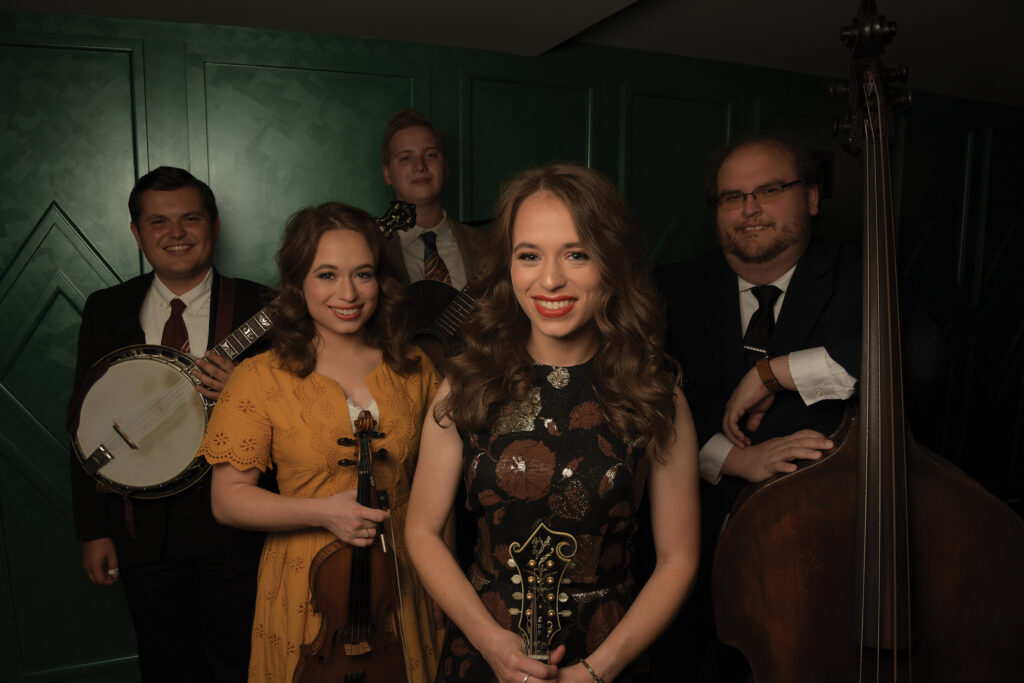
Trevor is prominently featured on the band’s two albums, Live at WPAQ and Live at WPAQ II. Both albums were recorded live in the studio of WPAQ, a legendary radio station in Mt. Airy, North Carolina. The band stood around one microphone and performed the songs just as if they were on stage. Most of the 37 cuts (!) were done in one take, with no overdubs or fixes anywhere on the album.
His banjo playing is flawless throughout. Every break, every kick-off, every fill—each note is right where it needs to be, played cleanly with authority and conviction. There are a whopping seven instrumentals on the two CDs that give him plenty of room to stretch out, and they are all quite impressive, particularly his original tune “Toast ’em Dry.”
His backup playing on the songs is no less impressive. “He’s back there playing this mind-boggling stuff behind us while we’re singing,” says Ashlee. “At first, before I got used to him, it was quite distracting. Not in a bad way, but I wanted to stop singing to listen to what he was doing.” Andrew adds, “I’ve never heard anybody back up a fiddle tune the way he does.”
Trevor also plays with the Price Sisters, an excellent traditionally oriented band with occasional progressive touches. Led by twin sisters Leanna (fiddle) and Lauren (mandolin) Price, the fast-rising band has appeared on the Grand Ole Opry and performed at such festivals as ROMP, Bean Blossom, and the University of Chicago Folklife Festival. Trevor came aboard in 2021, joining Bobby Osborne Jr. (bass) and guitarist Conner Vlietstra. Trevor played on the Price Sisters’ most recent album, Between the Lines, produced by Ronnie McCoury and released in 2024 by McCoury Music.
The final band (at last count) that Trevor plays with is Five Mile Mountain Road. It’s a fairly new band with a somewhat fluid line-up. Core members of the group include Trevor (banjo, steel guitar), Connor Vlietstra (guitar, fiddle), Josh Gooding (mandolin), Billy Hurt, Jr. (fiddle), Brennen Ernst (guitar, piano), and Austin Janey (bass).
“It’s kind of a bluegrass band,” Trevor explains, “but we also play a lot of old-time and country music, some ragtime and western swing. I’m trying to learn some steel guitar stuff to play with this band.”
Five Mile Mountain Road is recording this fall and winter and hopes to have an album and some singles by spring. In the meantime, several performance clips are available on YouTube. Trevor says one of his priorities for the next year is raising the professional profile of the band and playing more, and better, gigs. “The band doesn’t play that much at all,” says Trevor, “and I really would like them to play a lot. I think we’d do well. It will be interesting to take a little bit more of an active role in booking and promotion.”
Though not really a band, the sometime duo of Trevor Holder and Conner Vlietstra recorded a superb duet album, Chattanooga Dogs, in 2022, that draws from such influences as Uncle Dave Macon, Charlie Poole, the Monroe Brothers, Don Reno, Jim Eanes, Buzz Busby, and several others. The album is an exemplary showcase of Trevor’s mastery of several banjo styles, as well as Trevor and Conner’s peerless duet singing on songs such as “Railroad Bill” and “Pearly Gates.”
“Conner was already there when I joined the Price Sisters,” Trevor says. “We decided that since we were traveling, we’d record a few things, just the two of us. They always give Conner and me a song on their shows, and we thought we’d maybe have something to sell when we were on the road with them. The idea kind of snowballed, and we brought in some friends and finally had a whole album.
“I really didn’t sing much until Conner and I started messing around. We got into the brother duet style, learning a bunch of Louvin Brothers and Monroe Brothers songs. That helped me learn how to sing harmony parts. Conner is one of the best tenor singers I’ve ever sung with. A lot of people can sing the tenor part, but he’s a natural at it. All those parts fall right in the middle of his range.
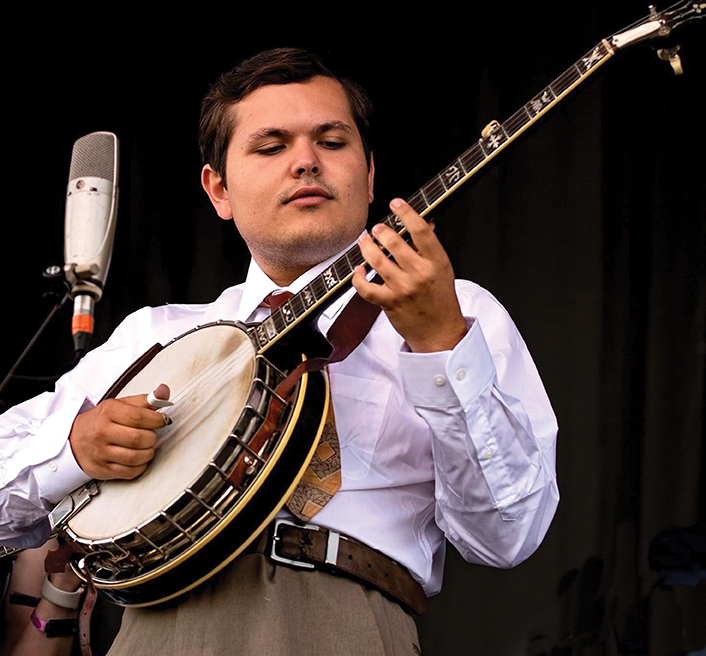
“Outside of bluegrass, Uncle Dave Macon is one of my favorite banjo players. He’s a great three-finger banjo player, though most people think of him as a clawhammer picker. But his early recordings have a lot of great three-finger picking. I’ve learned a lot from classic banjo players like Fred Van Eps and Vess Osman. I love Charlie Poole and the two-finger stuff of Omer Forster. Also, Georgia stringband music, like the Skillet Lickers and the Georgia Yellow Hammers. Stringbean [David Akeman] had a huge influence on me, both clawhammer and two-finger.
“I also listened to and learned a lot of modern bluegrass stuff. I learned Béla Fleck stuff and Noam Pikelny stuff. I used to play quite a bit of melodic banjo, but I’ve kind of forgotten how to do that. I’ve distilled it down to either using the techniques of classic banjo or doing a Reno-style thing. I think you can accomplish the same thing that way.”
Surprisingly for a banjo player adept at so many styles and genres, Trevor is basically a one-banjo man. “I play everything on my Gibson Mastertone banjo [a 1930 TB-1, with a five-string neck made by Frank Neat],” he says, “which I really like a lot for playing bluegrass. I think that if you have a banjo that’s set up well for bluegrass, it will do fine for old-time as well.
“Plus, I don’t want to carry more than one banjo. I have a couple of banjos at home set up for classic banjo, with these tiny bridges and synthetic gut strings. I’d maybe take one of them on the road, but then you have to find a band that’s willing to play that kind of stuff.”
Trevor still attends fiddlers’ conventions and contests when he has the time, particularly those in Mount Airy, NC, and Galax, VA. He has won several banjo contests, most notably at the Old Fiddlers Convention in Galax in 2019 and the Mount Airy Fiddlers Convention in 2025.
There aren’t many young banjo players who are equally proficient at clawhammer, two-finger style, and the three-finger styles of banjo, and there are even fewer who have studied the history of the instrument as deeply as Trevor has. His playing is fluid, inventive, powerful, and perfect, whatever the setting or context. He’s the real deal. You should check him out.
“The thing about Trevor,” says Ashlee Watkins, “is that he’s a master of so many styles of banjo playing. I honestly believe he’s the best banjo player. Full stop. It’s just so incredible getting to play music with him, and I’m forever going to be spoiled for other banjo players. I’m ruined.”