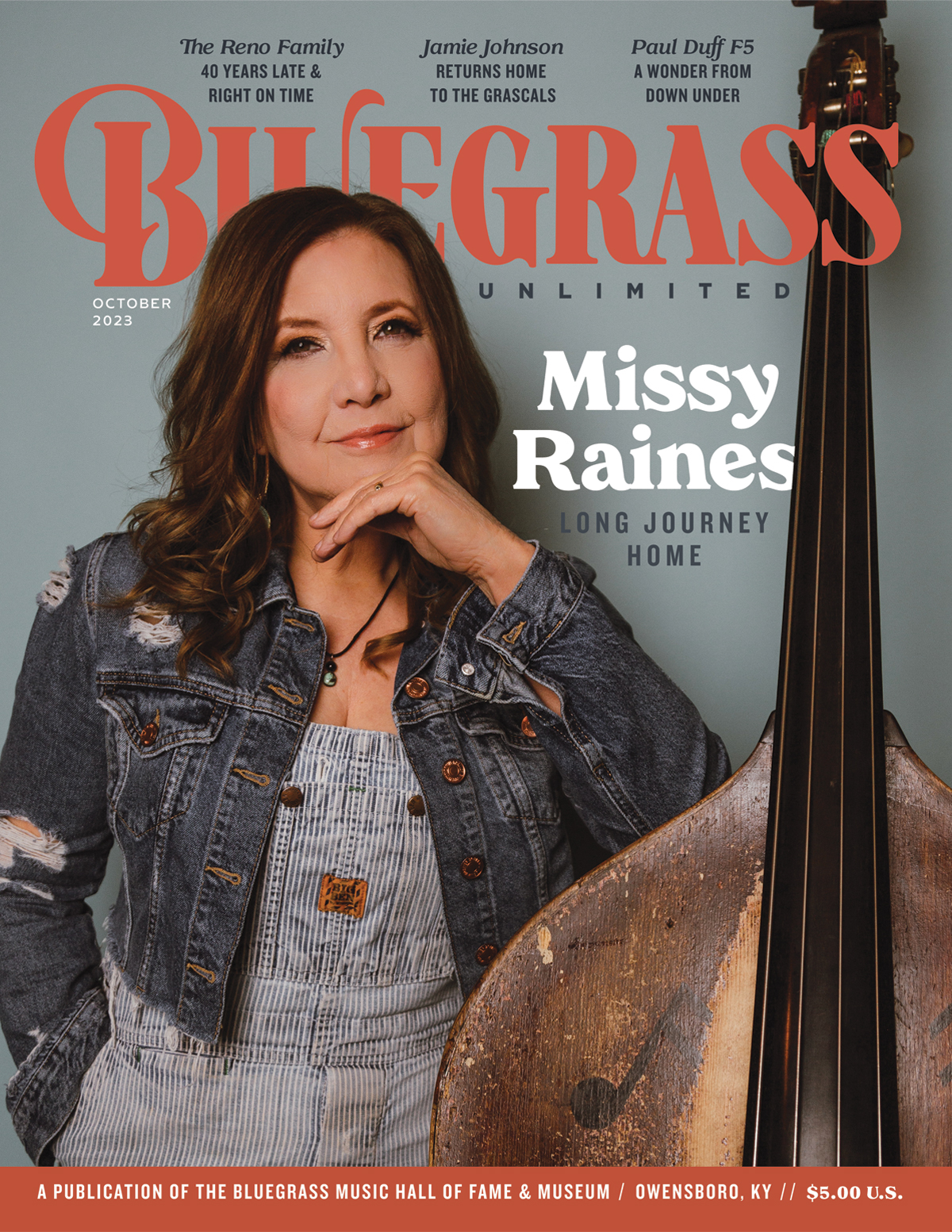
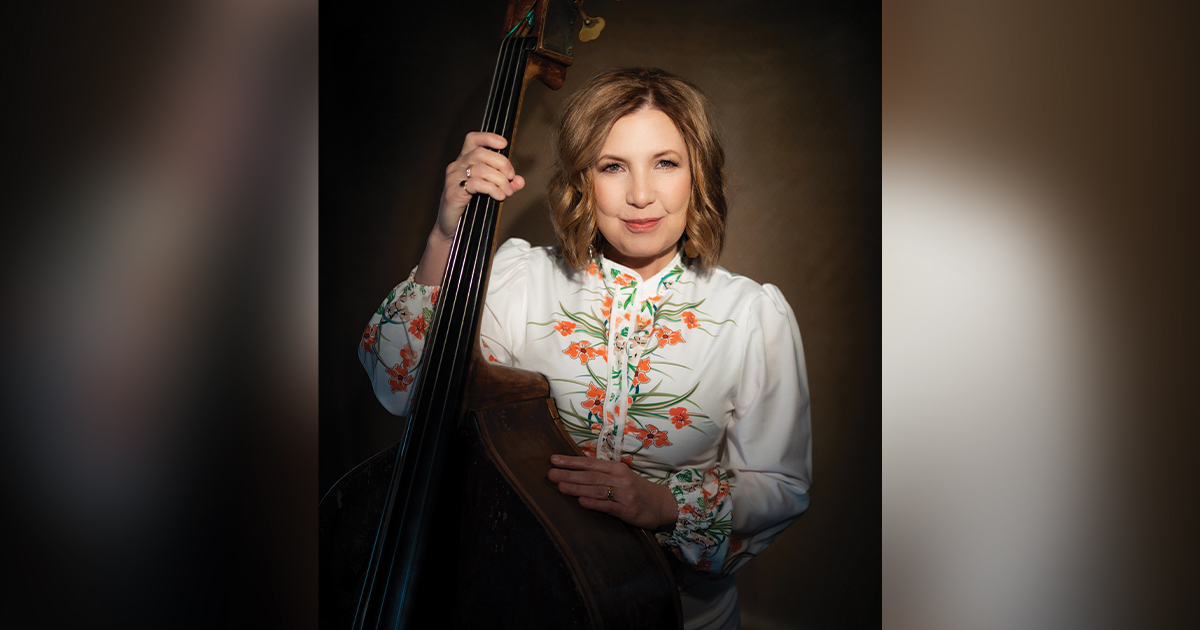
Missy Raines
Long Journey Home
Missy Raines has always been one to straddle the lines between bluegrass music’s insular tradition and its cutting edge. For years, she leaned more towards its contemporary evolution, embracing elements of jazz and Americana in her compositions. But now, as she enters the fifth decade of her illustrious career, she is seeking to say something new. Or rather, something old.
“I always knew that I was going to do a bluegrass band again,” says Raines of her new project, Missy Raines & Allegheny. “It was always in my heart. I just didn’t know when.”
Traditional bluegrass has been in Missy’s blood since birth, though not through the traditional means. Born in Cumberland, Maryland and raised just across the Potomac River in Short Gap, West Virginia, bluegrass resonated from the very mountains she stood upon. It was, in a sense, her birthright. But she wasn’t born into it, like many big name stars were — her family wasn’t composed of seasoned jammers; her siblings weren’t in a family band. They were, simply speaking, music lovers.
“Going to see music — that was their entertainment,” she says, recalling how her parents would travel to see nearby country shows. It was their date night. This tradition was briefly paused after her birth — her earliest years were consumed by health issues, with her having been born with a dislocated hip that left her in braces as a young child. But eventually, the family learned how to care for her and she learned how to move around the world. The family started going back to shows, this time with Missy in tow.
“They were listening to music all the time,” Raines says, smiling at the memory. “I was literally surrounded by it.”
Lucky for her, it was around this same time that bluegrass festival culture took off. Her parents, devoted music lovers that they were, started bringing her to festivals nearly every weekend — immersing a young Missy in music and independence and community. “It was magical,” she says. “So. Freaking. Magical.”
She credits attending festivals as a kid with inspiring her to become a professional bluegrass musician. “There was nothing I wanted to do more than play at a bluegrass festival,” she says. “And that was before I even started playing!”
She was fortunate — her parents recognized her budding passion for music and wholeheartedly embraced it, doing everything they could to support her as she explored the path that would eventually become her career. But even with her Appalachian roots and her lifelong dedication to the music, bluegrass didn’t always feel like a home to her. Despite the stereotypes associated with non-college educated white people from rural Appalachia, her parents were deeply liberal and instilled those values in their children as they grew up. When Missy was just eight years old, her eldest brother Rick came out to the family as gay. “I won’t say that my parents were immediately like ‘oh, this is great!’ It took them a minute,” she says in a matter-of-fact tone. “But it was 1970.” She points out that they regained their bearings and loved their son as he was, an outcome that I can attest from personal experience is the second best scenario for any queer coming-out tale. That narrative — one of acceptance of others as they come — was part of her upbringing. “That was all that I knew,” says Raines. “So there was no learning curve for me.”
As she grew up and began moving through the world as her own person, she came to realize that not everyone felt the same way that she and her family did. And, perhaps a bit ironically, she had zero tolerance for it. “In the early days, I remember being willing at any moment to be in your face and fight for my beliefs, and be immediately dismissive of anyone who had any differences of opinion,” she says. In part, this came from a protective instinct towards Rick, who undoubtedly had faced similar derision and bigotry before. But just because it was common, that still didn’t make it right. Especially as his life was cut short by AIDS in 1994 — and by the world’s indifference to it as a “gay plague” — how could she not fight for him? How could she not be her brother’s voice, now that his had been silenced?
On top of that, she was a woman working in a male-dominated field. Countless times in her early career, she found herself as the only woman in the room. “I remember sometimes feeling like the odd man out: gigs, bands, all of that. I had to learn how to exist in that world and face those daily battles,” says Raines.
Now, having been fighting these battles all her life, she’s learned to become more selective. She has more ability to discern between bad actors and those who may at least be open to new perspectives. But back in 1994 — wracked with the dual grief of having lost her brother and feeling isolated from her professional community — her bluegrass roots were tested. “I knew bluegrass was my connection, but there were some people that I just felt so distant from,” she says. “By April 1994, I felt pretty lost.”
It took about ten years for her to find her way back. “It wasn’t until the early 2000s that I felt like I started to come out of that… that things started changing,” she says. Plenty had changed for her during that time. She’d gone back on tour — first with the Brother Boys, and later Claire Lynch and Jim Hurst. She’d played on stage at the Opry. She’d become the first woman in bluegrass history to be named IBMA Bass Player of the Year. But it wasn’t until her mother’s passing in 2003 that she realized how different of a position she was in. Whereas before there was silence, now “there was this huge well of support from people in the bluegrass world,” says Raines. This time, her bluegrass family was there for her. Now that she’d lost both of her parents (her father had passed when she was just 20 years old) and one of her three siblings, that family was all the more important.
As she grieved and found solace in community, she came to recognize that there was something she needed to do. With all of the experiences she’d had, all of the roads she had travelled, and all of the people from whom she had learned, she now had the tools she needed to tell the stories she wanted to tell — in the way she wanted to tell them. “All of this culminated in the realization that I needed to make something that was my own,” she says, reflecting on her choice to lead her own band for the first time in her already groundbreaking career. “I felt like I had something I wanted to say.”
And thus, Missy Raines & The New Hip was born in 2009. Named after her literal new hip (a surgical replacement for the one that had caused her trouble and pain since birth), it was the first project that she helmed. “I never imagined it was going to be taken as a huge leap from bluegrass, I didn’t see it that way,” she says.
This makes sense in the context of her musical upbringing. She lived in a tiny rural town in northeastern West Virginia. From this position, it was actually easier to get to Washington DC than it was to go south into the beating heart of traditional bluegrass. She found herself immersed in opportunities and sounds that were a little more expansive than the pure-bred Blue Grass Boys of 1945 — instead, she grew up listening to the Stanley Brothers alongside the Seldom Scene, a shot of Flatt & Scruggs chased with Sam Bush, David Grisman, and Tony Rice. Since joining the scene as a professional picker, she’s been profoundly influenced by writers like Ed Snodderly and the more contemporary sounds of those that she worked with, like Claire Lynch. From her vantage standing in Short Gap, itself a gateway between the Eastern Seaboard and Appalachia, bluegrass was all of this and more. When she pursued her own voice, why wouldn’t that be considered part of this proud tradition too?
“In my band, The New Hip, I just wanted to be able to play any song that I wanted to play,” she said, as though it was as simple as that.
Of course, hindsight now shows that change is always met with its own reaction. But Missy takes the long view. She points out that even Sam Bush and Tony Rice were being ostracized as “not real bluegrass” when they were pioneering their own paths. Why should hers be any different? “It just felt like I was trying to go after my own thing — taking the stuff that I had been influenced by in the late 70s and into the 90s: pop music, jazz, all that sort of stuff… but doing it in the vehicle of a bluegrass band,” says Raines. “So I knew we weren’t traditional bluegrass, I got that. But I saw it as just an innovative left turn on it. I didn’t see it as much more than that.”
Yet despite not viewing this as a groundbreaking experience, at least in terms of the genre, it was nonetheless a transformative one. There aren’t a lot of other models for female bass players leading their own bands, especially within bluegrass. For her whole career, Missy had literally been in a supporting character — her job was to make everyone around her sound good. It’s rare for a bass player to be highlighted, let alone to be in a steering role. Stepping into the position of bandleader was a whole new challenge for her, and not just on the logistical or bureacratic level that I’m sure any other bandleader and manager can attest to. “That was the time that I found my voice,” says Raines, before smiling and joking. “Both literally and figuratively.”
Being in charge also put her in the position of being the lead vocalist, another new challenge. It’s this spirit of adventure and openness to new challenges that she says is one of the things that she is most proud of in her career. She points to some of her heroes, both contemporaries like Jerry Douglas and icons like Roland White, and remarks upon how they were always willing to push their boundaries. In Missy’s earlier career, she challenged herself on a technical level on her instrument. Now she’s pushing different boundaries. “Now I’m trying to drive this bluegrass band, while singing and leading the band and remembering the words!” she says, laughing. “It’s challenging, just in a different way.”
The New Hip was a fun challenge for a while, but eventually the spark faded. In 2015, Missy reckoned with the deaths of three more family members in just one year, including the loss of her remaining brother Steven. In the wake of all this grief, continuing to put her time and energy into a project that wasn’t fulfilling her anymore just didn’t seem worth it. She almost stepped away from music entirely. “I was so tired and beaten down by the nature of this business that I was actually questioning the point of it all. When I think about how close I came to not forging ahead and not making Royal Traveller, which ended up being nominated for a GRAMMY and catapulting me into a whole new realm of inspiration and opportunity… I realize how important it is to never give up. To never lose sight of what’s important about your art.”
Soon, that itch that she’d always had, the one that just wanted to play bluegrass, became undeniable. By 2017, she had begun playing as a trio and had hired the gifted guitarist, Ben Garnett. “Things felt much more open-ended and experimental in those days,” says Garnett. “For me, as an acoustic guitar player coming from the jazz world, this setting felt optimal. It had room for all these fluid leeways between our differing backgrounds, which wound up creating a deeply conversational musical and artistic environment that I think felt original, exciting, and personal for all of us.”
Occasionally, western bluegrass scion Tristan Scroggins would fill in or join for a show — leading to the group’s expansion into a quartet. It took a while for the right fiddle player for the job to fall into place: originally George Jackson served as the third member, though he would eventually pass the torch onto Avery Merritt as his own projects took off. It wasn’t until Avery took a job in Sierra Hull’s band that the missing magic was found in the form of Ellie Hakanson. Missy is quick to point out the almost spooky level of charisma between Scroggins’ mandolin picking and Hakanson’s fiddle playing — the instrumental equivalent of blood harmony. But Ellie brought more gifts with her to the table. “Singing duets with Ellie — singing with Ellie period — has made me a better [vocalist] and has given me confidence that I so needed,” says Raines. “She’s so generous with the way she sings harmony with someone. She’s in it the whole time like a hawk, listening to where you go and following. She’s not in it for herself. It’s a mentality I can relate to as a bass player: how can I make everyone sound better.”
But the final piece, the Big Bang of Allegheny, came in the form of a banjo. “I didn’t know Eli [Gilbert], but he’s absolutely great. They’re all perfect fits,” says Raines. Eli hails from the Northeast but plays like he’s from the Bible Belt — he trained at Eastern Tennessee State University to become a master in the style of his musical hero, J.D. Crowe. Much like with Bill Monroe and his Blue Grass Boys before her, that hard-driving sound was the final spark needed to set the fire. “It can sound cliché, but I do think this combination of these specific people at this time was meant to be.”
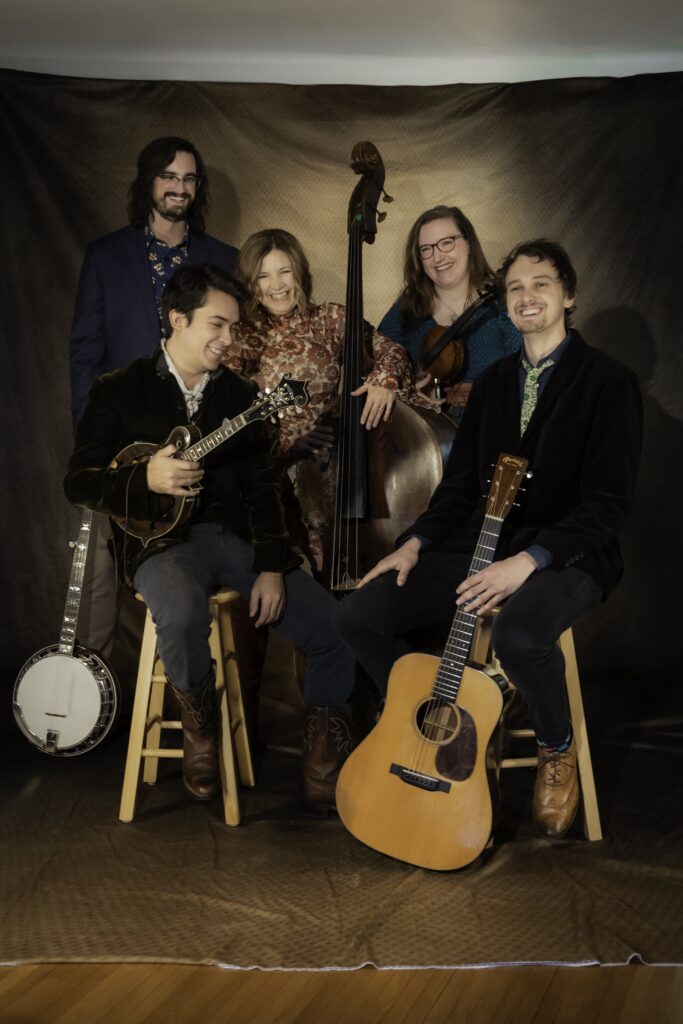
With this lineup — Missy on bass, Ben Garnett on guitar, Tristan Scroggins on mandolin, Ellie Hakanson on fiddle, and Eli Gilbert on banjo — magic was ready to be made. Raines is absolutely effusive in her praise of these young masters and how foundational they have been to the success of the upcoming Missy Raines & Allegheny album, Highlander. “I started hearing the wealth and depth of their knowledge, their absolute joy for doing that kind of music… that just fueled me to think ‘yeah, this is exactly what I’m supposed to be doing.’”
She points specifically to their deep knowledge of regional bluegrass sounds, and how it helped her to focus on the sounds of her home. From her upbringing in the Allegheny Mountains of West Virginia, she was just as influenced by the mid-Atlantic bluegrass scene and artists like Hazel Dickens & Alice Gerrard; the Seldom Scene; the Country Gentlemen; Ted Lundy, Bob Paisley & the Southern Mountain Boys; and Del McCoury & the Dixie Pals as she was by a lot of the core first generation players. Through dueting with Danny Paisley on “These Ole Blues” and mourning the devastation of the ongoing opioid epidemic ravaging her home with “Who Needs a Mine,” this new album pays tribute to that.
But more than that, this album pays tribute to the people who made Missy Raines who she is today. It shines a spotlight on her parents, who taught her how to accept and care for people who she might not understand. It highlights her brother Rick, and the strength and grace with which he had to navigate the world — and that Missy had to emulate after he was gone. And it shares the stories of her three siblings, Rick, Steven and Barb, all of whom left this world too soon. Missy highlights these foundational connections and the devastation of their losses in the song, “Are You Ready to Say Goodbye?” She shares that the song took her about five years to write, as it took her that long to put the right words together. Even though they aren’t here with her on Earth, she knows that she’s still “walking with the saints and the ghosts” of those that she lost. In a way, she is their legacy.
It’s a legacy her Allegheny bandmates are honored and proud to join. Scroggins has been an admirer of Raines since his childhood, sharing that he used to listen to her 2009 album Inside Out daily as he rode the bus to school. He says of Highlander, “I’m proud to be part of a project that means so much to Missy. I feel lucky to learn more about the bluegrass of her childhood and to help create something that invokes this connection to the past while being grounded in something new and personal.” Hakanson agrees, adding, “I’m really proud of the record… I think everyone brought a beautiful mix of innovative and traditional bluegrass sounds to every song.”
When asked about what Missy wants her legacy to be, she talks about the importance of building a stronger home for the people who need one. This too is a legacy her bandmates are eager to share. “In theory, being a member of the bluegrass community means you can go to jams and festivals anywhere in the world and participate using a shared repertoire and language, no matter who you are,” says Gilbert. “After joining Allegheny I’ve learned how much I appreciate working with people who are committed to making sure that’s how the bluegrass community really works, evidenced by Missy and the rest of the band’s support of groups like Bluegrass Pride.”
It’s a connection Missy is proud to draw. “Before I was a band leader, in the days when it was so much harder to talk openly about the LGBTQ+ community in general, I would make a point of wearing my World AIDS Day t-shirt and my red ribbon pin to as many bluegrass events as I could,” says Raines, drawing an analogy to the bright-and-cheery Bluegrass Pride pin she wears regularly now. “In the 90s, at least in the bluegrass world, such things were non-existent. And I remember many times that shirt started conversations — people would see my shirt and say, ‘I lost my son to AIDS’, or my cousin, or my friend… or sometimes they would just talk about someone they knew who was gay… And so I felt very strongly that just this simple act of wearing the shirt opened the door for people to talk about what was happening, to open up. Without the shirt, they might have never said a word. It was a welcome mat.”
She knows that “you can’t fully connect to who you are and what your gifts are until you feel safe,” and so she does her best to make herself that safe space for anyone who needs it. “I would love it if I made a difference for the women coming up behind me, particularly from rural parts of the world,” says Raines thoughtfully. “I’d like to be remembered as someone who helps make people feel that bluegrass is for everyone.”
In other words: she wants to be the one to welcome you home.
Missy Raines’ album Highlander on Compass Records, produced by Alison Brown, will be released Feb 9, 2024.